Operation Manual
All-Stainless-Steel Separable Tea Egg Pot
Thank you for your purchase. For your safety, please read this manual
carefully and keep it for future reference.
謝謝您的購買,為了使用安全,請詳讀並保存此說明書。
Translated 24 August 2026 · Revision 2, 25 August 2026
The original booklet is an appliance manual: it documents the machine and assumes you already know how tea eggs are made. Revision 2 keeps every word of that translation and adds the operating knowledge it takes for granted — how the eggs are cracked, what “cold boiled water” means, what the cloth actually is, how much marinade to mix, how to keep the marinade between batches, and how long the eggs may be held. Those additions are drawn from Taiwanese convenience-store practice and Taiwanese home-cooking sources, and are marked as such. Sections 1–7 are added; sections 8 onward are the original manual. Where the two conflict, the original Chinese manual governs the machine and the added sections govern the cooking.
1 · Quick Start — Tea Eggs 預煮作業 SOP
Confirm you are using a dedicated 110 V circuit outlet. Do not use an extension cord or a multi-way adapter.
!請確認使用 110V 專屬電壓迴路插座!
The manual's procedure, in full:
- Load the eggs and marinade. Place 60 commercial-grade eggs in the inner pot and pour in 2 packets of tea-egg marinade (茶葉蛋專用滷汁).
- Add water and cover. Add cold boiled water until the eggs are covered, then lay the dedicated tea-egg sediment-absorbing cloth (吸渣布) over the top and begin heating.
- Cook, then switch to Keep Warm. After it reaches a rolling boil, cook for 4 hours, then manually flip the selector switch to Keep Warm (保溫) for holding and serving.
- The eggs go in raw, and they are cracked first. One tap at the blunt end. See section 3 — this is the step Taiwanese store staff treat as the whole job.
- “Cold boiled water” is not a contradiction. See section 2.
- The pot is filled to 80–90 %, not to the brim. Covered eggs and a full pot are not the same instruction.
The manual's SOP says 60 eggs. The manufacturer's published specification for the WJ-1501 gives the 5 L pot a capacity of roughly 40–50 eggs (about 10 servings). Both figures are correct for different eggs: Taiwan's foodservice eggs are S grade or smaller (48–54 g), while a US large egg is 57 g. Treat 60 as a maximum commercial load, plan on about 48 with US large eggs, and start lower — the eggs must stay covered by liquid.
2 · Three terms the manual assumes you know
冷開水 — “cold boiled water”
This reads like a contradiction in English because English has no word for it. Chinese draws a three-way distinction where English draws none:
| Term | Literally | What it is |
|---|---|---|
| 生水 shēng shuǐ | “raw water” | Straight from the tap. Never boiled. |
| 開水 kāi shuǐ | “opened water” | Water that has been brought to a rolling boil. May be any temperature now. |
| 冷開水 / 涼開水 lěng kāi shuǐ | “cold opened water” | Boiled water that has been allowed to cool back to room temperature. |
So 冷開水 names the water's history, not its present state. It is water that was boiled and is now cool. The English phrase “cold boiled water” is a literal calque of a Chinese category, which is why it sounds wrong.
The term bundles two separate requirements, and only one of them is negotiable:
- Boiled — the sanitary half. This is a long-standing Chinese and Taiwanese convention for any water added to food that will then sit for hours. If you are on treated municipal water you would drink cold from the tap, this half is a tradition rather than a hazard control.
- Cold — the half you must not skip. Hot water poured over raw, cracked shells makes them burst and dumps white into the marinade. Every Taiwanese source is emphatic: 加的水要是常溫水 — the water you add must be room temperature.
In practice: use room-temperature water. Boiled and cooled, or filtered, or bottled — your choice. Never hot water from a kettle or the hot tap.
吸渣布 — the “sediment-absorbing cloth”
Literally absorb-dregs-cloth (吸 absorb · 渣 dregs · 布 cloth). Also sold and referred to as 吸渣紙 (paper), 濾渣布 (filter cloth), 煲湯吸油布 (soup oil-absorbing cloth), 濾油紙 or 吸油膜.
It is a disposable food-grade non-woven sheet — 不織布, usually polypropylene — cut round or square to sit inside the pot rim, and sold in packs of about thirty. It is not a tea towel and not cheesecloth.
Functionally it is a drop lid — the same object as a Japanese 落し蓋 (otoshibuta), which is exactly what Taiwanese cooks call it when asked. It does three jobs at once:
- Keeps the top layer of eggs wetted. In a packed pot the uppermost eggs sit proud of the liquid. A wetted sheet lying directly on them keeps them in contact with marinade so they colour and season evenly instead of drying into a pale ring.
- Absorbs the scum. Protein foam (浮沫) and fat rise through a long boil. Lift the sheet out and the scum goes with it.
- Stops spatter at a rolling boil in an open commercial pot.
The cloth sits on top of the eggs; tea leaves sink. Keeping tea out of a long braise is a job for a muslin bag and a timer (see section 4, step 6), not for this sheet.
Substitutes, best first
| Substitute | Verdict |
|---|---|
| Parchment paper, cut to fit, holes punched | Best home substitute. Inert, cheap, holds up for a whole batch. This is the drop-lid technique proper. |
| A wooden or stainless otoshibuta (drop lid) | Reusable and effective as a lid, but absorbs no scum — you will skim by hand. See Sheet or drop lid below: for this pot that is the wrong trade. |
| Kitchen paper towel | What several convenience-store chains actually use. It works, but paper towels carry wet-strength resins not intended for four hours of contact with hot food. Avoid for a long boil. |
| Cheesecloth or muslin (胚布) | Works as a drop lid, poor at absorbing scum, needs washing. |
Where to buy them
They are not sold under the Taiwanese name in the US. Search instead for “oil absorbing sheets soup”, “oil blotting paper kitchen”, “fat skimming sheet” or “scum absorbing cooking sheets” — it is the same product sold for hot pot, curry and stock.
| What to look for | Typical | Where |
|---|---|---|
| Round oil/scum absorbing sheets, food-grade non-woven PP (some are PP+PE) | 18–20 cm, packs of 100–200, heat rated to 120 °C | Amazon — the generic multi-packs (e.g. NUANNUAN 120-sheet, 20 cm; or a 200-sheet 18 cm pack) |
| Japanese “fat skimming” / “oil & scum blotting” sheets — the better-made version | 20 cm, packs of 12–20 | Lion, Kokubo — Japanese-goods shops (greatzakka.com and similar) |
| Reusable alternative: an adjustable stainless otoshibuta | Expands ~5.5–9 in | Amazon — TIKUSAN and similar. Drop-lid function only; absorbs no scum. |
| Free alternative: parchment cut to fit, holes punched | Any width | Already in your kitchen. Cheapest and works. |
The sheets sold for domestic hot pot are 18–20 cm. This is a 5 L commercial pot — its inner pot is meaningfully wider than that, so a single 20 cm sheet will not span it and will leave a ring of eggs uncovered at the rim. Measure your inner pot first. If it is much over 20 cm you want two sheets overlapped, a larger catering size, or simply parchment cut to the actual diameter.
The 120 °C heat rating is fine — a rolling boil is 100 °C and the keep-warm band is 70–80 °C, both comfortably inside it. Do check the rating on whatever you buy, though; the sheets sold purely for blotting fried food are not all rated for simmering.
⚠ That size warning applies to the SHEET, not to a drop lid. A traditional otoshibuta is meant to be a couple of centimetres narrower than the pot, so liquid can circulate up around its rim. Undersize is a fault in a sheet and a feature in a lid.
Sheet or drop lid — which one for this pot?
They look interchangeable and are not. They solve the same problem by opposite means: a sheet keeps the top eggs wetted; a drop lid pushes them under. Submerged beats wetted, so on that job the lid actually wins.
But that is not the job that matters most here. This pot's SOP loads cracked raw eggs and boils them for hours. Cracked raw shells leak albumen, and forty-odd of them leaking through a four-hour boil is a real scum load — which ends up on the eggs and in the liquid you are keeping as 老滷. A stainless drop lid absorbs none of it. The sheet's absorbency is the whole reason the Taiwanese name is 吸渣布, “absorb the dregs”, and not simply “lid”.
- Start with parchment cut to your inner pot's real diameter, holes punched. Free, already in the kitchen, and it tells you whether you actually want a consumable.
- Then buy the sheets if you run the pot often. Scum removal is the job this machine's method creates.
- The otoshibuta is the wrong single purchase for this pot — it does the lesser half of the job and none of the greater. It is a good second item if you find the top layer of eggs bobbing proud of the liquid: run the lid and a sheet under it. Use tongs; stainless over an 800 W element gets hot.
茶葉蛋專用滷汁 — the marinade packet
A proprietary Taiwanese tea-egg braising concentrate, sold either as a dry spice sachet (滷包, typically 20–30 g) or as a liquid. A representative dry blend contains Assam black tea, oolong, cassia twig, cinnamon, star anise, Sichuan pepper, liquorice, dried tangerine peel, fennel and sand ginger.
Published guidance runs about one packet per 10–20 eggs, which is consistent with the manual's two packets for a commercial load. See section 5 for a scaled table and a from-scratch alternative.
3 · Cracking the eggs
The manual never mentions this step. Taiwanese convenience-store staff describe it as the one thing you must not get wrong. There are two different cracking operations, done at different times, for different reasons — and confusing them is the usual cause of a disappointing pot.
A · The store crack — raw egg, one tap, blunt end
This is the operation the manual's SOP assumes.
- Find the blunt end. Every egg has a rounded end and a pointed end. The air cell sits under the rounded end — it forms as the freshly laid egg cools and its contents contract, pulling the two shell membranes apart.
- Tap once, over the air cell. Use the back of a spoon or the rim of the pot. You are listening for a single clean crack — 喀. A four-year veteran of a Taiwanese convenience store put it exactly this way: 只要聽到清脆的「喀」一聲,那就表示 OK 了 — as soon as you hear the crisp ‘crack’, it's right.
- Stop. One tap. Not a stipple of taps, not a crushed end. The membrane should still be holding the shell together.
The tap is a vent, not a flavour channel. As the egg heats, the air in the cell expands. With nowhere to go it splits the shell violently and white streams out into the marinade. Pre-venting gives the gas an exit and the egg stays intact.
The flavour gets in through the shell itself. As the same clerk explains: 雞蛋殼本身就有毛細孔,滷久了滷汁一定會滲透進去 — the shell has its own pores; over a long braise the marinade will certainly seep in. Four hours is long enough that the crack contributes very little.
Consequence: a store-method tea egg is uniformly dark, not marbled. If you want marbling, use method B.
Is a pin or thumbtack hole the same thing?
For the purpose that matters here, yes. Pricking the blunt end of a raw egg with a pin or tack and tapping the blunt end with a spoon are two ways of doing the same job: venting the air cell so expanding gas has somewhere to go instead of splitting the shell. If you already prick your eggs, you are already doing the manual's missing step.
Three differences worth knowing:
| Pin / tack hole | Blunt-end tap | |
|---|---|---|
| Vents the air cell | Yes | Yes |
| Opening | One channel, under ~1 mm | A short fracture across the air-cell dome |
| Marinade ingress | A direct channel into the air-cell pocket — expect a small dark spot at the fat end | Slightly more, spread along the fracture |
| Marbling | None | None |
Neither produces the marble pattern — that needs method B, on a cooked and chilled egg. And neither is doing much for flavour: over a four-hour braise the marinade goes in through the shell's own pores regardless.
The mechanism is sound; the effect size is genuinely contested, and the confident numbers online are not trustworthy. Searching this turns up a cluster of pages quoting precise-sounding figures — “68 % fewer cracks per FDA trials”, “73 % less in blind trials across 500 eggs”, and, from the other direction, “pricked eggs cracked 33 % more often”. None of them cites a study that can be found, several contradict each other outright, and they carry the signature of content-farm invention. No figure is quoted here, because there is not an honest one to quote. Prick if it works for you; it will not hurt.
There is a documented botulism case involving punctured eggs (MMWR 49(34):778–780, Illinois 1997), and the CDC's conclusion was blunt: “Pricking cooked eggs may introduce C. botulinum spores into the yolk.”
Note the word cooked. In that case the eggs were hard-boiled, peeled, punctured with toothpicks, and then held at room temperature in sunlight — puncture after the kill step, with nothing but a slow-travelling acid between the contamination and an anaerobic yolk. Pricking a raw, shell-on egg before it is cooked is not that situation: the hours of boiling that follow are the kill step.
What it does mean: a vented egg makes the pot's existing rule matter more, not less. Either the pot stays on Keep Warm, or the eggs and marinade go in the refrigerator. Never a switched-off pot cooling on the counter. And use a clean pin rather than the tack off a corkboard.
B · The marble crack — cooked egg, chilled, all over
This is the home method, and it is what produces the 大理石紋 marble pattern.
- Boil from cold. Eggs into cold water, bring to a boil, then time 6 minutes.
- Ice bath. Straight into ice water. This matters mechanically, not just for handling: the cooled white firms and contracts slightly away from the shell, so the shell will craze without the white tearing with it.
- Tap all over, evenly, with the back of a small spoon — every part of the shell. Finer and denser crazing gives a finer marble.
- Do not peel. The membrane holds the egg together and the marinade travels along the cracks beneath it.
The SOP assumes A. But this machine is 分離式 — separable, and that is the whole point of the design: you can lift the inner pot straight out, drain, ice the eggs, crack them all over, return them and marinate, all in one appliance. See section 4, which gives both routes.
4 · Full walkthrough
Route A — the commercial method (one loading, 2–4 hours)
- Wash the pot. Inner and outer pot clean and dry; the inner pot's base dry before it goes on the heater.
- Crack the raw eggs — one tap at the blunt end each, per section 3A.
- Load the eggs. About 48 US-large eggs for this 5 L pot; up to 60 if you have small Taiwanese-grade eggs.
- Add the marinade. Two packets, or the scaled from-scratch list in section 5. Order does not matter much — the Taiwanese chains each do it differently.
- Add room-temperature water to cover the eggs, filling the pot to 80–90 % of capacity. Never hot water.
- Bag the tea if you are using loose leaf or want to control bitterness — put the tea in muslin so you can lift it out at the one-hour mark. Whole spices can stay in for the duration.
- Lay the 吸渣布 (or parchment with holes punched) flat over the top of the eggs. Fit the lid.
- Power on, selector to 燉煮 (up). Red lamp lights. Bring to a rolling boil.
- Pull the tea after about an hour — see the caution below.
- Cook. The chains run: 7-Eleven 4 hours · FamilyMart 3 hours · Hi-Life 2 hours. The manual specifies 4.
- Switch the selector to 保溫 (down) for holding. Read section 8 first — the pot goes dark for thirty minutes and that is normal.
Tea left steeping through a multi-hour braise releases tannin and turns the whole pot astringent and mouth-drying (澀). Taiwanese home recipes remove the tea as soon as the colour and aroma come up — some after as little as five minutes of the aromatics boiling; one widely used electric-cooker recipe says plainly 把茶包拿起來(因為煮久會苦), take the tea bag out, because a long boil makes it bitter, while keeping the medicinal spice packet in.
This is the single most common cause of a pot that “tastes wrong”, and the original manual does not mention it at all.
Route B — the marble method, using the separable inner pot
- Boil. Inner pot, eggs, water to cover, selector to 燉煮. Six minutes from the boil.
- Lift the inner pot straight out, drain, and tip the eggs into ice water. This is what the 分離式 design exists for.
- Crack every shell all over with the back of a spoon. Do not peel.
- Build the marinade in the inner pot: seasonings and water, brought to a boil for five minutes to open the spices.
- Return the eggs, top up with room-temperature water to cover, drop the tea bag in and take it out again once the colour comes up.
- Sheet on, lid on, simmer 30 minutes, then switch to Keep Warm, or take the inner pot off entirely and refrigerate overnight.
Taiwanese cooks are consistent that flavour comes from the soak, not the boil. Typical advice is to steep at least four hours after the heat goes off; the Liberty Times version says 最好浸泡兩天,要吃時再次煮滾則味道更佳 — steep for two days ideally, then bring back to a boil when you want to eat them. Overnight in the refrigerator, eggs and marinade together, is the standard home finish.
Note the safety fork: eggs may be steeped hot on Keep Warm or cold in the refrigerator. Not warm on a switched-off counter — see section 7.
5 · Marinade ratios and scaling
Using commercial packets
Published packet guidance clusters around one 20–30 g packet per 10–20 eggs. A commonly given single-packet ratio is:
1 packet · 10 eggs · 1000 ml water · 100 ml soy sauce · 20 g rock sugar
Scaled to this pot:
| Eggs | Packets | Water | Soy sauce | Rock sugar |
|---|---|---|---|---|
| 10 | 1 | 1.0 L | 100 ml | 20 g |
| 20 | 1–2 | 2.0 L | 200 ml | 40 g |
| 30 | 2 | 2.5 L | 250 ml | 50 g |
| 48 (full pot) | 2–3 | 3.5–4 L | 400–500 ml | 80–100 g |
| 60 (small eggs) | 3 | 4 L | 500 ml | 100 g |
In a packed pot the liquid only fills the gaps between the eggs — roughly 38 % of the bed, not the whole volume. Work out how much water it actually takes to cover your eggs, then scale the seasoning to that. Scaling by egg count from a small-batch recipe mixes far more marinade than will physically fit.
Flavour here is set by concentration, not total quantity — the eggs sit in a bath, and what matters is how salty the bath is.
From scratch, without packets
A published Taiwanese reference formula, given here at its original scale — multiply by
your water volume ÷ 1.4 L:
| Ingredient | Per 1.4 L water | Scaled to ~4 L (full pot) |
|---|---|---|
| Water | 1400 g | 4.0 L |
| Soy sauce | 220 g | 630 g |
| Black tea leaves | 50 g | 143 g |
| Sugar | 20 g | 57 g |
| Salt | 6 g | 17 g |
| Star anise | 4 g | 11 g |
| Liquorice root | 4 g | 11 g |
Method: boil the aromatics, tea, soy, sugar and salt together for five minutes, then remove the tea and add the eggs.
Taiwan's Taoyuan District Agricultural Research and Extension Station publishes a home-scale version for 5 eggs: 1 five-spice braising packet · 5 g oolong tea · 20 g soy sauce · 5 g salt · 15 g star anise, with the eggs steamed first, cracked, then boiled in the marinade and steeped 2–3 hours.
6 · Keeping the marinade 老滷
The marinade is reusable, and in Taiwan it usually is reused. A kept marinade is called 老滷 — old braise. The original manual does not discuss this at all, and the handling rules are what keep it safe.
- Reuse only while it is sound. No mould, no sourness, no off smell. Any of those and it is finished — discard it.
- Strain out the spent tea and spice debris between rounds. Tea left sitting in the liquid keeps releasing tannin and the marinade turns astringent.
- Bring it back to a full boil before you store it, every time. This is the step that matters, and skipping it is what makes people ill. The Taiwanese cooking forums are unanimous: 記得要先滾過才可以冷藏 — remember it must be boiled before it can be refrigerated.
- Cool it uncovered, then refrigerate. A tightly covered pot of hot marinade left to cool slowly is exactly the wrong condition. Let it cool before the lid goes on.
- Re-boil on a schedule even when idle. Every 2–3 days in winter; every day in summer.
- Keep raw water and un-sanitised utensils out of it. Do not stir it needlessly.
This is the practice Taiwanese consumer-affairs reporting has repeatedly criticised in convenience stores: dropping new raw eggs into a pot of old marinade so that the batch is permanently half new and half old, with no egg's age actually known. Cook a batch, sell or eat the batch, then start again. The same reporting notes that the tongs are the other uncontrolled variable — clean them.
7 · Holding time and shelf life
In the pot, on Keep Warm
The keep-warm band is 70–80 °C (158–176 °F), comfortably above the 60 °C / 140 °F hot-holding line. A pot on Keep Warm is microbiologically safe more or less indefinitely; what continues to happen to the eggs is a quality change, not a safety one — they keep taking up salt and colour.
Cracked eggs in a warm, low-acid, barely-aerobic liquid, cooling slowly through the danger zone on a counter overnight, is a genuinely dangerous situation. Either it stays on Keep Warm, or the eggs and the marinade go in the refrigerator. There is no third option and the pot will not warn you.
Trade practice in Taiwan
There is no unified legal standard for tea eggs held in a warmer — as a ready-to-eat prepared food they fall outside even the bulk-food labelling rules, and Taiwanese consumer-protection officials have said so publicly. Each chain sets its own limit. Reported practice:
| Limit | What it governs |
|---|---|
| 10 hours | Maximum time in the marinade (加滷時間), at some operators |
| 24 hours | “Best before” (賞味期限) |
| 48 hours | Best selling period; beyond this, discarded |
For home use the 10-hour figure is the useful one — it is the only limit that is about the eggs rather than about a shop's stock rotation.
Refrigerated, off the heat
| Egg | Shell on | Peeled |
|---|---|---|
| Plain hard-boiled | 5–7 days | within 3 days |
| Tea eggs / braised eggs | 3–5 days | 2–3 days |
| Soft-boiled / marinated soft yolk | 2–3 days | 1–2 days |
Peeling roughly halves the keeping time in every row. The shell and its membranes are a barrier; once off, the egg picks up bacteria and odours and loses moisture much faster. Store the eggs in their marinade, shells on.
Four hours of boiling evaporates a surprising amount. Top up with hot water, not cold — a jug of cold water will drop the whole pot out of its hold band. (This is the opposite of the rule for the initial fill, because by now the shells are cooked and set, and the problem you are avoiding is temperature loss rather than thermal shock.)
Sections below are the original manual
8 · What happens after you switch to Keep Warm
The switch does not take effect instantly. Understanding this cycle prevents unnecessary “it's broken” calls:
| Stage | Behaviour | Lamps |
|---|---|---|
| Immediately after switching | The heater cuts power automatically for 30 minutes. | Red and amber both off |
| Inner pot falls to ≈ 70 °C (158 °F) | Keep Warm engages automatically and heats. | Amber on |
| Inner pot rises to ≈ 80 °C (176 °F) | Keep Warm shuts off automatically. | Amber off |
保溫功能:電熱爐從加熱狀態切換至保溫狀態時,會自動斷電 30 分鐘(紅、黃燈皆不亮)。待內鍋溫度下降至 70 度左右,會自動啟動保溫功能(黃色保溫燈亮起加熱)。當內鍋溫度上升至 80 度左右,會自動關閉保溫功能(黃色保溫燈不亮功能不運作)。
The heater base contains an over-temperature protection device. If the cooking (red) lamp will not light and the power switch does nothing, the cut-out has tripped. Switch the power off for about 30 minutes; once the body has cooled, switch it back on and normal cooking will resume.
加熱功能:電熱爐內有過熱保護裝置,若燉煮燈沒有亮起且電源按鍵切換功能也無作用,請關閉電源約 30 分鐘,待機體冷卻溫度下降,再重新開啟電源,恢復正常燉煮。
9 · Parts and controls 茶葉蛋鍋配件示意圖
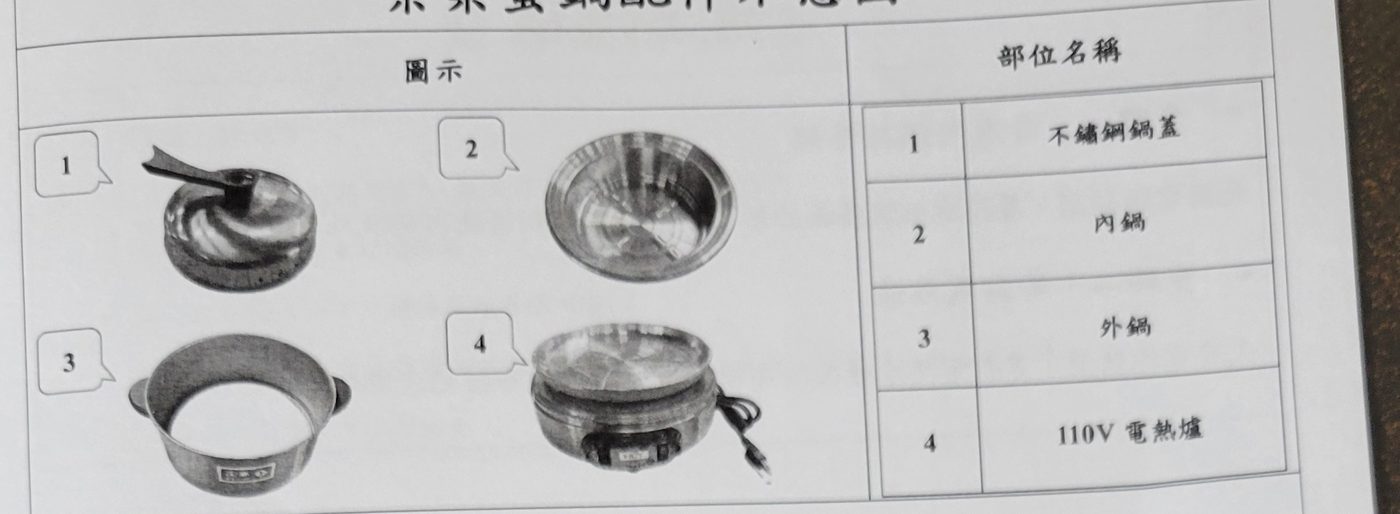
| No. | Part | Chinese |
|---|---|---|
| 1 | Stainless-steel lid | 不鏽鋼鍋蓋 |
| 2 | Inner pot | 內鍋 |
| 3 | Outer pot | 外鍋 |
| 4 | 110 V heater base | 110V 電熱爐 |
Control panel 面板按鍵功能操作說明
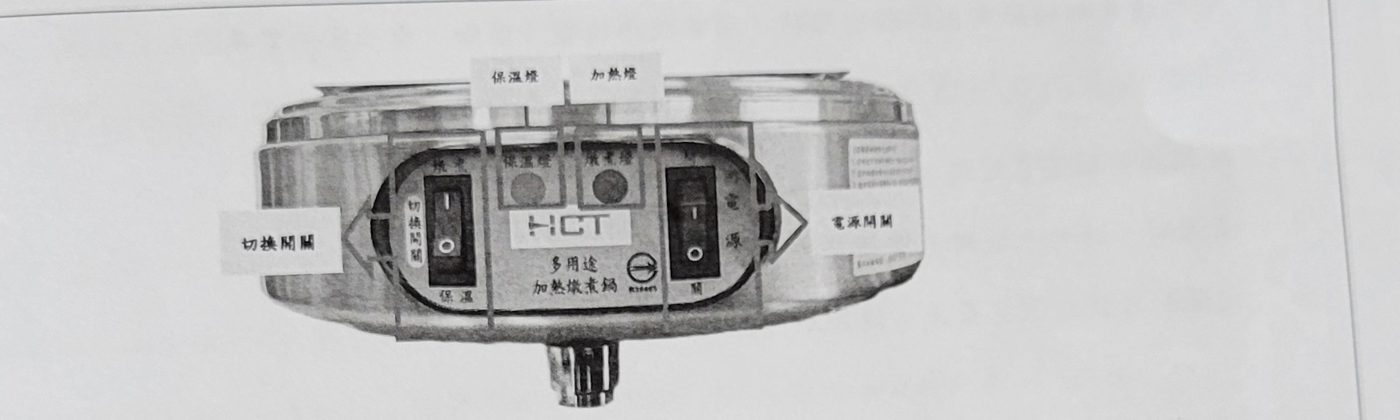
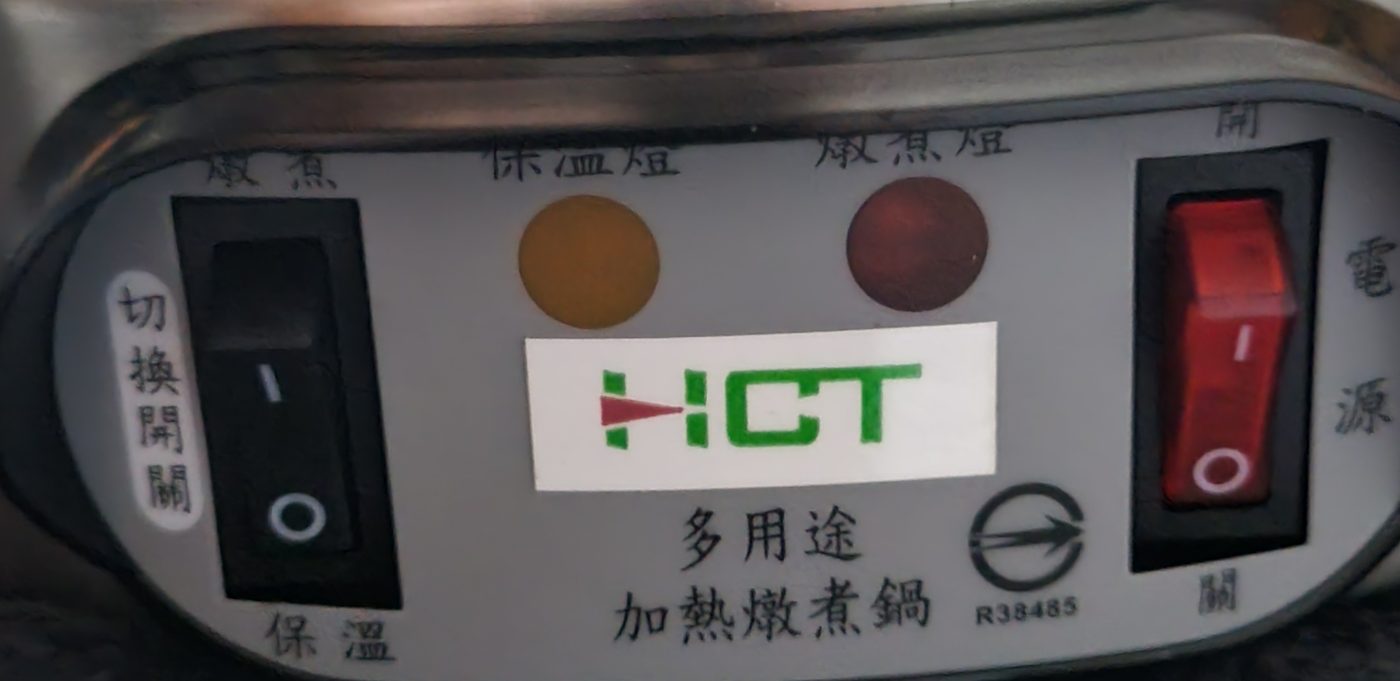
| Control | Marking | Function |
|---|---|---|
| Selector switch 切換開關 |
Up = 燉煮 Down = 保溫 |
Up selects Cook / Stew; down selects Keep Warm. This is the switch you flip by hand after the 4-hour boil. |
| Keep-warm lamp 保溫燈 |
Amber | Lit while the Keep Warm element is actively heating (between roughly 70 °C and 80 °C). |
| Heating lamp 加熱燈 / 燉煮燈 |
Red | Lit while the pot is cooking. If it stays dark, suspect the thermal cut-out. |
| Power switch 電源開關 |
I = 開 (on) O = 關 (off) |
Master power. Always switch off before cleaning. |
10 · Safety information 確保使用上的安全請注意以下標示
- Read the precautions in this manual carefully before operating the machine. Compliance is mandatory.
- Keep this manual somewhere the operator can easily reach it.
- The text uses two categories — Caution (注意) and Warning (警告). Both contain important safety information and must be observed.
| Category | Meaning |
|---|---|
| ⚠ WARNING 警告 | Failure to follow these instructions may result in personal injury or even death. |
| ⚠ CAUTION 注意 | Failure to follow these instructions may result in property damage or personal injury, the severity varying with the circumstances. |
Symbols used in this manual 符號說明
| Symbol | Meaning | Chinese |
|---|---|---|
| ! | General operating instruction | 常規操作說明標示 |
| △🔥 | Fire hazard warning | 火災危險警示 |
| △⚡ | Electric shock hazard warning | 觸電危險警示 |
| △♨ | High temperature may cause a malfunction | 高溫造成故障標示 |
| ⊘ | Prohibited action (general) | 一般操作禁止行為標示 |
| ⊘🔧 | Do not disassemble the unit yourself | 請勿自行拆卸標示 |
11 · Installation 安裝注意事項
- Set the machine up in a safe, level, stable location. An unsuitable position can lead to the unit falling, to fire, or to electric shock.
- Install in accordance with Taiwan's Act Governing Food Safety and Sanitation (食品衛生法) and Electricity Act (電業法). Unlawful installation invites accidents.
- Check the surroundings for flammable gas. A gas leak near the machine can cause an explosion or fire.
- Never use an extension cord or an “octopus” multi-way plug adapter — this will cause a fire.
- Do not step on the power cord, stack heavy objects on it, or bend it. Doing so damages the cord and creates a shock hazard.
12 · During use 使用上注意事項
- Do not put food unsuitable for this machine into it — this readily causes a malfunction.
- Never touch the switches or the outlet with wet hands; risk of electric shock.
- The machine gets very hot in operation. Do not touch the body or the glass cover with bare hands. When you have finished, switch the power off and let it stand for 10 minutes before cleaning, to avoid burns.
- Keep the lid properly closed while the machine is running, to avoid food-hygiene problems.
13 · Cleaning 清潔流程
Step 1 — Clean the inner and outer pots 清潔內鍋及外鍋
Switch the power off first. Wait for the heater surface to cool, then wash the inner and outer pots with a sponge brush and wipe them dry.
Step 2 — Clean the heater base 清潔電熱爐
Switch the power off first. Wait for the heater surface to cool, then wipe it clean with a lightly dampened cloth only.
When cleaning, unplug the unit. Never wash the heater base with water — it will destroy the electronic components.
★注意事項:清潔時,請將電源插座拔除,電熱爐基座請勿水洗,避免零件故障。
- A factory warranty label is affixed to the underside of every heater base. If a fault occurs, report it for service — electronic parts must be tested by a qualified technician. Do not tear off or damage the warranty label, and do not disassemble the unit yourself; damage from human causes is not covered by the warranty.
- The inner pot is purpose-made for tea eggs. Do not substitute a different inner pot, as this affects heating and stewing performance.
- When cleaning, do not wash with water [i.e. the base], to avoid failure of the electronic components.
- After washing the inner and outer pots, dry the bottoms before placing them back on the base for use.
14 · Additional precautions printed on the machine body
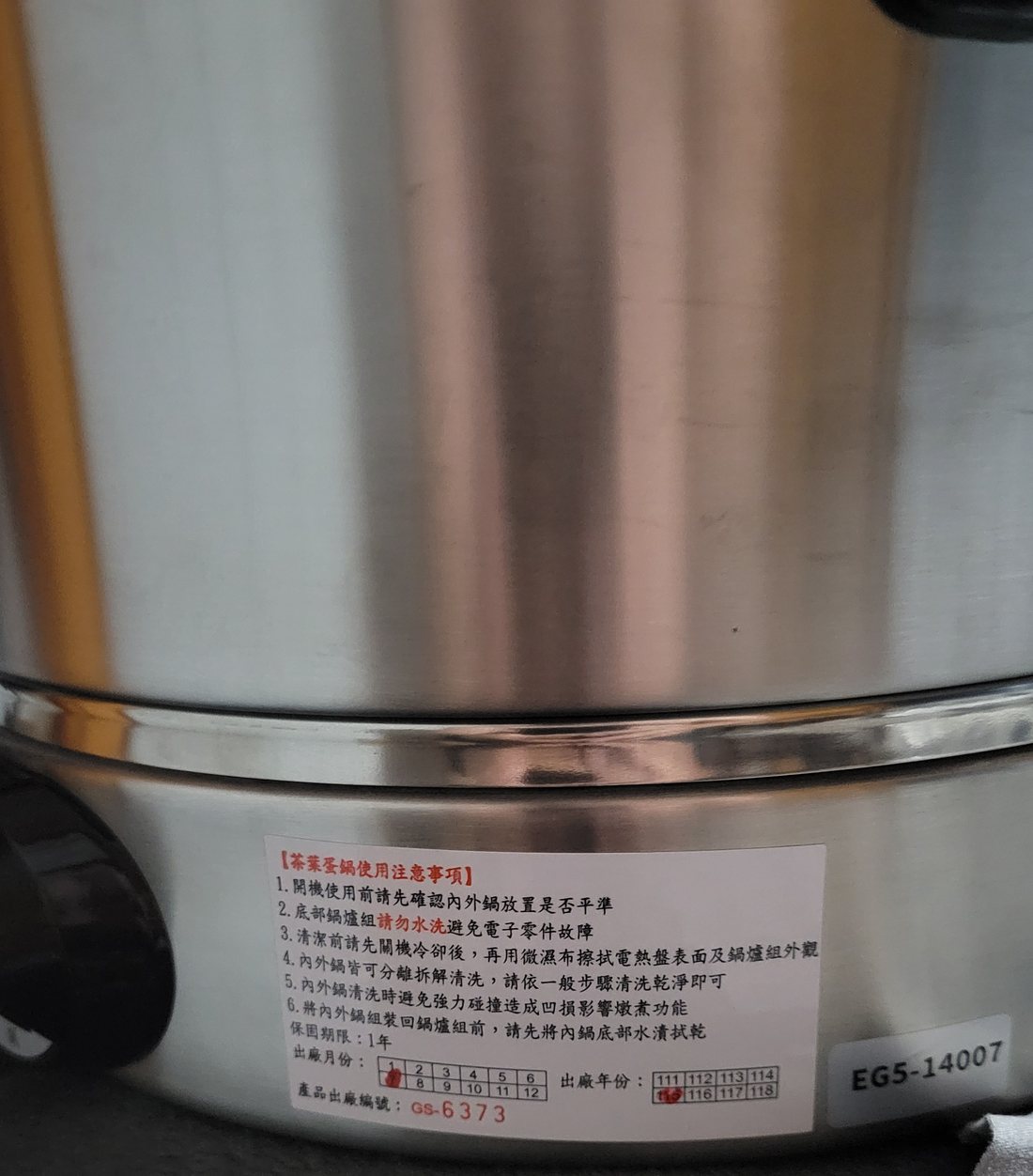
- Before switching on, check that the inner and outer pots are seated level and true.
- Do not wash the base/heater assembly with water — this prevents failure of the electronic parts.
- Before cleaning, switch off and let the unit cool, then wipe the hot-plate surface and the outside of the base with a lightly dampened cloth.
- Both the inner and outer pots detach for washing; clean them normally.
- When washing the pots, avoid heavy knocks — dents will impair cooking performance.
- Before reassembling the pots onto the base, wipe any water off the bottom of the inner pot.
15 · Troubleshooting 簡易故障排除
Q1 · The tea egg pot has no power. 茶葉蛋鍋無電源?
Check whether the outlet itself is faulty (use a dedicated 110 V power outlet).
- Yes, the outlet is faulty → have an electrician repair or replace the outlet.
- Yes — outlet confirmed good → call the service hotline.
- No → the over-temperature protection device in the heater has tripped. Wait about 30 minutes; once the body has cooled, restore power and normal cooking will resume.
Q2 · The tea egg pot will not heat. 茶葉蛋鍋無法加熱?
The over-temperature protection device inside the heater has tripped. Wait about 30 minutes; once the body has cooled, restore power and normal cooking will resume. If it still does not work, call the service hotline.
Q3 · The tea egg pot trips the breaker. 茶葉蛋鍋跳電?
Confirm the supply is 110 V. The over-temperature protection device inside the heater has tripped — wait about 30 minutes, and once the body has cooled, restore power and normal cooking will resume. If it still does not work, call the service hotline.
Q4 · A panel switch has failed. 茶葉蛋鍋按鍵故障?
Store staff must not open the machine or change parts themselves — call the service hotline. (Opening the heater yourself risks current leakage and compromises public electrical safety.)
16 · Specifications 產品規格
| Model | WJ-1501 |
|---|---|
| Product | All-stainless-steel separable tea egg pot 全不鏽鋼分離式茶葉蛋鍋 |
| Input voltage | 110 V / 60 Hz 輸入電壓:110V / 60Hz |
| Power consumption | Cooking 800 W · Keep warm 600 W 消耗功率:燉煮 800W/保溫 600W |
| Capacity | 5 litres 容量:5 公升 — approx. 40–50 eggs (about 10 servings) |
| Dimensions | 35 cm diameter × 32.5 cm high 直徑 35cm、高 32.5cm |
| Inner pot material | Food-grade 316L stainless steel 食品級 316L 不銹鋼 |
| Outer pot material | SUS-304 stainless steel SUS-304 不銹鋼 |
| Safety approval | BSMI R38485 (Taiwan) |
| Quality system | ISO 9001:2015 |
Electrical, capacity and dimensional figures are from the manufacturer's published product specification; the printed manual itself does not state them.
17 · Your unit 出廠標籤
| Serial number | GS-6373 產品出廠編號 |
|---|---|
| Date of manufacture | Month 7, year ROC 115 = July 2026 出廠月份/出廠年份 |
| Label on unit | EG5-14007 |
| Warranty period | 1 year 保固期限:1 年 |
Warranty 保固說明
- One year from the date the machine is delivered.
- For faults arising under normal use within the warranty period, repairs are handled by the warranty service provider.
- For faults arising under abnormal use (human causes) within the warranty period, parts replacement is charged at cost of labour. Do not open the machine and repair it yourself — if the warranty label is damaged or removed, the warranty no longer applies.
- The company accepts no warranty liability for faults caused by natural disaster, earthquake, user error, or overloading the machine.
Contact 聯絡方式
| Company | HO CHIU TAI CO., LTD. 禾久代股份有限公司 |
|---|---|
| Telephone | 04-8833257 (Taiwan) · +886 4 883 3257 |
| Fax | 04-8833239 |
| [email protected] | |
| Address | No. 261, Shunzhen Lane, Nanzeng Village, Tianwei Township, Changhua County, Taiwan 彰化縣田尾鄉南曾村順圳巷 261 號 |
| Website | steamer-hct.com · official LINE account (QR code on back cover of original) |
18 · Sources for the added sections
Sections 1–7 draw on Taiwanese trade practice and Taiwanese cooking sources. The machine sections (8–17) are translated from the printed booklet and the labels on the unit.
- 茶葉蛋怎麼煮才入味?釣出超商店員公開「煮法步驟」:必做1動作 — NOWnews 今日新聞.
Convenience-store staff describe the full store procedure: cracking, egg counts, per-chain
loading order and cook times, room-temperature water, the absorbent sheet.
nownews.com/news/6748630 - 超商店員曝光煮茶葉蛋秘技 一動作「不會爆開又能入味」 — 聯合新聞網.
The blunt-end tap as an anti-burst measure; the shell's own pores as the flavour route.
udn.com/news/story/120915/5802776 - 茶葉蛋滷出「完美大理石紋」這樣做!免顧火也超入味 — 自由時報 食譜自由配.
The marble method, the from-scratch reference formula, and the two-day steep.
food.ltn.com.tw/article/11649 - 農產知識 — 分享做茶葉蛋的小撇步 — 行政院農業委員會桃園區農業改良場.
Home-scale blend and the steam-then-crack sequence.
tydares.gov.tw/ws.php?id=8456 - 第一次做茶葉蛋就大成功! — 愛料理 (iCook).
Packet ratios; removing the tea bag while keeping the spice packet; overnight steep.
icook.tw/recipes/463370 - [問題] 茶葉蛋的滷汁是可以重複使用的嗎? — 批踢踢實業坊 (PTT) cookclub.
Marinade reuse and the boil-before-refrigerating rule.
ptt.cc/bbs/cookclub/M.1484453946.A.286.html - [問題] 請問茶葉蛋上的紙的名字? — 批踢踢實業坊 (PTT) cookclub.
Identification of the sheet as a drop lid (落蓋); non-woven fabric; parchment as substitute; the
objection to kitchen paper towel.
ptt.cc/bbs/cookclub/M.1618901885.A.8E1.html - 茶葉蛋專用滷包 — 和春堂 (Hechuntang, est. 1974). Packet composition and size.
hct1974.com/products/茶葉蛋專用滷包 - 超商、賣場茶葉蛋 消保官:有衛生疑慮 — 元氣網 / 聯合報.
The absence of a unified standard; the 10-hour, 24-hour and 48-hour chain limits.
health.udn.com/health/story/6010/4182205 - 他不敢吃超商茶葉蛋 一票店員揭SOP作法 — 中時新聞網.
Store practice on mixed-age eggs and pot hygiene.
chinatimes.com/realtimenews/20250309002723-260405 - 「水煮蛋、茶葉蛋、滷蛋、溏心蛋」冷藏能放多久?專家揭極限期限 — 台視新聞.
Refrigerated shelf life, shell-on versus peeled.
news.ttv.com.tw/news/11503260002300W - HCT 5L 全不鏽鋼茶葉蛋專用鍋 WJ-1501 — 全能冷凍餐飲設備.
Manufacturer's published specification: capacity in eggs, wattage, dimensions, materials.
ocantech.com.tw/goods.php?id=2481