Frogmore Stew
I saw it on a sign, and I thought it might be some kind of frog stew.
It is not. But my instinct was closer than I had any right to expect, and working out why is the best thing on this page.
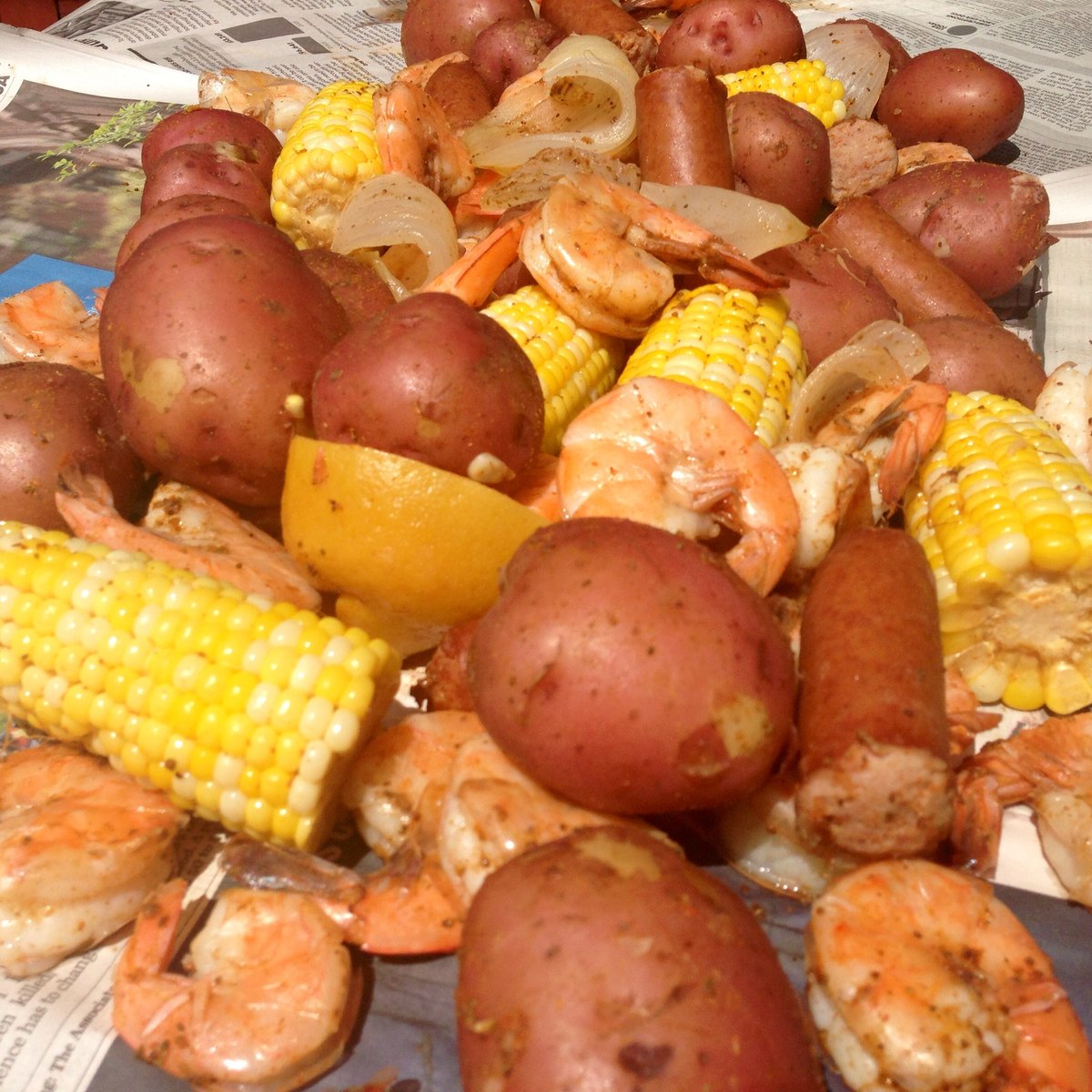
What I actually got
This was St. Helena Island, near Beaufort, in the early nineties. I stopped, I ordered it on the strength of the name, and it was amazing.
Shrimp. Corn on the cob. Sausage. Crab. Potatoes. All smothered in Old Bay — which is one of my favourite things in a cupboard anyway. There may well have been more in there; I wasn’t taking notes, I was eating.
⭐ And the service is half the dish. It came out on a large cookie sheet covered in newspaper, and the cookie sheet was set down on the table. That’s it. No plates, no bowls, no ceremony. Alongside it: a bucket of Rolling Rock on ice.
I went back for it repeatedly after that. I think I may have tried every restaurant in the area that made it. One of them had tables with a hole cut in the middle and a bucket underneath — for the crab shells, the corn cobs, the shrimp shells. Which tells you everything about how this food is meant to be eaten.
⭐ Frogmore is a place, and you were standing on it
Here is what I did not know at the time.
Frogmore is a community on St. Helena Island. Not a metaphor, not a joke name — an actual place, in the middle of the island I was eating on. I ate the dish in the place it is named after, entirely by accident, because I liked the sound of a sign.
🔴 And the frogs are real — just not in the pot
My guess was wrong about the stew and accidentally right about the name.
Frogmore, South Carolina takes its name from Frogmore in England, brought over by an early landowner who named the place after his ancestral home.
⭐ And the English Frogmore is named after frogs. The place-name comes from Old English frogga and mere — a pool frequented by frogs — describing exactly the low, marshy, flood-plain ground it sits on.
So the chain runs: marshy English pool full of frogs → the family that lived there → a Sea Island community named after it → a stew named after the community. The frogs are four steps back and never went anywhere near a pot, but they are genuinely in the etymology. I have rarely been so satisfied to be wrong.
How old is it, actually?
I never knew, so I went and found out, and the honest answer has two halves.
The name is recent. The food is not.
⭐ The name is credited to Richard Gay of the Gay Fish Company on St. Helena Island, in the 1960s — the account being that he was faced with feeding around a hundred National Guardsmen in one sitting and adapted an old family seafood recipe to do it. The name came off the community he was standing in.
⭐⭐ But the dish is much older than its name, and the older lineage is Gullah Geechee. The one-pot boil belongs to the cooking of the Sea Islands — a way of feeding a large gathering quickly from what the water and the field gave you, all in the same pot, at the same time. That is the thing being named in the 1960s, not invented.
It reached a wider audience after a Gourmet cover in the 1980s.
⚠ So when I ate it in 1992, the name was about thirty years old and the cooking was a great deal older. That gap is worth holding onto, because the same shape turns up all over this section: a name attaches late to a practice that was already there.
⭐ And it puts me in the right neighbourhood twice over. Beaufort and the Sea Islands are the heart of Gullah Geechee country — which is also why the word goober was in the air at the bar where I first ate boiled peanuts, a few miles away and around the same time.
What it’s called depends who’s asking
Frogmore Stew is the St. Helena name. You will also hear:
- Lowcountry boil — the general, exportable name.
- Beaufort stew or Beaufort boil — the county claiming it.
- Tidewater boil, further up the coast.
⚠ The names are contested and mildly political, in the way regional food names always are. I use Frogmore because that is what the sign said.
⚠ And it is not a stew. There is no broth to speak of by the time it reaches the table — it is boiled, drained and tipped out. The word is doing something social rather than technical.
Making it
I make my own now, and I catch most of it myself. I love shrimping and crabbing, and it did not take long after Beaufort before I was putting this together from things I had pulled out of the water that day. That is the version worth aiming for — the dish is simple enough that the ingredients are the whole argument.
The order is the entire technique, because everything goes in one pot and nothing wants the same amount of time:
- Heavily seasoned water — Old Bay, or a crab boil. Be more aggressive than feels reasonable; you are seasoning through shells.
- Potatoes first. They take the longest. Small whole or quartered.
- Sausage next — smoked, in lengths. It is also flavouring the water for everything after it.
- Corn, halved. Ten to fifteen minutes.
- Crab, if you have it.
- Shrimp last, and only for a few minutes. ⭐ This is the step that decides whether it was worth doing. Shell-on, and pull them the moment they turn — overcooked shrimp do not come back.
- Drain, tip out, more seasoning over the top.
⚠ Do not add water to the shrimp’s world after they go in. Everything before them is building a broth; the shrimp are riding it for three minutes.
Recipe: Frogmore Stew — scales from a family dinner up to a half-bushel of crabs and fifteen pounds of shrimp.
How I serve it
Outside, on a picnic table covered in newspaper.
It is messy, and pretending otherwise ruins it. Newspaper down, food tipped straight onto it, something for the shells, plenty of napkins, cold beer. No plates. People stand up, reach across, and take what they want.
⭐ That is not a shortcut, it is the point. This is a dish that exists because somebody needed to feed a hundred people at once, descended from a way of cooking that existed because a community needed to feed everybody at once. The newspaper is the recipe carrying its own history to the table.
It lends itself to a nice dinner with friends better than almost anything else I make.
Back to: The South Is Not One Place · and the other Beaufort dish, Boiled Peanuts
Comments (0)