Which Olive, and What For
A deli counter looks like a display of different fruits. It is not. Almost everything on it is one species, and a good part of what separates one bin from the next is not the tree at all — it is what somebody did to the fruit after picking it.
That is the useful frame for this page. Some of the difference is genetics, some is when it was picked, and some is which cure it got. Pull those apart and the counter starts making sense.
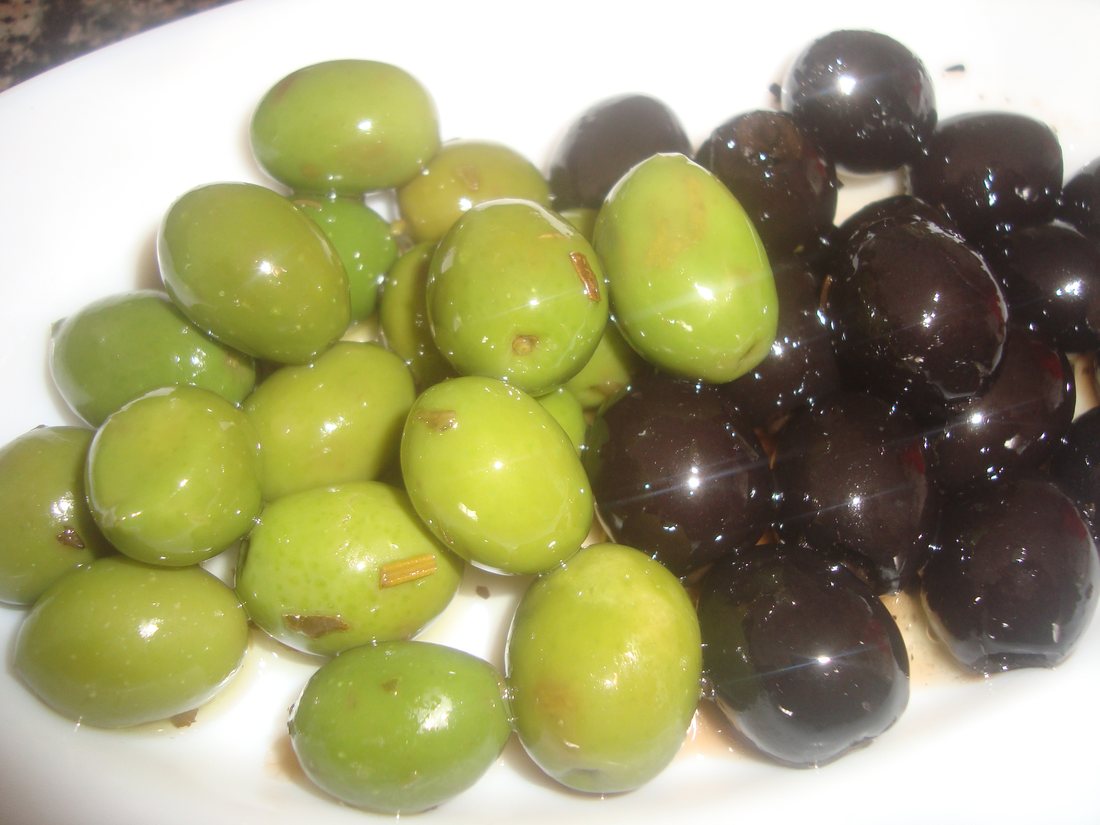
First, the taxonomy, because “species” is the wrong word
There is essentially one olive: Olea europaea. Kalamata, Manzanilla, Picual, Castelvetrano, Mission — every one of those is a cultivar, the horticultural equivalent of a dog breed. Not a species. Not even a subspecies.
The picture immediately below that is worth knowing:
- Olea europaea is a complex of six subspecies — europaea plus laperrinei, guanchica, maroccana, cerasiformis and cuspidata. The last few are African, Saharan-montane and Macaronesian trees and have nothing to do with your martini.
- Subsp. europaea splits two ways: var. europaea, the cultivated olive, and var. sylvestris, the wild oleaster. The oleaster is a real thing with small, mean, stony fruit — the ancestor and still the rootstock.
- ⚠ Cultivar counts vary wildly by source, from “over 350” to well past a thousand depending on whether you are counting distinct genotypes or every local name. Names are the problem: the same tree collects a different name in each valley, and DNA work keeps collapsing “distinct” cultivars into synonyms. Treat any specific total with suspicion, mine included.
So Jeff’s question — what are the different species — has a slightly annoying answer: there is one, and the interesting variation is a rung below it. Which is also true of apples, and of chili peppers, and it is a good reminder that the shelf is a cultural artefact more than a botanical one.
What actually varies, from a cook’s point of view
Five traits, and only five, really decide what a given olive is good for.
| Trait | Why it decides the use |
|---|---|
| Size | The whole business case for a stuffed olive. Big, low-oil fruit stuffs; small fruit does not. |
| Pulp-to-pit ratio | You are buying flesh. A high ratio is a table olive; a low one is a nuisance. |
| Oil content | High oil (24–28%) → the press. Low oil → the table. This is the main fork in the road. |
| Flesh firmness & skin | Whether it survives lye, cracking, months of brine, or turns to mush. |
| Detachment force / bruising | Whether it can be shaken off mechanically or has to come off by hand. |
⭐ The one that surprises people is the oil. A table olive is very often a bad oil olive, and deliberately so. High oil content makes for soft, greasy flesh that goes to pieces in brine. Gordal and Cerignola are enormous and low in oil — that is the point of them. Koroneiki and Arbequina are tiny and oil-dense — also the point.
The cultivars, sorted by what they are for
Table olives — bred for flesh
| Cultivar | Where | The character | Usual cure |
|---|---|---|---|
| Manzanilla | Spain | The default green olive of the Western world. Firm, nutty, holds a stuffing | Spanish/lye, then brine ferment |
| Gordal (“the fat one”) | Spain | Huge, thick-fleshed, mild. The Spanish “queen” olive | Lye or natural brine; often stuffed or halved |
| Hojiblanca | Spain | Dual-purpose, but a fine firm table olive; common in “black ripe” | Lye, or Californian oxidation |
| Nocellara del Belice (sold as Castelvetrano) | Sicily | Buttery, sweet, barely olive-tasting. Improbably green | Quick lye + brine — see below |
| Bella di Cerignola | Puglia | Spectacular size. Mild, crisp, faintly sweet | Lye then ~4 weeks brine ferment; also sold blackened, and dyed red/green |
| Ascolana Tenera | Marche | High pulp-to-pit, thin skin, cold-tolerant. The stuffed-and-fried olive | Lye/brine; the olive ascolane. ⚠ Prone to softening |
| Kalamata | Greece | Almond-shaped, purple-black, wine-sharp. The great natural ferment | Slit, 8–12 months in 6–10% brine, often finished with vinegar |
| Konservolia / Amfissa | Greece | Greece’s workhorse table olive, green through black | Natural brine |
| Halkidiki | Greece | Large, firm, green, tart. The Greek answer to Manzanilla | Natural brine ferment; also lye-processed commercially |
| Throumba (Thassos) | Greece | Wrinkled, intense, faintly sweet. See the strange one, below | Debittered on the tree, then dry-salted |
| Gaeta / Itrana | Lazio | Soft, tart, wine-coloured | ~1 month in water, then salt, 4–6 months brine |
| Nyons / Tanche | Provence | Wrinkled, nutty, low salt-burn. AOC | Dry salt, 5–6 months |
| Beldi | Morocco | Shrivelled, chewy, pleasantly bitter. The “oil-cured” olive | Layered in sea salt, barrels rolled to oxidise |
| Lucques | Languedoc | Crescent-shaped, bright green, buttery, almost avocado | Lye ~15 hours, then a year in weak brine |
| Picholine | France | Elongated, crisp, tart, with a bite of anise | Lye-and-brine, no fermentation (“Picholine style”) |
| Mission | California | America’s own, from Franciscan stock. Fruity | Californian oxidation, or dry salt |
| Sevillano | Spain → California | Very large, firm, low oil. The classic home-curing olive in the US | Anything. It is forgiving |
| Domat | Turkey | Big, high pulp ratio, low oil, made for the table | Brine |
| Azapa | Chile | Meaty, plump, high quality | Natural brine |
Oil olives — bred for fat
Picual (Spain, 24–27% oil, pungent and stable), Arbequina (Spain, small, soft, sweet — the one everybody plants in a hedgerow orchard), Koroneiki (Greece, 24–28%, tiny, high-polyphenol), Frantoio and Leccino (Tuscany, the classic blend — Frantoio for fruit, Leccino for gentleness), Chemlali and Chetoui (Tunisia), Ayvalık and Memecik (Turkey).
You can cure these. They are small and oily and you will not enjoy it much.
Dual-purpose — pressed or eaten depending on when you pick
Taggiasca (Liguria — tiny, sweet, and both a superb oil and a superb little brined olive; traditionally 15–40 days of daily water changes, then months in sea-salt brine), Carolea (Calabria), Picholine Marocaine (Morocco), Nocellara del Belice again, Sarıulak and Topak Ulak (Turkey).
Matching the cultivar to the cure
This is the practical heart of it, and it is mostly about size and firmness.
| If you want… | Use | Why |
|---|---|---|
| Water cure, cracked green (start here — 6–7 days) | Sevillano, Manzanillo, Mission, any large firm green | Mallet-cracked flesh leaches fast, and the crack is the whole texture |
| Water cure, Kalamata style (8–10 days, then a month) | Ripe black Manzanillo, Mission, Kalamata — ⚠ not Sevillano, it softens | Two knife cuts, red wine vinegar, an oil cap. The one that keeps at room temperature |
| Natural brine ferment, black (3–6 months) | Kalamata, Konservolia, Halkidiki, Gaeta, Taggiasca | Firm skin, moderate oil, enough sugar for the lactic bacteria |
| Natural brine ferment, green (Sicilian style, 4–6 months) | Sevillano above all, or Manzanillo and Mission | Whole fruit in seasoned brine. Brine strength depends on size — big fruit shrivels |
| Dry salt cure | Ripe black Mission, Beldi, Tanche, Throumba | Must be fully ripe, and small. Salt curing a green olive gives you a bitter pebble |
| Lye | Manzanilla, Sevillano, Nocellara, Lucques, Picholine | Firm, uniform-sized fruit. Uneven sizes cure unevenly and that is the danger |
| Stuffing | Gordal, Cerignola, Manzanilla, Ascolana | Big cavity, low oil, flesh that stays put |
🔴 A correction I owe this table. It used to file “cracked green” as Cypriot / Sicilian style, and Sicilian does not belong there. In UC’s publication, Sicilian-style green olives are a brine ferment — whole fruit, seasoned brine, four to six months — not a cracked water cure at all. The cracked-green water cure is real and is what UC calls the Mediterranean style. Cypriot tsakistes genuinely are cracked; Sicily was my own conflation, and it had made its way into a recipe before the primary source caught it.
⚠ The size rule is the one that bites home curers. Mixing large and small fruit in one lye batch means the small ones are over-processed and mushy while the large ones are still bitter in the middle — and the middle is exactly where you cannot taste-test without ruining the olive. Grade by size before you start. The olive page says grade by ripeness too; both are real, and size is the one people skip.
⭐ The strange one: an olive that debitters itself
Throumba, from Thassos, is the exception to the flat statement on the olive page that an olive must be debittered before you can eat it.
It still must be. It just does not need you. The fruit is left on the tree past full ripeness, and a fungus — Phoma oleae — colonises it and hydrolyses the oleuropein in place. The EU PDO file for Throumpa Thassou says it in those terms: with the appearance of Phoma oleae, the variety “looses its bitter taste, due to the hydrolysis.” By the time it is picked it is already sweet, and the subsequent 30–40 days under 30–40% salt is about texture and keeping, not bitterness.
So the mechanism is the same one the lactic bacteria use in a Greek brine ferment — enzymatic hydrolysis — the difference being that the fungus does it on the branch instead of in your crock.
🔴 And a wrinkle I did not expect. Even here, the PDO’s own commercial-handling section describes green fruit being treated with caustic soda solution before sale. So the one olive on earth you can eat straight off the tree still meets lye on its way to a jar, if it goes through trade. The naturalness is real in the orchard and negotiable in the packing house.
Three things the shelf tells you that are not true
1. Castelvetrano is the “natural” one. It is the opposite. That fluorescent, almost artificial green is the lye — a brief alkaline soak that strips bitterness before the fruit can go grey or brown, and that is precisely why it looks the way it does. A naturally fermented Nocellara comes out a dull grey-green. The most “fresh-tasting” olive on the counter is the most chemically processed one there. I still eat them by the bowl. I just stopped telling people they were the artisanal choice.
2. Black olives are ripe olives. Sometimes. A Kalamata or a Gaeta genuinely is ripe fruit. A canned California “black ripe” olive is a green olive that was turned black with lye, forced air and an iron salt — the whole mechanism is on the history page. And ⚠ Cerignola is sold in three colours, two of which are done to it.
3. “Kalamata” is a place. It is a cultivar and a PDO region, and outside the EU the name is used loosely on the cultivar grown elsewhere — Californian, Chilean, Australian Kalamatas are real Kalamata trees and legitimately labelled in their own markets. So the name on the tub tells you about the fruit, not reliably about the field.
Buying raw olives to cure
The season is short and this is what catches people out: raw olives are a September-to-January product and they do not keep. They bruise, and a bruised olive ferments badly.
- Green, firm, for water or lye curing: late September into October.
- Ripe black, for dry salt curing: November into January.
In the US the realistic sources are California growers who ship direct — several around Corning and the Sacramento Valley sell 10 lb and 20 lb boxes of fresh Sevillano, Manzanillo and Mission for exactly this purpose, on a pre-order-by-harvest-wave basis. Otherwise: Middle Eastern, Greek and Italian grocers in season, farmers’ markets in growing regions, or a neighbour with a tree.
⚠ Ask what cultivar and what stage you are getting, and do not accept “olives.” Sevillano and Manzanillo behave differently in a lye bath, and a box of ripe blacks is useless if you planned a cracked-green cure.
Recipes: the cures themselves are written up as Olives, Water-Cured (Green), Olives, Water-Cured, Kalamata Style, Olives, Sicilian Style in Brine, Olives, Brine-Cured Greek Style, Olives, Dry Salt-Cured and Olives, Lye-Cured.
Next: Olives for the methods, or How They Became Edible for where the methods came from.
Comments (0)