Under Oil
Four times now this section has run into a language that refuses to use one word where English uses one word. Japan sorts pickles by the bed they sit in — salt, soy, vinegar, rice bran, miso, koji, sake lees — and only one of the seven is vinegar. Turkish turşu covers both of this section’s methods under a single word. Traditional Indian achar has no vinegar in it at all.
Italy makes it four, and Italy splits by the medium:
| Italian | Literally | What is doing the work |
|---|---|---|
| sott’aceto | under vinegar | The acid. This is a pickle in the English sense |
| sott’olio | under oil | 🔴 Nothing. Read on |
| sotto sale | under salt | Salt, by dehydration |
| in salamoia | in brine | Salt — and if it is olives, a ferment |
| sotto spirito | under spirits | Alcohol. Cherries in grappa |
Five categories, five preservation mechanisms, five prepositions. English has “pickled” and then runs out.
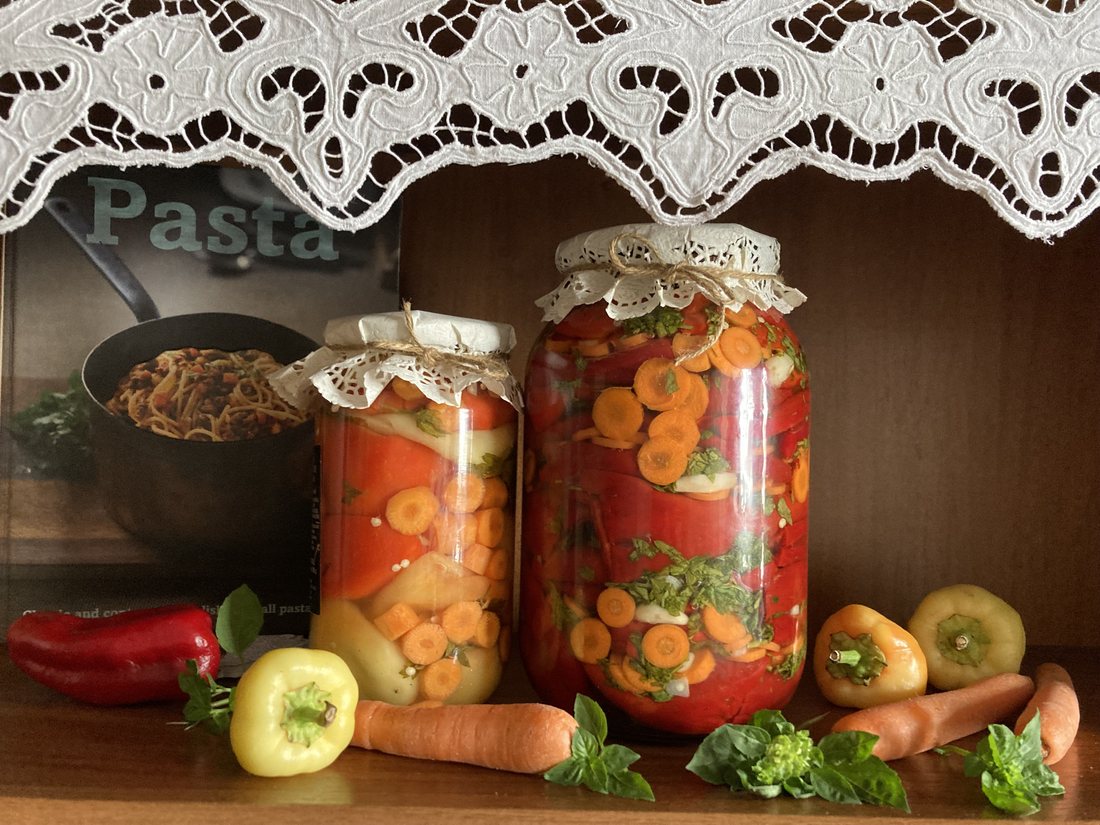
The uploader names these turshi me vaj — Albanian for pickles with oil. ⚠ And I want to be straight about it: at this angle I cannot see an oil layer, and I am not going to caption something I cannot see. Which turns out to be the page in one photograph. You cannot tell by looking at a jar what is keeping it safe — and that is precisely the problem this page is about.
🔴 The oil is not preserving anything, and Italy has the case numbers
This is the page’s whole point and it is worth being blunt about.
Oil excludes oxygen. That is the opposite of preservation for the organism that matters here, because Clostridium botulinum is an anaerobe — a sealed, oxygen-free, low-acid, room-temperature container is the exact set of conditions it wants. A jar of vegetables under oil is that container unless something else was done first.
Italy’s Istituto Superiore di Sanità — the national health institute, which runs the country’s botulism reference centre — publishes guidelines for home preserving. Two sentences from them, verbatim:
“Gli alimenti maggiormente coinvolti sono conserve vegetali sott’olio. Per questo tipo di prodotti l’errore di preparazione più frequentemente commesso è un’insufficiente acidificazione.”
“The foods most often involved are vegetable preserves under oil. For this type of product the most frequently committed preparation error is insufficient acidification.”
Note what that says and what it does not. The error is not “used oil.” The error is “did not acidify.” The oil is not the hazard; the missing step before the oil is the hazard. Italy records 20–30 botulism cases a year, and the ISS states that the overwhelming majority come from preserves made at home without following the rules.
⚠ And immediately, a correction to that, before it becomes a slogan
It would be very easy to leave the last section as “oil is dangerous, vinegar is safe” and move on. The same ISS document does not let me.
For products in water or brine, it says, the most common domestic error is too little salt — and it names the specific case: “I prodotti in salamoia, come per esempio le olive verdi, sono prodotti fermentati che richiedono un quantitativo di sale almeno pari al 10% dell’acqua utilizzata.” Brined products such as green olives are fermented products requiring salt of at least 10% of the water used. Below that, alongside the organisms that ferment the olives, harmful ones including C. botulinum can grow.
That is a number I did not have when I wrote the olive page, and it belongs there — that page correctly says brine-cured olives are a genuine ferment and correctly says to get below pH 4.6, but 10% of the weight of the water is the practical figure a home curer can actually act on.
⚠ If you do want the pH figure rather than the salt one, measure it properly. A vegetable under oil is the hardest case there is — you have to pour the oil off and blend the solids before the number means anything. How to do it, and what to buy.
🔴 And the food the ISS lists first among Italy’s home-made botulism vehicles is not an oil preserve at all — it is black olives in water. So the honest version of this page is not “oil bad, brine good.” It is: every medium on that table has a mechanism, and botulism arrives whenever the mechanism is skipped. Oil’s mechanism is that there isn’t one.
The method, from the people who publish the case numbers
I am giving the ISS procedure rather than an Italian grandmother’s, for the obvious reason. It is specific, and several steps in it are not what a home cook would guess.
- Blanch the vegetables in equal parts water and vinegar, a few minutes. This both cooks and acidifies them — the acidification happens here, not in the jar.
- Wine vinegar at 6% acidity or higher is recommended. If you are using a non-wine vinegar at 5%, do not dilute it — use it neat. (Compare the 5% floor for canning: under oil, the bar goes up.)
- Cook only to al dente. Longer and the vegetables lose their texture completely during storage.
- ⭐ Blanch the herbs and spices too. This is the step everyone skips. Dry aromatics going into the jar unblanched are unacidified material sitting in an anaerobic environment.
- Drain, then cool and dry on a clean dry cloth. Water carried into the jar dilutes everything you just did.
- Pack filling the voids — but do not crush.
- Cover completely with oil and work out trapped air with a plastic spatula. Use a spacer to keep everything under the surface.
- Pasteurise, longer for larger jars.
- ⚠ If you top up the oil afterwards — and you may well need to, because the vegetables absorb it — you must pasteurise again. Rest half a day before shelving so you find out.
- Check at 10–15 days. Bubbles rising from the bottom, or the oil going opalescent, means it is spoiling. “Anche al solo sospetto di alterazione, la conserva non va assaggiata né consumata” — on suspicion alone, it is not to be tasted or eaten.
Kept properly it will hold up to about a year and a half, and it is better after two or three months than it is fresh.
🔴 Diamante, August 2025
I would rather not use a recent death to make a point, and I am using this one because it is the clearest illustration available of what the ISS document is actually about.
In Diamante, in Calabria, in early August 2025, people who had eaten sausage-and-friarielli sandwiches from a food truck on the seafront began arriving at hospital. Two died and more than a dozen were hospitalised. Friarielli are Neapolitan turnip greens, and they were preserved in oil. Two brands were recalled; contamination was reported in multiple lots.
Two things about it are worth carrying away.
First, the vehicle is on the ISS’s list by name. Its home-preserve list reads: “le olive nere in acqua, le conserve di funghi sott’olio, le conserve di cime di rapa, le conserve di carne e di pesce (soprattutto tonno)” — black olives in water, mushroom preserves in oil, turnip-green preserves, meat and fish preserves, especially tuna. Cime di rapa is friarielli. This was not an exotic failure mode; it was the third item on a published list.
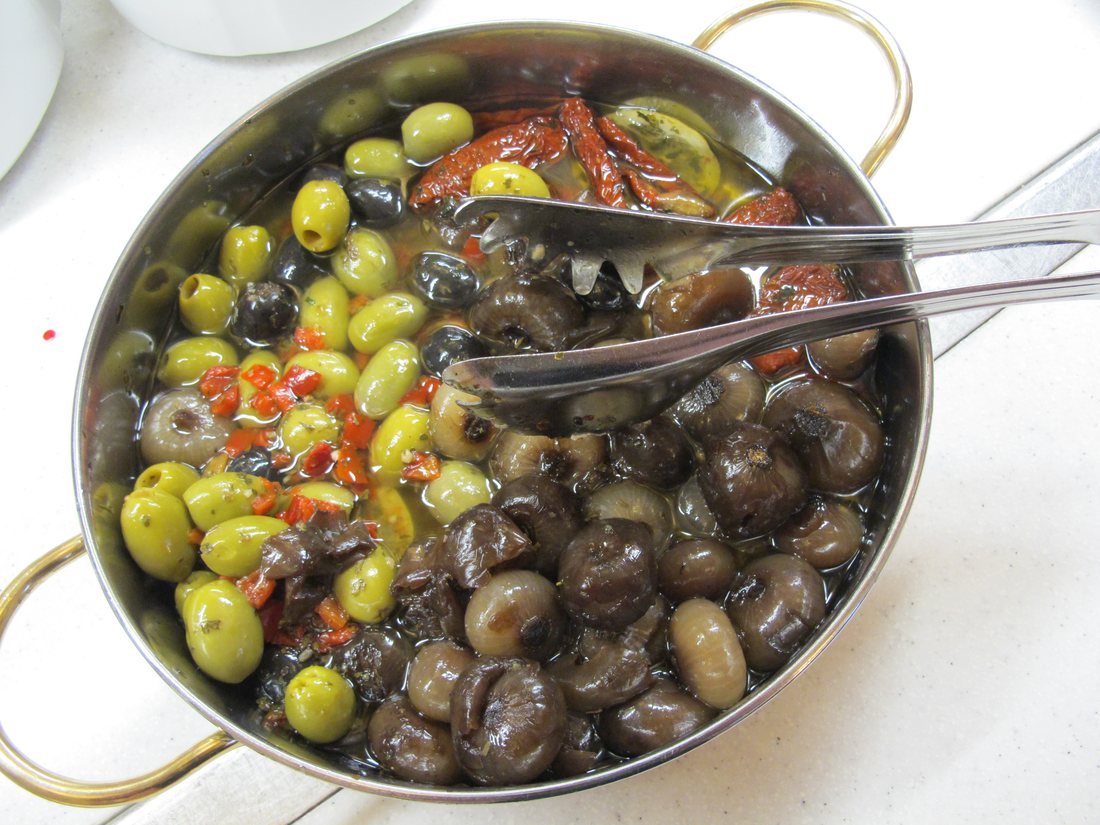
Olives and mushrooms, in one dish, on an antipasti counter. These are the first two items on the ISS’s list of the home preserves most often implicated in Italian botulism cases — the olives in water, the mushrooms in oil. Both are also completely ordinary, sold everywhere, and eaten by everybody without incident. The hazard is not the food. It is one skipped step in a kitchen.
Second, and this is the part that stayed with me: the ISS notes that botulism’s fatality rate has fallen from 60–70% in the 1920s to 3–5% today, and attributes that to correct and early diagnosis plus the antitoxin distributed by the Ministry of Health. In the Calabrian case, several doctors were placed under investigation over whether the diagnosis came fast enough. ⚠ That is an allegation being examined by a prosecutor and not a finding, and I am not going to treat it as one — but the shape of it is worth understanding. The reason modern botulism is usually survivable is a fast response, which means the disease’s danger sits partly outside the kitchen, in whether the first doctor you see thinks of it.
🔴 A correction I owe two of my own pages
Writing this sent me back to check something I had asserted twice, and I had it wrong.
The safety page and the Russia page both say that pickled mushrooms are a refrigerator preparation “unless you are following a tested pressure-canning process.” The pressure-canning part is wrong.
The National Center for Home Food Preservation publishes a tested recipe for Marinated Whole Mushrooms that is processed in a boiling-water canner — half-pints for 20 minutes at sea level. And it contains, per 7 lbs of mushrooms, 2½ cups of 5% white vinegar, ½ cup of bottled lemon juice — and 2 cups of oil.
So both of my sentences were wrong in the same way: oil in the jar does not put a preserve beyond the reach of a tested boiling-water process, and acid is what makes the difference, not the absence of fat. Plain mushrooms with no added acid do need a pressure canner, because they are low-acid. Mushrooms carrying that much vinegar and lemon juice do not, because they are no longer low-acid. The distinction I flattened is the one this entire section is built on.
Both pages now say so. I would rather leave the error visible with the fix attached than quietly rewrite it, which is how everything else here has been handled.
Giardiniera, which is the same jar twice
The neatest illustration of sott’aceto versus sott’olio is a jar that exists in both forms and is called the same thing.
Italian giardiniera is sott’aceto: large pieces of vegetable — cauliflower, carrot, celery, peppers — in a vinegar-forward brine, served as antipasto. It is a way of putting the garden away.
Chicago giardiniera is the same idea after emigration. Italians brought it to Chicago in the late 19th and early 20th centuries, and there it picked up hot peppers, got chopped much finer, and the brine became oil and vinegar rather than vinegar alone. It stopped being a side dish and became a condiment — the thing that goes on an Italian beef.
⭐ The same jar, in two countries, and the medium changed with the job. A big vinegary chunk is something you eat off a plate. A fine oily relish is something you spoon onto meat. The preservation method followed the function, and the name did not change to record it — which is the whole reason this section keeps having to look inside jars instead of reading labels.
I do not have a giardiniera recipe. That is now on the list twice, because the pepper page wants one too.
Achar, and the one case where oil really is the point
India deserves a return visit here, because traditional achar is the one preparation on this page where the oil layer is doing exactly the job it looks like it is doing — and it still is not the preservative.
Achar is salt, spice, mustard oil and sun. The salt draws water out, the sun drives more off, the spices are antimicrobial, and the mustard oil seals the surface. Nothing in that list is a poured-in acid. It works because the water activity has been driven down far enough that very little can grow, and the oil’s job is to keep the atmosphere off a product that has already been made inhospitable.
Which is the correct relationship between oil and preservation, and it is the one the sott’olio jar is imitating without having done the work first.
The rule, in one line
Ask what is keeping this jar safe, and if the answer is “the oil,” the answer is nothing.
Vinegar, salt, sugar, alcohol, cold, heat, or a low enough water activity. Oil is not on that list. It is a very good lid and a genuinely delicious storage medium, and it is the only thing in an Italian pantry that preserves nothing at all.
Next: Keeping Them — how long any of this actually lasts, how to read a jar that looks wrong, and the one rule about reusing brine.
Comments (0)