Olives
The olive gets its own page because it is the only thing in this section that is genuinely inedible before you process it, and because the processing splits four ways — two of which belong here and two of which belong in Fermentation.
It is also where I have a story I like, from a duplex in Kuwait.
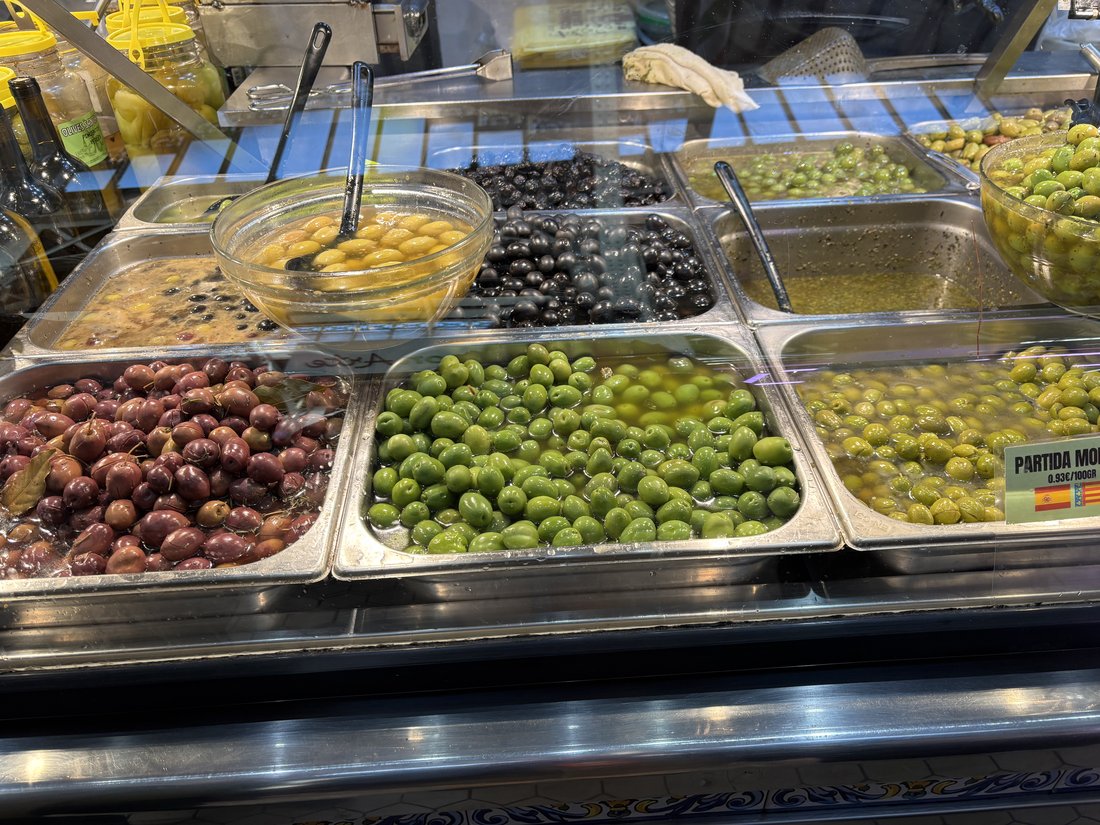
This page is the methods. Two companion pages carry the rest: How They Became Edible — where the methods came from, which one was first, and why the answer is not the one I assumed — and Which Olive, and What For, on cultivars and matching the fruit to the cure.
Raw olives are not food
Bite a raw olive off a tree and you will not do it twice. The bitterness is oleuropein, a phenolic compound that is present in serious quantity in every olive on earth, and it is not a matter of taste or ripeness. An olive must be debittered. This is not a preference, it is a requirement, and it is the reason olive curing is a craft rather than a recipe.
⭐ One qualification, added later, because there is exactly one exception and it is a good one. The Throumba olive of Thassos debitters on the tree — a fungus, Phoma oleae, hydrolyses the oleuropein in place while the fruit hangs there, and it is the one olive you can genuinely eat straight off the branch. So the rule survives — it still has to be debittered — but it does not have to be debittered by you. Details on the varieties page.
Every method below is, at bottom, a different way of getting the oleuropein out.
The four methods
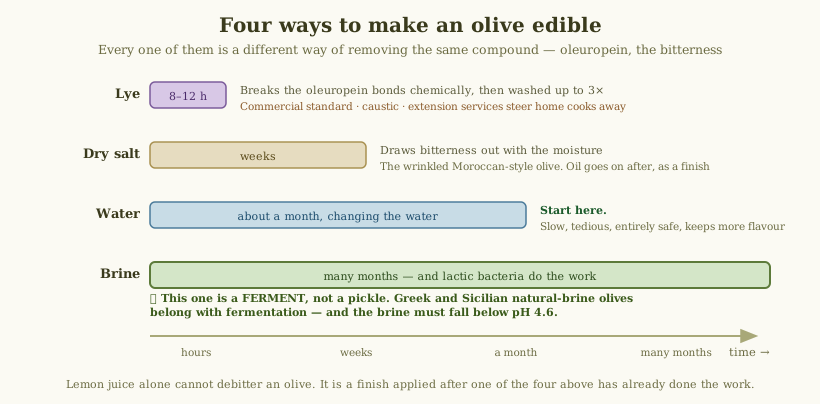
| Method | How long | What it does | Where it belongs |
|---|---|---|---|
| Lye | 8–12 hours, then washed | Chemically breaks the oleuropein bonds | This section |
| Water | About a month, changing water | Leaches it out slowly | This section |
| Brine | Many months | Leaches it and ferments | Fermentation |
| Dry salt | Weeks | Draws it out with the moisture | Borderline — mostly here |
Lye
The commercial method and the fastest by an enormous margin. A sodium hydroxide solution breaks the chemical bonds holding oleuropein together, which then leaves the fruit into the liquid. 8 to 12 hours, then the olives are washed thoroughly — up to three times — until no trace of lye remains, and then brined for keeping.
This is how the smooth, mild, uniform “California black ripe” olive in a can is made. It works, it is fast, and it produces a consistent product.
🔴 And it is worth knowing exactly what that product is, because I had it wrong. A canned black ripe olive is not a ripe olive. It is picked green, lye-soaked, and then air is bubbled through the water between soaks — oxygen polymerises the fruit’s own phenolics and turns it dark — after which ferrous gluconate is added to hold a colour that is not stable on its own. “Black ripe” is a trade term, not a description. The full account is on the history page.
⚠ Several extension services steer home cooks away from it, and I think they are right. Lye is genuinely caustic — it will burn skin and eyes and it must not touch aluminium — and the margin for error on the washing step is the difference between an olive and a chemical burn. It is not that it cannot be done at home. It is that the payoff is speed, and speed is the thing a home cook needs least.
Water curing
About a month, changing the water daily or every couple of days. Slow, tedious, entirely safe, and it keeps more of the olive’s own flavour than lye does because you are not chemically stripping it. This is the method I would tell anybody to start with.
Brine curing — which is a ferment
Olives in a salt brine for many months, during which lactic-acid bacteria go to work and the oleuropein leaches out slowly. The Greek and Sicilian natural-brine olives are genuine lacto-ferments — the same craft as everything in the other section, applied to a fruit.
Which is why they taste the way they do. A brine-cured Kalamata has the complicated sour depth of a ferment; a lye-cured canned black olive does not, and cannot, because nothing lived in it.
Safety: as with any ferment, the brine must fall below pH 4.6 to exclude C. botulinum, and the olives must stay under the brine. This is the point at which the safety page applies with full force.
Dry salt curing
Ripe black olives packed in layers of salt, which draws out both moisture and bitterness. Weeks rather than months. The result is the wrinkled, intense, slightly leathery oil-cured olive — the Moroccan-style one. Often finished with olive oil and herbs afterwards, which is where the “oil cured” name comes from, though the oil is a finish and not the cure.
⚠ Home-cured olives have a real safety history
Worth stating plainly, because olives feel like a Mediterranean-sunshine food and not like a hazard.
Home-cured olives have a documented botulism history. The risk factors are exactly what you would predict from the rest of this section: low acid, long anaerobic storage, and sometimes a layer of oil on top excluding air — the same shape as garlic in oil.
🔴 And it is not a small history. Italy’s Istituto Superiore di Sanità, which runs the country’s botulism reference centre, lists the home-made preserves most often implicated in Italian cases — and the first item on the list is black olives in water. Not an oil preserve. Olives.
⭐ The ISS also gives the number I was missing when I first wrote this page. For brined products, it says, the most common domestic error is too little salt — and specifically: “I prodotti in salamoia, come per esempio le olive verdi, sono prodotti fermentati che richiedono un quantitativo di sale almeno pari al 10% dell’acqua utilizzata.” Brined products such as green olives are fermented products requiring salt equal to at least 10% of the water used. Below that, alongside the organisms that are supposed to be fermenting your olives, harmful ones including C. botulinum can grow.
10% of the weight of the water is a figure you can act on, which “get below pH 4.6” is not, quite. Use both.
The controls:
- Salt properly. At least 10% of the weight of the water for a curing brine, per the ISS.
- Acidify. Brine-cured olives need to come below pH 4.6, and a home curer should be checking that with a meter, not guessing. ⚠ And not with strips — a cured olive is a solid, it needs blending to a slurry to read at all, and 4.6 is precisely the region where paper is not good enough. How to measure it, what to buy, and how not to wreck the probe.
- Keep them submerged.
- Refrigerate anything you are not certain about, and anything finished in oil.
- A boiling-water bath will not make an olive shelf-stable. Olives are low-acid. That much I had right.
🔴 Correction: there is a tested canning process, and I said there wasn’t
This page used to end that last bullet with “do not can them at home without a tested process”, which is true in the narrow sense and wrong in the way that matters — it left the impression that no such process exists. It does.
It is in UC ANR Publication 8267, Olives: Safe Methods for Home Pickling (Yada and Harris, UC Davis, 2007). ⚠ I first found it second-hand, in a county extension digest of that publication, and have since read the original — which corrected several things I had written from the digest, so everything below is from the primary:
- Brine of 4 oz pickling salt (6 level tablespoons) per gallon of water, brought to a boil.
- Pack to the shoulder of pint or quart jars, cover completely, ½-inch headspace, debubble.
- Whole olives only.
- Pressure canner: 60 minutes for pints, 70 minutes for quarts, at 10 lb weighted gauge or 11 lb dial gauge at sea level — and adjust for altitude, which is not optional. On a dial gauge that runs 11 / 11 / 12 / 13 / 14 psi as you climb through 1,000 / 2,000 / 4,000 / 6,000 ft; a weighted gauge goes to 15 psi above 1,000 ft and stays there.
🔴 And UC says the thing plainly, so this page will too: “Olives canned improperly at home have caused botulism poisoning.”
⭐ But read the suitability table before you reach for the canner, because it is the real finding. Not every cured olive is a candidate:
| Cure | Brine | Refrigerate | Freeze | Dry | Pressure can |
|---|---|---|---|---|---|
| Water-cured (Kalamata / Mediterranean cracked) | ✓ | ✓ | — | — | no |
| Brine-cured (Greek black / Sicilian green) | ✓ | ✓ | — | — | no |
| Dry salt-cured | — | ✓ | ✓ | ✓ | no |
| Lye-cured (green / dark ripe) | ✓ | ✓ | ✓ | ✓ | yes |
| Lye-cured, then fermented (Spanish-style green) | ✓ | ✓ | — | — | yes |
Only the lye-cured olive is listed as safe to pressure can. So the shelf-stable jar is not a reward for patience — it is specifically available to the method this page steers you away from. Everything I would actually tell you to make is a refrigerator food, and that is not a limitation I am apologising for.
⚠ Note the last row carefully. The fermented Spanish-style olive may be canned but is not cleared for freezing or drying — and freezing has a condition the summary version of this table loses: lye-cured olives must be boiled in light brine (4 oz per gallon) for 10 to 15 minutes before they go in the freezer, or they soften. Dry salt-cured olives need no such treatment. Higher-oil varieties (Mission, Kalamata, Picholine) freeze best; Sevillano, Ascolano and Barouni soften.
⭐ And one independent corroboration worth having. The same publication, discussing why home-cured olives go soft, recommends “a storage brine that is at least 10 percent salt (13 ounces [1¼ cups] of pickling salt per gallon of water).” That is arrived at from a completely different direction — pectin-degrading enzymes from surface moulds and bacteria, which can ruin a batch within two weeks — and it lands on the same 10% figure the Italian ISS gives above. When a food-safety body and a texture problem agree on a number, use the number. This version even comes with a measuring cup attached.
⭐ Kuwait, and Mary’s lemon olives
Around 2009 I was living in Kuwait, in Yusef’s duplex, and Mary — who was from the Philippines — made olives with lemon. They were terrific and I have thought about them on and off ever since.
Now that I understand the chemistry, I can tell you something about what she must have been doing, and I want to be careful to separate what I know from what I have worked out.
What I know: she made olives, they were finished with lemon, they were very good.
What the chemistry says: lemon juice alone cannot debitter an olive. Citric acid does not break oleuropein down the way lye does, and it does not leach it out the way weeks of water or months of brine do. A raw olive covered in lemon juice stays a bitter olive.
So she must have cured them first — water or brine — and used the lemon as a finish: the flavouring stage after the debittering was already done. That is a completely standard and very Mediterranean-and-Levantine way to handle olives, lemon and often garlic and chili going in at the end.
I am setting that out as a reconstruction, not a memory. I did not watch her do the first part, and forty-year-old — well, fifteen-year-old — recollections of somebody else’s cooking are exactly the thing this section keeps catching itself getting wrong. But the chemistry only permits one answer, and it is a nice case of being able to recover a method you never saw.
If you want to try it
Get raw olives in season — roughly September to January. They are not a year-round product and this catches people out: firm greens run late September into October, and ripe blacks for dry salting come November into January. Farmers’ markets in olive-growing regions, Middle Eastern and Mediterranean grocers, several California growers who ship direct, or a neighbour with a tree. Which cultivar to ask for — and do ask, because “olives” is not an answer.
Then:
- Sort by ripeness and by size. Green and black cure at different rates, and so do large and small — a mixed lye batch gives you mush and bitterness in the same jar.
- Cut each olive if water curing — it dramatically speeds the leaching, and how you cut it is the fork in the road: two lengthwise knife cuts for ripe black fruit (the Kalamata style), or a smack with a mallet until the flesh splits for green fruit (the Mediterranean cracked style). They are two different recipes with two different finishing brines.
- Water cure, changing water daily. ⚠ Not “about a month” — I had that wrong, from a digest that had merged the two styles. UC gives 8 to 10 days for the Kalamata style (up to 20 for milder, and over-soaking gives soft, washed-out olives) and 6 to 7 days for cracked greens. Taste, do not count.
- When the bitterness is where you want it, move to the finishing brine — red wine vinegar and an olive-oil cap for the Kalamata style, white wine vinegar and the refrigerator for the cracked greens — and season with lemon, garlic, chili, oregano, bay, whatever you like.
- Keep them cold, keep them submerged, and check the pH if you brine-cured. For long storage the number to hit is 10% salt — 13 oz (1¼ cups) per gallon.
It takes a couple of weeks and almost all of it is waiting. It is the least demanding project in this section and one of the most satisfying, because you start with something you genuinely cannot eat.
The cures, written out properly: Olives, Water-Cured (Green) — start here, the cracked green · Olives, Water-Cured, Kalamata Style — ripe black, oil cap · Olives, Brine-Cured Greek Style · Olives, Sicilian Style in Brine · Olives, Dry Salt-Cured · Olives, Lye-Cured (Reference) · Olives, Marinated with Lemon and Garlic
Comments (0)