Grinding
The grinder is where a pile of meat becomes a sausage, and it is the step where the most decisions get made without anybody realizing a decision was made. Which plate? One pass or two? Everything together or lean and fat separately? Those three answers determine the texture of the finished sausage more than almost anything else you do.
The machine itself — what a “#12” actually means, why the auger and knife and plate have to be seated in a particular order, and the argument for a real grinder over a stand-mixer attachment — is on the grinder and plates and knives in the Equipment section. This page is about using it.
The plate chart
This is the chart I keep taped inside my cabinet door. It came off my own machine — I have a Weston #12 — and it is the reference I actually reach for.
| Plate | Grind | What I use it for |
|---|---|---|
| 1/8” | Fine | Bologna, franks, forcemeats, hamburger, beef jerky |
| 3/16” | Medium | Breakfast sausage, hamburger, Polish and Italian sausage |
| 1/4” and 5/16” | Coarse | Hamburger, salami, summer sausage, pepperoni, bratwurst |
| 3/8” | Coarse | First grind; chili meat and chorizo |
| 1/2” | Very coarse | First grind; chili meat, stew meat, vegetables |
| 3/4” | Very coarse | First grind, or chunking meat |
| Bean plate | — | Use this without a blade to stuff sausage into casings |
| Stuffing star | — | See the manual |
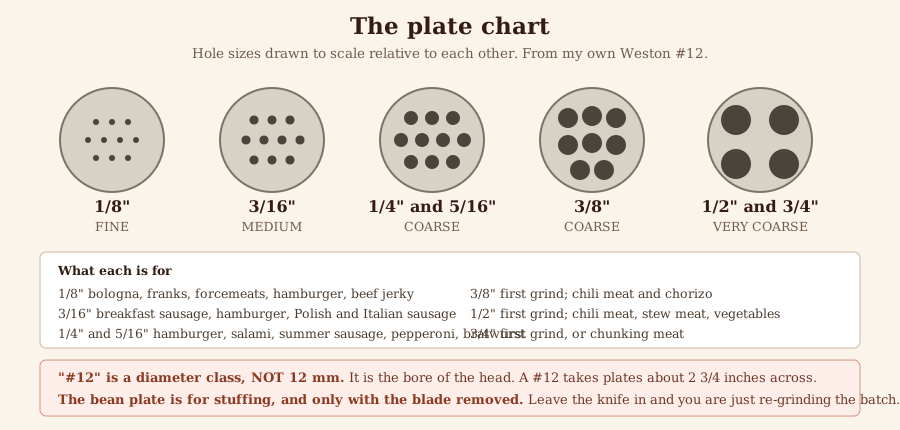
The hole sizes drawn to scale against each other, which is the comparison the numbers alone never quite give you.
Two notes on that chart, because both have caught people out.
The “#12” is a diameter class, not 12 millimeters. It is the old US grinder sizing system referring to the bore of the head. A #12 takes plates about 2¾ inches across. It has nothing to do with the hole size on the plate, which is what the chart above lists. I have watched people try to buy “12 mm plates” for a #12 grinder and get very confused.
The bean plate is for stuffing, and only with the blade removed. If you leave the knife in and run a bean plate you are just grinding the meat again through very large holes while chewing up your bind. The blade comes out. Better still, use an actual stuffer — grinder-stuffing is a compromise and it warms the meat, which is why I built a foot-pedal stuffer and rarely stuff through the grinder any more.
Single grind or double?
The default assumption in most recipes is a single pass, and for a lot of sausage that is right. But the double grind is one of the most useful techniques in the craft and it is worth knowing when to reach for it.
Single grind. One pass at the final plate size. Best particle definition — every piece was cut once, cleanly. This is what I want for a coarse sausage where the cut face should look like a mosaic: bratwurst, Italian, most salami, Landjäger.
Double grind, coarse then fine. First pass through a large plate (3/8”, 1/2”), second through the target plate. Two advantages: the machine works far less on the second pass because it is handling uniform pieces rather than fist-sized chunks, and the mix is more homogeneous. Two costs: more handling means more warming, and the particles get slightly softened at their edges so the cut face is less crisp.
The rule I use: if the target plate is 3/16” or finer, double grind. If it is 1/4” or coarser, single grind. A fine plate fed with big chunks is where jams, heat, and smearing come from. A coarse plate can handle a big cube directly.
Double grind, same plate twice. A specific trick for a firmer bind without going finer: run the same plate twice. You get more surface area for salt to work on without shrinking the visible particle much. Useful for a summer sausage that you want to slice cleanly.
Grinding lean and fat separately
The technique I would most encourage anyone to try, because it fixes the most common textural complaint.
The problem: lean and fat behave completely differently in a grinder. Lean muscle is fibrous and cuts cleanly at almost any temperature. Fat is soft and plastic and wants to smear. If you feed them mixed, the plate size is a compromise that suits neither.
The fix: grind them separately, at different plate sizes, and combine at the mix. Two common patterns:
- Fat coarser than lean. Lean at 3/16”, fat at 1/4” or 3/8”. Gives you distinct white flecks against a finer red background — the classic look of a good salami or summer sausage. The larger fat particles survive the mixing better and stay visible.
- Fat finer than lean. Less common, used where you want the fat distributed rather than visible — some breakfast sausages, some emulsion-adjacent products.
There is also a purely practical benefit: you can take the fat straight from the freezer harder than the lean, because you only need it to survive one short pass.
The Swiss Gendarme Landjäger takes this furthest — the traditional Swiss method runs the beef through in several successive passes down to a 3–4 mm grain while the fat gets one coarse pass and gets folded in last.
Actually running the machine
Everything frozen first. Head, auger, knife, plate. See the cold chain; I won’t repeat the argument, but this is the step where it pays off most visibly.
Seat the knife the right way around. The flat, sharpened face of the knife must sit against the plate. Backwards, it doesn’t cut — it mashes. This is the single most common beginner error and it produces exactly the gray paste people blame on their meat. If the knife is in correctly and the ring is snug, meat comes out in clean discrete strands.
Snug the ring, don’t crank it. Too loose and the knife floats away from the plate and stops cutting. Too tight and you are grinding metal on metal, generating heat and wearing both parts. Snug, plus a small nudge.
Feed steadily; don’t force. The auger should be doing the work. If you are leaning on the stomper, something is wrong upstream — pieces too large, plate blocked, or knife dull.
Catch into a chilled bowl, ideally sitting in a larger bowl of ice, and put it in the freezer between passes on a double grind.
When it stops extruding properly
The classic failure: the machine is running, you are pushing meat in, and what comes out is a slow gray extrusion rather than clean strands.
Ninety percent of the time it is connective tissue wrapped around the knife and blocking the plate — silverskin you didn’t trim. Stop. Take the head apart, clear the plug off the knife and out of the plate holes, and go back and trim better.
The other causes, in rough order of likelihood:
- Knife in backwards. Check first, it costs ten seconds.
- Dull knife or worn plate. They wear as a matched pair and should be replaced as one; a new knife on an old plate still won’t cut.
- Meat too warm. Warm fat is smearing rather than cutting, and the smear is blocking the holes.
- Ring too loose.
Never fix a jam by pushing harder. Pressure means heat, and heat means smear, and now you have two problems.
Reading the output
You can diagnose the whole grind by looking at what comes out.
Good: discrete strands falling cleanly off the plate. Visible distinction between red lean and white fat. The plate face stays relatively clean. The meat feels crisp, not tacky.
Smearing: the output looks pasty and slightly glossy; white fat has stopped being white specks and become a haze through the whole mass; the plate face has a film on it. Stop and chill everything. This is recoverable if you catch it in the first pound and not if you catch it in the last.
Mashing: gray, extruded, no strand structure. Knife backwards, or blunt, or blocked.
Grinding wild game
A few things change with venison and other game.
Trim harder. Deer carries silverskin heavily and all of it has to come off — see trimming.
Add the pork fat as a separate grind. Game brings no usable fat; deer fat is waxy and goes rancid. So the fat in the block is pork, and there is no reason to grind it with the venison.
Watch for hair and debris. Field-dressed game is not butcher-shop clean. Anything that came in on the hide will end up in the sausage.
And the safety note that does not apply to pork: trichinae in wild game are freeze-resistant in a way that domestic pork’s are not, so the familiar “freeze it and you’re fine” rule does not transfer. For anything raw and never-cooked this matters a great deal — the full argument is on the venison Landjäger card and on meat.
Cleaning, and why it matters to the next batch
Grinder parts get washed and dried immediately and completely. Carbon-steel knives and plates will rust overnight in a dish rack, and a rusted plate face never cuts the same again. I dry mine and give them a wipe of food-grade mineral oil before they go away.
The auger and head go back in the freezer clean, so the next batch starts cold without a wait.
Part of Making Sausage. Next: mixing and the bind — the step that decides whether all this becomes a sausage or a crumble.
Comments (0)