Scaling and Recordkeeping
The best sausage I ever made, I could not make again.
That’s the honest version of why this page exists. Somewhere in the late nineties I made a batch of smoked kielbasa that came out exactly right — the tang, the smoke, the snap — and I have never fully reproduced it, because I wrote nothing down. I know roughly what went in. I don’t know the ratios, I don’t know the smoke schedule, and I don’t know what I did differently. It is gone.
Recordkeeping is not bookkeeping. It is the difference between a craft that improves and one that just repeats.
Percentage formulas: the one idea that makes everything scale
Recipes written as “1 tsp salt per pound” fall apart the moment you change the batch size, the cut, or the units. Recipes written as percentages never do.
Every ingredient is expressed as a percentage of the meat block. The meat block — lean plus fat — is 100%. Everything else is calculated from it.
A bratwurst formula in percentage form:
| Ingredient | % of meat block |
|---|---|
| Pork shoulder | 80 (of the block) |
| Back fat | 20 (of the block) |
| Meat block total | 100% |
| Salt | 1.8% |
| White pepper | 0.25% |
| Marjoram | 0.15% |
| Nutmeg | 0.08% |
| Ginger | 0.05% |
| Ice water | 10% |
Now the same formula works at 2 lb or 50 lb, in pounds or kilograms, and if you buy a fattier shoulder you adjust the lean/fat split without touching a single seasoning number.
The arithmetic: multiply the meat block weight by the percentage. A 5 kg block at 1.8% salt: 5000 × 0.018 = 90 g. That’s it.
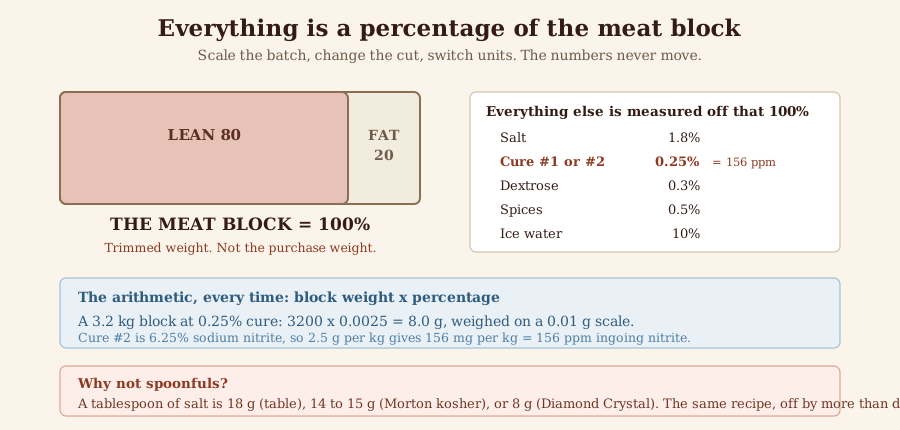
The meat block is 100%. Everything else is measured off it, which is why the formula survives a change of batch size, cut or units.
Two things this fixes immediately
Cure is always right. Cure #1 or #2 at 0.25% of the meat block gives 156 ppm ingoing nitrite every single time, at any batch size, with no per-pound conversion to get wrong. This is a safety number and percentage form is how you stop it being a guess. A 3.2 kg block: 3200 × 0.0025 = 8.0 g of cure, weighed on a 0.01 g scale.
Salt-by-volume stops lying to you. A tablespoon of table salt is around 18 g; Morton kosher is around 14–15; Diamond Crystal is around 8. A recipe calling for “2 tablespoons kosher salt” can be off by more than a factor of two depending on which box is in your cupboard. Percentage by weight has no such ambiguity, and it is why every formula in my collection is written that way now. The full argument is on salt.
What “of the meat block” actually means
The trimmed weight. Not the purchase weight, not the bone-in weight, not what the recipe assumed. Weigh the lean and the fat after trimming and cubing, add them, and that is your 100%.
This is where most percentage errors come from. A batch that came out over-salted almost always had its percentages calculated against a weight the block never reached.
Where liquid and binder sit
By convention, water/ice and binders are also expressed as a percentage of the meat block, even though they add to the total weight. So a formula might total 112% or 115%. That’s normal and correct.
It does mean you have to be careful reading published formulas: some European sheets quote additives per kilogram of total materials rather than of the meat block, and for a cure that difference is not cosmetic — it’s the difference between 125 and 177 ppm. When a source is ambiguous, compute on the meat block and show your arithmetic, which is what every recipe in my collection now does.
The batch sheet
One page per batch. I keep them in a ring binder at the bench, and it is the most valuable object in my sausage kit.
What goes on it:
The header
- Date, sausage name, batch number
- Total meat block weight
- Who it’s for / why (a party, a test, restocking the freezer)
The formula
- Every ingredient as a percentage and a weight. Both. The percentage lets you scale it; the weight is what you actually put in, and if they disagree you want to know.
- Lean and fat weights separately, and the resulting fat percentage.
- Brand and lot of anything that matters — the cure, the culture, the casings, which P.S. Seasoning blend if you used one.
The process log — the part people skip and the part that carries the information
- Temperature at the grinder, at the mix, at the stuffer. Three numbers.
- How long you mixed, and what the bind felt like.
- Green weight — the weight of the finished raw sausage, and specifically the weight of one tagged link or pair that you’ll weigh again later.
- The smoke schedule: chamber temperature, times, wood, dampers.
- pH readings with times, for anything fermented.
- Weights during the dry, with dates, and the resulting weight loss %.
- Internal temperature at finish.
The verdict — written after eating it, not the same day you made it
- What it tasted like. Be specific: “needed more salt” is useful, “good” is not.
- What you’d change by how much. “Marjoram up to 0.2%. Smoke was too heavy — two passes, not three.”
- Whether you’d make it again.
That last section is the whole point. A formula without a verdict is a record of what you did, not of what you learned.
Tagging, and the green weight
For anything that dries, one specific habit matters more than all the rest: tag a link and weigh it.
Tie a piece of string or a numbered tag onto one link or one Landjäger pair at stuffing time. Weigh it. Write that number on the sheet. That is the green weight.
Then weigh that same tagged piece as it dries. Weight loss percentage is:
(green weight − current weight) ÷ green weight × 100
A pair that went in at 240 g and now reads 156 g: (240 − 156) ÷ 240 = 35% loss. Done.
That number is the only honest home proxy for water activity, and it is the finish condition for every dry-cured sausage — 30–40% for a traditional raw stick, around 15% for a cooked semi-dry. “Dry until firm” is not a specification and it is how people end up eating an under-dried raw sausage.
Weighing a different link each time tells you nothing, because links vary. Weigh the same one.
Scaling up, and what doesn’t scale linearly
Percentages scale perfectly. Several other things do not, and this catches people out on their first big batch.
Mixing time doesn’t scale. A 20 lb block in the same mixer takes longer than 5 lb to reach the same bind, and it warms more while it does. Consider splitting into two mixes.
Chilling time definitely doesn’t scale. A 20 lb bin of cubes takes far longer to reach 30°F than 5 lb spread on a sheet pan, because the surface-to-volume ratio collapsed. Spread it out. This is the commonest scaling failure I see.
Drying time doesn’t scale with batch size — it scales with diameter. A 22 mm sheep-cased stick dries in three weeks; a 60 mm salami takes months. Doubling the number of sausages changes nothing about the time. Changing the casing changes everything.
Smoker capacity is about airflow, not shelf space. A crowded smoker gives you pale patches where links touch and uneven color where air can’t circulate. Fewer sausages properly spaced beats a full house.
Your attention doesn’t scale. A 40 lb batch is a long day and the cold chain gets sloppy in hour five. I would rather do two 20 lb batches on two days.
Scaling a published recipe safely
Most published recipes aren’t in percentage form. Converting them is straightforward and worth doing before you make anything:
- Add up the meat and fat weights. That’s your 100%.
- Divide every other ingredient by that number and multiply by 100. Now you have percentages.
- Sanity-check them against the known ranges — and this is the step that matters.
Known ranges to check against:
| Ingredient | Sane range | If it’s outside |
|---|---|---|
| Salt | 1.5–2.0% fresh; 2.5–3.0% dry-cured | Suspect a units error |
| Cure #1 or #2 | 0.25%, essentially always | Recompute. Do not average two sources |
| Dextrose | 0.2–1.0% | Higher = tangier ferment |
| Fat | 20–35% | Outside that, expect trouble |
| Water/ice | 5–15% fresh; 0 for dry-cured | — |
Published cure numbers are wrong often enough that you must recompute. I say this from experience, not caution. Working through the formulas for this collection I found a source specifying Cure #1 for a dried, raw-eaten sausage — nitrite depletes over a multi-week dry, so it must be #2. Another gave 312 ppm, double its own site’s stated norm. A third, an otherwise excellent venison recipe, dosed 165 ppm against a 156 ppm ceiling. And a widely-copied Marianski formula is genuinely ambiguous about whether its g/kg figure is per total materials or per meat block — read one way it’s 125 ppm, the other 177.
Compute on the meat block, and show the arithmetic. Every recipe I’ve written since carries the calculation on the card so the next person can check it rather than trust it.
What I actually keep
Honestly: a ring binder, a pencil, and a cheap kitchen scale next to a good 0.01 g scale.
I have tried spreadsheets. The spreadsheet is better for the arithmetic and worse at the bench, because at the bench my hands are covered in cold ground pork and I am not touching a keyboard. Paper in a plastic sleeve, pencil, and I type it up afterward if I feel like it.
The important thing is not the medium. It is that the verdict gets written down after eating, days later, when the batch is a memory and the temptation is to move on. That’s the entry that makes the next batch better, and it’s the one I’ve most often skipped.
Thirty years on, my binder is the most useful thing I own for this craft. It is also the reason I can tell you what my grandfather’s kielbasa needed and cannot tell you what that one perfect batch in the nineties actually was.
Part of Making Sausage, and one piece of the whole craft at Sausage. This is the last chapter of the section — what happens after the sausage is made, in the smoker and the chamber, is the curing, smoking and cooking section still to come.
Comments (0)