The Guilds: How a Law Turned a Stuffed Gut Into a Nürnberger
Here is the thing I wish somebody had told me thirty years ago, back when I was still trying to understand why the sausage world is carved up the way it is — why a Nürnberger is one specific finger-sized thing and a Thüringer is another and a Toulouse is a third, each with borders you could draw on a map and a rule book you could photocopy. I used to think that was about ingredients, or climate, or some deep folk genius passed down in one valley and not the next. It isn’t, mostly. It’s about law.
Regional sausage identity is a legal artifact. Somebody in a town, centuries ago, wrote down who was allowed to grind pork, what could go in the casing, and where the meat could be sold — and then that rule sat there, frozen, for four or five hundred years while the town on the other side of the river froze a different rule. Do that everywhere, and you don’t get chaos. You get style. You get a Nürnberger that is a Nürnberger because in Nuremberg the sworn butchers had to chop pork loin fine and get it inspected, and a Toulouse that is a Toulouse because the men who could legally sell you cooked pork in Paris couldn’t legally sell you the raw beef next to it.
That’s the whole page. Regulation didn’t restrict style. It manufactured it. The guild is the missing link between “a farmer stuffs a gut in his kitchen” and “a Nürnberger Rostbratwurst is a legally defined object with a size, a spice, and a jurisdiction.” And if that sounds like a stretch, hang on, because the same idea is running today at continental scale — the EU protected-name system is the direct descendant of these medieval town statutes, doing in Brussels exactly what the sworn masters did in Nuremberg in 1313.
Let me show you how it happened, in two towns that did it two completely different ways.
First, what a guild actually was, in the kitchen
Strip the pageantry off it — the banners, the feast days, the saints — and a medieval guild was a licensing board with teeth. It was the answer to a problem that anybody who has ever bought a sausage from a stranger understands in their gut: you cannot see what’s in it. A ground, seasoned, cased sausage is the single most adulterable food a dishonest butcher ever invented. Bad meat disappears into it. Spoiled meat disappears into it. Bread, water, the trimmings off something you’d never sell whole — all of it disappears into the grind and behind the casing, and the customer finds out three days later, if the customer is lucky.
So towns did the obvious thing. They said: not everyone gets to do this. You get to do this if you’ve served your apprenticeship, sworn your oath, and submitted to inspection — and if you break the rules, you lose the right. The guild controlled who could make the product, what the product had to be, and where it could be sold. Those three levers — who, what, where — are the three levers that, held in a fixed position for centuries, machine a regional sausage into existence.
I want to be careful here, because the romantic version — noble craftsmen guarding sacred tradition — is half true and half self-congratulation the guilds wrote about themselves later. They were also cartels. They kept competitors out and fixed who could earn a living. A lot of what looks like quality control was a closed shop protecting its members’ incomes. Both things are true at once, and you don’t have to pick. The point for us is that whatever the motive, the effect was the same: the rules got written down, and once written down they stopped moving, and a sausage that stops moving for four hundred years turns into a landmark.
Now the two towns.
Paris: the charcutiers, and the craft the law backed into a corner
The French story is the cleaner one to see, because in Paris the law didn’t just regulate the sausage — it carved out an entire profession by subtraction, and that profession then had to invent its whole art in the space the subtraction left.
The word tells you where it starts. Charcutier comes from chair cuite — “cooked flesh.” That is the origin of “charcuterie,” the whole glorious world of it, and it is worth sitting with, because the name is not describing a technique or a flavor. It’s describing a legal permission. The charcutier was, by definition, the man who dealt in cooked pork. Not the man who raised the pig, not the man who slaughtered it, not the man who sold you a raw chop. The cooked-flesh man.
In Paris, by royal charter, the charcutiers were incorporated as their own guild — and here I have to stop and be honest with you about a date, because the sources genuinely disagree. You will see 1475 and you will see 1476, and they are both cited by people who ought to know. The most likely reconciliation is that the charter and its royal confirmation straddle those two years — the guild’s founding paperwork and the crown’s edge-to-edge sign-off didn’t necessarily land on the same New Year’s Day. I’m not going to pick one and pretend it’s settled, because it isn’t. Call it the 1475–1476 charter and know that the wobble is real.
What the charter said is the part that matters, and it is remarkable. The charcutiers got the exclusive right to prepare and sell cooked pork — sausages, roasts, the whole cooked repertoire — and raw pork fat. But they were forbidden from selling raw meat. Raw meat was somebody else’s monopoly. Raw meat belonged to the bouchers — the butchers.
Read that again, because it’s the hinge of the entire French charcuterie tradition. The charcutier was legally a cook, not a slaughterer. The most valuable, most obvious thing in a meat shop — a fresh cut you take home and cook yourself — he was not allowed to sell you. The butcher across the way sold that. What the charcutier could sell you was pork that had already been transformed: cured, cooked, ground, seasoned, stuffed, potted, jellied. Raw fat, yes — because fat is the medium of the craft and somebody had to be allowed to trade it. But not the raw muscle.
Now watch what a constraint like that does to a person who has to make a living inside it.
If I tell you that you may not sell raw meat — but you may sell anything you do to it — I have not shut down your business. I have pointed it, like a firehose, straight at technique. Every euro the charcutier was ever going to earn had to come from transformation. So the transformation is where the whole craft went. Curing became an art because curing was legal and selling a raw loin was not. Cooking sausages, building terrines, rendering and seasoning fat, jellied head cheeses, pâtés, galantines, the whole encyclopedia of French pork cookery — it grew, luxuriant and deep, precisely in the space the law fenced off for it. The butcher had the raw meat and stayed, forever, a butcher. The charcutier had only the doing, and so the charcutier became one of the great cooks of the Western tradition.
This is the deepest lesson of the guild system and I’ll say it plainly: the constraint bred the craft. Not despite the restriction — because of it. Bar a man from the easy money and you drive him into the hard, skilled, valuable money. French charcuterie is what you get when a law tells a whole profession, for centuries, “you may not sell it raw; you may only sell what your hands and your fire and your salt have made of it.”
There was a dependency built into the setup, and it’s worth naming because it shows how tightly these guilds interlocked. The charcutiers, barred from the raw-meat trade, initially had to buy their fresh pork from the butchers — the very monopoly they were fenced out of. So the cook was, by law, a customer of the slaughterer. That’s a leash. It kept the charcutiers dependent and it kept the bouchers’ revenue up. That leash is said to have been lifted in 1513, when the charcutiers won the right to buy their own pigs directly — though I’ll flag that date as resting on a single source, so treat it as likely-but-thin rather than carved in stone. And there was a public-health rule stitched through all of it, the kind that tells you these people had been burned before: fifteenth-century French law forbade mixing raw and cooked products on the same premises. Cross-contamination legislated against five hundred years ago, by men who had no germ theory but had plenty of buried customers.
If you want to taste what came out of that fenced-off garden of technique, the French pork tradition is all over the collection — go pull up a Toulouse sausage, which is the coarse, garlicky, pure-pork link that the charcutier’s craft points straight at, or work through the wider French pork world at /recipes/?q=charcuterie. Every one of those is downstream of a 1475 charter that told a man he could cook pork but not sell it raw.
Nuremberg: the sworn butchers, the fine chop, and the sausage as a defined object
Now cross the Rhine and go back a hundred and sixty years earlier, because the Germans got there first, and they got there in a way that produced not a whole profession but one hyper-specific, legally pinned-down product — the one that is still, today, the most tightly regulated small sausage on earth.
The document is a Nuremberg city statute of 1313. That’s not a typo and it’s not a legend — 1313, in the middle of what most people think of as the deep medieval murk, a German free city already had a written ordinance governing how its bratwurst was to be made. And the ordinance is not vague. It reads, across the centuries, like a modern spec sheet:
- Only sworn, specialist pork butchers could make the city’s sausages. Not any butcher — sworn ones, oath-bound, licensed for this specific work.
- The meat had to be finely chopped pork loin. Not trimmings, not scraps, not whatever was left at the end of the day. Loin — a premium cut — chopped fine.
- The finished sausages were inspected by sworn masters, who checked the recipe, the composition, and even the water content, because watering a sausage to cheat the weight is a trick as old as sausage itself.
There was, from early on, a “bratwurst kitchen” near the church of St. Sebald — a fixed place, a named institution, sausage-making as a civic fixture with an address. The tradition is documented from that 1313 statute forward, which is why the modern Nürnberger can, without embarrassment, call itself a seven-hundred-year-old product.
Now, I have to put up a caution flag here, because this is exactly the kind of story that grows barnacles. You will read, in a lot of retellings, wonderfully vivid details — that sub-standard sausages were seized and thrown into the Pegnitz river that runs through the city, that the inspectors had colorful nicknames, and so on. I love those details. I also can’t stand behind them. They trace to single, promotional sources — essentially the trade association that today protects the Nürnberger name telling its own founding legend — and they have the smooth, too-good feel of a story polished by people with an interest in polishing it. The 1313 statute and its substance — sworn butchers, fine-chopped pork loin, inspection — that’s solid. The river-tossing and the cute nicknames I’d file under “possibly true, definitely embroidered, and I’m not going to assert them as fact.”
Here is why the Nuremberg case is the purest illustration of my whole thesis. Look at what the law froze in place: who (sworn pork specialists), what (fine-chopped pork loin, water content controlled, inspected), and by strong implication where (the city, the St. Sebald kitchen). Freeze those three parameters and hold them for seven centuries and you have not written a regulation — you have written a recipe and made it mandatory. The Nürnberger Rostbratwurst is small and finger-sized and finely textured and made of good pork because a fourteenth-century statute said it had to be, and the statute never really let go. When you eat one today, you are eating a legal document.
And notice the contrast with Paris that makes the point ring. In France the law defined a profession by what it couldn’t sell, and the craft flooded into the gap. In Germany the law defined a product by what it had to contain, and the sausage crystallized around the spec. Two towns, two completely different regulatory strategies — and each one manufactured a distinct sausage identity that we now mistake for pure culinary tradition. It isn’t pure culinary tradition. It’s culinary tradition wearing a statute underneath.
Thuringia’s claim, and why the fine print matters
Down the road, more or less, Thuringia has its own bratwurst and its own founding paper, and the two — Nürnberger and Thüringer — are a perfect pair for seeing how a legal line drawn between two places becomes two different sausages that people will genuinely argue about.
The Thuringian claim is a separate 1432 purity document said to require only fresh pork in the Thüringer Rostbratwurst — no filler, no off-meat, fresh pork or nothing. I want to flag this one too, gently: the precise text of that 1432 document is claimed by regional historians, and I have not seen it reproduced independently, so I’ll give it to you as their claim rather than as something I can put my hand on. Take the date as approximate and the spirit as sound: another German region, in the fifteenth century, pinning its sausage to a written purity rule.
But look at what even the claimed difference does. Nuremberg’s fourteenth-century rule specified fine-chopped pork loin, inspected, water controlled. Thuringia’s fifteenth-century rule specified fresh pork, purity. Those are not the same specification. Hold each one in place for centuries and you get two bratwursts that are recognizably cousins and unmistakably not the same thing — different coarseness, different seasoning traditions, different size and snap — and a rivalry between two towns’ rule books that outlived the towns’ original reasons for writing them. The Thüringer is longer and more coarsely marjoram-forward; the Nürnberger is small and fine and marjoram in its own register. Ask a German which is correct and you have started a fight. That fight is, at bottom, a dispute between a 1313 statute and a 1432 statute that nobody alive has read and everybody alive can taste.
If you want to make the German bratwursts and understand where they sit in the German scheme of things — the whole Roh-/Brüh-/Kochwurst classification that organizes German sausage far better than the English language ever managed — that lives on the Germany page, and it’s worth the trip. A Nürnberger and a Thüringer are both Bratwurst, both in the fresh-to-grill family, and the classification page will show you exactly where they land. Or just go grill some: /recipes/?q=bratwurst.
A timeline, because the sequence is the argument
I find this history clicks into place when you see the dates in a row, because the sequence is the argument — food-purity law shows up early, spreads, and never stops.
| Year | Place | What the law did |
|---|---|---|
| 1313 | Nuremberg | City statute: only sworn pork butchers may make bratwurst; finely chopped pork loin; inspected for recipe, composition, water content |
| ~1432 | Thuringia | Claimed purity document requiring only fresh pork in the Rostbratwurst (text single-source; treat as regional claim) |
| 1475–1476 | Paris | Royal charter incorporates the charcutiers — the right to sell cooked pork and raw pork fat, but not raw meat (sources split on the exact year) |
| 1513 | Paris | Charcutiers said to win the right to buy pigs directly, ending the dependency on butchers for fresh meat (single-source — WEAK) |
| 1516 | Bavaria | The Reinheitsgebot — the beer purity law — the famous sibling to all of this: the same medieval instinct that a staple food or drink must be legally defined |
| 20th–21st c. | European Union | PDO / PGI protected-designation system — the medieval town statute, generalized to a continent |
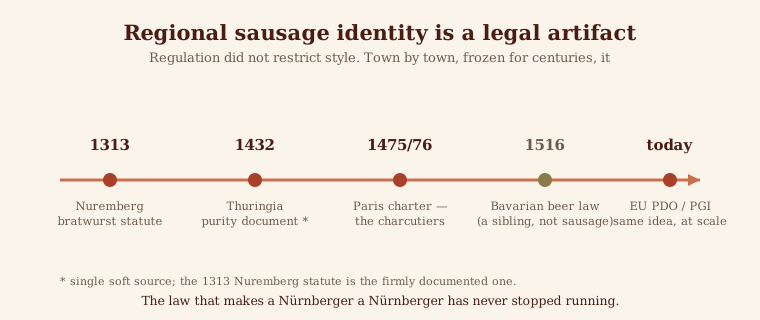
I put the 1516 Reinheitsgebot on that timeline on purpose, even though it’s about beer, because it’s the famous member of this family and it helps people see the pattern. Everybody has heard of the Bavarian beer purity law — barley, hops, water, and nothing else. Almost nobody realizes it has older, humbler siblings in the sausage world that were doing the identical thing two centuries earlier. The bratwurst statute of 1313 is Reinheitsgebot energy applied to pork, generations before the beer law made the idea famous. The impulse is the same one every time: a food this important to a town’s identity and a town’s honor cannot be left to the honesty of whoever’s making it this week. Write down what it has to be. Make the rule the product.
The straight line to your grocery cold case
And that impulse never died. It just changed jurisdiction.
The modern EU protected-designation system — PDO (Protected Designation of Origin) and PGI (Protected Geographical Indication) — is the direct lineal descendant of these medieval town statutes. Same idea, exactly, scaled from a city wall to a continent. When the Nürnberger Rostbratwurst carries a protected geographical indication that says it must be made in the Nuremberg area, must be finger-length, must weigh within a defined range, must be marjoram-seasoned pork of a specified fineness — that is not some modern bureaucratic novelty. That is the 1313 statute, still running, translated out of medieval German civic law and into Brussels regulation, but doing the identical job: fixing who, what, and where, so the sausage stays the sausage.
Think about what that means for the thing in your hand. When you buy a “Nürnberger” and it’s the real protected article, an unbroken chain of law connects it back to sworn butchers chopping pork loin under inspection seven hundred years ago. When you buy something labeled “Nürnberger-style” made in Ohio, you’re buying a sausage that is free — legally free — to be whatever the maker wants, because it’s outside the jurisdiction the rule froze. Neither is dishonest. But only one of them is the legally defined object, and the difference between them is precisely the difference this whole page is about: a sausage identity is a rule with a border, and the rule and the border are the identity.
This is why, when people ask me why European sausages are so relentlessly regional — why the map of Europe is a map of a thousand named local sausages while America is mostly a handful of styles smeared coast to coast — the answer isn’t romance and it isn’t terroir, or not mostly. It’s that Europe spent five or six hundred years under thousands of overlapping town statutes, each one freezing a slightly different recipe in a slightly different place, and America mostly didn’t. The regionalism is legislated. Take away the guilds and the charters and the protected designations and you take away the mechanism that made a Nürnberger different from a Thüringer different from a Toulouse. They’d have blurred together the way American “breakfast sausage” is just… breakfast sausage, the same from Maine to Oregon, because no statute ever stood over it and said this and not that.
What I take to my own bench from all this
I make sausage in Michigan with a Weston grinder and a smokehouse and no guild anywhere in sight, and you might think this medieval legal history is just color. It isn’t, not for me. Two things from the guilds sit at my bench every time I grind.
The first is the charcutier’s lesson about constraint — that being told what you can’t do is what drives you into the skill that’s worth having. I feel that every time I decide not to reach for the fillers and the shortcuts and the phosphates that would make a batch easier and cheaper and a little bit fake. The charcutiers, barred from the easy raw-meat money, became great cooks. When I hold myself to a hard version of a thing — the coarse pure-pork grind, the real cure, the honest fat — I’m making, on purpose and for no legal reason at all, the choice the law once forced on a Paris pork cook, and getting the same reward for it: the product is better because I fenced off the easy way.
The second is the Nuremberg lesson about definition — that a sausage becomes a thing the moment somebody writes down what it has to be. I keep notes, for exactly the reason the sworn masters kept the 1313 statute: so that “my” version of a sausage is a real, repeatable, defined object and not just whatever I felt like on grind day. My grandfather’s kielbasa took me forty years to pin down partly because nobody ever wrote it down, and I’ve been reverse-engineering a statute that existed only in the smell of a Sunday kitchen. The guilds understood, seven hundred years before me, that a sausage you can’t write down is a sausage you’ll lose. Write it down. Fix the who, the what, the where. That’s how a stuffed gut becomes a thing with a name.
That’s the guild’s gift, and it’s the whole reason this history is worth knowing instead of just eating past. The farmer who stuffs a gut has made a sausage. The town that writes down what that sausage has to be has made a Nürnberger — a legally defined object that will outlive the town, outlive the statute, and outlive, by centuries, the last person who could tell you why the rule was written in the first place. Regulation didn’t restrict the style. It was the style, all along.
Part of the old-world history of sausage. Next: Germany — where these bratwurst statutes grew into the best sausage classification scheme in the world, the Roh-/Brüh-/Kochwurst three-way split that the English language never managed. See also Rome, where the word for “sausage” first spread across a continent, and how it all fits together on the family tree.
Comments (0)