Germany: The Country That Wrote the Sausage Down
Here is the thing people get wrong about German sausage, and I say this as someone who makes it — bratwurst, Weisswurst, Bockwurst, and a good half-dozen others, out of a shelf of cookbooks I’ve been building for forty years. The German tradition is not deep because Germans are somehow more inventive with a pig than the Poles or the French or the Turks. It isn’t. Everybody who kept animals made sausage, and everybody made a lot of it. What Germany did that the others mostly didn’t is codify it — write it down, sort it, name it, and eventually build a food code around it that reads like a legal standard. The German gift to sausage isn’t the sausage. It’s the filing system.
And once you understand the filing system, you understand German sausage better than most Germans I’ve talked to at a bratwurst stand, because the system is genuinely good. It is more precise than the muddled English scheme I grew up with, and learning it changed how I think at my own grinder. So this page is really about one idea — the Rohwurst / Brühwurst / Kochwurst classification — plus a correction to a myth you have almost certainly heard, and then a walk through the regional stars. Let me start with the classification, because everything else hangs off it.
Three families, sorted by the one thing that matters
The English-language way of talking about sausage is a mess, and I include the way I talked about it for my first decade. We say “fresh,” “cooked,” “smoked,” “dried,” “cured” — and those categories overlap so badly they barely mean anything. A smoked sausage can be fresh or cured. A “cooked” sausage might be cooked one of three completely different ways. Fresh and dried are opposite ends of the same axis, but “smoked” is a separate axis entirely, and nobody keeps them straight. When I read an old American sausage book, half the confusion is that the author is sorting by two or three axes at once and doesn’t know it.
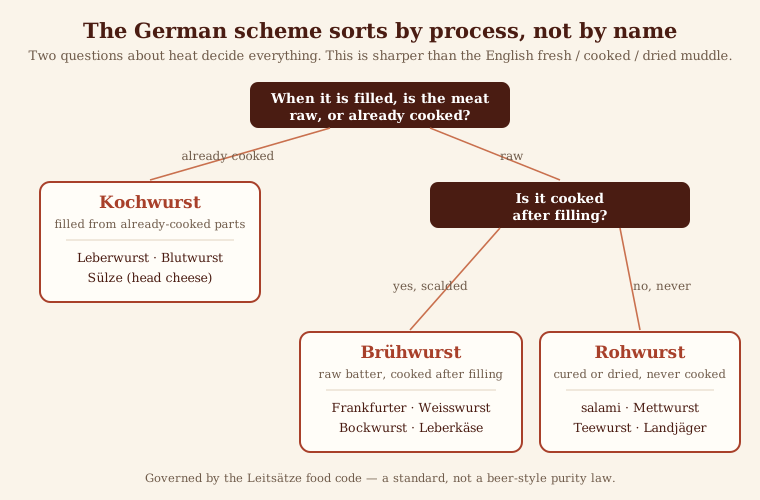
The Germans sort by one axis, and it’s the right one: what state is the meat in, and when — if ever — does heat hit it? That single question splits every sausage in the German canon into three families, and the families really are different animals — different food-safety logic, different texture, different everything.
| Family | German meaning | The meat is… | Heat step | The discriminator | Examples |
|---|---|---|---|---|---|
| Rohwurst | ”raw sausage” | raw, stays raw | Never cooked. Stabilized by cure, salt, ferment, dry, and/or smoke | Safe because water activity drops and it’s cured — not because it was heated | Salami, Mettwurst, Teewurst, Landjäger, Cervelat |
| Brühwurst | ”scalded sausage” | raw, ground fine into a brät (an emulsion) | Cooked after filling — the raw batter is stuffed, then scalded so it sets | The batter goes in raw and sets in the casing under heat | Frankfurter/Wiener, Weisswurst, Bockwurst, Bierwurst, Lyoner, Leberkäse |
| Kochwurst | ”cooked sausage” | already cooked before it’s filled | Components are boiled first, then filled (and maybe warmed to set) | Filled from pre-cooked parts — boiled liver, blood, head meat, gelatin | Leberwurst, Blutwurst, Sülze (headcheese) |
Read that middle column again, because it’s the whole lesson. The three families are separated by the order of operations between grinding, filling, and heating.
-
Rohwurst never sees a cooking temperature at all. You take raw meat and raw fat, you cure it, and then you make it safe by lowering its water activity — through salt, through fermentation that drops the pH, through drying, through smoke, or some combination. A dry salami is safe on your counter not because anything killed the bugs with heat but because you made the meat a place bacteria can’t live: too salty, too acidic, too dry. This is the hardest family to make and the one that scares beginners, and it should, because you are relying on hurdles instead of a kill step. It’s also the family I find the most satisfying, because nothing is faking it — a good Landjäger is pure preservation craft.
-
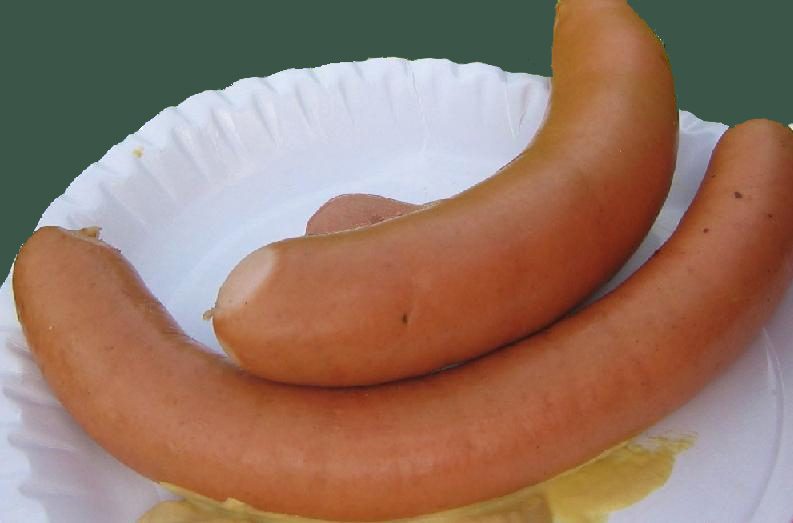
Brühwurst is what most Americans picture when they picture a “German sausage,” even though they’ve never heard the word. You grind the meat very fine — with cure, with ice to keep it cold, often to a true emulsion — into a smooth, sticky batter the Germans call brät. You stuff that raw batter into a casing, and then you scald it, usually in water at around 160–175°F, until the batter sets into that springy, snappy bite. This is hot-dog physics. A frankfurter is Brühwurst. A Weisswurst is Brühwurst. A Leberkäse — which despite the name (Leber = liver, Käse = cheese) usually contains neither liver nor cheese — is Brühwurst baked in a loaf pan instead of stuffed. The defining move is: the batter is raw when it goes in, and it cooks in the casing.
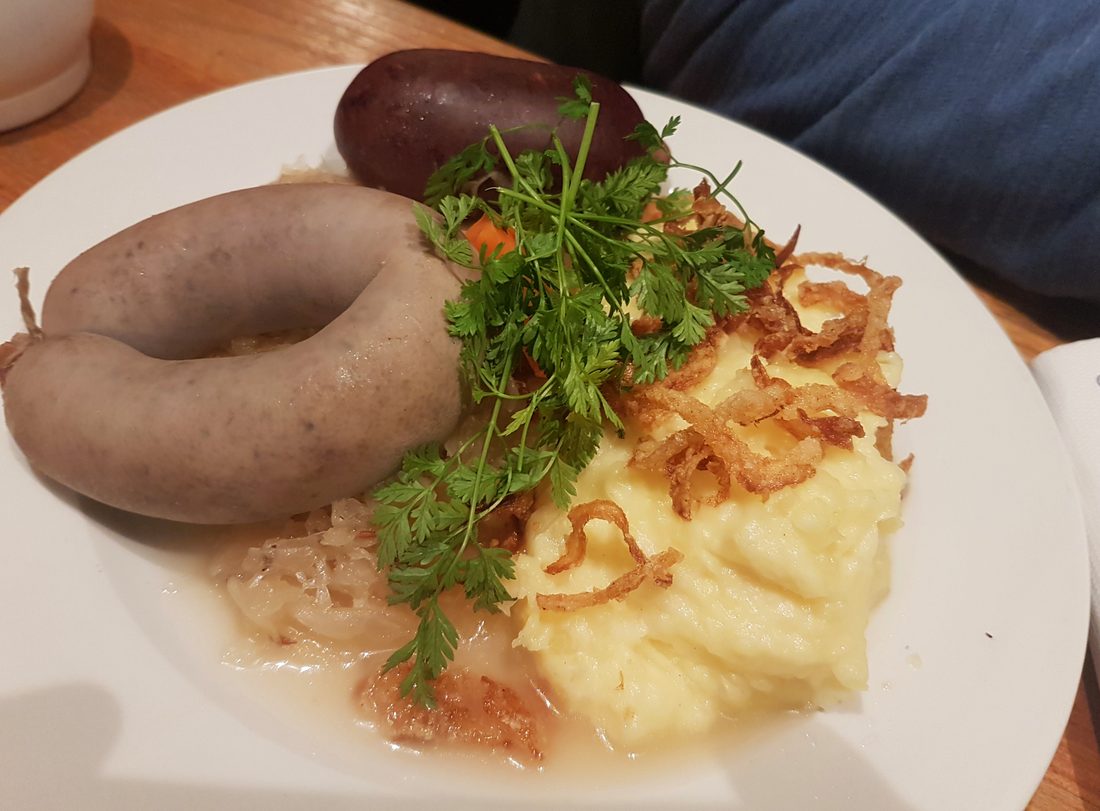
- Kochwurst is the one people mix up with Brühwurst, and the German scheme makes the difference crisp. In Kochwurst, the ingredients are cooked before they ever get near the casing. You boil the liver. You cook the blood. You simmer the head meat until the collagen turns to gelatin. Then you grind and season and fill, and often you gently warm the finished sausage just to set it. Leberwurst (liverwurst), Blutwurst (blood sausage), and Sülze (headcheese) are all Kochwurst. This is the old thrift family — it’s built around organ meat and blood and the connective-rich cuts, the parts that spoil fastest, cooked down promptly at slaughter and packed into gut so they keep a little longer. I write about this whole family’s logic on the blood and offal page, because it deserves its own room.
So the clean three-word test, the one I actually use in my head now: Rohwurst is never cooked. Brühwurst is cooked after filling. Kochwurst is filled from already-cooked parts. Once that clicks, you can pick up any German sausage you’ve never met, ask those two questions — is the meat raw or pre-cooked, and when does heat touch it? — and you’ll know how it was made, how to store it, and how dangerous it is to get wrong.
Why the German scheme beats the one I learned
I want to dwell on why this is better, because it’s not just tidier — it’s more true to the physics.
When I started, I thought of a sausage’s safety as living mostly in the spice cabinet: did I add cure or not? That’s a real question, but it’s the wrong organizing one, because it doesn’t tell you what actually makes a given sausage safe to eat. The German axis does. It tells you which hurdle is doing the work. In Rohwurst, the hurdle is water activity — the thing I harp on everywhere, because “dryness” is a feeling and water activity is the number that actually predicts spoilage, and 30–40% weight loss is just a proxy you can weigh on a scale. In Brühwurst, the hurdle is a cook step that pasteurizes the batter in place. In Kochwurst, the meat was already cooked, and what you’re managing after that is recontamination and cold storage.
Three families, three completely different safety stories, and the German words tell you which story you’re in before you’ve read a single ingredient. The English words don’t. “Cooked sausage” could mean a frankfurter (Brühwurst) or a liverwurst (Kochwurst), and those two could not be less alike in how they’re built — one is a raw emulsion set by heat, the other is boiled organ meat packed cold. Calling them both “cooked” throws away the exact distinction that matters.
There’s a practitioner payoff, too, not just a taxonomist’s one. Knowing which family I’m in tells me where the failure will come from. In Brühwurst, my enemy is the fat smear — if the brät gets warm during grinding, the fat and water break out of the emulsion and I get a greasy, grainy sausage with a broken bind. That’s why my Weisswurst brät goes together with ice and near-frozen meat and I don’t dawdle; the smear is a temperature failure before it’s anything else. In Rohwurst, my enemy is a slow pH drop that lets Staphylococcus aureus get ahead of the ferment and lay down a toxin that survives every later step — which is exactly why the acid has to fall fast. Different family, different demon. The classification isn’t academic. It’s the first thing I think about before the first grind.
The myth: there is no Reinheitsgebot for sausage
Now the correction, and it’s the reason this page earns its keep, because you have almost certainly heard the wrong version stated as fact.
The story goes: “Just like beer has its famous purity law, German sausage is governed by a strict purity statute — that’s why it’s so consistent and so good.” You’ll see it in travel writing, on menus, in the mouth of many an enthusiastic tour guide. It is wrong as stated, and it’s worth taking apart carefully, because the real answer is more interesting than the myth.
First, the thing it’s borrowing from. The Reinheitsgebot is real — it’s the 1516 Bavarian beer law that restricted beer to water, barley, and hops (yeast wasn’t understood yet). It’s a genuine, dated, famous statute, and it applies to beer. There is no sausage equivalent. There is no single “Wurstreinheitsgebot,” no 1516-style criminal purity law that says a German sausage may contain only these permitted things and nothing else on pain of penalty. People hear “Germany + purity law + food” and glue the beer story onto sausage. Don’t.
What actually governs German sausage is a different kind of instrument entirely — and understanding the difference is the payoff. It’s the Deutsches Lebensmittelbuch, the German Food Code, and specifically its Leitsätze für Fleisch und Fleischerzeugnisse — the “guiding principles for meat and meat products.” This is a food code, not a criminal statute. It’s drafted by an expert commission, and for each named product it lays out what that product has to be to legitimately carry that name: how much meat, which cuts, what’s permitted, what method. If you sell something as “Leberwurst,” the Leitsätze describe what the buying public is entitled to expect a Leberwurst to be.
The crucial distinction — and this is the correction to foreground — is that the Leitsätze are guidance that functions as a quasi-legal reference standard, not a purity law in the criminal sense the beer story implies. It’s the standard courts and food inspectors reach for when deciding whether a product was mislabeled or adulterated. It has real teeth in that it defines the honest use of a name. But it is not “thou shalt put only X in a sausage or go to jail.” It’s closer to a very detailed, semi-official reference dictionary of what each sausage is, maintained by people who know sausage, and leaned on as the benchmark for truth-in-labeling.
That’s a subtler and, to me, a more impressive thing than a blunt purity ban. It’s the codification instinct I opened with, made concrete. Germany’s sausage integrity doesn’t come from one dramatic 16th-century “purity law.” It comes from a modern food code that patiently defines hundreds of products by name — plus, scattered underneath it, some genuinely old town ordinances that predate the beer law entirely.
The most-cited of those old ordinances is a claimed 1432 regulation in Weimar, in Thüringen, setting standards for Thüringer Rostbratwurst. If true, that would predate the 1516 beer law by most of a century — a sausage rule older than the famous beer rule, which is a lovely fact. But I can only find it in one lifestyle source, and I haven’t been able to run it down to a municipal archive. So I’ll tell you it’s claimed, and that medieval Thüringer bratwurst statutes are entirely plausible, and I’ll flag the specific 1432 date as unverified rather than launder it into a fact.
The numbers, handled honestly
You’ll also hear that Germany has “over 1,500 kinds of sausage.” I’m going to give you that number and then tell you exactly what it is, because the honest version and the myth version use the same digits.
The 1,500 figure is real as an attributed estimate. It’s the standing line of the Deutscher Fleischer-Verband, the German Butchers’ Association — “over 1,500 types.” It gets repeated everywhere. But there is no public, auditable list of the 1,500; no methodology you can check; no way to see what counts as a distinct type versus a regional spelling of the same thing. It’s an industry association’s estimate, and it should be tagged as one.
Set against it is a firmer, smaller number. The Leitsätze — the food code we just talked about — codify on the order of 400 to 435 named, historically established meat products. So the honest framing is: roughly 400 sausages and meat products are formally codified in the official guidelines, and “over 1,500” is an industry estimate that sweeps in all the uncodified local and regional variants on top of that. Say both numbers. Don’t let the impressive 1,500 quietly become the codified one. (And I’ll be straight that even the ~400 figure I’ve seen only once secondhand — treat it as the right order of magnitude, not a hard count.)
There are also rough per-family counts that travel together — something like 800-plus Brühwurst types, 350-plus Kochwurst, and only around 60 Rohwurst. I’d treat those as soft; they circulate without a clear primary source, and the Rohwurst figure in particular looks low to me given how many dry and semi-dry sausages exist. Useful as a shape — Brühwurst is the biggest family, Rohwurst the smallest — not as a census.
The regional stars
With the framework in hand, the famous named sausages stop being a random list and become a map. Here are the ones worth knowing, sorted by what they teach.
Thüringer Rostbratwurst — the Thuringian grilling sausage, from the middle of the country. It carries EU PGI (Protected Geographical Indication) status, which ties the name to the region. It’s the sausage the possibly-1432 ordinance is about, and whatever the true date, the point stands: this is one of the oldest named, regulated sausages in Germany, a fresh coarse-ground pork bratwurst built to go over coals. When I make a bratwurst to grill, this is the tradition I’m working in — a fresh Brühwurst-adjacent link that’s actually eaten fresh-cooked rather than scalded-and-stored.
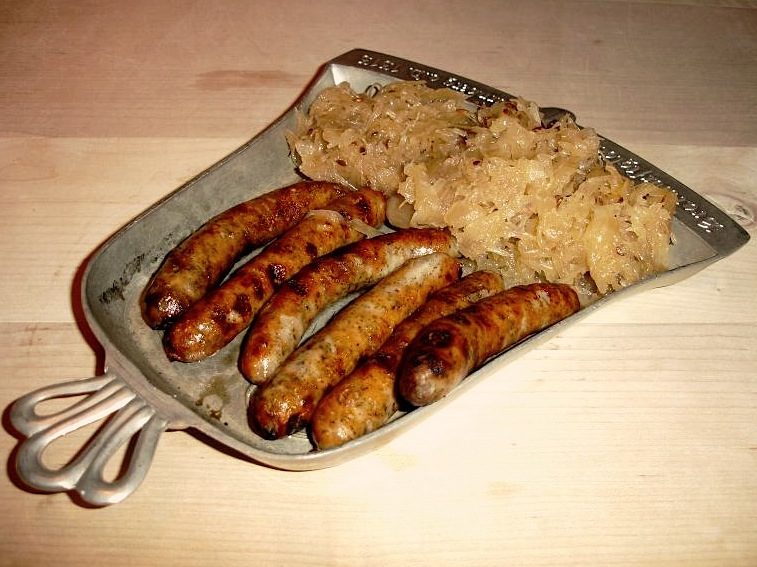
Nürnberger Rostbratwurst — also PGI, and unmistakable: finger-sized, tiny, barely three inches, traditionally served six or a dozen to a plate, often in a bun as Drei im Weckla (“three in a roll”). The Nürnberger’s whole personality is marjoram. That’s the flavor that defines it — not garlic, not caraway, marjoram, forward and unmistakable. If you’ve had a Nürnberger and thought “what is that herb,” it’s marjoram, and once you know it you can’t un-taste it. I just published a Nürnberger recipe built around exactly that, and the discipline of the thing is restraint: it’s a small, simple sausage that lives or dies on one herb being right.
Weisswurst — Munich’s white sausage, and the one with the most corrections attached, so let me slow down. It’s a Brühwurst: a fine, pale veal-and-pork brät with parsley and a whisper of lemon and mace, stuffed and gently poached, never browned — you slip it out of its skin and eat the tender inside. It’s traditionally eaten before noon, and there’s a genuine reason underneath the ritual that I’ll get to.
But first, two myths to clear. The popular story is that Weisswurst was invented in 1857 at a Munich inn when a cook ran out of the right casings and improvised — a classic “invented by accident on a specific date” tale. Per the deeper research behind this hub, that’s not right: Weisswurst is not a clean 1857 invention. It’s better understood as a variant of the older Altmünchner Bockwurst, and the white veal-sausage type is documented earlier than 1857 and was first written down not in Munich at all but in Zurich. So the tidy origin date is another of those just-so stories the sausage world loves. The sausage is real and old; the birthday is folklore.
The second, the “eat it before noon” rule, is more interesting, because the myth is a misreading of a real thing. Weisswurst is a fresh, uncured, un-smoked sausage with nothing preserving it — no cure, no acid, no drying, none of the hurdles. In the days before refrigeration, a Weisswurst made at dawn genuinely had to be eaten by midday or it wasn’t safe. The famous saying is that the Weisswurst “must not hear the noon bell.” That started as an honest pre-refrigeration food-safety rule — a real deadline enforced by real spoilage. What’s charming is that it has outlived its own reason. We have refrigerators now; the sausage keeps fine. But the noon rule survives as performance — as tradition, as the proper Bavarian way, long after the danger it guarded against went into the icebox. It’s a safety rule that turned into a manner. I love that, because it’s exactly the kind of thing that happens all through this history: the practical becomes the ceremonial once the practical problem is solved.
Frankfurter — from Frankfurt, and the ancestor (or at least the co-ancestor with the Vienna Wiener) of the American hot dog. Pure Brühwurst, a smooth cured pork brät in a thin casing, scalded, often lightly smoked. The name has been fought over — the Frankfurters guard “Frankfurter Würstchen” jealously, and there’s a long-running who-owns-the-name story with Vienna over Frankfurter-versus-Wiener that’s essentially the same argument as the Debreziner name-migration across the old Habsburg lands. The physics, though, is the plainest example of the whole Brühwurst family: raw fine batter in, gentle scald, springy snap out.
Braunschweiger — here’s a name that confuses Americans constantly, so it’s worth the paragraph. In the United States, “Braunschweiger” almost always means a smooth, spreadable liver sausage — a Kochwurst, a Leberwurst by another name. In Germany the picture is muddier; depending on the style, a Braunschweiger can be a smoked liver Kochwurst or edge into cured-meat Rohwurst territory. When I say Braunschweiger to an American deli, I mean the smooth liver spread, and that’s a fine working definition for this side of the ocean. The lesson is the recurring one of this whole section: one name, more than one thing, depending on where you’re standing — the same trap that makes kielbasa a category rather than a product.
Landjäger — and I’ll admit my bias, because Landjäger is a sausage I love. It’s a flat, pressed, hard, dark snacking sausage of beef and pork, cured and fermented and dried, from the Alpine and Swabian country. The German food code files it precisely: a schnittfeste Rohwurst, a firm sliceable raw sausage, “storable uncut without refrigeration,” made from sinew-rich beef and fat-rich pork in pork small intestine and pressed flat. Not semi-dry — that describes the American cooked adaptation, and the two get confused constantly. ⚠ And the name does not reliably mean “country hunter” or “gamekeeper,” which is what I used to write here and what almost every English source says: that’s folk etymology. There are three competing readings and none is settled — the Swiss culinary-heritage inventory points at the rural gendarmerie called Landjäger, the Schweizerisches Idiotikon derives it from lang tige, “long-cured,” and the hunter story is the one that simply sounds best. Whatever it’s named for, it’s the German cousin of every keeping-sausage a person ever put in a coat pocket for a day outdoors — kin to the Polish myśliwska and the whole family of small dried sticks that were designed to travel and survive. Because it’s Rohwurst, everything I said about that family applies: it’s safe because it’s cured and its water activity has dropped, not because anything cooked it. Getting the ferment and the dry right is the entire craft, and when it’s right there’s almost nothing better to eat off a board with cheese and a beer. I make it, I’m always fiddling with it, and it’s the German sausage I’d take to a desert island — a Landjäger is preservation and pleasure in the same hard little stick. The full argument, and five raw formulas, are in the Landjäger dive.
What Germany actually contributed
So let me close where I started, because the walk through the stars proves the thesis. Germany didn’t invent the sausage — nobody did; it shows up independently everywhere people keep animals, as I argue on the origins page. Germany didn’t even necessarily make more kinds than its neighbors, though it makes a staggering number. What Germany did was think about sausage systematically — sort it by the one axis that actually governs how it behaves, name the products, and eventually write a food code that defines them with a precision no other country’s popular sausage culture quite matches.
That instinct to codify is the same one that built the medieval guilds that standardized the craft in the first place, and it’s why, when I want to understand a sausage rather than just eat one, I reach for the German categories even when I’m making something Polish or French or Italian. Is the meat raw or cooked? When does heat touch it? Which hurdle keeps it safe? Those three questions, which the German scheme forces you to ask, are the questions I ask before every batch I make, whatever flag it’s flying. The Germans didn’t give the world the sausage. They gave it the grammar of the sausage, and forty years in, I still find myself thinking in their language at my own bench.
This is part of the old-world history of sausage. Next: Austria-Hungary, where a New World pepper delivered by the Ottomans became “Hungarian” paprika, and where the Habsburg Empire worked as a distribution network that let a Hungarian sausage pick up a German name in Vienna. See also Poland and the East and, for how these families fit together, the family tree.
Comments (0)