Britain: The Sausage That Is Really About the Bread
Here is the thing nobody tells you about the British banger, and it’s the thing that reorganizes the whole page once you see it. Every other sausage tradition I’ve written up in this history is defined by a meat, a spice, or a preservation method. Poland’s category is a garlic-and-smoke ring. Spain’s is pimentón. Germany’s whole classification scheme is built on how the meat is treated. But the British sausage — the fresh breakfast link that the whole world calls a “banger” — is defined by its binder. It’s the only major sausage I know of whose signature ingredient isn’t meat at all. It’s bread. Specifically, it’s rusk, and understanding rusk is understanding why a British sausage bites the way it does and why it has spent a century getting slandered as filler.
I’ve made a lot of fresh sausage over forty years, and most of my emulsions and coarse grinds bind on their own — the meat protein, the salt, the fat, cold temperatures, a good mix. You don’t strictly need a cereal binder to make a sausage hold together. So the first time I made a proper British-style banger to the traditional formula, my instinct as an American maker was that the rusk was there to stretch the meat, to pad it out cheap. That instinct is half right and completely misleading, and sorting out which half is true is the best story on this page.
What rusk actually is, and what it does
Rusk is not breadcrumbs. That’s the first correction, and it matters. Rusk is a hard, twice-baked, yeast-raised wheat product — bread baked, dried out completely to drive off the moisture, then ground to a crumb. Twice-baked is the whole point; the word itself, across a dozen European languages, keeps circling back to “baked twice” (think of biscotti, think of the ship’s biscuit). You bake it, you dry it hard, you grind it. What you get is a pale, thirsty granule that has almost no water in it and desperately wants some.
That thirst is the entire mechanism. When you mix ground rusk into sausage meat, it does three things at once, and they’re worth separating out because they get muddled constantly:
- It absorbs and holds free water and rendered fat. A fresh sausage has a lot of water in it — some natural to the meat, some added at mixing. Without something to hold that water, it weeps out in the pan and the sausage goes dry and tight. Rusk soaks it up like a sponge and holds it inside the link through cooking. This is why a good banger stays juicy while a lean all-meat link can cook out hard.
- It spaces the meat fibers apart. This is the one that took me a while to feel in my hands rather than read about. When the ground meat is packed with hydrated rusk granules distributed through it, the muscle fibers can’t knit into a dense, tight, chewy mass. The rusk holds them slightly open. The result is that soft, tender, yielding bite — the banger doesn’t fight you the way a snappy all-meat sausage does. That softness is not a defect. It is the designed texture of the thing.
- It legally pads the meat content. Here’s the half that feeds the slander. British sausage law has for a long time set a minimum meat percentage, and rusk (plus the water it holds) is what fills the rest. So yes — rusk is also the legal and economic mechanism that lets a sausage be, say, 42% meat and still be sold as a sausage. Cheap sausages lean on it hard. That’s real.
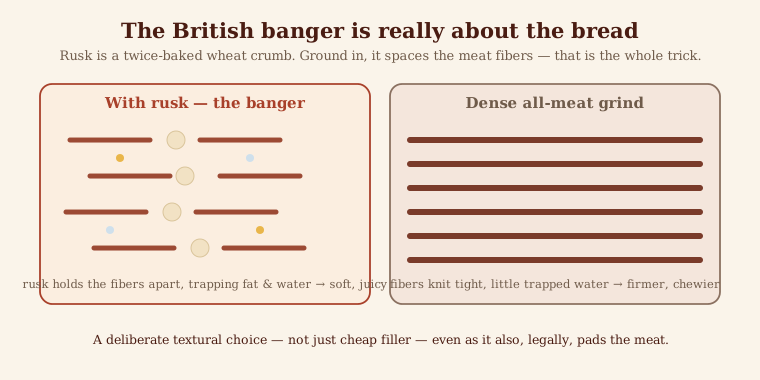
Now hold those three together, because the honest reading of rusk lives in the tension between them. A food snob will tell you rusk is cheap filler that dilutes the meat, and he’s pointing at reason #3. A butcher will tell you rusk is what makes the sausage taste and feel right, and he’s pointing at reasons #1 and #2. They’re both correct, and they’re describing the same ingredient. Rusk is a deliberate textural and structural choice that also happens to be economical. It is not merely padding that happens to be tolerable. Strip the rusk out of a traditional British banger entirely and you don’t get a “better, meatier” sausage — you get a different, tighter, drier sausage that isn’t a banger anymore. The Germans would recognize it; the British wouldn’t.
Why rusk, and why the 1920s
The detail that convinced me rusk is a real culinary decision and not just an accountant’s trick is when it showed up. British sausages weren’t always bound with rusk. For a long time the binder was stale breadcrumbs — day-old baker’s bread, dried and crumbed, doing more or less the same water-holding job. Rusk entered sausage-making in the 1920s, in southwest Britain, and it entered as a replacement for stale breadcrumbs because the bread itself had changed.
Think about what modern industrial baking did to bread in the early twentieth century. Bread got softer, more uniform, and it staled differently — the reliable, coarse, dry stale loaf that a butcher used to crumb became harder to source consistently. So makers went to a purpose-built product: bread baked specifically to be dried hard and ground, standardized, shelf-stable, always the same. Rusk isn’t a corner-cutting substitute for breadcrumbs; it’s the engineered version of breadcrumbs, invented because the casual supply of the thing it replaced dried up. Today the trade splits it into two families — a yeastless rusk that’s the bulk of the market, and a bread rusk closer to the original — but the job is identical: a standardized, thirsty cereal crumb.
I find this genuinely clarifying as a maker. The rusk in a banger is the same kind of decision as the fennel in a Tuscan finocchiona being a cheap wild substitute for imported pepper — an economic constraint that hardened into a defining flavor and texture, so that now you couldn’t remove it without destroying the identity of the thing. Cheapness and authenticity aren’t opposites in sausage. Half the great regional sausages on earth are what a poor household did with what it had, done for long enough that it became the definition.
The banger, and the myth that has it exactly backward
Which brings us to the word. Everybody “knows” why an English sausage is called a banger: wartime sausages were so padded out with water and cereal that they burst and banged in the hot pan, and the name stuck. It’s a great story. It is also folk etymology grafted onto a real word, and it gets the premise inverted. I built a whole section of the Irish breakfast dive around this correction, and I want to deepen it here rather than repeat it, because Britain is where the word actually lived first.
Here’s what the record actually shows. The earliest firm attestation of “banger” for a sausage isn’t from the trenches at all — it’s from The Tatler, London, 27 July 1904, a decade before the First World War. It’s a midshipman’s letter home from the China station, and he writes: “We had bangers again and yet again; I feasted royally.” Read that again. The word is naval slang, it’s Edwardian, pre-war, and it is used as unambiguous praise. This kid isn’t complaining about exploding ration sausages. He’s delighted — he feasted royally. The naval writer who published as “Bartimeus” (an RN officer, Lewis Ricci) called bangers “a delicacy peculiar to Gunrooms of the Fleet.” A delicacy. The word traveled with the sense desirable, not defective.
Even the standard reference dictionaries don’t back the shell story. Etymonline dates the sausage sense only to “by 1919” — which is already later than the 1904 Tatler find — and it floats “perhaps from a sense of ‘a bludgeon’,” i.e. from the sausage’s shape, as its best guess. When even the dictionary won’t endorse the exploding-shell etymology and offers a plainer alternative, you’re looking at a legend, not a history.
And notice the structural problem with the myth, because this is the part I love. The folk story requires the sausages to be bad. Its whole premise is that these were degraded, watered-down, cereal-padded rationing-era sausages so pathetic they detonated. But the earliest real evidence has the word attached to sausages that a young officer feasted royally on and a naval writer called a delicacy. The myth needs the banger to be a defective sausage. The evidence says it started as a good one. The premise is inverted, not just the date.
So where does the “bang” come from? Almost certainly the plainest thing: sausages spit and pop in a hot pan. Any sausage does, especially a fresh, juicy, moisture-rich one — which, thanks to rusk holding all that water, the British sausage very much is. The bang is onomatopoeia for a sausage cooking, full stop. It doesn’t need a war or an artillery shell. It’s the sound your breakfast makes. There is a real 1918 POW letter, from the Holzminden camp, describing tinned sausages as “bangers” that were “especially explosive” — but that’s from October 1918, it postdates the 1904 Tatler citation by fourteen years, and it’s a soldier making a joke about bad tinned rations, not the origin of the word. The joke works because the word already existed.
One honest caveat, and I’d rather give it to you than pretend: I can’t tell you the banger word has no earlier attestation, because the free sources run cold before that 1904 letter and the paywalled OED is the thing that would settle it. So I won’t claim “the word was born in 1904.” I’ll claim what the evidence actually supports — that the WWI-exploding-shell origin is folklore, that the earliest firm attestation is 1904 naval slang meaning a good sausage, and that the myth’s own premise is upside down. That’s plenty. The corrections are the product on these pages, and this is a clean one.
The great regionals
Under the rusk umbrella, Britain fans out into a proper regional map of fresh sausages — each one a distinct object with a signature you can name in a word or two. Here are the three that matter most, and then the blood tradition that stands deliberately apart from all of them.
| Sausage | Region | Form | Meat | Signature |
|---|---|---|---|---|
| Cumberland | Cumbria (NW England) | Long unlinked coil, sold by length | Coarse-chopped pork | Heavy spicing — pepper, thyme, sage, nutmeg, cayenne; PGI since 2011 |
| Lincolnshire | Lincolnshire (E England) | Standard links, coarse and chunky | Pork, rusk-bound | Sage as the dominant, defining herb |
| Lorne / square | Scotland (central belt) | Skinless loaf, sliced into squares | Pork and/or beef | Griddled flat; the breakfast-roll staple |
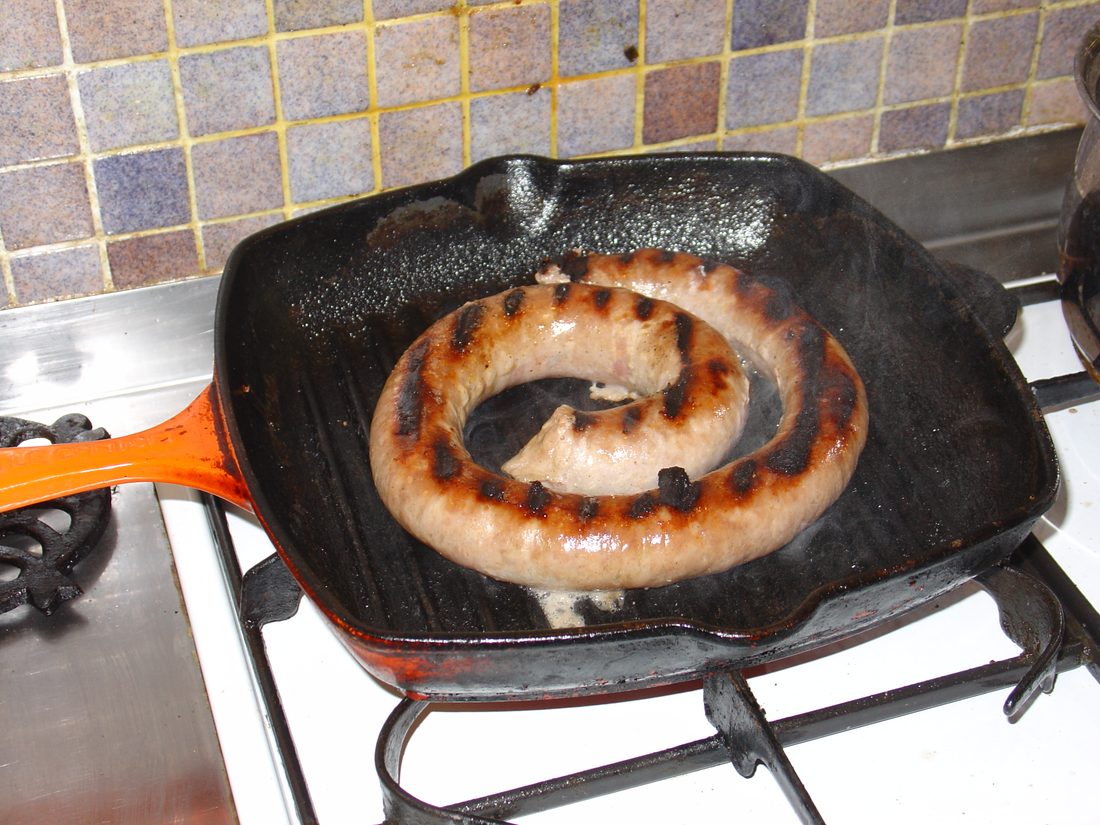
Cumberland is my favorite of the three to talk about because its identity is partly a shape and partly an accident of trade history. The shape first: a true Cumberland isn’t linked into a string. It’s a single long coil of sausage, wound into a spiral, sold and cooked by length rather than by the link. Coarse-chopped pork — properly chopped, not fine-ground, so you see the meat — with a serious hit of black pepper, thyme, sage, nutmeg and often cayenne. And that heavy spicing has a real cause: Whitehaven, on the Cumbrian coast, was a major eighteenth-century port in the spice trade, and pepper, nutmeg and ginger came ashore there in quantity. A region with cheap access to spice seasons its sausages harder, and Cumberland did, and the tradition stuck long after the port declined. The Traditional Cumberland Sausage earned EU PGI protection in 2011, which ties the name to the geography and the coil form. If you want to make one or find one, the collection has Cumberland sausage.
Lincolnshire is the cleaner correction because it comes down to one herb. Where Cumberland is a whole spice chorus, Lincolnshire is defined by sage — assertive, dominant, unmistakable sage — over a coarse, chunky, rusk-bound pork base. That’s it, and that’s enough; the herb is the identity. It’s the sausage most Americans have actually tasted the profile of without knowing the name, because “pork sausage with sage” is the flavor a lot of American breakfast sausage was built to imitate.
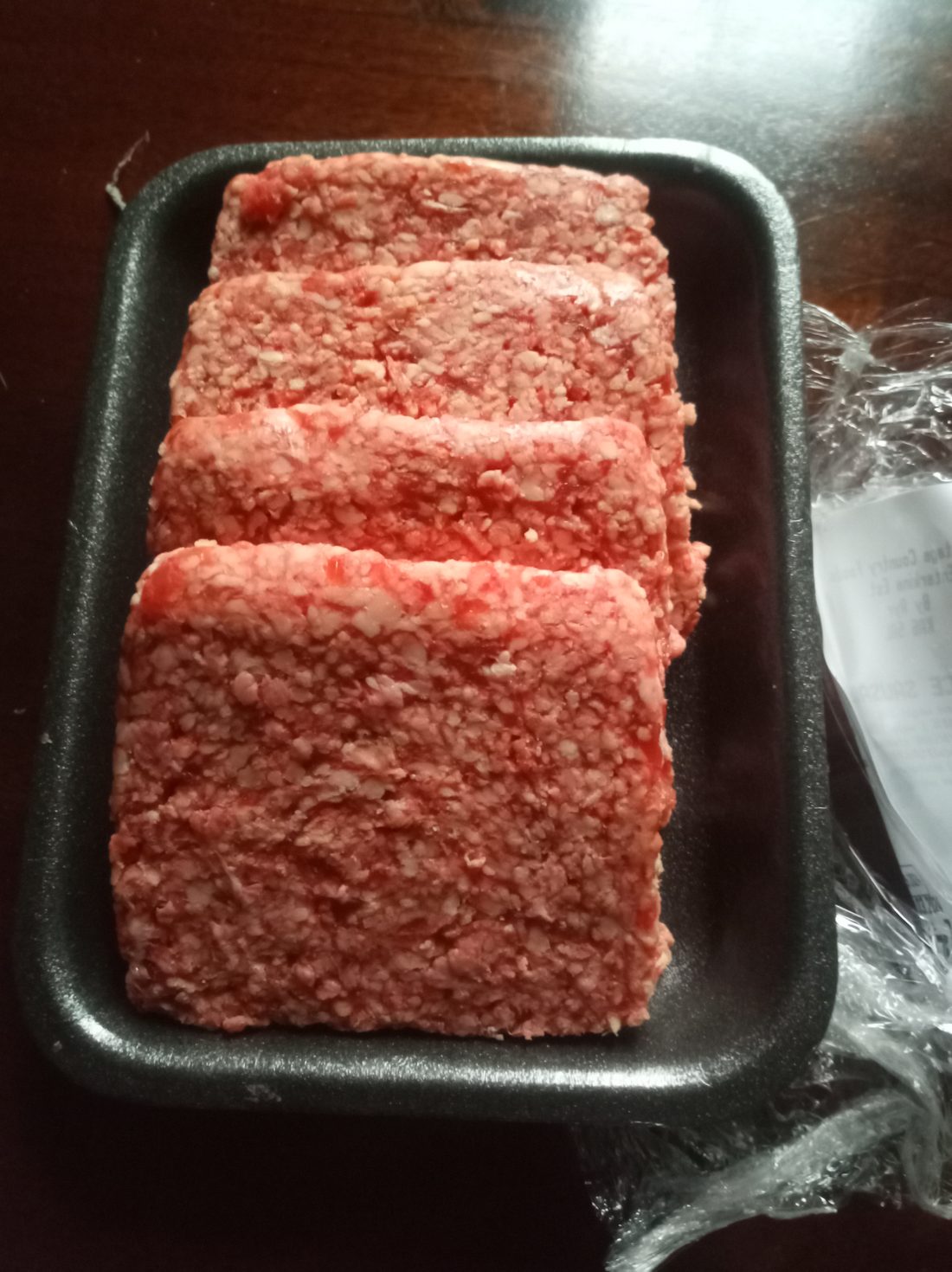
Lorne, the Scottish square sausage or “slice,” is the odd one and the one I’d most like to put in front of an American who thinks they know what a sausage is. It has no casing at all. The seasoned meat — pork, or beef, or both, with rusk and pepper — is packed into a rectangular loaf tin, chilled firm, and sliced into flat squares that get griddled. It’s a sausage in seasoning and grind, but in form it’s closer to a slice of meatloaf, and in Scotland it’s the non-negotiable heart of a morning roll. It matters here because it shows how loose the category “sausage” really is: strip the casing, square off the shape, and the British still call it a sausage without blinking. The casing was never the definition. The seasoning and the bind were.
Black pudding, and the anti-rusk
You can’t write about British sausage without the blood tradition, and here Britain hands me the perfect foil for this whole page. Black pudding is the British blood sausage — pig’s blood, fat, and a cereal (oatmeal or barley in the north where it’s most alive), seasoned and cased, sliced and fried. It’s ancient in lineage; the oldest sausage in Western literature is a black pudding, the paunch of fat and blood roasting on Odysseus’s fire. I’ve covered the wider blood-sausage tradition — how it’s a now-or-never food made in the hours after slaughter, and why the filler grain is the fingerprint of the country — on the blood and offal hub and in the Irish black pudding page, so I won’t re-run all of it. What belongs here is one specific pudding that exists as the deliberate opposite of everything the rest of this page is about.
Stornoway Black Pudding, from the Isle of Lewis in the Outer Hebrides, earned PGI protection in 2013 — and the reason it’s the perfect closing note is that its legal specification explicitly forbids rusk. Not “discourages.” Forbids. The PGI spec bans rusk, other fillers, bulking agents, and mechanically recovered meat outright. What it permits is a short, strict list: beef suet (37–50%), oatmeal (16–20%), onion, blood (12–26%), salt, and pepper. That’s the whole sausage. It’s been sold under the Stornoway name since 1931, and the PGI came in 2013 specifically because “impostor puddings” made off the islands were riding the name.
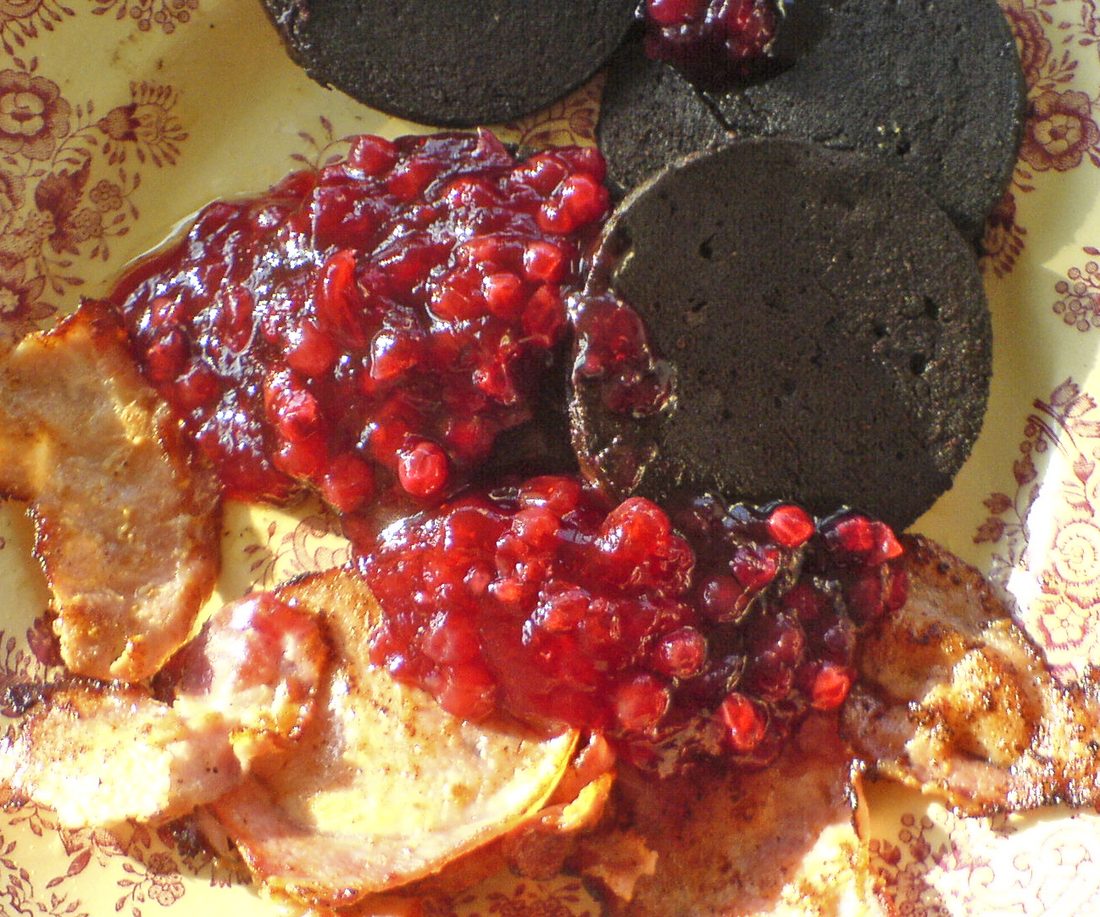
Sit with the contrast for a second, because it’s the argument of the page in one object. The British banger is defined by the presence of a cereal binder — rusk is what makes it what it is. And the most protected, most prized British blood sausage is defined by the absence of exactly that kind of filler, written into law. Rusk is the signature of one great British sausage and the explicitly banned enemy of another. Which tells you the deepest truth on this page: rusk was never simply “bad.” It’s a tool, and whether it belongs depends entirely on what you’re trying to make. In a fresh breakfast banger, rusk is the point — it delivers the soft juicy bite. In a Stornoway pudding, where the suet and oatmeal already carry the texture and the whole prestige of the thing is its purity, rusk would be exactly the adulteration the PGI was written to keep out. Same ingredient, opposite verdict, and both traditions are right about their own sausage. If you want to make one, black pudding is in the collection.
A note on the law, because it feeds the myth
One last thread, because it ties the rusk story and the banger myth together. The reason “banger” and “cheap filler” got welded together in the popular mind is that British sausage really has been governed by a minimum meat percentage, and rusk-plus-water is legally what fills the balance. The commonly cited figures are that a product sold as “pork sausage” must be at least 42% meat, and other sausages at least 32%. When the meat floor is that low, the space below it is cereal and water, and a genuinely cheap sausage maximizes that space — which is exactly the “watery banger” the exploding myth needs. So the myth isn’t conjured from nothing; it’s built on the real fact that some bangers were mostly rusk. The error is generalizing from the worst sausages to the word, and then back-dating it to a war. A good Cumberland or a proper butcher’s Lincolnshire is well over that floor and uses its rusk for texture, not just tonnage.
That’s Britain: a sausage tradition where the most important ingredient is the one that isn’t meat, where the national nickname is a compliment the folklore mistook for an insult, and where the crown-jewel blood pudding defines itself by banning the very binder that makes the everyday sausage what it is. The rusk is the whole story. Learn to read the binder and you can read the sausage.
This is part of the old-world history of sausage; the whole family and how these pieces fit together is on the family tree, and how to read any of these as a working formula is on reading a recipe. Next: Ireland, where the blood-and-offal tradition and the provisions trade take the story across the water — and where the existing Irish breakfast dive already lays out the plate.
Comments (0)