Reading a Sausage Recipe
Most of the sausage recipes you will find — in books, on forums, on the good reference sites, in the PDF a vendor packs with your spice order — are usable. A meaningful minority are wrong, and a few of those are wrong in the one place it matters. Not wrong in the sense of “I’d use more marjoram.” I mean specifying the wrong curing salt for the process, stating a dose without saying what it’s a percentage of, or reproducing a number that contradicts the same author’s other twelve recipes.
I have caught every one of those in the last few months, from sources I trust and still use. None of them came from content farms. They came from the best free reference material in English.
So this page is the one I’d hand to somebody before they made anything. It is how to pick a recipe up, turn it over, and find out in about ninety seconds whether the person who wrote it knew what they were doing. Sausage is unusually readable this way: a cake recipe hides its logic, but a sausage formula puts almost everything on the surface, in percentages, and percentages can be checked with arithmetic you can do standing at the counter.
1. Percentages, not volumes
The first thing to look at is whether the recipe is written in percentages of meat weight or in spoons. If it’s in spoons, you are not reading a formula. You are reading somebody’s notes.
“One teaspoon of salt per five pounds” is a bad instruction for three separate reasons, and they compound.
Density and crystal shape. A teaspoon is a volume; salt is sold as a mass; the bridge between them is bulk density, and bulk density varies wildly with crystal geometry. Table salt is fine cubic crystals that pack tightly. Kosher salt is larger and flakier, so a spoonful is mostly air. Diamond Crystal is flat hollow pyramids and is the airiest of the common ones; Morton kosher is a rolled flake and sits between. Approximate weights per level teaspoon:
| Salt | Approx. g per level tsp |
|---|---|
| Fine table / canning salt | ~6 g |
| Morton kosher | ~4.8 g |
| Diamond Crystal kosher | ~2.8 g |
That is better than a two-to-one spread across three rows. A recipe calling for “3 tablespoons of kosher salt” in a five-pound batch lands somewhere between about 1.5% and 2.5% of meat weight depending purely on which box you own. 1.5% is a mild fresh sausage; 2.5% is a dry-cure. Same instruction, two different products.
Packing. Even holding the salt constant, a scooped spoon and a leveled spoon differ, and so does a box that has caked in a humid Michigan summer. My grandfather’s kielbasa took me years to get close to, and part of that was that his measurements were in handfuls and mine had to become numbers before I could iterate on them at all.
How to convert a volume recipe to percentages
This is worth doing to any recipe you intend to make twice.
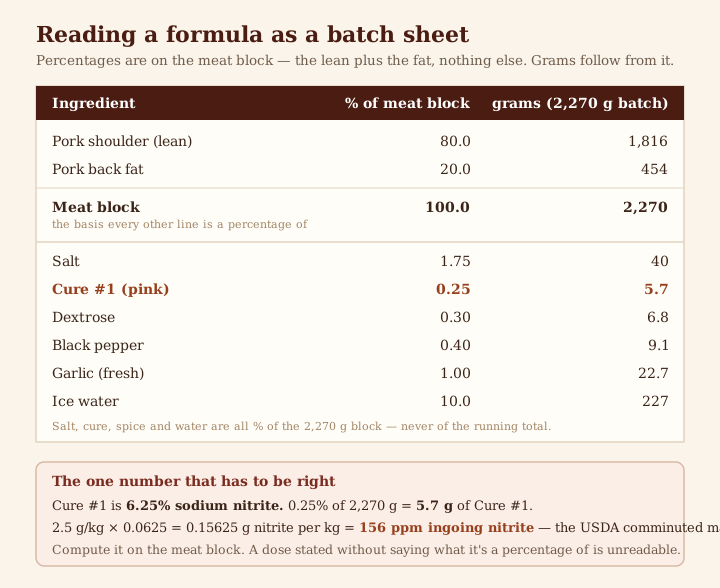
- Establish the meat block. Lean plus fat, in grams — not the water, not the spices. If the recipe is in pounds, multiply by 454. Five pounds is 2,270 g, the batch size I use throughout.
- Weigh each seasoning as the recipe states it. Measure that tablespoon of salt out of your own box onto your own scale. You are calibrating the recipe to reality, not looking a number up.
- Divide and multiply. Percentage = (grams of ingredient ÷ grams of meat block) × 100.
Worked: a recipe says 5 lb pork and 3 Tbsp Morton kosher salt. Three tablespoons is nine teaspoons; at ~4.8 g that’s ~43 g. 43 ÷ 2,270 × 100 = 1.9% — a sane fresh-sausage salt level, and now you can scale it to any batch size forever.
Going the other way is how I actually work: pick the percentage, multiply by the meat block, weigh it out. 2.0% salt on a 2,270 g batch = 45 g. No spoons at any point.
2. Salt is the first number you check
Salt is not just flavor. It extracts myosin, which is what makes the farce sticky and gives you a bind rather than a crumbly patty; it controls water activity, a real preservation mechanism; and it suppresses spoilage organisms. It is also the one number you can sanity-check without knowing anything about the sausage.
| Product class | Salt, % of meat block | Notes |
|---|---|---|
| Fresh sausage, cook and eat | 1.5–2.0% | 1.8% is the workhorse; nearly every German and French formula I’ve read lands there |
| Cooked/emulsified, kept a few days | 1.5–1.8% | Often a touch lower; added water dilutes the perception |
| Dry-cured, fermented, eaten raw | 2.5–3.0% | Higher because salt is doing preservation work, not just seasoning |
A fresh sausage recipe reading 1.2% will taste flat and won’t bind well. One reading 3% is either a dry-cure the recipe hasn’t told you about yet, or an arithmetic slip. Either way you’ve learned something in ten seconds.
3. Cure arithmetic — the part you must be able to do yourself
This is the heart of the page. If you take one thing away, take this: you can compute the ingoing nitrite in parts per million of any recipe, from the label, in one line of arithmetic. Once you can, a whole class of published error becomes visible to you.
Cure #1
Cure #1 — also sold as Prague Powder #1 and Instacure #1, dyed pink so nobody mistakes it for table salt — is 6.25% sodium nitrite and 93.75% salt. The salt is a carrier, the pink dye is a safety measure, and the working ingredient is 1 part in 16.
The standard dose is 0.25% of meat weight, which is 2.5 g per kilogram. Here is why that number and not some other:
2.5 g of Cure #1 per kg × 0.0625 = 0.15625 g of sodium nitrite per 1,000 g of meat = 156.25 mg per kg = 156 ppm ingoing nitrite.
156 ppm is the USDA maximum for comminuted products — ground and mixed meat, which is nearly every sausage. The dose isn’t a rule of thumb; it is the legal ceiling, and there is no reason to go under it and no permission to go over.
For the 2,270 g batch this collection uses throughout: 2,270 × 0.0025 = 5.7 g of Cure #1. Weigh it. Do not spoon it — sources disagree about what a teaspoon of Cure #1 weighs, which by itself should tell you something.
Cure #2
Cure #2 (Prague Powder #2, Instacure #2) is 6.25% sodium nitrite plus 4% sodium nitrate, the rest salt. Same 2.5 g/kg dose, and now the arithmetic runs twice:
2.5 g/kg × 0.0625 = 0.15625 g/kg = 156 ppm nitrite 2.5 g/kg × 0.04 = 0.100 g/kg = 100 ppm nitrate
The nitrate is the entire point, and it is why Cure #1 and Cure #2 are not interchangeable in either direction. Nitrite is consumed. It reacts — with myoglobin to give you the cured pink, with fat and protein, with the bacterial load — and within a few days to a couple of weeks there is essentially none of it left doing a job. That is completely fine in a sausage you smoke on Saturday and eat by Wednesday.
It is not fine in a salami that hangs for eight weeks and gets eaten raw. Nitrate does nothing on its own; bacterial nitrate reductase has to convert it to nitrite, slowly, over weeks. So the nitrate sits there as a reservoir, feeding a trickle of fresh nitrite into the sausage for the entire drying period — protecting it across the months where Cure #1 would have left it bare.
The rule decides itself from the process, not the meat:
- Cure #1 — cooked, smoked, or eaten within days. Bockwurst, Knackwurst, Morteau, bacon.
- Cure #2 — dried for weeks and eaten raw. Saucisson sec, rosette, chorizo, salchichón, fuet, sobrasada, soppressata.
- Neither — fresh sausage you fry. Nürnberger, Thüringer, Toulouse, botifarra, merguez. Cure in a fresh sausage is a color and flavor decision, not a safety improvement, and adding nitrate to something you’ll cook tonight gives it no job to do.
More on the chemistry at curing salts.
Morton Tender Quick is a third thing
This trips people constantly, including in my own family — my mother’s summer sausage card uses Tender Quick, and it sits in the collection as a deliberate contrast with the Cure #1 school.
Tender Quick is not Cure #1 and it is not a substitute for it at the same dose. It is a complete curing mix: mostly salt, plus sugar, plus much smaller fractions of sodium nitrite and sodium nitrate. Because it is largely salt, it is used at roughly a tablespoon per pound of meat rather than a fraction of a percent — an order of magnitude more material.
Morton states the composition plainly: 0.5% sodium nitrite and 0.5% sodium nitrate, the balance being roughly 79% salt and 20% sugar with a trace of propylene glycol as an anti-caking agent. Put that next to Cure #1’s 6.25% nitrite and the whole picture snaps into focus — Tender Quick is one-twelfth-and-a-half the nitrite strength of Cure #1. That is not a rounding difference. That is why it is dosed by the tablespoon and Cure #1 by the fraction of a percent, and it is why the two can never be swapped by weight.
Note also that Tender Quick carries nitrate as well as nitrite — so in that one respect it behaves more like Cure #2 than Cure #1, which is worth knowing before you reason about what it is doing in a long hold. My mother’s summer sausage is a Tender Quick recipe, and it sits in a different school from my InstaCure #1 summer sausages for exactly this reason.
The consequence doesn’t depend on the exact percentages: substituting Tender Quick for Cure #1 gram-for-gram massively under-cures, and substituting Cure #1 for Tender Quick gram-for-gram massively over-cures and under-salts. They are not one product at two strengths. If a recipe names one, use that one, or recompute from scratch.
| Cure #1 | Cure #2 | Morton Tender Quick | |
|---|---|---|---|
| Sodium nitrite | 6.25% | 6.25% | 0.5% |
| Sodium nitrate | none | 4% | 0.5% |
| Remainder | salt, pink dye | salt, pink dye | ~79% salt, ~20% sugar |
| Typical dose | 2.5 g/kg (0.25%) | 2.5 g/kg (0.25%) | ~1 Tbsp per lb of meat |
| Ingoing nitrite at that dose | 156 ppm | 156 ppm + 100 ppm nitrate | compute it — the dose is by volume, so weigh your tablespoon |
| Use it for | cooked / smoked / short-hold | long dry-cure, eaten raw | its own recipes, as written |
| Interchangeable? | No | No | No |
The general method
For any recipe, any cure, any batch size:
ppm = (grams of cure ÷ grams of meat block) × (nitrite fraction of the cure) × 1,000,000
Simpler in practice: work out grams of cure per kilogram of meat, multiply by the nitrite percentage, shift the decimal three places, and read the answer as milligrams per kilogram — which is ppm. That’s the whole trick.
4. The basis trap — “2.0 g/kg” of what?
Here is where I got caught, and it is the most common structural error in published formulas.
A recipe gives you a table of ingredients in “g/kg.” Grams per kilogram of what? Of the meat block — lean plus fat? Or of total materials, meaning lean plus fat plus the water or ice that goes into an emulsified sausage? For a sausage that’s 30% added water, those two bases differ by about 43%.
The real example is Marianski’s Knackwurst. That formula is computed on total materials including water, which the page does not say:
| Grams | |
|---|---|
| Lean beef and/or pork | 1,135 g |
| Pork belly / fat trim | 454 g |
| Meat block | 1,589 g |
| Water / ice | 681 g |
| Total materials | 2,270 g |
Cure #1 is specified at 2.0 g/kg. Now compute it both ways.
On total materials: 2.0 g/kg × 0.0625 = 0.125 g/kg = 125 ppm. Comfortable, under the limit.
On the meat block: the batch gets 2.270 kg × 2.0 g = 4.5 g of Cure #1, and that 4.5 g is acting on 1,589 g of meat. 4.5 ÷ 1.589 = 2.83 g per kg of meat. 2.83 × 0.0625 = 0.177 g/kg = 177 ppm — over the 156 ppm comminuted maximum.
Neither number is dangerous at these levels. But they are different numbers, they differ by about 40%, and the recipe does not tell you which one it means. That is the finding.
The rule: compute on the meat block, and show your work. Nitrite acts on meat; water is not meat. For that Knackwurst the correct dose is 1,589 g × 0.0025 = 4.0 g of Cure #1, landing on 156 ppm exactly. Whenever you write a formula down — and you should, see scaling and recordkeeping — put the basis at the top of the sheet in words: “percentages are of meat block, excluding added water.” One line, and the ambiguity is dead.
5. Three published recipes that are wrong, and how to see it
These are all real, all from sources I keep using, all found by running the arithmetic above.
A fuet recipe specifying Cure #1
Fuet is a thin Catalan dry sausage. It ferments, hangs for two to three weeks, grows a white Penicillium bloom, and is eaten raw, sliced, never cooked. A well-known formula for it specifies Cure #1.
That is an error, and section 3 tells you why. Cure #1’s nitrite is consumed in days. From the end of the first week to the day you eat it — the great majority of the sausage’s life, all of it spent at cellar temperature in air — there is no nitrite left and no nitrate reservoir to make more. The product is unprotected for exactly the part of the process that needs it most.
The tell needs no chemistry at all: every other fermented recipe on the same site uses Cure #2. A number that contradicts its own author twelve times over is a typo, not a technique. Use Cure #2 at 2.5 g/kg.
A rosette de Lyon recipe at 312 ppm
Same site, different failure. The rosette page specifies Cure #2 at 5.0 g/kg. Run it:
5.0 g/kg × 0.0625 = 0.3125 g/kg = 312 ppm ingoing nitrite
That is double the conventional artisan dose, and double what the same source uses on saucisson sec, on salchichón, on chorizo. It is legal — 9 CFR 424.22(b) permits up to 625 ppm ingoing nitrite in dry-cured products — and at that level it is not dangerous. It is an outlier, and an independent hobbyist formula for the same sausage uses 3.0 g/kg. I use 2.5 g/kg and say out loud that I’ve overridden the source.
The general lesson: when a number disagrees with the rest of its own document, that is evidence. You don’t need to know which is right to know that one of them isn’t.
The “dry-cured = 625 ppm” figure, applied where it doesn’t govern
This is the one that could actually hurt somebody, and it’s the same trap I already logged on the Irish rasher page. The 625 ppm dry-cured ceiling is real and it is in the regulation — but it is a general figure, and specific products have their own, much lower limits. Dry-cured bacon’s ceiling is 200 ppm. Read the general line in isolation, apply it to bacon, and you have over-cured by more than three times — in the one product cooked at high heat, where nitrite chemistry is least forgiving.
The failure mode isn’t ignorance. It’s reading one sentence of a regulation without reading what it governs. Any time you see a ppm ceiling quoted in a hobby write-up, ask for which product class — comminuted, dry-cured, bacon, immersion-cured are all different numbers. See food safety.
6. Fat ratio — what the number actually refers to
A recipe says 70/30 or 80/20. That is lean to fat, by weight, of the meat block — simple enough, except it is almost never true as written, because “lean pork” in a recipe is ambiguous. Pork shoulder, the default sausage meat, is already something like 20–25% fat before you add anything. So a formula reading “75% pork shoulder, 25% back fat” does not give you a 25%-fat sausage; it gives you roughly 35–40% total fat, because three quarters of the block brought a quarter of its own weight in fat along with it.
That’s not necessarily wrong — Toulouse is a fatty sausage and so is a good bratwurst. But it means the ratio is a shopping list, not a specification. If you actually want 30% total fat, you’re looking at something nearer 85% shoulder and 15% back fat.
Reading rules I use: a ratio of two named cuts is a shopping list, so estimate the true fat; a stated fat target (“total fat ≤ 35%”) is a specification, and usually comes from a legal text rather than a recipe — the Nürnberger PGI works this way; “lean pork” with no cut named is unusable precision, so assume shoulder at 20–25% fat. Then fry a test patty, which answers the fat, salt and seasoning questions at once before you’ve committed the batch.
7. Time-and-temperature schedules
A smoke schedule reading “130°F for an hour, 150°F for an hour, 170°F to color, 190°F to finish” looks like instructions about the clock. It isn’t. It’s instructions about the meat’s internal temperature and its surface, expressed in the only variables you can set on a smoker.
- The first stage is a drying stage. Dampers open, no water pan. Smoke does not adhere to a wet casing — it beads and runs. Skip it and you get a pale sausage and a bitter one.
- Rising chamber temperature keeps the differential between chamber and core moderate, which stops the outside setting hard before the middle has moved. My own kielbasa runs 130 → 150 → 170 → 190°F for exactly that reason, and I start about 20°F above the animal’s living temperature — a hog runs about 101°F, so I start around 120°F.
- The finish is a temperature, not a time. I pull at 155–165°F internal. The clock is a prediction; the probe is a measurement. A recipe giving hours with no target internal temperature has told you what worked in the author’s smoker on the author’s day.
For anything dried the rule is blunter: weigh it, don’t count days. A dry-cured sausage is finished when it has lost 30–40% of its green weight, not when the calendar says so. Weight loss is a proxy for water activity, which is the actual preservation metric. A 36 mm fuet might get there in 18–25 days; a 60 mm rosette in a pork bung might take 8–12 weeks, so a recipe saying “45 days” for that casing is describing a minimum, not an outcome. Weigh it the day you hang it, write that number on the string, weigh it weekly. Below about 35% loss for a raw-eaten product, it isn’t done.
8. Cultures, dextrose, and pH
Two corrections here, and the second one changed how I think about a whole category.
Dextrose is food for bacteria, not a sweetener. In a fermented sausage the starter culture metabolizes sugar into lactic acid, and that acid drop is both the safety hurdle and the flavor. Dextrose is used because it’s the simplest sugar and the culture can eat it immediately; typical doses run 0.2–0.5% of meat weight. More sugar means more acid and a lower final pH — so a recipe heavy on dextrose is telling you it wants a tangy sausage, whether it says so or not.
And the thing most American recipes get wrong: traditional French and Spanish dry sausage is deliberately low-acid. The target for saucisson sec, salchichón, fuet and traditional sobrasada is pH 5.2–5.4 — not the 4.9–5.2 that fast-ferment American and modern Italian formulas aim for. pH 4.9 gives you the sharp lactic tang of an American-style soppressata; a real saucisson sec does not taste tangy, it tastes mellow, nutty and meaty. Some traditional production uses no culture at all — salt, nitrate and a cool cellar, native flora, months.
So when a recipe pairs a fast culture with a 75–85°F ferment and an 18–24 hour schedule for a French sausage, every number can be safe and the product will still be wrong. Use a slow culture (T-SPX is the usual choice), ferment at 68–72°F, stop at pH 5.2–5.4. pH is a flavor dial as well as a safety dial — once the cure and the water activity are handling safety, how far you let the pH fall is a stylistic choice, and it is the single biggest difference between French and Italian dry sausage.
One thing not to soften: for raw fermented products, a recipe that lists a cure and stops has not addressed the real hazard. Nitrite is a Clostridium botulinum control. The organisms that have actually killed people in fermented sausage were pathogenic E. coli, which nitrite does not control, and the toxin problem in a slow ferment is Staphylococcus aureus, whose toxin survives cooking. A fermentation recipe without a named culture, a target pH and a way to verify it is incomplete. Details on food safety.
9. The checklist
Run this before you buy meat. It takes a couple of minutes and it has caught something in roughly one recipe in six for me.
| # | Check | What “fails” looks like |
|---|---|---|
| 1 | Is it in percentages of meat weight? | Spoons only, no weights anywhere |
| 2 | Does it state the basis — meat block or total materials? | “g/kg” with added water in the formula and no basis given |
| 3 | Is salt 1.5–2.0% (fresh) or 2.5–3.0% (dry-cured)? | Below 1.2% or above 3.2% with no explanation |
| 4 | Which cure, and does it match the process? | Cure #1 in a weeks-long raw-eaten dry-cure; Cure #2 in a fresh sausage; Tender Quick swapped for Cure #1 |
| 5 | Compute the ppm. g/kg × nitrite % → mg/kg | Anything above 156 ppm for a comminuted product without a stated reason |
| 6 | Does the cure dose agree with the author’s other recipes? | One outlier at 2× or 0.5× the site’s own norm |
| 7 | Is a quoted legal ceiling the one that governs this product? | “625 ppm” applied to bacon (200 ppm) or to a comminuted sausage (156 ppm) |
| 8 | Is the fat ratio a shopping list or a target? | “75% shoulder / 25% fat” presented as a 25%-fat sausage |
| 9 | Does the thermal schedule end in an internal temperature? | Hours only, no probe target |
| 10 | For dried product: a weight-loss target, not a day count? | ”Ready in 12 days” with no green weight recorded |
| 11 | Fermented: is there a named culture, a pH target, and a way to measure it? | Ferment temperature and time only |
| 12 | Does anything contradict the product’s own diagnostic feature? | Salchichón de Vic at 1 g/kg whole peppercorns — you’d never see them on the slice |
Row 12 is the one I use most. Every traditional sausage has a defining characteristic that everybody who describes it mentions: the Knackwurst snaps, the fuet is thin and white, the salchichón shows whole peppercorns, the Nürnberger tastes of marjoram. If the formula’s numbers can’t produce that characteristic, the formula is incomplete no matter how the arithmetic checks out. Marianski’s Knackwurst lists no garlic at all, and garlic is the flavor every description of Knackwurst names. That isn’t a matter of taste — something is missing from the printed page.
What this actually buys you
None of this makes you a better cook directly. It makes you a less credulous one, which turns out to matter more. Forty years in, my failures have almost never come from a technique I couldn’t execute. They’ve come from doing exactly what a recipe said while the recipe was wrong, and then blaming the smoker.
The habit is small: before you make anything, convert it to percentages, compute the ppm on the meat block, and check the cure against the process. Three operations. Write them on the batch sheet next to the numbers, so next time you can see what you did and why — that sheet is the difference between making a sausage and developing one.
And when you catch a mistake in a published formula, record what it was and what you did instead. I have overridden three doses from my most-trusted source and I keep the originals written beside my corrections, because I want to be able to find out later if I was the one who was wrong. Often enough to keep me honest, I have been.
Comments (0)