Casing or Not
The family tree ends on a claim I want to make good on here: take one bowl of seasoned farce and it becomes a different food depending on nothing but the shape you give it. Not a different version — a different food, with a different texture, a different cooking method, a different place on the table and a different name in the mouth of anybody who eats it.
That page settled the negative half of the argument. The casing is not what makes a sausage. Ćevapi have no casing. Scrapple has no casing. My mother’s summer sausage has no casing. A patty of breakfast sausage is unambiguously sausage and always has been, and nobody in Michigan has ever needed that explained.
So what is the casing for? Three jobs, and it’s worth separating them, because most of the confusion in this subject comes from people talking about one job while thinking about another.
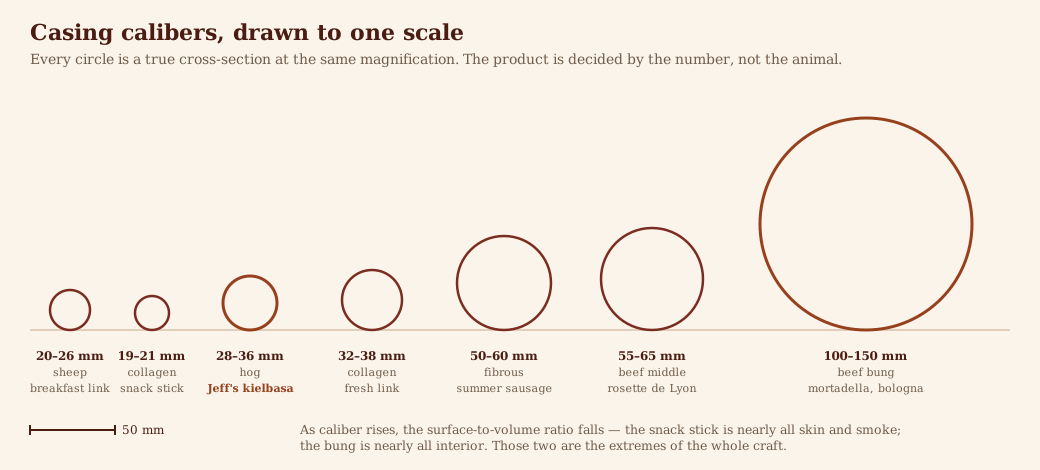
One: it gives the farce a shape that holds itself. Ground meat has no structure. It’s a slurry with ambitions. A casing is a mold you can carry, hang, coil, twist and turn on a grate, and the sausage keeps its geometry from the stuffer to the plate.
Two: it lets you cook by moist heat inside a self-contained envelope. Inside an intact casing, the meat cooks in its own rendered fat and released water, at a temperature that can’t climb past boiling until the moisture is gone — a braise happening inside a skin the size of your finger. It’s why a poached weisswurst is succulent and a fried patty of the same batter is not. The patty has nowhere to keep the water.
Three: in dry-curing, it’s a semi-permeable membrane that controls the rate of water loss. This one has no substitute at all. A dry-cured salami is a months-long negotiation between the water leaving the core and the water leaving the surface, and the casing keeps those two rates close enough that the surface doesn’t seal into a case-hardened shell over a wet, spoiling middle. Not plastic, not a loaf pan, not caul fat.
Notice that jobs one and two are conveniences. Job three is a requirement. That asymmetry is the whole map of this page: everywhere you’re not dry-curing, the casing is a choice, and the choice changes what you’re eating.
Links — the default, and why the length is regional
Links are the form most people picture when they hear “sausage,” and they earn that position honestly. A link is the smallest unit that still gets all three casing jobs: it holds its shape, it cooks moist inside its own skin, and it hangs.
My grandfather’s kielbasa goes into medium hog casings, 30/32 mm, twisted at about six-inch lengths. That’s the recipe card and I’ve never changed it, because at that caliber and that length the link does exactly what I want in a smokehouse: enough mass that the center doesn’t blow past the target temperature while the surface is still taking smoke, enough surface that the smoke and the color get there at all.
Twisting versus tying. Twisting is what you do when the casing is filled evenly and you’re cooking it soon. You pinch, spin one link forward and the next backward — alternate directions or the whole rope unwinds the moment you set it down — and the twist holds because the casing grips itself. Fast, wastes nothing, and reversible if you overfill a link.
Tying is what you do when the link has to hang, survive weeks, or take heat hard enough that a twist would let go. Every dry-cured link is tied, because a twist under the weight of a two-pound salami through six weeks of drying will simply unspin. Anything going into a smokehouse on a stick gets a loop. The mechanics get their own page: linking and tying.
Why length is regional. A Nürnberger is tiny, about three inches, because it was priced and eaten by the handful off a hot grill. A British banger is longer and fatter because it goes in a pan or under a broiler at a gentler heat and has to survive being turned. American breakfast links are short because they share a plate with eggs. Kielbasa at six inches is a portion — one link is one serving of a main course.
Underneath all of it: link length is a cooking-time decision disguised as a cultural one. A short link and a long link of the same caliber cook at nearly the same rate, since heat travels in from the circumference and not the ends — but a short link has proportionally more twisted end, more browned surface per bite, and more of the crisp-to-soft contrast people actually eat sausage for.
Coils — one long link, cooked differently
A coil is what you get when you don’t link at all: you fill a continuous length and wind it into a spiral. Boerewors and Cumberland are the famous ones, and there are a hundred regional coils that never got a name in English.
The coil is not laziness. It’s a different cooking strategy, and the difference is real.
A coil goes on the grill or in the pan as one object with one continuous surface. Nothing is trapped between two adjacent links, so nothing steams itself gray — every square inch of casing sees direct heat. You turn the whole spiral once, usually with two spatulas or a skewer run through it crosswise. And because there are no twisted ends there are no weak points: a twisted link fails at the twist, where the casing is thinnest and most stressed. A coil has no twists to fail.
The trade-off is that you can’t portion it before it’s cooked and you can’t cook a little of it. A coil is a commitment. You cut it after, and the cut ends leak — which is exactly why boerewors is served as cut lengths of a bigger thing rather than tidy individual sausages. It’s a communal form.
Coils also want a slightly looser fill than links. A tightly stuffed coil cracks on the outside radius when you wind it, because the outside of the spiral has farther to travel than the inside. Underfill by a hair and the casing takes up the slack instead of splitting.
Patties — the form that trades moisture for crust
A patty gives up job one and job two entirely and buys something else with the proceeds: surface area.
Flatten a link’s worth of farce into a patty and you roughly double the exposed surface, and all of it can hit a hot pan directly, dry out, and brown. That’s the entire point — a patty is a crust delivery system. American breakfast sausage is a patty in its native form for a reason: sage, black pepper and brown sugar are all flavors that come alive in Maillard browning.
But be honest about the cost. The fat renders out instead of staying in. Inside a casing the rendered fat has nowhere to go; it stays in the matrix, it’s still there when you bite it, and that’s the juice. In a pan it leaves the patty and pools around it — delicious, spoonable back over, and nevertheless not in the sausage anymore. A patty made from a formula designed for links comes out drier than the same farce in a casing, every time. The fix isn’t more fat; it’s accepting that a patty is a leaner-eating, crustier food and seasoning it for that.
Patties also need no cure, no equipment and no technique. A bowl and a pan. This is the form that keeps sausage-making alive in households that will never buy a stuffer, and there’s nothing second-rate about it.
Bulk — the sausage that gets its shape in the pan
Bulk sausage is seasoned ground meat with no shape at all, and it’s a legitimate terminal form, not an intermediate step.
Mexican chorizo is the clearest case. It is fresh, it is bulk, it goes into a hot pan and gets broken up with a spoon, and its whole texture — that loose, crumbled, deep-red rubble that soaks into eggs and potatoes — is impossible in a casing. I ate it constantly in Mexico and built my own recipe because good chorizo is nearly impossible to buy in the States, and I have never once put it in a casing. It would be a worse food. (And this is a good place to repeat the correction the family tree makes: Mexican chorizo and Spanish chorizo are different categories, not variants. The Spanish one is dry-cured and sliced and absolutely requires a casing, for job three.)
Bulk is also where sausage goes when it’s an ingredient: into a stuffing, a lasagna, a pizza, a gravy. There the shape it takes is the shape of the dish, and a casing would just have to be cut off.
The practical upside is that it removes every equipment barrier at once. No stuffer, no casings, no linking, nothing to blow out. Grind cold, season, mix until it just grabs, rest overnight so the salt and spice equilibrate. If you’re learning sausage, learn it in bulk first — you can fry a test spoonful and adjust the seasoning of the whole batch, which you cannot do once it’s stuffed.
Skinless formed — ćevapi, sheftalia, crépinettes
Then there’s a whole family that has a definite shape and no casing whatsoever, and the way they hold that shape is genuinely interesting.
Ćevapi — this little sausage from Serbia is another of my favorites — are shaped by hand or extruded into short fingers and grilled directly on a hot grate. Nothing holds them together but the meat’s own bind, which is why the mixing matters far more here than in a link: without a casing to contain it, you need a real primary bind, so the farce is worked to a genuinely tacky paste and rested. The reward is a food with no skin at all — char directly against the meat, no membrane between, soft the whole way through. Anybody who says the casing snap is the best part of a sausage has not eaten good ćevapi.
Sheftalia and crépinettes solve the same problem a different way, and it’s a solution worth understanding on its own terms: they’re wrapped in caul fat, the lacy fat membrane from around a pig’s or lamb’s stomach.
Caul is not a casing. A casing contains; caul melts. Under heat the lace renders away almost completely, and what it leaves behind is basting fat distributed over the entire surface of the sausage and a thin, crisp, browned residue of connective tissue. It holds the shape exactly as long as it needs to — through handling and the first minutes on the fire — and then it disappears into the food. It is a wrapper that becomes an ingredient.
That’s a real third category, and once you see it you notice it everywhere — the same logic as bacon around a filet or a fig leaf around a cheese. The wrapper gives temporary structure plus fat and flavor, not containment.
Caul is also the answer to a practical problem. If you want a shaped, grillable sausage and can’t get casings, caul fat from a good butcher does the structural job for anything you’re cooking today. It will not do job three — it dries and cracks, it isn’t semi-permeable in any controlled way, and nothing dry-cured uses it.
Loaf pan and terrine — the honest way in
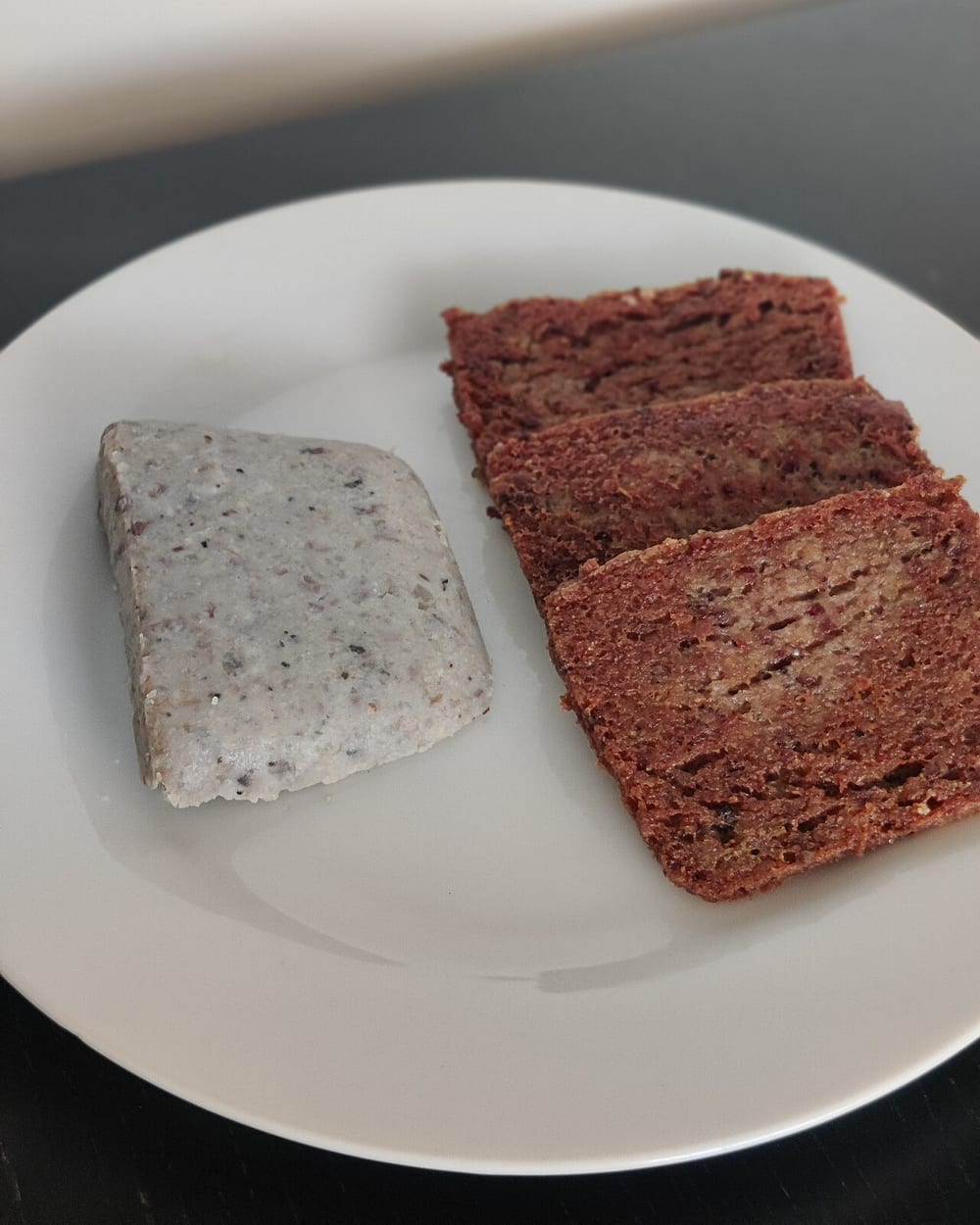
Some of the best sausages in the world are set in a rectangular pan and were never near a casing.
Black and white pudding, scrapple, goetta, leberkäse, summer sausage. All sausages by construction — comminuted meat, salt, seasoning, a set — and all perfectly at home in a loaf pan, because in every one of them the set comes from something other than a casing. Blood proteins coagulating around grain and fat cubes. Gelatin from simmered head meat. Cornmeal and buckwheat gelatinizing. Coagulating myosin in a leberkäse batter. None need a membrane; they set into a solid that stands up on its own once cold.
And here is the honest practical argument, which I’d rather state plainly than dress up as tradition: most Americans can source blood OR casings, but rarely both on the same afternoon. I get frozen blood from a market near the MSU campus. Casings come from a different supplier entirely, usually by mail. Make the loaf-pan version the entry point and a person can make black pudding this weekend with what they can actually buy. Insist on casings and most people make nothing and read about it instead.
The loaf pan is the way in, and it isn’t a compromise. A pudding baked or poached in a pan, chilled solid, turned out and cut into thick slices to fry is how most people eat blood pudding anyway — the slice is the serving unit, and it looks the same whether it came from a casing or a terrine mold. The blood and offal page covers what actually sets these.
Large-format — caliber is the product
Now the other end. When you go big, the casing stops being a shape and becomes a defining specification.
Bologna, mortadella, rosette de Lyon — these are large-caliber products, stuffed into beef bungs or the equivalent, at diameters from about 100 mm up. And the size is not a serving-convenience decision. It changes the food.
At large caliber the ratio of surface to volume collapses, and three things follow:
- The core cooks slowly and gently while the surface never gets hot enough to toughen. A mortadella baked for many hours reaches a uniform, springy, silky texture across a foot of diameter that no small sausage can imitate.
- Drying is slow and even. A large-caliber dry-cured sausage loses water over months, not weeks, and that long equilibration is where the flavor complexity comes from. Short-dried small salami is a sharper, simpler food.
- The slice is wide. Every large-format sausage is a sliced food, designed around what the cut face looks like — mortadella’s fat cubes and pistachios, the peppercorns in a rosette.
Rosette de Lyon is the sharpest illustration I know. It takes its name from the casing — the rosette is the end section of the hog’s large intestine — and and the conventional specification is a 50–60 mm pork bung, a wide, irregular, thick-walled natural casing that gives the sausage its bulbous shape and a very slow dry. That caliber IS the product. Put the identical farce into a 36 mm hog casing and you have not made a smaller rosette; you’ve made a different sausage: it dries in a third the time, develops a fraction of the fermented complexity, has a much higher proportion of dried rind to interior, and eats sharper and firmer. Same meat, same salt, same culture, same cellar. Different food.
Substitute a straight beef middle and you get a perfectly good sausage that simply is not a rosette. And stuff a bung firmly — they’re thick-walled and they will not blow on you the way a hog casing will.
Snack sticks — the opposite extreme
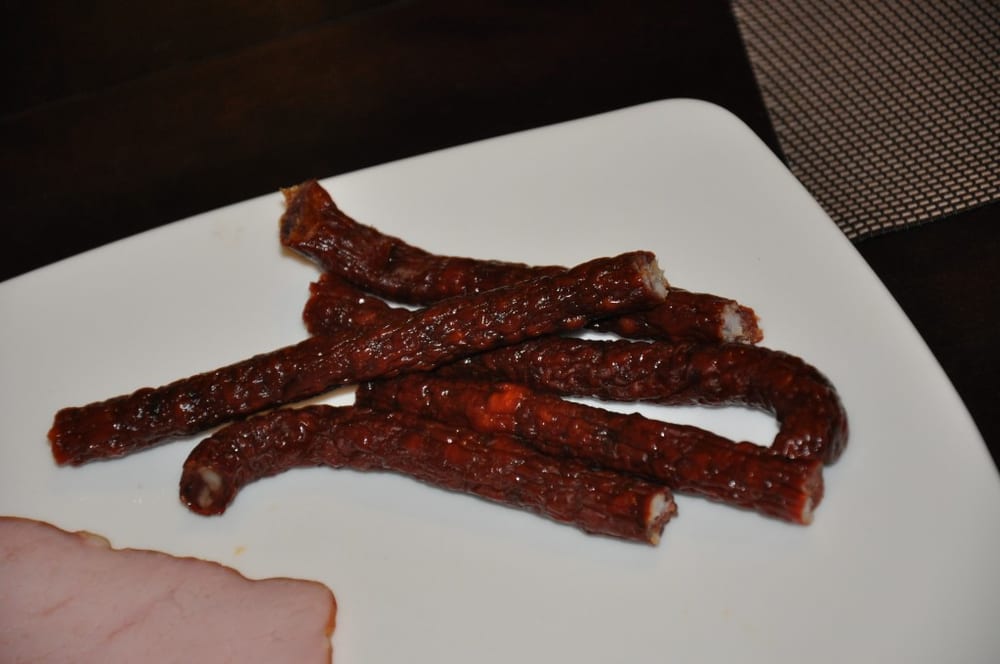
At the other end is the highest surface-to-volume ratio in the whole craft: snack sticks, 19-21 mm.
I use a 12 mm stuffing tube for 19-21 mm snack stick casing. That’s the note on my own card and it’s the number people get wrong most often — a tube much bigger than that and you can’t get the casing shirred onto it; much smaller and you’re fighting back-pressure and smearing fat in the horn.
Everything about a snack stick follows from its diameter. It dries fast — days, not months. It takes smoke fast and hard, and takes too much faster than anything else on a rack, so a schedule that’s right for kielbasa will make sticks acrid. It comes to temperature almost immediately, so the window between “done” and “rendered out into a greasy stick” is narrow. And its texture is dominated by the casing and the dried outer layer, because at 20 mm there is barely any interior left — the surface is most of the food.
That’s also why snack sticks are the one product where a collagen casing is arguably the right choice rather than a compromise.
Natural versus artificial — what each one is actually for
| Casing | Typical caliber | What it’s for | Eat it or peel it |
|---|---|---|---|
| Sheep | 20-26 mm | Breakfast links, merguez, small frankfurters, chipolatas. The thinnest, most delicate natural casing — the source of true “snap” | Eat it |
| Hog | 28-36 mm | The workhorse. Kielbasa, Italian, bratwurst, most fresh and cooked-smoked links. My kielbasa runs 30/32 mm | Eat it |
| Beef rounds | 35-46 mm | Ring sausages, some blood sausage — tougher, curved by nature, which is why ring bologna is a ring | Eat it (chewy) |
| Beef middles | ~55-65 mm | Large salami, sopressata, cervelat. Strong enough to hang heavy product for months | Eat it or peel it — many peel it |
| Beef bung | ~100-150 mm | Large-format: bologna, mortadella, rosette de Lyon, capocollo-scale dry product | Peel it |
| Collagen | 19-21 mm up to ~45 mm | Uniform caliber, no soaking or rinsing, no grit, no surprises. Ideal for snack sticks and any product where consistency beats character | Eat it (the edible grades) |
| Fibrous | 40-100+ mm | Summer sausage, large bologna, deli chubs. Reinforced cellulose — won’t stretch, holds a printed label, hangs heavy loads | Peel it |
| Cellulose | ~18-24 mm | Hot dogs and skinless franks. Cooked in it, then stripped off before packing | Peel it — the manufacturer already did |
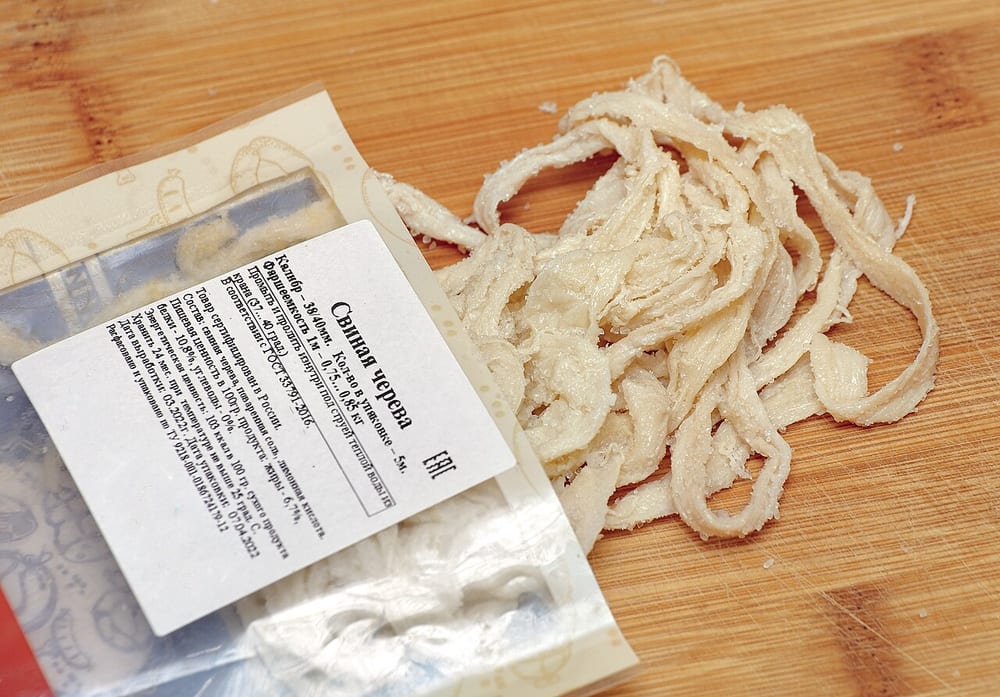
Natural casings are the actual intestine, cleaned down to the submucosa, and they have two properties nothing synthetic reproduces. First, they’re permeable in a genuinely controlled way — smoke goes through, water goes out at a rate that tracks the humidity around it. That’s job three. Second, they shrink with the meat. As a dry-cured sausage sheds 35% of its weight it loses volume too, and a natural casing follows it down and stays tight. A casing that didn’t shrink would leave an air gap, and an air gap is where mold and spoilage live.
The drawbacks are real: variable caliber within a single hank, weak spots that blow out at the worst moment, and they arrive packed in salt needing a soak and a flush.
Collagen casings are reconstituted beef hide collagen, extruded to a chosen diameter. What you’re buying is uniformity — every stick the same size, which matters enormously when a hundred of them are on one schedule, because they all finish at the same time. No soaking, no weak spots, and the edible grades are thin and tender. The trade-off is that they don’t shrink like a natural casing, don’t have the same snap, and eat a little anonymous. For snack sticks that’s a fair trade. For a bratwurst, it isn’t.
Fibrous casings are cellulose reinforced with paper fiber. They are not edible and not meant to be — you peel them. They do one job supremely well: hold a large, heavy, uniform log through a long thermal cycle without stretching or failing. That’s why every commercial summer sausage and deli chub is in one. My own note is specific about the handling: fibrous, pre-stuck — perforated at the factory so trapped air escapes instead of forming a pocket under the casing — soak 30 minutes in warm water, and crimp the end with a hog ring and hog ring pliers. The soak makes it pliable enough to stuff without splitting and lets it shrink slightly onto the meat as it dries. Skip it and you get a stiff tube, a loose fit and a void under the casing. The hog ring is the closure — a metal staple crimped by the pliers, far more reliable on a stiff casing than any knot.
Cellulose casings are pure regenerated cellulose, and they’re the most quietly interesting item on the list, because their entire purpose is to be removed. A hot dog is stuffed into cellulose, cooked and smoked in it, chilled, and then the casing is peeled off before packing. It held the shape and the moisture through the cook, and then it left. That’s why a standard American hot dog has no casing and no snap. A “natural casing” hot dog isn’t a fancier hot dog; it’s a hot dog that kept its skin.
For choosing between all of these on a specific product, the casings ingredient page goes deeper, and the mechanics of getting farce into any of them live at stuffing.
Two summer sausages, one family
I want to end on the disagreement inside my own kitchen, because it makes the argument better than I can.
My mother’s summer sausage has no casing at all. Morton Tender Quick, a three-to-four-day cure in the refrigerator, rolled into tubes, then five hours in a 200°F oven. No fibrous casing, no smokehouse, no culture, no fermentation. It comes out as firm sliceable logs with a dry burnished exterior, and it is genuinely good.
The fibrous-casing school does the same product completely differently: Cure #1 rather than Tender Quick, stuffed into a soaked 50-60 mm fibrous casing, hog-ringed shut, and run through a staged smokehouse cycle to a finished internal temperature — sometimes with a culture and a real fermentation step first.
Both are summer sausage. Both work. And the differences are entirely differences of form.
The oven version has no membrane, so it loses water directly from its surface all five hours — that’s why it comes out with a burnished, slightly leathery exterior and a firm, dense slice. It’s partly a dried product, not just a baked one. The fibrous version loses water far more slowly through the casing, comes out moister and more uniform corner to corner, and gets its exterior character from smoke instead of from drying.
Note too that you can’t simply swap one element for another across the two schools: Tender Quick and Cure #1 are different compositions used at completely different rates and are not interchangeable. Each version is an internally coherent system, and you pick one whole.
The truthful summary is the one I’d tell anybody starting out: my mother’s version needs a bowl, a refrigerator and an oven. The fibrous version needs a stuffer, a casing order, hog ring pliers and a smoker you can hold at staged temperatures. One of those is a Saturday. The other is a hobby.
The form is the decision. The farce was never the hard part.
Comments (0)