The Collection
I have made sausage for forty years, and somewhere in that time I stopped counting the recipes. When I finally sat down and pulled every making formula out of the file, there were about sixty-one of them — not dishes that use sausage, but recipes that tell you how to grind, season, stuff, and finish one. That is a real collection. It is big enough to have a shape, and the shape says more about me than any single recipe does.
This page is a guided tour of that shelf, walked the way I’d walk a friend through my smokehouse: here’s what I’m deep in, here’s what’s thin, and here’s the strangest thing about it — a whole tradition I make all the time that had somehow never landed on one of my own cards. A collection is a self-portrait you didn’t mean to paint. Mine has a Louisiana accent, a freezer full of wild game, two dead relatives I’m still chasing, and — for a man who owns a shelf of fifty-some sausage books — a curious blind spot I only noticed when I sat down to count.
If you haven’t read the family tree yet, read it first. It lays out the nine classes I’ll organize this tour around: fresh, cooked, emulsified, cooked-smoked, dry-cured, semi-dry, blood, offal, and grain-extended. That page’s point is that you classify a sausage by what you did to it, not what it’s called. This one’s point is what forty years of doing those things left on my shelf.
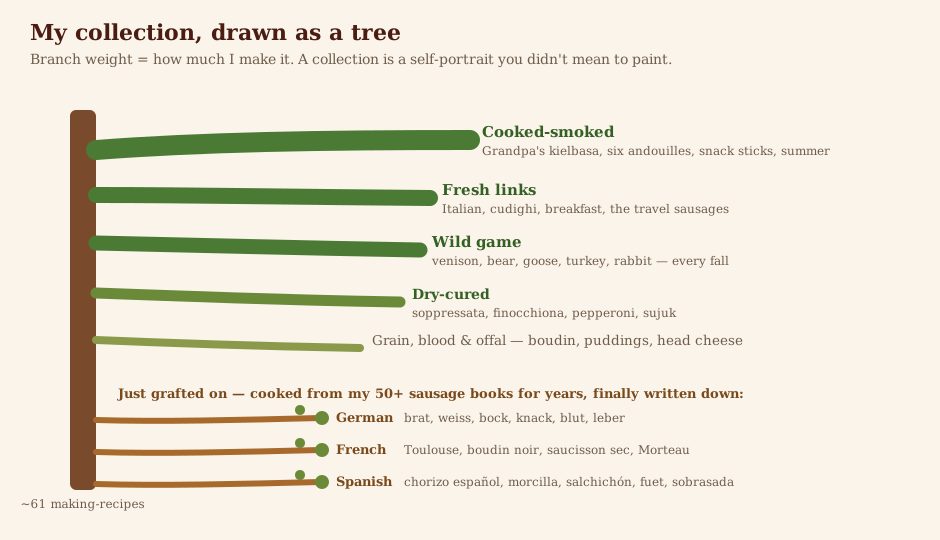
Where I’m deepest: fresh, and cooked-smoked
Two branches carry most of the weight.
Fresh is the biggest and the most scattered, which makes sense — a fresh sausage is the easiest thing to make and the first thing anybody tries. I’ve got Italian in all three registers: sweet, hot, and a hot venison version for when the freezer is full of deer. There’s country sausage in three near-identical drafts, garlic-and-pepper, a plain Irish grind, and the travel sausages — South African boerewors, Serbian ćevapi, Filipino longganisa, and Northern Thai sai ua. And the one I’m proudest to have chased down: cudighi, the fresh Lombard pork sausage that barely exists outside three towns in Michigan’s Upper Peninsula. I’ve eaten a lot of sausage in a lot of countries; the fresh branch is where that shows.
Cooked-smoked is the branch I’m best at, because it’s the one I’ve done longest and most seriously. It’s anchored by my grandfather’s Polish sausage — the recipe that took me years to reverse-engineer from the smell of a Sunday morning — and it runs through the six andouilles I’ll come back to in a minute, a smoked beef sausage, hunter sausage, a generic smoked sausage, and smoked venison snack sticks. This is the branch that needs a smokehouse and a probe thermometer and a staged temperature schedule, and it’s the branch where the difference between a good maker and a bad one actually shows up. Everything I know about drying the surface before I introduce smoke, about the hot-water bath at the finish, about pulling at 155–165°F — all of it lives here.
The Cajun concentration
Here is the first thing that jumps out of the file, and it’s not subtle: six andouille recipes. #1, #2, #3, #4, a Louisiana version, and a smoked one. Nobody needs six andouille recipes. Nobody needs two. So why do I have six?
I can answer this honestly without inventing a backstory I don’t have. Look at the rest of the file and it’s obvious. My collection tilts hard toward Louisiana — there’s andouille gumbo, chicken-and-andouille gumbo, seafood gumbo with andouille, jambalaya, a whole shelf of Justin Wilson recipes, boudin, tasso, remoulade. Cajun and Creole cooking is a genuine gravitational center in how I cook, and andouille is the load-bearing sausage of that whole cuisine. You cannot make a real gumbo or jambalaya without it, and — this is the key part — you cannot reliably buy good andouille in Michigan. So when a good-looking recipe crossed my path, I saved it. Six times. What looks like obsession is really just a supply problem: the sausage my kitchen demands isn’t on the shelf at the store, so I collected every plausible way to make it myself. The Cajun concentration isn’t a taste I picked up somewhere exotic. It’s the sausage-shaped hole in a Louisiana-leaning kitchen sitting seven hundred miles from Louisiana.
The boudin problem, stated plainly
While we’re in Louisiana: there are two files in here both titled boudin blanc, and both of them are wrong.
Boudin blanc #1 and #2 are, on paper, French boudin blanc — the pale, delicate, poached white sausage of pork, milk, and egg that belongs to a French Christmas table. That is not what’s in the file. Open either one and you find pork shoulder, liver, the holy trinity of onion-celery-bell-pepper, cayenne, and cooked rice, three cups of it. That is Cajun rice boudin. It’s a completely different animal — a cooked, grain-extended sausage from the same swamp that gave me the andouille, not a French emulsion at all. The third “boudin” in the file (filed, endearingly, as “noudin”) is the same thing again: smoked Cajun boudin with deer meat as an option.
I found this while writing the family tree, and I want to name it rather than quietly move on. Both boudin-blanc files are mislabeled. They’re good recipes — one of them rates a 5 with me — but the title is a lie, and it’s the kind of lie that matters, because boudin blanc and Cajun boudin are in two different classes on the tree. Renaming them is on the list. I’d rather tell you the label is wrong than let you make a French Christmas sausage and get rice.
Cooked and emulsified: the thin branches
If fresh and cooked-smoked are where I’m deep, the poached-and-baked “cooked” class and the emulsified class are where I’m thin, and I own that.
For emulsified — the mortadella-and-frankfurter family, where fat and lean are whipped into a paste that stays bound — I have essentially the bologna pair: old-fashioned bologna and a smoked bologna. The old-fashioned one is worth reading precisely because its own notes explain what happens when you botch the emulsion: skip the ice water, let the temperature climb, and you get a crumbly burger in a casing instead of the tight, springy slice you were after. Fat smear is a temperature failure, and bologna is where you feel that lesson hardest. But two recipes is a thin branch for a whole class, and there’s no frankfurter, no mortadella, no knackwurst in the file.
The cooked class — poached or baked, no smoke — barely exists as its own thing in my collection, mostly because the two candidates for it, the boudin blancs, turned out to be Cajun rice boudin hiding in the wrong bin. There’s a canned sausage procedure that’s really about preservation, and the bangers — English and otherwise — which are a fresh grain-extended sausage more than a cooked one. It’s a thin spot on my cards, at least — the weisswurst and bockwurst I now cook are exactly this class, and they came out of my books long before they came into my file.
Dry-cured and semi-dry: small but serious
The dry-cured branch is small in number but it’s the most technically demanding thing on the shelf, and the recipes here know it. There’s soppressata, finocchiona — the fennel salami — a slow-fermented dry pepperoni, a plain salami, and the three sujuk/sucuk recipes I’ll get to. These are Cure #2 products: the ones that hang for weeks and are never cooked, so they need a nitrate reservoir feeding a slow nitrite release the whole time they dry. Anyone who tells you dryness is the preservation metric is skipping a step — it’s water activity, and the 30–40% weight loss you’re chasing is a proxy for it.
Lap cheong, the sweet Chinese dried sausage, sits in this branch with an asterisk: it’s dried but it’s meant to be cooked before eating, which puts it in a slightly different safety category than a salami you slice raw.
The semi-dry branch — fermented for tang but not dried to shelf stability — is where some of my most-loved recipes live. The cooked Landjäger is here, and its own notes are a small master class: you can use Cure #2, the recipe says, but you’ll get a very hard link. That’s the nitrate-reservoir logic showing up as texture instead of safety, which is exactly the kind of thing you only understand once you’ve made the mistake. And summer sausage lives here in three versions, one of which I’ll single out below.
But that cooked Landjäger is the American one, and for a long time it was the only one in this collection — which was a real gap, not a preference. The German food code lists Landjäger as a schnittfeste Rohwurst: a firm, sliceable raw sausage, “storable uncut without refrigeration.” Never cooked. So the collection now carries five traditional raw formulas alongside it — Swabian, Swiss Gendarme, an Alpine butcher’s schedule, a pork-forward home version and a venison one. Cure #2, a live culture, a verified pH, cold smoke that never cooks anything, and a month of hanging down to 30–40% weight loss. That’s the whole story of this section in one sausage: same name, two completely different products, and the popular one is the adaptation.
Blood, offal, and grain: the honest fringe
The last three branches are small, but I have at least one real example of each, which is more than most home makers can say.
Blood: Irish black pudding, which I’ve actually made, with frozen pig’s blood I bought from a market near the MSU campus. Blood sausage is where squeamishness kills a lot of would-be makers, and I’d argue it’s some of the best eating on the whole tree.
Offal and head: hog head cheese — souse, in the Appalachian telling — the terrine set in its own gelatin from a simmered hog’s head. Nose-to-tail, the way it was actually done after a November hog killing.
Grain-extended: Irish white pudding, the rusk banger where the oatmeal-adjacent rusk is the whole point and not a “filler” to apologize for, and the Cajun boudin trio above, whose three cups of rice make them grain-extended whether the label admits it or not.
The wild-game seam
Run your finger down the file and a seam of game runs right through it, and this one isn’t an accident of collecting — it’s who I am the other nine months of the year. I hunt, and the collection knows it.
Deer is the backbone, because a season fills a freezer: venison breakfast sausage, venison chorizo in two versions, a wild-game chorizo that widens it past deer, venison summer sausage, the hot Italian venison up in the fresh branch, and smoked venison snack sticks. But it doesn’t stop at deer. I hunt bear, geese, wild turkey, rabbit and squirrel, and every one of those has gone through the grinder at some point — and I fish fresh water and salt, and dig clams, pull oysters, drop crab traps and go shrimping besides. The game seam is really the whole outdoor half of my cooking coming home to the bench. There’s a mutton sausage from sheep and goat, and there’s reindeer — though I’ll be honest about that last one: it’s a skillet for reheating and caramelizing the fully-cooked smoked sausage I ate off every cart in Alaska, not a formula for grinding your own. I haven’t shot a reindeer.
The through-line is simple and it isn’t romantic: wild game is lean, often almost fatless, and it wants to be sausage. A backstrap you grill, but the trim, the shoulders, the tough bits, the goose legs, the odd rabbit become sausage or they become waste. Add 20–30% pork fat and a coarse grind, and a season’s worth of animal turns into breakfast links, chorizo, snack sticks, summer sausage, and smoked goose. This is the most coherent part of the whole collection, because it comes from a real, recurring thing I do every fall.
The duplicate clusters — and why I keep every one
A collection this size, built by a magpie over forty years, accumulates duplicates. Andouille ×6. Linguiça ×4 — these three plus a homemade one filed, bizarrely, under “Desserts.” Mexican chorizo ×4, from a plain grind to a chile-forward one to Isabel’s to my own. Country ×3. Sujuk ×3 — dry-cured, the intense Turkish garlic version, and a Cyrillic-titled one. Summer ×3. Boudin blanc ×2. Venison chorizo ×2.
And I’m not going to thin them out — that’s the part people expect me to apologize for, and I won’t. Every one of these is a recipe I found somewhere or worked out myself over the years and liked enough to save. That’s the whole reason it’s in the file. The six andouilles aren’t a filing error waiting to be merged; they’re six andouilles I like, each a little different, and on a given batch I might want the coarser grind, or the darker pecan smoke, or the Louisiana one with its measured Prague Powder #1. The four Mexican chorizos really are four different animals, weeknight-fast to a project. Even the three near-identical country sausages earned their spots by being the ones I chose to keep twice. A collection built over forty years is supposed to have duplicates. They’re not clutter I’m hiding — they’re a record of everything that turned out good enough to save again.
The two recipes that rate a 5 — and what they have in common
I don’t rate many of these. Most sit at zero because I’ve never bothered to score them. But two of the making recipes carry a 5, and it’s worth sitting with which two.
They’re my grandfather’s Polish sausage and my mother’s summer sausage. The two highest-rated sausages in the entire collection are the two I inherited.
That’s not a coincidence, and it’s not really about the recipes being technically superior. Grandpa never smoked his — he boiled it, and that plain boil is exactly what threw the smell across the street on a Sunday morning. What I do is my own decision laid on top of his recipe: I take his kielbasa and smoke it — hickory, a staged 130-to-190°F schedule, the hot-water bath at the finish, an ice plunge, a two-to-three-hour bloom to a deep brown — and it’s a different, equally wonderful thing than the one he made. Mom’s is almost defiantly simple: hamburger and pork, Morton Tender Quick, a three-to-four-day cure in plastic wrap, and five hours in a 200°F oven with no casing at all. Technically they couldn’t be more different — one is the Prague-powder-and-fibrous-casing school, the other is the recipe-card school. What they share is that I’m not really scoring the sausage. I’m scoring the memory. Grandpa’s is the smell that hit me walking out of church every Sunday as a boy; it took me years to get close to it. Mom’s is her handwriting on a card. A 5 on those two isn’t a claim about brine ratios. It’s the collection telling me why I started doing this in the first place.
The tradition that lived in books, not on my cards
Here’s the oddity I promised, and it took me an embarrassingly long time to see it. Line up my saved making-recipes and — until this year — there was not one German card in the stack. No written-down bratwurst. No weisswurst, bockwurst, knackwurst, blutwurst, leberwurst. That looks damning right next to the family tree, where I spend a whole page arguing the German scheme — Rohwurst, Brühwurst, Kochwurst — is the smartest way to think about any of this.
But it was never that I don’t make German sausage. I make it all the time. I have hundreds of cookbooks and easily fifty of them are sausage-specific — Bruce Aidells’s Complete Sausage Book, Rytek Kutas’s Great Sausage Recipes and Meat Curing, the German Sausages book, Stanley Marianski on fermented sausages, Ruhlman and Polcyn’s Charcuterie — and I cook bratwurst and weisswurst and the rest straight out of them. What I’d never done was write the formulas down as my own. A whole tradition I make constantly was living in other people’s books instead of in my file. That’s a stranger blind spot than “I never made these.” It’s “I never bothered to save what I already make.”
So that’s what this program fixed first. The German sausages are on my shelf now — Nürnberger and Thüringer bratwurst, weisswurst, bockwurst, knackwurst, blutwurst, Braunschweiger leberwurst, and a currywurst sauce — and so are the French (Toulouse, boudin noir, merguez, saucisson sec, rosette, Morteau) and the Spanish (chorizo español, morcilla de Burgos, salchichón, fuet, sobrasada, botifarra). Same reasoning throughout: these are sausages I make or mean to make, drawn from my own books, so they belong on my cards and not just on someone else’s page. (The two I won’t write up as home recipes are raw Mettwurst and Teewurst — spreadable, raw-fermented, and genuinely dangerous to make without a lab’s worth of verification. I’ll buy those.)
And before anyone points at my chorizos to say I already had Spain covered: those are all Mexican chorizo, fresh and bulk, a completely different category from the dry-cured Spanish one now sitting beside them. Four Mexican chorizos never did anything for the Spanish shelf, any more than a linguiça covers Spain for being next door to Portugal.
A note that isn’t mine
One provenance problem to flag before I close, because leaving it unsaid would be its own kind of dishonesty. The mutton sausage file carries a long, lovely note — a memoir about a childhood trip through oak forests to a country fair, and the thin smoked sheep-and-goat sausages called virșli that the writer never forgot. It reads beautifully. It is not mine. It’s a machine-translated Romanian memoir that rode along with the recipe, and its slightly-off English is the tell. I’ve left it in the file for now, but it’s on the list to strip or clearly attribute, and I won’t present that trip through the Zarand hills as something I took. I didn’t.
The technique reference that ties it together
Underneath all sixty-odd recipes sits one file that isn’t a recipe at all: my grinding, stuffing, and notes page. This is the reference I actually reach for. It’s where I’ve written down that I run a Weston #12 (not a Walton — people mix those up) and now mix the seasoned meat in a Vevor BMM-10, a hand-crank sausage mixer whose parts I throw in the freezer first so the meat never warms while it blends — it comes together far better, and far easier, than it ever did working it by hand in a bowl over ice. It carries the plate chart I use to decide comminution: 1/8” for bologna and frankfurters, 3/16” for breakfast and Polish and Italian, 1/4” and 5/16” for salami, summer, pepperoni, and bratwurst, on up to the 3/4” chunk plate. It’s where “start with cold meat — 30°F is perfect” is written down as a rule, not a suggestion, because cold meat is the whole game and warm fat smears. And it’s where the hot-water finish lives — for years that meant a turkey roaster, but I’ve since traded up to a big bin with a sous-vide heater holding the bath dead-on temperature instead of me babysitting a thermometer. It’s got the thermal-processing logic — start the smoker about 20°F above the animal’s living temperature (a hog runs ~101°F, so I start around 120°F), and treat that first hour as a drying stage with the dampers open and no water pan yet, or the smoke won’t adhere and you’ll get a streaky link. It even admits what I don’t have: a psychrometer, the wet-and-dry-bulb instrument a commercial smokehouse uses to actually control humidity instead of guessing with a pan of water. And it tells you where I buy spices — PS Seasoning, online.
That page is the connective tissue. Every recipe on this shelf assumes the knowledge in it.
What the shelf says about the maker
Step back from all sixty-one and the portrait is pretty clear.
Inheritance is the emotional core: the two recipes I rate highest are my grandfather’s and my mother’s, and I’m scoring the memory as much as the meat. Absence built the biggest working part of it: I make chorizo and andouille in quantity not because I fell in love with them on a trip, but because I can’t buy them good where I live, and a Louisiana-leaning kitchen in Michigan has to make its own. Travel shows up in the edges — the ćevapi from Serbia, the sai ua from Chiang Mai, the longganisa, the boerewors, the cudighi I drove north to eat and then reverse-engineered. And the hunt runs right down the middle: a whole seam of venison and game that exists because every fall I have a freezer full of lean trim that wants to become sausage.
The blind spot was just as telling. For years the German, French and Spanish cards were missing — not because I don’t make those sausages, but because I made them out of a shelf of books and never once copied them onto my own cards. Writing them down is a big part of why this program exists. A collection is a self-portrait you didn’t mean to paint. This one shows a maker who cooks from memory, makes what he can’t buy, brings sausages home from everywhere he goes, turns a season of wild game into dinner, and — finally — moved the traditions he’d been cooking from books into his own file.
If you want the how behind all of this, read forty years at the grinder next. And the whole shelf, duplicate clusters and mislabels and all, is browsable in the recipe collection.
Comments (0)