Blood, Liver, Head and Offal
This is the part of the world’s sausage that America mostly gave up.
Not all of it, and not everywhere — Louisiana still runs a boucherie, Pennsylvania still eats scrapple, Cincinnati still eats goetta, and every Polish, German, Mexican and Korean neighborhood grocery in the country has a case with something dark in it. But as a default — as the thing an ordinary American butcher makes and an ordinary American cook buys — the blood and offal branch is gone. Ask for pig blood at a chain grocery and watch what happens.
I want to write about it without either of the usual postures — not squeamish, because there’s nothing here to be squeamish about that isn’t equally true of a pork chop, and not evangelizing, because the nose-to-tail sermon has been preached enough and mostly makes people defensive. Just what this branch is, why it’s built the way it’s built, and what was lost.
Because something was. This is where the original logic of sausage is still visible — the animal is finite, and everything in it either becomes food or becomes garbage. Every other class has drifted from that. This one can’t, because it’s made of the parts nobody would eat any other way.
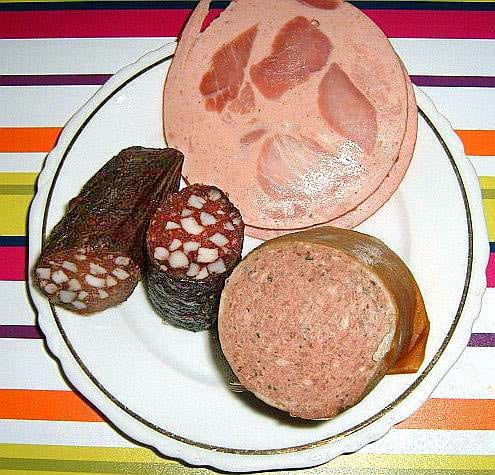
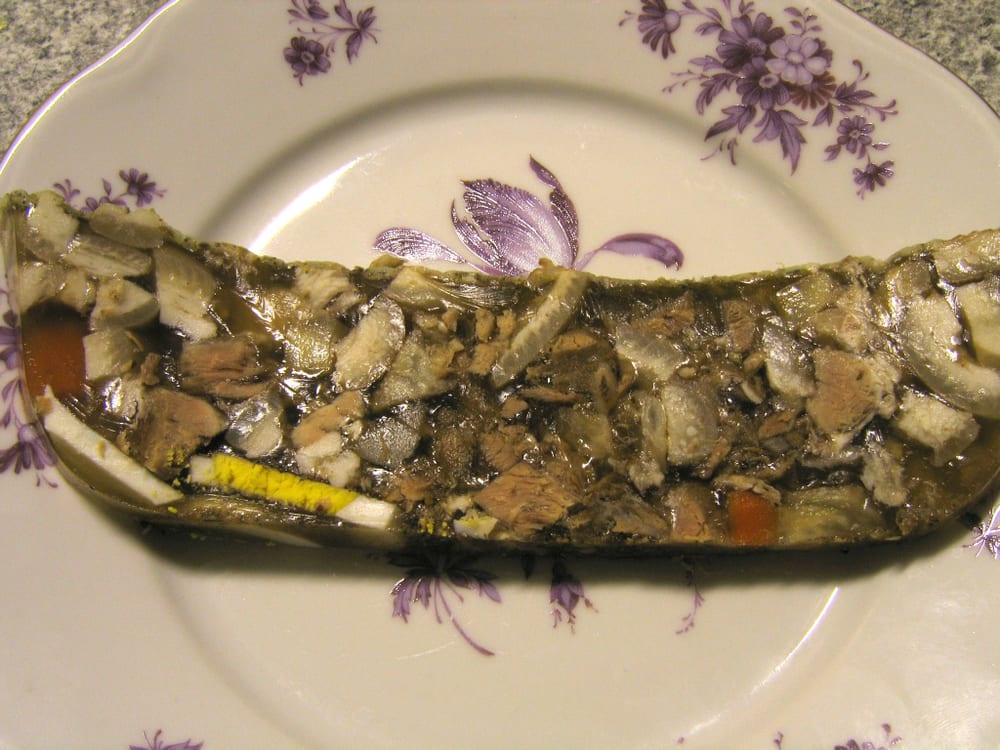
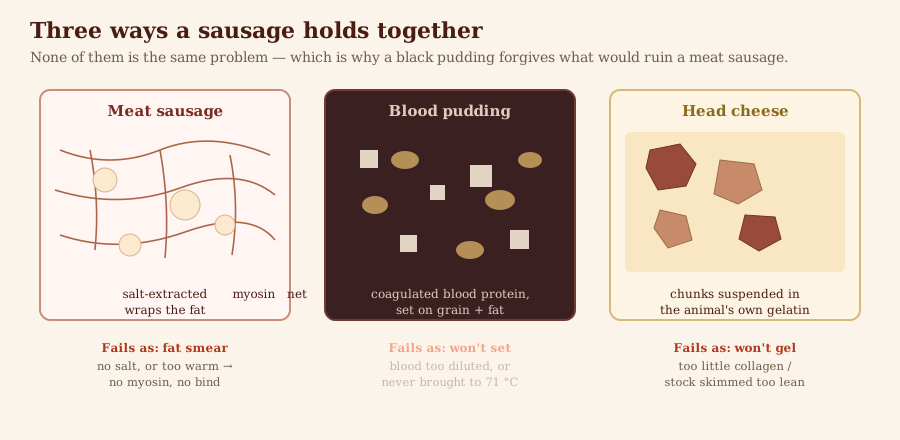
Three different bind mechanisms in one photograph, and not one of them is the myosin bind that holds a bratwurst together.
Why this branch exists at all: killing day
A hog gives you maybe 100 pounds of muscle that obviously becomes chops, roasts and grinding meat. It also gives you a head, four trotters, heart, liver, lungs, kidneys, spleen, tongue, stomach, thirty-odd feet of intestine, skin, and — depending on how it’s bled — three to five liters of blood. That second list is most of the animal by count of usable parts, and essentially all of it spoils faster than the muscle does.
Blood is the extreme case. It starts clotting within minutes of leaving the animal — fibrin comes out of solution and turns the whole thing into a jelly full of stringy clots. So it has to be caught clean, stirred continuously while it cools (defibrinating it: the fibrin wraps around the whisk and you pull it out), strained, and chilled hard. And it’s a superb bacterial growth medium — functionally, culture broth. Not dangerous by nature; just nutritious and warm. Organs run the same clock, slower: liver goes off fast, intestines have to be stripped and scraped within hours. The head can wait a little. Blood cannot wait at all.
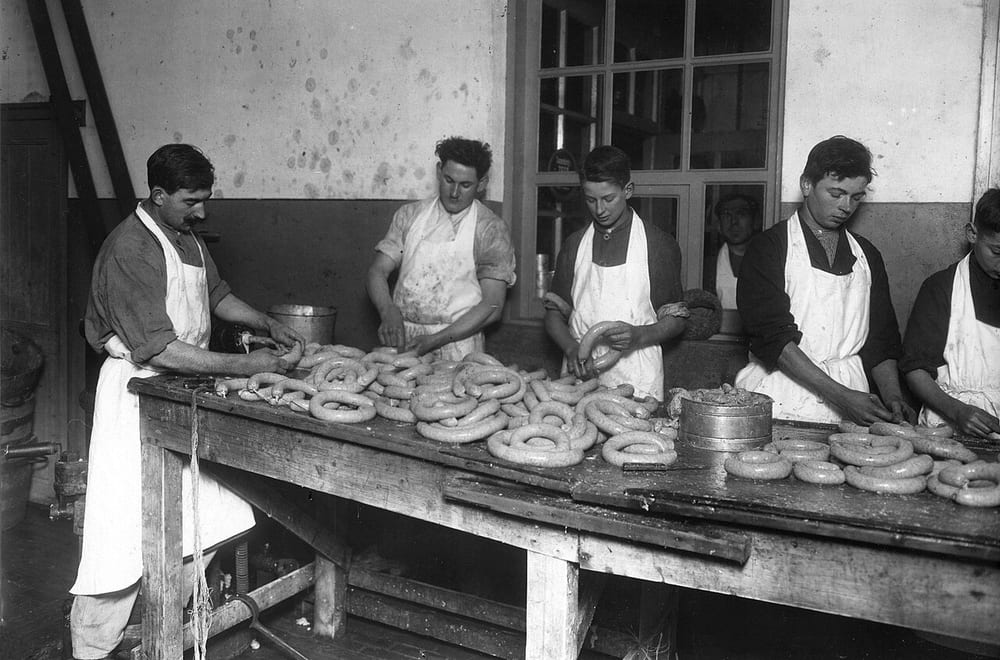
This is why the pig killing was a communal event everywhere pigs were killed. Not sentiment — throughput. One family cannot process a whole hog’s perishable fraction in the window available, so the neighbors come, and they go home with some of it, and you go to their place next month. The Cajun boucherie does it in Louisiana, boudin made the same day. The German Schlachtfest — “slaughter feast” — turns out Blutwurst, Leberwurst and Sülze from one animal, plus Kesselfleisch, the boiled fresh bits eaten immediately because there’s no other option. The Spanish matanza and the Polish świniobicie are the same event under other names. And the cold months aren’t tradition — they’re refrigeration.
So a blood sausage is a preservation technology aimed at the most perishable thing the animal contains, executed under time pressure, by committee. Everything else follows from that brief.
The bind is different, and that changes everything downstream
The family tree page makes the core point: blood sausage has no myosin bind. I want to build on that, because the consequence is bigger than it first looks.
A meat sausage is held together by a protein network you build, by working salt into cold lean meat until the batch turns tacky. You control it, you can test it, and both failure modes have names and fixes. A blood sausage is held together by three things you assemble rather than develop:
- Blood protein coagulating with heat. Hemoglobin and the serum proteins set the way egg white sets — a one-way, temperature-triggered event, and the reason the poach must stay gentle. Push past it and the blood doesn’t set, it curdles, into grains suspended in weeping liquid, and no subsequent step undoes that.
- Fat, in cubes, on purpose. The white flecks in a good black pudding slice are structural. They sit in the coagulated matrix as discrete solid inclusions and keep it from setting into a brick.
- A grain or starch matrix that absorbs liquid, swells, and provides a skeleton.
So the whole troubleshooting vocabulary of meat sausage is useless here. No primary bind to fail, no patty test. Fat smear isn’t your enemy; heat is, in a different way — not smearing fat but curdling protein. A blood pudding that fell apart failed on grain hydration, fat loading or poach temperature. It did not fail on mixing.
The one crossover failure is temperature-of-inclusion. Hot onion going into cold blood begins coagulating it in the bowl, and you get grainy pudding before it ever sees the oven. I’ve done that. I blamed the blood for a while.
Blood sausages of the world
The axis that actually separates them is how much grain, and after that, what the fat and aromatics are doing. Here’s the shape of it.
| Grain / starch | Blood | Signature | |
|---|---|---|---|
| Irish black pudding | Pinhead oatmeal, heavy | Pig or beef | Coarse, crumbly-moist, pepper-forward |
| British (Bury) | Barley groats, rusk | Pig | Boiled, eaten with malt vinegar |
| Boudin noir (France) | Little to none | Pig | Cream-enriched, smooth, fine; apple is common |
| Morcilla de Burgos (Spain) | Rice, a lot of it | Pig | Rice, onion, paprika — and no meat at all |
| Blutwurst (Germany) | Sometimes barley; often none | Pig | Diced cooked meat/rind set into the matrix |
| Soondae (Korea) | Glass noodles, sometimes barley | Pig | Steamed in intestine, sliced, eaten with salt |
| Moronga (Mexico) | Little | Pig | Onion, chile, mint or oregano; often stewed in salsa |
| Biroldo (Tuscany) | Little | Pig | Head meat and blood; spice-forward |
A few of these deserve more than a table row.
Irish black pudding I’ve covered properly on its own page — the beef-blood Clonakilty problem, the dried-blood-powder reality of the commercial product, the “banned in America” myth. Short version here: it’s the grain-heaviest branch of the family.
Boudin noir is the opposite pole. Little or no cereal, often cream, sometimes apple or onion cooked down soft, and the texture is smooth and almost spreadable when warm. Put it next to a slice of Irish pudding and they read as unrelated products. Same primary ingredient, opposite philosophy.
Morcilla de Burgos is the one I find most interesting, because it’s the case where the grain isn’t extending anything. Rice, onion, pork fat, blood, salt and spice — and no meat. That’s not an economy measure, it’s the definition. The product carries EU protected geographical indication status, and the specification is built around the local onion variety and the rice load rather than around any meat content at all. The specification calls for at least 30% Horcal onion, 10–40% rice, and more than 9% blood — and no meat requirement at all. Stuff it loose, because the rice swells as it poaches; it’s the same physics that governs the oats in an Irish white pudding, and it’s the same mistake people make with both.
A sausage defined by its onion and its rice, whose meat content is zero by design, is a useful thing to have in your head when someone tells you filler is a compromise.
Soondae is the branch’s healthiest surviving popular form anywhere in the world — street food and comfort food in Korea, sold everywhere, eaten without ceremony, its matrix dangmyeon sweet potato glass noodles rather than grain. Nobody in Korea considers it challenging eating. That’s worth sitting with if you grew up thinking blood sausage was an extreme food: in Seoul it’s about as transgressive as a soft pretzel.
Sanguinaccio is the strangest branch. In southern Italy sanguinaccio dolce is a sweet pudding — pig blood, chocolate, sugar, sometimes candied peel — traditionally made at Carnival. Blood as dessert reads as bizarre to an American, and it shouldn’t: blood is iron-rich and faintly sweet-metallic, and pairs with chocolate for the reason chocolate pairs with anything dark and tannic. Modern commercial versions in Italy are generally made without blood.
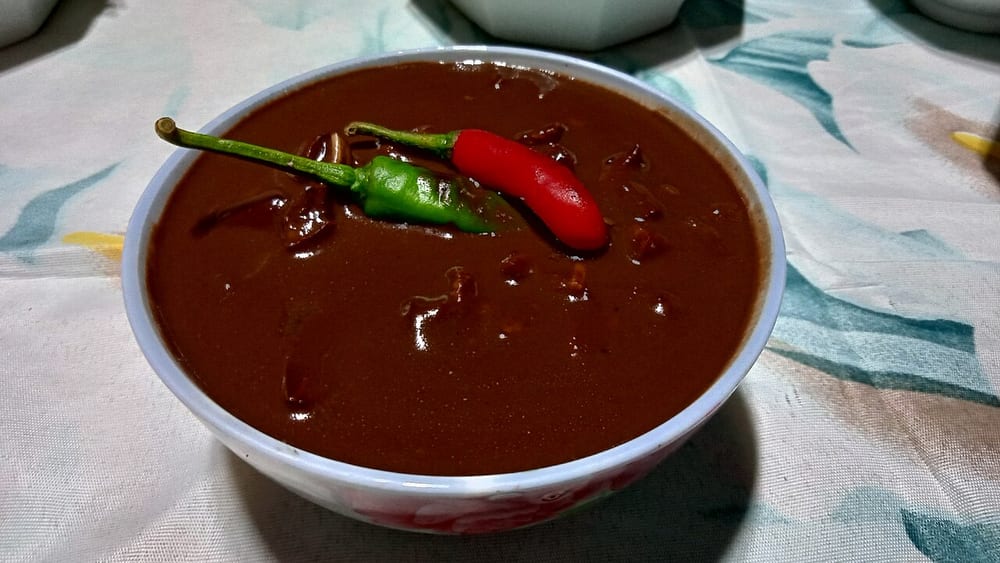
Dinuguan isn’t a sausage at all, and I’m including it deliberately. The Filipino stew — blood, vinegar, chile, usually offal — is the same logic without the casing, blood as sauce and thickener rather than the body of a set loaf. “Sausage” is a delivery format, not a category of ingredient. The branch exists wherever pigs are killed; whether it ends up in a casing is a local accident.
Grain is structure, not filler
Call the oats in a black pudding “filler” and you have made a claim about the maker’s motives — that they were stretching the good stuff, cutting the expensive with the cheap, getting away with something. That’s a class judgment dressed as a technical one, and it collapses the moment you look at what the grain is doing.
Pull the oats out of a black pudding and you do not get a purer black pudding. You get a puddle. Coagulated blood alone is a dense, dark, rubbery-then-crumbly solid with nothing holding water. The grain is the water-holding phase: it swells in the soak, holds that liquid through the poach, and gives the coagulating blood protein something to grip. Pinhead oatmeal specifically, because it stays granular and you get a crumb. Rolled oats collapse into wallpaper adhesive. That’s a structural distinction, not a quality-grade one, and any cook who’s tried both knows it in four minutes.
Same story down the line. Rice in morcilla gives discrete grains in a soft matrix, so the slice reads studded rather than uniform. Barley brings a chewier, glossier particle. Buckwheat in Polish kaszanka carries its own flavor in, which is the point — a kaszanka made with rice would taste wrong at identical texture. Glass noodles in soondae aren’t grain at all but pure sweet potato starch: almost no flavor, and a slippery springiness unlike any of the above. Bread and rusk in the English tradition sit closest to the “economy” reading, and I’ll grant that one — rusk in commercial sausage genuinely is a yield measure as often as a texture choice.
So the honest position isn’t “grain is never filler.” It’s that in this branch the grain is load-bearing by design, chosen by type for what it does structurally, and the cook who removes it doesn’t get a better product — they get a failed one. “Filler” imports a suspicion the technique doesn’t earn.
Liver: scald it, never boil it
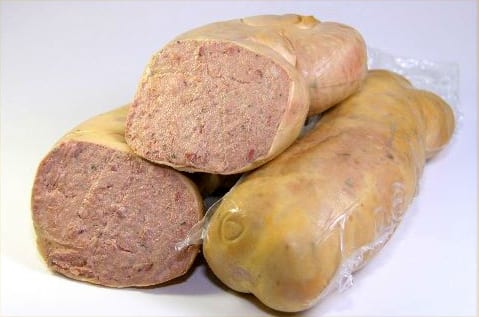
Liver sausage is a different construction from blood sausage, and the German scheme is clearer about it than English is: leberwurst and blutwurst are both Kochwurst, built from material that was cooked before it became sausage.
The critical rule, and the one that separates a silky liverwurst from a grainy disappointment:
Scald the liver. Do not boil it.
Liver’s contribution to a liver sausage is emulsifying capacity — it holds fat in suspension, which is what gives leberwurst its spreadable, unctuous body. That capacity lives in liver proteins that are intact and still functional. Boil the liver and you denature them past usefulness; the emulsion won’t form, the fat separates, and you get a gritty, greasy paste with a weeping edge. Scalding — a short dip in hot but not boiling water — firms the surface and leaves the interior protein able to do its job. Blanch it too hard and the failure is unrecoverable in exactly the way over-boiled blood is. Both classes punish heat, at the same step, for related reasons.
Braunschweiger in America means a smoked liver sausage, usually spreadable, usually sliced onto rye. Worth knowing that in Germany Braunschweiger Mettwurst is a smoked raw spreadable pork sausage with no liver in it at all — the American product borrowed the city’s name and attached it to a different thing.
And pâté is the same family wearing better clothes. A pâté de campagne is a coarse ground pork-and-liver batter, seasoned, packed into a vessel and cooked — a sausage by every criterion except the casing. Terrine names the dish it’s cooked in; pâté just means paste. The French kept the technique inside the fine-dining tradition while the same technique in a casing got filed under peasant food, and that split is entirely presentation and nothing method. A charcutier making pâté and a butcher making leberwurst are doing the same job.
Head, gut and the rest
The head branch sets on gelatin — not coagulating protein, not emulsion. Simmer the head (or trotters, or hocks) until the meat drops off and the collagen has converted to gelatin in the liquid. Pick the meat, chop it, season it hard — vinegar, pepper, bay, allspice, more of all of them than feels right, because gelatin mutes everything — reduce the stock until it will set, combine, mold, chill. A terrine with a sausage’s genealogy.
Head cheese and souse are the same construction, the second name Southern and Appalachian. I keep a hog head cheese in the collection. Its American survival is real but regional — the South, Pennsylvania Dutch country, Cajun Louisiana, every Eastern European deli case, and approximately nowhere else on the national grocery shelf.
Andouillette is where I stop soft-pedaling. It’s a French sausage made of pork large intestine and stomach, cut into strips lengthwise and packed into a casing so the strips run along the length, poached, then grilled or pan-crisped and served with mustard.
It tastes and smells strongly of what it’s made of. That isn’t a defect and a good producer doesn’t minimize it; it’s the point. It divides people absolutely, including French people, and I’d be lying if I called it a taste everyone acquires. Anyone who tells you an andouillette is subtle has either not eaten one or is selling something. It is also — the accuracy note that matters most on this page — completely unrelated to Cajun andouille, a coarse smoked pork sausage with nothing offal about it. Shared root word, different products, and confusing them is the commonest error in American writing about either.
Kishka splits into two products under one name. Polish kaszanka is genuinely a blood sausage — buckwheat groats, blood, offal, in a casing. Ashkenazi Jewish kishke (stuffed derma) is not, and cannot be: kashrut forbids consuming blood, so the Jewish version is flour or matzo meal, onion, schmaltz and seasoning stuffed into beef intestine and roasted, often with a cholent. Same word, same casing, same corner of Eastern Europe — and one is defined by the absence of the ingredient the other is defined by having.
Haggis is sheep’s pluck — heart, liver, lungs — with oatmeal, suet and onion, cooked in the stomach. And this is the product with a genuine US problem: FSIS regulations prohibit lungs in human food, which is why authentic haggis can’t be imported or made here to the traditional formula. The rule is real, it names haggis, and it does not touch black pudding, which contains no lung. That confusion is the whole origin of the “black pudding is banned in America” story.
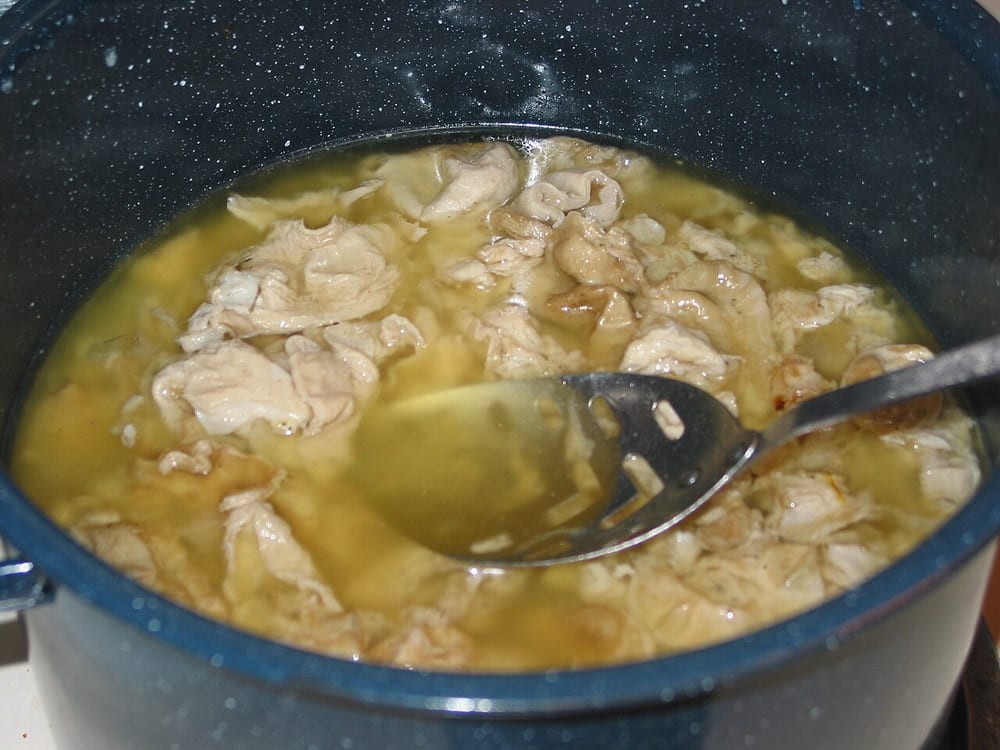
Chitterlings are the American holdout — a stew and a side rather than a sausage, small intestines cleaned exhaustively, simmered long, served with vinegar and hot sauce. They’re load-bearing in Black Southern cooking and holiday cooking specifically, and they survived the industrialization of American meat because the demand never went away. Which is exactly what didn’t happen for blood.
Getting blood in America, honestly
The practical answer is less dramatic than the reputation.
Frozen, from an Asian or Latino market. That’s how I got mine — a market near the MSU campus, in a freezer case, next to things no chain grocery in Michigan stocks, for almost nothing. Online Asian grocers ship it frozen. A butcher who slaughters will often set some aside with a week’s notice, if you ask like someone who’s going to use it rather than someone running a dare.
What most commercial pudding actually uses is dried blood powder — reconstituted, usually imported. Not a scandal, a shelf-life answer, and it means the supermarket product is often less “traditional” than a home cook working from a freezer bag. It also means powder is a legitimate option for you. It’s what the industry runs on.
What I’d tell you about the rules: blood is legal to buy and sell as food in the US, and food-purpose blood should come from an inspected source. Beyond that I won’t pretend to more precision than I have. On the black pudding page I said plainly that I could not locate the specific FSIS regulation governing edible blood collection for retail, and never verified state rules including Michigan’s. Still true, and I’m not going to quietly upgrade it here. Doing anything past cooking for yourself, call your state ag department.
Handling, which is the part that actually matters: keep it below about 35 °F throughout, strain it after thawing because thawed blood always throws clots, never refreeze it, cook to 160 °F internal, and never let the poach reach a boil.
So why did America lose it?
Three things, and I want to be careful about the weight on each, because this is where confident narratives outrun the evidence.
1. Industrial slaughter physically separates the blood from the butcher. This one is structural rather than cultural, and I’m confident about it. In a high-throughput plant blood goes into a collection system feeding rendering — blood meal, fertilizer, feed. It’s a byproduct stream by default. Collecting it as food is a separate, more sanitary process with its own handling requirements, and a plant only builds that if there’s a buyer. When the butcher stopped being the person who killed the animal, blood stopped being something they had. Nobody decided it; it’s a plumbing consequence.
2. Regulation raised the floor for the small producer. Federal inspection requirements make it meaningfully harder for a small operation to sell blood and offal products across state lines than to sell ground pork, and the volumes rarely justify the compliance. Same mechanism that keeps Irish black pudding out of American groceries — establishment certification and paperwork, not prohibition. Haggis is the one true ban, and it’s about lungs.
3. A cultural shift that arrived with the supermarket meat case. Self-service refrigerated meat in trays under film ended the transaction where a customer asked a butcher for a cut and the butcher answered. What’s on offer became what’s pre-cut and pre-wrapped, and blood and offal don’t merchandise that way. A generation grew up on meat that looks nothing like an animal, and the parts that obviously are an animal started reading as transgressive. I think this is right, but I’ll flag it as the softest of the three — a plausible historical story rather than a documented mechanism, and I’ve seen it asserted more than demonstrated.
What I’d resist is the fourth explanation people reach for — that Americans are uniquely squeamish. We eat hot dogs, which are a mechanically separated emulsion, and bologna, and Braunschweiger on rye, and chitterlings at Christmas, and scrapple for breakfast. The squeamishness is specific and recent and about visible offal, not about offal. A merchandising artifact more than a national character trait.
What’s actually worth making
The on-ramp is not the andouillette.
Start with blood pudding in a loaf pan — the one sausage in the family that genuinely needs no casing and no stuffer, because it sets by itself. Blood, diced fat, soaked pinhead oats, cooked-and-cooled onion, salt, pepper, into a lined pan, into a water bath, gentle heat, chill overnight, slice and fry. No cure arithmetic, no fermentation clock, no emulsion temperature ceiling. The hardest part is buying the main ingredient, and the hardest part of that is deciding to.
Then head cheese — a pot, a head and patience, and it teaches you more about gelatin than any amount of reading will. Liver sausage third, because the scald window is the fussiest thing on this page.
In the collection: black pudding · head cheese and souse
Elsewhere in this dive: the family tree for where these three classes sit among the other nine, and blood as an ingredient for the material itself. The Irish breakfast dive has the deepest treatment of a single blood sausage anywhere in my writing, including the myths.
Comments (0)