Black Pudding
I’ve made this. Twice-ish, if you count the one that went wrong.
The blood came frozen from a market near the MSU campus that I love shopping at — the kind of place with an aisle for things no chain grocery in Michigan would stock. I want to lead with that, because the single biggest barrier between an American cook and a black pudding is the belief that you can’t get blood. You can. It’s in a freezer case, probably within driving distance, and it costs almost nothing.
Everything else about black pudding is easier than the reputation suggests. It’s the ingredient that scares people, and the ingredient is the easy part.
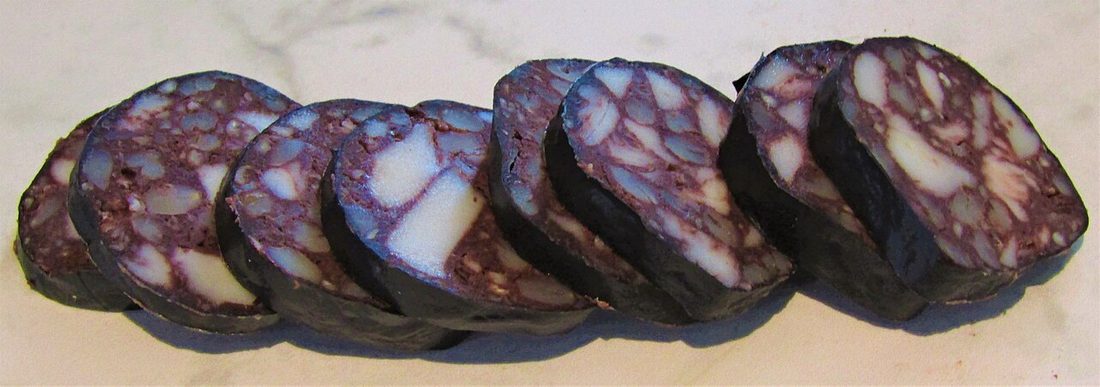
The white fat cubes are diagnostic — that’s why the fat is diced at 6 mm and never ground. Grind it and you lose both the look and the texture.
What it actually is
Blood, hard fat, a cereal, onion, salt, spice — stuffed into a casing and poached at manufacture, then sold ready-cooked. You slice it and fry it. It is not raw when you buy it, and frying is a reheat-and-crust step, not the cook.
That last point trips people up constantly. You’re not cooking black pudding in that pan. You’re putting a crust on something already cooked.
And here’s the distinction that actually defines it, which most explainers miss entirely:
It isn’t the blood. Everybody’s blood sausage has blood. It’s the cereal.
Wikipedia puts it well — “the high proportion of cereal, along with the use of certain herbs, distinguishes black pudding from other blood sausages.” That’s the real axis. The British Isles pack their blood sausage with grain. The continent mostly doesn’t.
Three things nearly every explainer gets wrong
1. Clonakilty — the most famous Irish black pudding — is BEEF
Not pork. Beef blood and beef fat.
Clonakilty’s own site says the pudding is made from “beef, oatmeal, onions, beef blood and a secret blend of spices,” first made in the 1880s. The Irish Times did a teardown of actual supermarket labels and found Clonakilty declaring beef blood powder and “Irish beef fat (25 per cent).”
So every “black pudding is pig’s blood” explainer fails on the flagship example. The most famous Irish black pudding in the world is a beef product.
Ireland has historically used both pig and cattle blood — and sheep, once. (See drisheen, the Cork one, which is its own strange story.) The folk explanation for Clonakilty’s beef is that beef blood was simply more locally available, and some tellings add that it gives a deeper flavour. The availability story is plausible; the “deeper flavour” part reads as marketing. I found no primary documentation of either. Treat as tradition.
2. Ireland’s famous puddings are mostly made from DRIED BLOOD POWDER
This is the one that genuinely deflated me.
The romantic story — fresh blood, the farm, the morning of the slaughter — describes the artisan tier only. Wikipedia notes commercial black puddings use synthetic cellulose skins and are “usually produced from imported dried blood.” The Irish Times label survey found Clonakilty uses beef blood powder; Denny (Kerry Foods) uses “haemoglobin powder” — and Denny’s main ingredient is pork rind. “Most of it is imported.” The more elaborate brands carry sodium triphosphate, polyphosphate, nitrate and nitrite.
So the supermarket pudding is reconstituted powder in a plastic skin. Which means — and I say this with some satisfaction — the black pudding I made in Michigan from actual frozen pig blood is, on that one axis, more traditional than the one you’d buy in a Cork supermarket.
The artisans who do use fresh blood are worth naming:
- Inch House (Thurles, Co. Tipperary) — made by Nora Egan to a family recipe handed mother-to-daughter. Declared: fresh pig’s blood, kibbled onions, mixed spices, oatmeal, pork fat, rice, salt, water. That rice is fascinating — it puts an Irish artisan pudding closer to Burgos morcilla than to Bury.
- Jack McCarthy (Kanturk, Co. Cork) — fresh blood from free-range pigs, coarse Macroom oatmeal, cream and butter from a North Cork dairy, and Midleton Special Reserve whiskey. Served at the state banquet for Queen Elizabeth II’s 2011 visit. Gold from the French blood-sausage brotherhood in 2010 and 2013.
- Rosscarbery (Co. Cork) — Avril Allshire, inducted into the same Confrérie in 2010.
⚠ I’d intended to write about McGeough’s of Oughterard too, but I could not verify anything about their black pudding — they’re well known for air-dried lamb and charcuterie, and whether the pudding is a significant product I couldn’t confirm. So I’m not writing about it.
3. “Black pudding is banned in the US because of sheep lungs” — false twice over
This is everywhere, and it’s wrong on both the fact and the reason.
On the reason: it’s a haggis conflation. The 1971 USDA lung ban is real, and it’s why authentic haggis can’t be imported. But black pudding contains no lung. Not one composition source in this entire research — Wikipedia, Clonakilty, Inch House, Jack McCarthy, Marianski, the Irish Times label survey — lists lung. The claim is pure contamination between two “weird British offal” stories that got filed in the same mental drawer.
On the fact: it isn’t banned. Ireland is an FSIS-eligible country for pork exports to the US. The actual reason you can’t buy Clonakilty in Boston is gloriously boring: individual establishments must be FSIS-certified to export, product needs foreign inspection certificates and reinspection, and the Irish pudding makers haven’t gone through that process because the volumes don’t justify it. It’s paperwork and economics, not prohibition. Clonakilty themselves have said that “due to the stringent restrictions on importing meat products to the USA, people this side of the pond will not be able to try this tasty new treat.”
Scorecard: “Clonakilty isn’t sold in the US” ✅ true. “Black pudding is banned in the US” ❌ false. “Because of sheep lungs” ❌ false and confused with a different food.
Oatmeal vs barley — real, but not a law
The clean version you’ll read is Ireland = oatmeal, Britain = barley. It’s broadly right with one honest wrinkle.
For it: Irish makers’ own labels say oatmeal — Clonakilty (oatmeal), Inch House (oatmeal + rice), Jack McCarthy (coarse Macroom oatmeal, a named Irish stoneground). And the cleanest published traditional British formula I found is genuinely barley-dominant — 300 g pearl barley against 150 g fine oatmeal per kilo.
The wrinkle that breaks the tidy framing: Scottish black pudding — Stornoway especially — is famously oatmeal-heavy. And Scotland is British.
So don’t write “Irish = oats, British = barley” flatly. The real shape is Ireland and Scotland lean oatmeal; England leans barley, rusk and breadcrumb.
Pinhead oatmeal = steel-cut oats = groats chopped, not rolled. This is the texturally correct choice and it’s not a detail you can skip: pinhead stays granular, giving that characteristic gritty-but-moist crumb. Rolled oats go pasty. I tried rolled once. Don’t.
⚠ On rusk as a black pudding binder — I could find no authority establishing it as traditional in either country. It reads as a modern commercial economy. Unverified.
Where it sits among its cousins
| Cereal | Blood | Fat | Signature | |
|---|---|---|---|---|
| Irish | Pinhead oatmeal (Inch House also rice) | Pig or beef (Clonakilty = beef) | Back fat or beef suet | Pepper-forward; crumbly-moist; sliced & fried |
| British (Bury) | Barley groats / rusk | Pig | Back fat / suet | Boiled, served with malt vinegar from paper; heritage claims to 1810 |
| French (boudin noir) | Little to none | Pig | — | Cream-enriched, fine, smooth |
| Spanish (morcilla) | Rice (Burgos) | Pig | — | Rice + a high quantity of onions; varies hugely by region |
The one-line answer: cereal load is the axis. Continental blood sausage is blood-and-fat with little grain, or rice. The British Isles pack it with oats and barley. Ireland’s marker within that is coarse oatmeal.
The fat — and a claim I’m dropping
Both beef suet and diced pork back fat are well sourced. Clonakilty’s declared 25% beef fat is a useful real-world benchmark for loading.
The white cubes are diagnostic — the finished pudding “should be dark brown or black, with white pieces of fat.” That’s why the fat is diced at 6 mm and never ground. Grind it and you lose the visual and the texture in one move.
⚠ A correction against my own draft: I’d planned to write that Irish black pudding uses flare/leaf fat (the soft kidney fat you’d render for lard). I couldn’t source that at all. Every source says back fat (hard, dorsal) or beef suet (hard, kidney). And it makes mechanical sense that they’d be right and I’d be wrong: leaf fat is soft, and it wouldn’t hold its shape as those visible white cubes. So the claim is dropped rather than repeated. I’m noting it because it’s the sort of plausible-sounding thing I’d otherwise have sailed straight past.
⚠ “Black pudding is a superfood” was a marketing stunt
You may remember a wave of headlines around 2016 declaring black pudding a superfood. I did.
It came from an online retailer called MuscleFood, and their “new research” was an analysis of customer searches on their own website. Not testing. Not nutrition science. Search queries. On their own shop.
The Irish Examiner headline is admirably blunt: “Black pudding ‘superfood’ status was a marketing ruse.” Dr Anna Williams of the British Dietetic Association: “No. Black pudding is not a superfood.”
The actual numbers: roughly 300 kcal and 21.5 g fat (8.5 g saturated) per 100 g, and 1.5–1.8 g salt per 60 g serving. The iron is real — but it arrives packaged with saturated fat and salt, and haem iron carries bowel-cancer concerns at high processed-meat intakes.
Good Food Ireland still runs a “Black Pudding is the Newest Superfood” page. The ruse is still propagating on an otherwise reputable Irish site, ten years on.
Black pudding is delicious, genuinely iron-rich, and a treat. It is not health food. I’d rather tell you that and have you eat it happily.
Sourcing the blood — the honest version
Where to get it: Asian and Latino markets, frozen. That’s the reliable route and it’s how I got mine. Hank Shaw is right that “you can definitely buy pork blood in the United States.” Online Asian grocers ship it frozen. A butcher will often order it with a week’s notice. Farms that slaughter their own hogs are the other path, if you have the relationship.
On legality — the careful answer. Pig blood is legal to buy and sell in the US; there’s no federal ban on blood as a food ingredient. The sensible principle is that food-purpose blood should come from a USDA-inspected source.
⚠ But I want to be straight about the limits of what I checked. That “buy from a USDA-inspected source” framing comes from secondary sources, not from a primary regulation I could put my hands on. I did not locate a specific FSIS regulation governing edible blood collection for retail, and I did not verify state-by-state rules — including Michigan’s, which is the one that would actually apply to me. The principle is sound. The citation is missing. If you’re doing anything beyond cooking for yourself, ask your state ag department rather than trusting a food blog — this one included.
Handling, which is where the real risk is:
- Cook it thoroughly. 72 °C / 160 °F internal. Blood is a superb bacterial growth medium — it is literally culture broth. Never eat it raw.
- Keep it cold. Shaw’s rule for grinding: no warmer than 35 °F. Same discipline here.
- Don’t refreeze thawed blood.
- Strain it. Thawed blood clots, and the clots give a genuinely nasty texture. This is the step I skipped the first time and regretted.
- Never boil. Shaw: “you want something like 170 °F. Not a simmer, and definitely not a boil (the blood will curdle).”
- Fresh blood: ~2 days refrigerated. Frozen: ~3 months. ⚠ Those timings come from a blog-tier source; they’re consistent with general USDA practice for perishable raw animal products but I didn’t confirm them against an FSIS document.
One genuinely useful texture note from Shaw: “Pork blood will solidify and stay moist, while beef blood becomes crumbly and dry.”
That’s a real, practical distinction and it explains a lot. It’s likely why Clonakilty’s beef-blood pudding has its characteristic crumbly slice. And it means if you substitute beef blood into a pork-blood formula, expect a drier result — raise the fat a little to compensate.
The recipe
Black Pudding, Irish — the loaf-pan method.
Honesty label: this is a reasoned formula built from sourced anchors — Marianski’s traditional structure, re-cereal’d to oatmeal for the Irish profile and rebalanced toward a higher blood fraction, with poaching temperatures from both Marianski and Hank Shaw. It is not a transcription of a tested house recipe. I’ve made black pudding by this method and approach; I have not made these exact numbers enough times to swear by them. Treat it as a strong starting point, not scripture.
Why the pan method leads. Most American home cooks can get blood or casings, rarely both easily. Casings need a stuffer and ideally a second pair of hands. Blood pudding is one of the few sausages that genuinely doesn’t need a casing — it sets into a sliceable loaf because the blood proteins coagulate. A loaf pan and a roasting tray is all you need. This is the version to start with, and honestly the version I keep coming back to.
Makes one 9×5 in (23×13 cm) loaf, ~1.4 kg
| Ingredient | Weight | Notes |
|---|---|---|
| Pig’s blood (or beef) | 600 g | thawed, strained |
| Pork back fat, or beef suet | 300 g | diced 6 mm — do not grind |
| Pinhead (steel-cut) oatmeal | 220 g | dry weight |
| Whole milk or stock | 300 ml | for soaking the oats |
| Onion, finely diced | 150 g | sweated soft, then cooled completely |
| Fine sea salt | 22 g | ≈1.6% |
| White pepper, ground | 4 g | pepper-forward |
| Ground mace | 1.5 g | |
| Ground allspice | 1.5 g | |
| Dried thyme | 1 g | |
| Dried marjoram | 1 g |
Method
- Soak the oats. Warm the milk to lukewarm, pour over the pinhead oats, stand 30–60 min (or overnight in the fridge). Hydrated but still granular.
- Sweat and COOL the onions. ⚠ This is the step that got me. Cooked onion must be at fridge temperature before it meets blood. Hot onion starts coagulating blood in the mixing bowl and you get grainy pudding — which is exactly what happened on my first attempt, and I spent a while blaming the blood.
- Strain the blood through a fine sieve. Keep it cold.
- Mix blood, soaked oats with any unabsorbed liquid, diced fat, cooled onion, salt, spices. Thoroughly — but don’t whip air into it.
- Pan it. Grease a 9×5 loaf pan, line with parchment leaving overhang. Fill, tap down to knock out voids.
- Bain-marie. Loaf pan into a roasting tray; hot water halfway up the outside.
- Cook low: 160 °C / 325 °F, ~75–90 min, to an internal 72 °C / 160 °F. Do not let the water bath boil. Blood curdles above a gentle poach — this is the single most common failure and it is unrecoverable.
- Chill hard. Room temperature, then refrigerate at least overnight. It must be cold and fully set before it will slice. Not optional — warm pudding crumbles into the pan and you’ll think you failed when you were just impatient.
- Then slice ~1 cm and fry in a little fat, 2–3 minutes a side, until crusted.
Casing variant. If you have casings: stuff loosely into 36–40 mm hog casings — loose, because the oats swell and tight casings burst. Tie with butcher’s twine rather than twisting (Shaw: “twisted links will fall out” with blood sausage). Poach at 80 °C / 176 °F for ~40 min to 72 °C internal. Prick any that float. Marianski’s warning is explicit: “Don’t increase temperature as the casings may burst.” Cool in cold water, refrigerate.
A note on cloning Clonakilty: you can’t, and neither can anyone else. Their blend is a trade secret, the company won’t disclose it, and I found no credible reverse-engineering. Anyone selling you a “Clonakilty clone” spice blend invented it.
Next: white pudding — which is not “black pudding without the blood,” and the lazy definition hides something genuinely interesting.
Sources & further reading
- Wikipedia, Black pudding — the cereal-load distinction and the dried-blood note.
- Irish Times, “What is really in black pudding, apart from the bleeding obvious” — the label teardown. Genuinely valuable and slightly deflating.
- Clonakilty — clonakiltyblackpudding.ie.
- Inch House — inchhousepudding.ie · Jack McCarthy — via Bibliocook.
- Irish Examiner, “Black pudding ‘superfood’ status was a marketing ruse” and The Conversation, “Is black pudding really a superfood? Err… no!”.
- Hank Shaw, blood sausage — the best practical writing on handling blood in an American kitchen.
- Marianski, Black Pudding — Traditional and Blood sausages.
- USDA FSIS, Ireland import/export library — Ireland’s eligibility, against the “banned” myth.
- Tasting Table, on black pudding imports — cited as the source of the lungs myth, not as authority.
Comments (0)