Eggs, Tomato, Mushrooms & the Beans Question
The rashers get the billing. The puddings get the arguments. But the thing that actually makes an Irish breakfast taste like an Irish breakfast is a puddle of rendered pig fat in the bottom of a pan, and what you do with it next.
I’ve had the full Irish a handful of times in Galway, and the ones that stuck with me weren’t better because the bacon was better — though it was. They were better because everything on the plate tasted faintly of everything else. That isn’t an accident and it isn’t nostalgia. It’s a cooking method, and most places have quietly stopped using it.
The fat is the through-line
Here’s the idea this whole page hangs on, and the research file states it flatly enough that I don’t have to dress it up: the fry is not a collection of items cooked separately. It’s a sequence, and the fat carries flavour forward through it.
The bacon goes in first and renders. That fat is now the cooking medium for everything that follows. The eggs fry in it. The soda farl gets split and its cut faces go down in it. The potato farl fries in it. The mushrooms go in and drink it. The tomato halves sit cut-side down in it and pick up the fond off the bottom of the pan.
By the time the plate is assembled, every component has been through the same fat, in order, each one taking a little of what came before and leaving a little behind. The mushrooms taste of bacon. The bread tastes of sausage. The egg white has crisp brown lace on the edge because it hit fat that had already been hot for ten minutes with a pig in it.
This is exactly the thing a hotel buffet destroys. Not through malice — through logistics. A buffet cannot cook in sequence. It cooks in parallel, in separate hotel pans, in bulk, ahead of time, and then holds everything at 65°C under a lamp until you walk past with a plate. Every component is technically present. The bacon is there. The eggs are there. The mushrooms are there. But they’ve never met. You get a plate of adjacent foods instead of a meal, and you can’t quite articulate why it’s disappointing, so you blame the bacon.
It isn’t the bacon. It’s the missing sequence.
I cure my own bacon, so I have a slightly unfair relationship with this: I know what comes out of the pan when it renders, and I’m not throwing it away. If you take one operational thing off this page, take that. Cook in order. Don’t wipe the pan between things. The whole method is on how to cook one; the bread half of it is over on farls and boxty; the pig that starts it is on rashers, sausages and puddings.
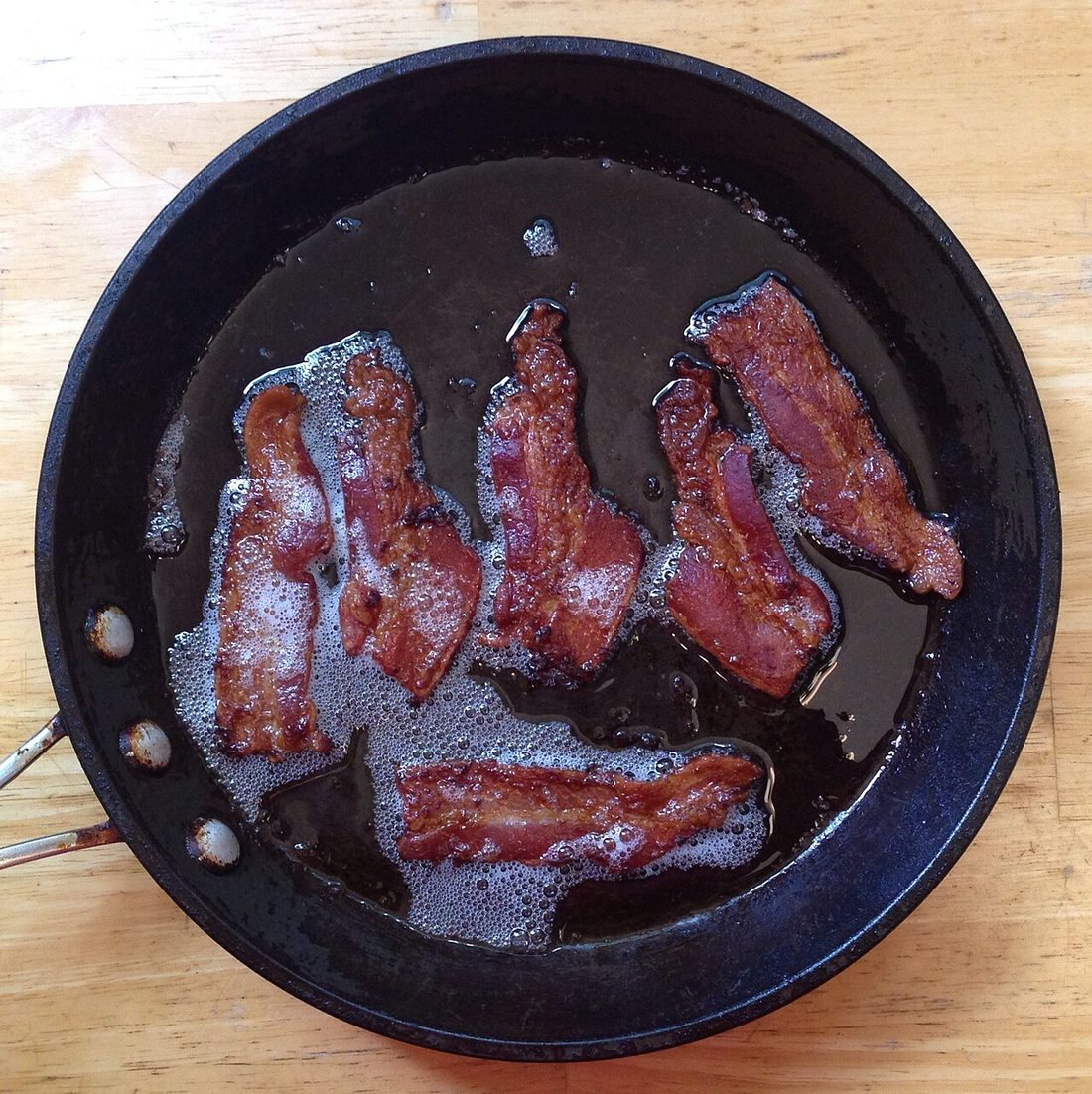
The fat is the through-line. Everything that follows the bacon fries in this — eggs, mushrooms, tomato, and the farl last of all.
The quiet ones: tomato and mushrooms
Now the honest part.
I went looking for the history of the grilled tomato and the fried mushroom on the Irish plate. When did they arrive? Who put them there? What did they displace?
NOT FOUND. Both of them.
Not “the sources disagree.” Not “it’s contested.” There is essentially no documented history of either component. Every blog treats them as eternal — as if the tomato has been sitting on the edge of the plate since the invention of the pig. Nobody says when. Nobody cites anything. Nobody appears to have asked.
I could invent something plausible here. It would be easy. Something about Victorian glasshouses and market gardening, a nod to the tomato’s slow acceptance in the British Isles, a confident sentence with no citation under it. That’s how food-blog history gets made — someone writes a reasonable-sounding guess, three sites copy it, and by the fifth copy it has hardened into fact with no source anywhere in the chain.
So instead: these are the quiet ones, and nobody has written their history. That’s a more interesting sentence than fake provenance, and it’s also true. Two of the six or seven things on the national breakfast plate of an entire country have no recorded origin. That’s a genuinely strange fact about how little we bother to document ordinary food.
What I can tell you is what they’re for, because that part is observable. The tomato is the only acid on the plate. Everything else is fat, salt, and starch — the tomato is the thing that cuts it and lets you keep eating. The mushroom is the sponge; it’s there to hold fat and deliver it. Halve the tomato, cut side up, grill it or fry it in the pan fat, season it. Mushrooms go in the fat and stay until they’ve stopped squeaking and gone properly brown.
Undocumented isn’t the same as unimportant. It just means nobody wrote it down.
The beans question
Right. Beans.
The correction here is bigger than it looks, and it starts with the fact that almost everyone — including me, before I read the research — has the nationality wrong.
Baked beans are American. Not English. Heinz is H.J. Heinz, of Pennsylvania. The beans on your Irish breakfast plate are an American product that took a very long detour through the British grocery trade and came out the other side sounding local.
The timeline:
| Year | What happened |
|---|---|
| 1886 | First sold in the UK — at Fortnum & Mason, London, as a luxury import at ninepence a can |
| 1895 | First mass commercial canning of baked beans, in the US, by Heinz |
| 1899 | ⚠ Reported first on sale in Ireland, at Alex Findlater & Co stores, Dublin |
| 1901 | Sold throughout the UK |
| 1905 | First UK factory opens at Peckham, south London |
| 1927 | ⚠ A Heinz marketing campaign is attributed with positioning beans on the breakfast plate |
Two of those rows need flags on them, and I’d rather flag them loudly than let them slide.
The 1899 Irish date is reported, not independently verified. The source is a retailer page. It reads like Heinz Ireland marketing copy, and Wikipedia’s own Heinz Baked Beans article doesn’t mention Ireland at all. It’s plausible — Findlater’s was a real and significant Dublin grocery chain — but a retailer telling you how long it’s been selling something is not scholarship. Treat it as reported.
The 1927 campaign is attributed, not confirmed. The date is repeated across sources, but the primary campaign material was never seen. The corporate dates around it (1886, 1901, 1905) are well-documented company history and I’d stand behind them. 1927 as the exact pivot is softer than the confidence with which the internet repeats it.
Also worth noting: nobody has established when beans first appeared on an Irish breakfast plate, as opposed to on a shelf in Ireland. Retail availability is not the same as plate presence, and the gap between those two events could be decades. NOT FOUND.
Now the interesting bit. The recipe was deliberately reformulated for the British and Irish market — less sweet, with the maple syrup, molasses and brown sugar dropped. An American company took its American product, took the sugar out of it because the locals didn’t want that much, and sold the result for a century and a quarter until it tasted native. American beans, anglicised in the can.
So what do we call them? Retailer copy calls them “essential to any traditional Irish breakfast.” That’s wrong on one word: traditional. They’re not. They arrived through commerce, they were positioned by advertising, and there is no folk tradition anywhere in their story.
But they’ve been on this island roughly 125 years. My grandparents weren’t alive for their arrival. At some point “recent import” stops being a useful description of something that’s outlived everyone who remembers it being new. So: not traditional, but naturalised. That’s the honest word. They’re beans that got citizenship.
I’m not going to tell you to leave them off. I’m telling you not to call them traditional, and not to let a can convince you it’s older than the pig.
Hash browns: the displacement
The hash brown gets called a modern invention. That’s wrong too, just in a different direction.
“Hashed brown potatoes” appear in Victorian-era cookbooks. The dish is old. Anyone telling you hash browns were invented in the 1980s is as wrong as the person telling you beans are English — they’re just wrong about a smaller thing.
What is recent is the hash brown as a breakfast-plate fixture, and the mechanism is depressingly specific:
- 1982 — McDonald’s puts its hash brown on the breakfast menu
- 1980s — fast food normalises the shape
- 1990s — frozen hash browns hit grocery freezers, and from there the café and hotel pan
So it’s a Victorian dish that became ambient via American fast food and the freezer aisle. Wikipedia’s Full breakfast article files it alongside baked beans and coffee-instead-of-tea as a “common contemporary but non-traditional inclusion,” and notes that “traditionalists consider hash browns to be an abomination, even though they are increasingly popular.”
⚠ No Irish-specific date exists for either beans or hash browns entering the Irish fry. The timeline above is British and American and was almost certainly transferred, but I have no Irish source pinning it, so I’m not going to pretend I do.
Here’s the sharp point, and it’s the reason this section exists at all: the hash brown didn’t ADD potato to the plate. It DISPLACED a better potato.
The traditional plate already had potato on it. It had potato farls. It had yesterday’s spuds sliced and fried. The plate was never short of potato — this is Ireland. So the hash brown isn’t an addition, it’s a replacement, and it replaced something made in the same kitchen that morning with something that arrived frozen in a box.
That’s not a moral failing. It’s a hotel doing hotel arithmetic. A frozen hash brown holds under a lamp; a potato farl doesn’t. It’s portioned, it’s costed, it’s identical every time, and it takes zero skill. If you’re feeding 200 tourists before the coaches leave at nine, the freezer aisle is a rational answer. The Ulster fry never needed one, but the Ulster fry was never trying to serve 200 people at once.
I just want the trade named. You didn’t gain a potato. You lost a better one.
What the potato is supposed to be
The actual tradition is duller than a hash brown and better than one: yesterday’s boiled potatoes, sliced, and fried in the fat.
That’s it. That’s the whole thing. Traditional Irish breakfasts often included fried potatoes or potato farls, and both of them are the same idea — the potato on the breakfast plate is a leftover. Sunday’s spuds are Monday’s breakfast. It isn’t a garnish, it isn’t a side, it isn’t there for the photograph. It’s thrift, cooked in the fat that was going to be there anyway, using a thing that already existed and would otherwise have been binned.
This is the side I’d champion over every other item in this section. It costs nothing. It uses fat you already have and potato you already cooked. And a cold boiled potato, sliced thick and put down in bacon fat until the outside goes glassy and brown while the middle stays waxy, is genuinely one of the great breakfast foods. It’s better than a hash brown by every measure except reproducibility, which is the only measure a hotel cares about.
Potato farl is the more finished version of the same instinct — cooked mash plus flour, griddled, then split and fried. It’s on farls and boxty with the ratios that matter.
The bottles on the table
Brown sauce. The famous one is HP, and it genuinely gets used — but HP is British. Ireland’s own brown sauce is Chef, and Chef is what’s actually on an Irish kitchen table. The tourist-facing blogs only ever name HP, and the reason is simple: they’re writing for Americans, and Americans have heard of HP. It’s not that they’re lying. It’s that they’re describing a table they’ve never sat at.
Brown sauce itself is tomatoes, malt vinegar, molasses, dates, spices, and — the interesting one — tamarind. Wikipedia describes it as “similar to Worcestershire sauce,” which will surprise nobody who’s read the ingredient list, because that’s essentially the Worcestershire palette: sour, sweet, dark, funky, tamarind-driven. If you want to go down that particular hole, I’ve got a whole Worcestershire section with the oak-aging work in it. Brown sauce is Worcestershire’s thicker, sweeter, less mysterious cousin.
Ketchup. Chef again. Same story.
Mustard. Some people dip. Less common.
Butter. Not a condiment and not a garnish. Irish butter is the point — it goes on the farls, the soda bread, the potato bread, and it’s a genuinely distinct product from what most Americans have in the fridge. Don’t treat it as a spread. Treat it as an ingredient that happens to arrive at the table.
Marmalade. Belongs to the toast course, not the fry. It’s a British Isles breakfast convention rather than an Irish tradition, and I found no Irish-specific history for it at all. Keep it away from the bacon.
Tea, and the interloper
Tea is the tradition. Full stop, no hedging, and it’s got its own page: the tea.
Coffee is not. Wikipedia’s Full breakfast article lists coffee-in-place-of-tea as a “common contemporary but non-traditional inclusion” — on the same list as baked beans and hash browns. Coffee is the interloper. It’s in the same category as the frozen potato disc.
This is a slightly painful sentence for me to type, because I have an entire coffee section on this site and I am not a casual participant. But the research says what it says, and the whole point of this dive is that I don’t get to overrule a source because I’d prefer a different answer. Coffee is a guest at this meal. A welcome one, a good one, one I’d probably order — but a guest, and the fry’s native drink is a strong mug of tea with milk in it.
Drink what you want. Just don’t tell me it’s traditional. That’s the same move the bean can is trying to pull.
What all of it comes back to
Every correction on this page is a version of the same one.
Beans: not traditional, naturalised, arrived by commerce. Hash browns: old dish, new fixture, displaced something better. Coffee: fine, but a guest. Tomato and mushroom: genuinely undocumented, and honest about it. Fried leftover potato: the actual tradition, and the cheapest thing on the plate.
And underneath all of it, the fat. The sequence. The reason a fry cooked properly in one pan tastes like a meal and the same components cooked separately taste like a buffet. Everything else on this page is an argument about what goes on the plate. That one is about how, and it’s the only one that changes how the food tastes.
The rest is worth knowing. That one’s worth doing.
If you want the history of how the plate got assembled in the first place, it’s on the history page. If you want to cook one, that’s here.
Sources & further reading
- Wikipedia: Full breakfast — the source for beans, hash browns and coffee as “common contemporary but non-traditional inclusions,” and for the “traditionalists consider hash browns to be an abomination” line.
- Wikipedia: Heinz Baked Beans — the 1886 Fortnum & Mason luxury sale at ninepence, 1901 UK-wide, 1905 Peckham factory, and the deliberate less-sweet reformulation. Note: does not mention Ireland at all.
- Wikipedia: Baked beans — 1895, first US mass commercial canning by Heinz.
- Irish Crossroads: Heinz Baked Beans — the 1899 / Alex Findlater & Co, Dublin claim. ⚠ A retailer page, not a scholarly source. Reported, not independently verified.
- Food Republic: the origins of beans on toast — background on the 1927 campaign attribution. ⚠ Primary campaign material not seen; treat 1927 as attributed.
- Back Then History: the history of hash browns — Victorian “hashed brown potatoes,” McDonald’s 1982, the 1990s freezer aisle.
- The Spectator: Full English — the hash-brown discourse, including the English Breakfast Society’s “lazy American replacement” line and Felicity Cloake’s reply.
- McCain: potato hash browns — the industrial vector, for what it’s worth.
- Wikipedia: Brown sauce — the tomato/malt vinegar/molasses/dates/spices/tamarind composition and the “similar to Worcestershire sauce” comparison.
Explicit negative results — stated because they’re part of the finding:
- Any documented history of grilled tomato on the Irish breakfast plate: NOT FOUND.
- Any documented history of mushrooms on the Irish breakfast plate: NOT FOUND.
- The date beans first appeared on an Irish breakfast plate (as distinct from on sale in Ireland): NOT FOUND.
- Ireland-specific dates for beans or hash browns entering the Irish fry: NOT FOUND. The timeline is British/American and almost certainly transferred, but no Irish source pins it.
- Any Irish-specific history of marmalade at breakfast: NOT FOUND.
Comments (0)