What's Actually On It
There is no official Irish breakfast.
I mean that literally, and I can prove it with the Irish state’s own paperwork. Fáilte Ireland grades every approved B&B in the country, and its Minimum Requirements and Classification Matrix requires star-rated houses to offer cooked options besides — and I’m quoting the punctuation exactly — “Full Irish Breakfast”.
In scare quotes. Never defined. The state treats it as a known constant, a fixed point you must offer alternatives to. And the items the document actually mandates are: bacon, eggs, sausages, tomatoes, brown and white bread, toast.
No black pudding. No white pudding. The components every tourist article calls the definitive markers of Irishness are not required by the Irish state’s own breakfast standard. (That whole document is worth its own section — see Where You Eat It.)
So this page is not a canonical list, because there isn’t one. It’s an honest inventory: what’s on the plate, how solid each item’s claim is, and where to read more.
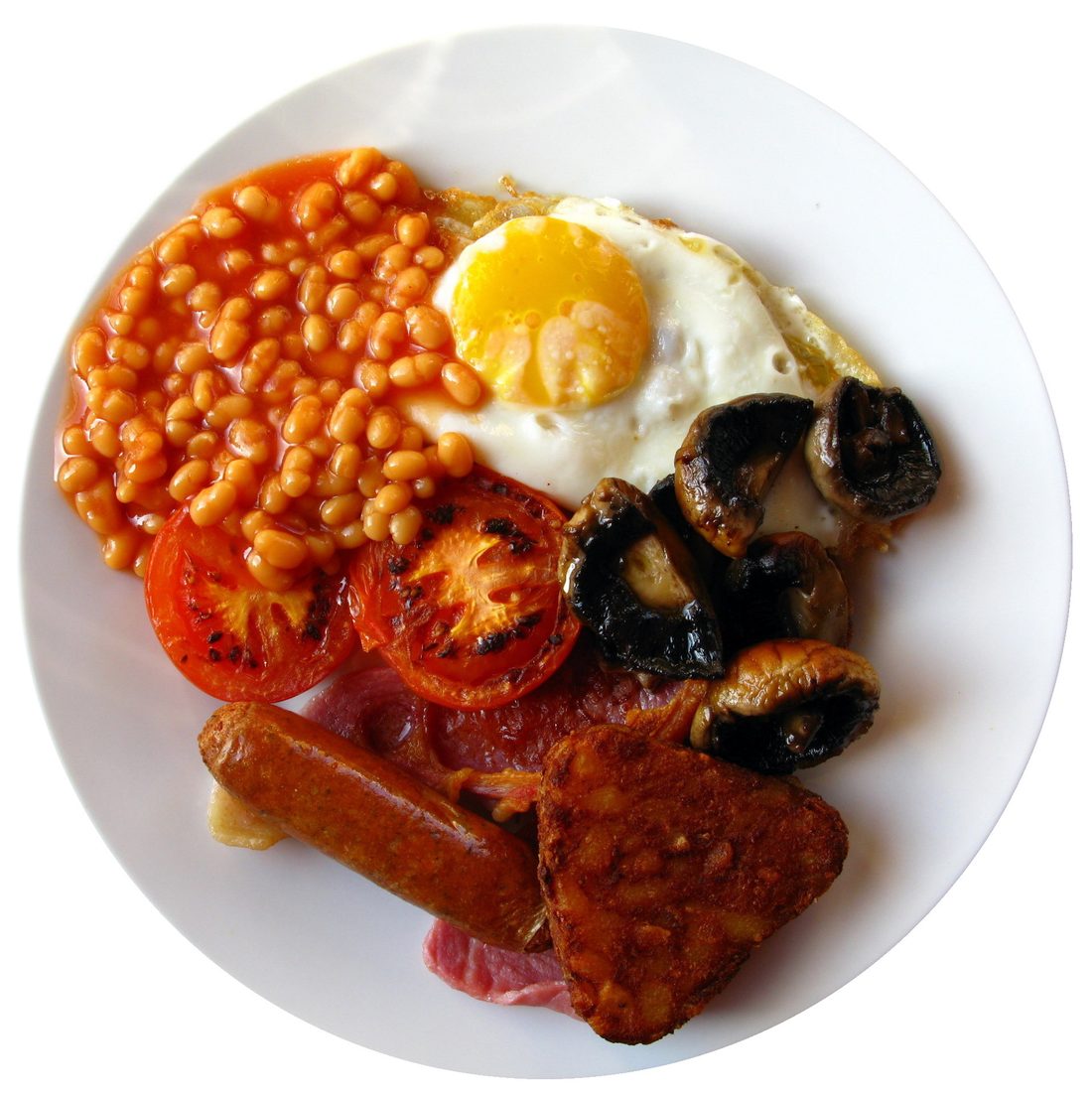
A cooked breakfast from overhead. This one’s a full English — note the hash brown and the total absence of pudding — but the geometry is the same, and look how much of the plate is starch.
The inventory
| Component | Claim to the plate | Verdict |
|---|---|---|
| Rashers | Back bacon — loin eye + belly tail | Core. In the state’s list. Not American bacon |
| Sausages | Pork + rusk, mild, pale | Core. In the state’s list |
| Eggs | Fried in the bacon fat | Core. In the state’s list |
| Black pudding | Blood + pinhead oatmeal | Iconic — but not in the state’s list |
| White pudding | Pork + oatmeal | Iconic — but not in the state’s list |
| Soda / brown bread | Bicarb + buttermilk | Core. In the state’s list |
| Tomato | Halved, grilled or pan-fried | Core. In the state’s list. No documented history |
| Mushrooms | Fried in the fat | Common. No documented history |
| Potato / soda farls | Griddled, fried in the fat | The Ulster marker. In the Republic, a northern borrowing |
| Fried potatoes | Yesterday’s spuds, sliced, fried | The real potato tradition. Undersung |
| Baked beans | Heinz | Not traditional — American, ~1927. But naturalised for ~125 years |
| Hash browns | Frozen, hotel pan | Not traditional. McDonald’s 1982 + the 90s freezer aisle |
| Tea | Assam + East African leaf | The native drink |
| Coffee | — | Listed as a “contemporary but non-traditional inclusion.” The interloper |
Two things jump out of that table.
First: the two most photographed, most talked-about, most “you have to try the black pudding” items are the two the state doesn’t require. Iconicity and canonicity are different things.
Second: look how much of the plate is potato or bread. Farls, fadge, boxty, soda bread, brown bread, fried potatoes, toast, hash browns, and beans on top of it. This is a breakfast built on starch with pork for flavour — which makes complete sense once you know that the pig was rent and the potato was dinner.
The thing that makes it a fry and not a buffet
If there’s one idea worth taking from this whole section, it’s this — and it isn’t an ingredient at all.
The fat is the through-line.
The bacon renders. The eggs fry in that fat. The farls go down cut-side into that fat. The mushrooms and the tomato go into that fat. The pudding crusts in that fat.
The fry is not a collection of items cooked separately and arranged on a plate. It’s a sequence — and the fat carries flavour forward through it, picking up something from each component and handing it to the next. By the time the soda farl hits the pan it’s frying in bacon, sausage, and pudding.
That’s the concept a hotel buffet destroys. Chafing dishes of separately-cooked components, each one fine, none of them talking to each other. It’s why a mediocre fry made in one pan at home beats an expensive one assembled from steam trays, and it’s why the whole thing is worth sequencing properly.
Component by component
Rashers & Bacon — the biggest thing Americans get wrong. A rasher is back bacon: the loin eye plus a tail of belly. American bacon is belly only. It’s a different cut of the pig, not a different cure, and the failure mode is trying to make it crispy. It’s meant to stay tender and be eaten with a knife and fork. I’ve cured both cuts, wet and dry.
The Sausage — pale, soft, mild, and defined by rusk, a yeastless twice-baked crumb that absorbs three times its weight in water. Americans sneer at “filler”; the filler is the point. And the word “banger” is attested in 1904 as naval slang for good sausages — so the exploding-wartime-sausage story isn’t just mis-dated, its premise is inverted.
Black Pudding — blood, hard fat, pinhead oatmeal, pepper. The cereal is what distinguishes it from continental blood sausage, not the blood. Clonakilty, the famous one, is beef — and it’s made from dried blood powder, like most commercial pudding. It is not banned in the US, and the sheep-lung reason is a haggis conflation. I made mine with frozen blood from a market near campus.
White Pudding — not “black pudding without the blood.” That definition hides the answer. The Irish version has pork and pork liver where the black has blood, and it’s a survivor of the medieval sweet-savoury pudding — a sibling of mincemeat and Christmas pudding that walked the other way. The one you genuinely cannot buy in America.
Soda Bread & Brown Bread — bicarb plus buttermilk, no yeast, no time, no oven. It solved three Irish problems at once: soft low-gluten wheat, no ovens, no reliable yeast. The bastible — a pot with coals piled on its lid — is why the loaf is round and domed. The bread is the shape of the pot. And the cross is folklore that the chemistry later justified, not the other way round.
Farls, Fadge & Boxty — the griddle breads, and the best things on the plate. A griddle has no lid and no top heat, so the dough goes thin and gets cut in quarters — farl is from fardel, a fourth part. Split and fried in the bacon fat, a soda farl is the single best bite at breakfast.
Eggs, Tomato, Mushrooms & the Beans Question — the supporting cast, plus the two most-argued items. Beans are American, put on the plate by an advertising campaign attributed to 1927. Hash browns didn’t add potato — they displaced a better potato. And nobody, anywhere, has written the history of the tomato or the mushroom on this plate.
Irish Breakfast Tea — Assam plus East African leaf, blended for soft Irish water. Which means my hard Michigan water is already a problem before I open the box. And Lyons, the “Dublin” tea, was founded by a London catering empire.
What I actually think belongs
Since there’s no official list, here’s mine — as one guy in Michigan who’s eaten this in Galway several times and now makes most of it himself.
Non-negotiable: rashers (real ones), sausages, a fried egg, black pudding, white pudding, and something griddled in the fat — a soda farl for preference, potato farl a close second. Brown bread and butter on the side. Tea.
Welcome: grilled tomato. Mushrooms. Fried leftover potatoes.
Fine, and I’m not going to be precious about it: beans. They’ve been on the island 125 years, everybody eats them, and food snobbery about a naturalised ingredient is tiresome. Put them in a little dish so they don’t flood the plate and we’ll have no argument.
The one I’d actually drop: the frozen hash brown. Not on authenticity grounds — on the grounds that it’s occupying the spot where a potato farl should be. It’s not an outrage. It’s just worse than the thing it replaced.
And if you only make one thing from this entire section, make the white pudding. No blood to source, no casings needed, no nitrite math — and there’s nothing on an American shelf that comes close.
Start with the history, or go straight to cooking the whole thing.
Comments (0)