Irish Breakfast Tea
Every blog post about Irish breakfast tea says the same thing: it’s Assam. Strong, malty, dark, Assam.
That’s half the story, and it’s the boring half.
The half nobody tells you is that in 1960, Peter Barry pioneered sourcing tea from East Africa, and it’s the African leaf — Kenyan and Rwandan — that defines what the modern Irish cup actually tastes like. Barry’s own marketing credits “the bright freshness of the African leaves,” and they’re not being poetic. Barry’s Gold Blend is not an Assam monolith. Neither is the category.
So here’s the honest line, and it’s the one this page hangs on:
Irish breakfast tea = an Assam backbone for malt and colour, plus East African leaf for briskness and that red-gold colour — blended for soft Irish water.
Not “just Assam.” And that last clause is where this gets genuinely interesting, because it means the tea in your cupboard in Michigan is not the tea they’re drinking in Cork. Twice over.
The water. This is the part that got me.
I brew. I make coffee seriously enough that there’s a whole coffee section on this site. Which means I’ve spent an unreasonable amount of my life on water chemistry — mineral content, extraction, why the same beans and the same grinder and the same recipe produce a different drink in two different kitchens. It’s not mysticism. It’s dissolved solids.
So when the research turned up the line that African teas steep particularly well in Irish water, which is soft, my head came up off the desk.
Then it got better. Lyons is blended one way for the Irish market and another way for export — precisely because the domestic blend is tuned to soft Irish water and the export blend can’t count on it.
A box of “Irish tea” bought abroad is not the same blend as the box on a shelf in Dublin. It’s not a scam and it’s not a downgrade — it’s a blender doing their job. But it means “I drink the real Irish stuff, I get it imported” is doing less work than the person saying it thinks. The export blend is a different tea. It was designed to be.
And then there’s my end of it. I’m in Michigan. Michigan water is hard. Limestone country. My water is full of calcium and magnesium and bicarbonate, and it is the near-exact opposite of the water this tea was designed around.
So a reader in Michigan brewing “authentic Irish breakfast tea” is not drinking what Cork drinks, and they’re missing twice:
| What Cork gets | What I get in Michigan | |
|---|---|---|
| The blend | Domestic formulation, tuned to soft water | Export formulation, tuned for elsewhere |
| The water | Soft — low mineral | Hard — high calcium/magnesium/bicarbonate |
Two independent variables, both wrong, in the same mug. And hard water does a specific, visible thing to tea: it’s why a hard-water brew goes flat and murky and grows that iridescent scum on the surface, while a soft-water brew of the same leaf comes up bright and clear. Carbonate hardness reacting with the tea polyphenols — the same chemistry that makes hard water a nightmare for a light-roast pourover.
I’m not going to tell you to buy a reverse-osmosis system to make a cup of tea. I’d think less of you and you’d think less of me. But if you’ve ever made a pot of Barry’s from a box a friend brought back and thought this is fine, but I don’t really get what the fuss is — it’s not you and it’s not the tea. You are drinking a different beverage than the one people are enthusiastic about. That’s not a fun fact. That’s the whole explanation, and it’s almost never printed anywhere.
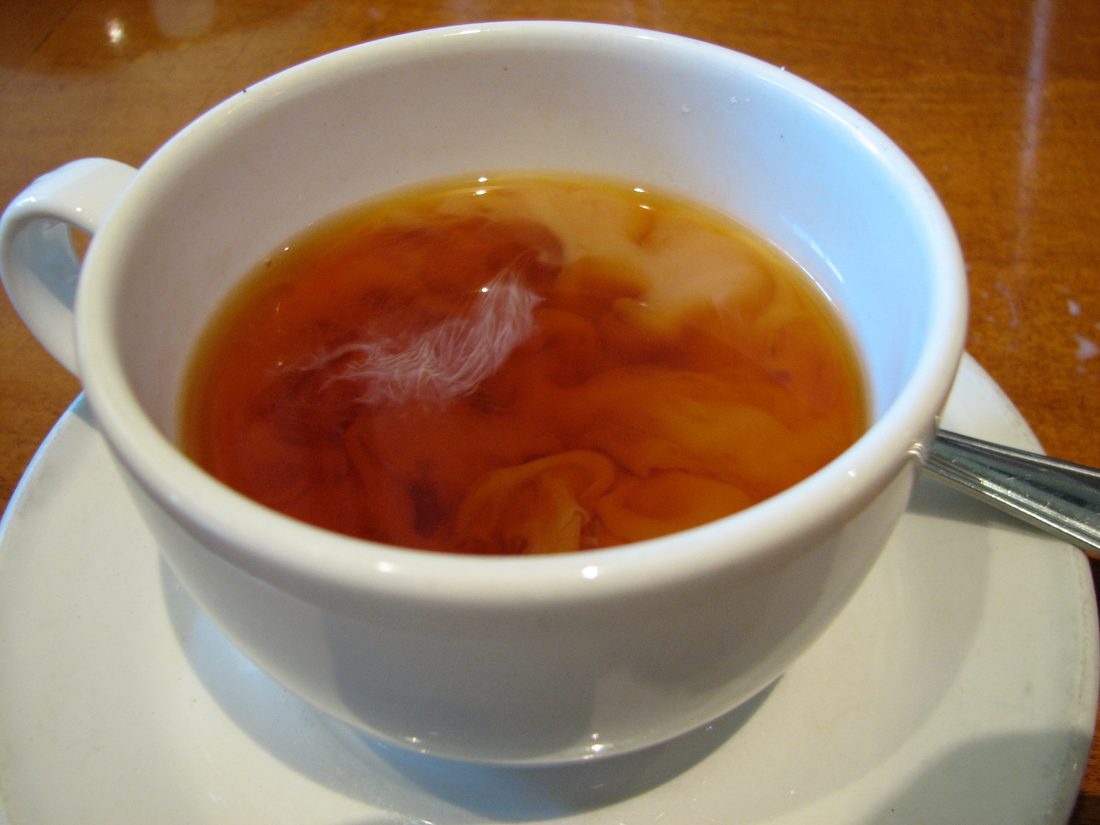
Strong, with milk, and drunk all day rather than at breakfast. The blend is built for soft Irish water — which my Michigan tap emphatically is not.
⚠ The correction: Lyons is a London company
This is the one that’ll cost you friends.
The Cork-versus-Dublin tea rivalry is one of the great small wars of Irish life. Barry’s is the southern tea. Lyons is the Dublin tea. Culchie versus jackeen, fought in a mug, and people are not joking about it.
Here’s the problem. Only one of those companies is from where you think it’s from.
Barry’s is genuinely Cork. Founded 1901 by James J. Barry, on Prince’s Street, Cork. Family firm. Every bit of the story checks out. Peter Barry — son of Anthony — is the pivotal figure: it was his 1960 move into wholesaling and East African sourcing that built the modern Irish cup and made the brand national by the mid-1980s.
Lyons is not a Dublin company. Lyons was founded by J. Lyons & Co., a London catering empire built by the Salmon and Gluckstein families — German-Jewish immigrants in London. Joseph Lyons himself was installed as chairman in 1895 essentially as the public face of the operation. Packaged tea sales from 1904.
The Irish part of the story is real, and it’s not nothing: the Dublin factory on Davitt Road was a major local employer for decades, and that is the actual basis of the brand’s Irish identity — not its founding. In 1996 the business was sold to Unilever, which owns it today.
And there’s a live dispute about how that history gets told. Unilever states the business started “in 1902 on High Street in Dublin.” TheJournal.ie has disputed that narrative directly, arguing the Irishness is substantially a marketing construct. I’m not going to adjudicate that from Michigan. I’ll do what the research file told me to do, which is present both, because it’s a live dispute and not a settled fact.
The line I’ll actually defend:
The Cork-versus-Dublin rivalry is completely real as consumer identity, and completely false as corporate history.
Both halves matter. The rivalry isn’t fake just because the corporate genealogy doesn’t support it. Loyalty to Lyons is about the Davitt Road factory and their mother’s kitchen and sixty years of the tea being theirs, and none of that becomes untrue when you learn about the Salmon and Gluckstein families. Identity doesn’t run on incorporation documents. But if you’re going to write the history down, write the history down.
⚠ Market share: the numbers are a mess
I wanted to give you a clean “Barry’s X%, Lyons Y%” table. I can’t, and I’d rather say so than fake it.
- Barry’s own website claims 38% of Irish tea sales, around €85m a year.
- An Irish Times piece put Lyons at 56% — but that’s from 1996. It is thirty years old. It gets quoted as current constantly. Don’t do it. I’m only naming the number so you recognise it when you see it and know to discard it.
- Recent sales data suggest Barry’s has overtaken Lyons.
So the defensible statement is the shape, not the digits: Lyons dominated historically; Barry’s leads now, at around 38%. Barry’s has a near-cult following in Cork and the south; Lyons long held Dublin and the Pale. That geography is the durable fact. The percentages are quicksand.
Consumption: a real number, with the year stapled to it
This one I can give you, with caveats attached, because the caveats are the interesting part.
Ireland drinks 2.36 kg (5.21 lb) of tea per person per year — second in the world.
| Rank | Country | kg/capita/yr |
|---|---|---|
| 1 | Turkey | 3.16 |
| 2 | Ireland | 2.36 |
| 3 | Azerbaijan | 2.10 |
| 4 | United Kingdom | 1.82 |
Source: Statista, 2016 data, via Wikipedia.
⚠ Now the honesty. That data is ten years old. Coffee has been climbing hard in Ireland since, and consumption has probably fallen. Other figures circulate — 2.19 kg, or about 4.8 lb a head — reflecting different methodologies and different years. If you quote 2.36 kg, quote the year with it, or don’t quote the number at all.
The robust claim is the ranking. Ireland is second, behind Turkey, ahead of the UK — stable across every source, whatever the methodology. And let’s be honest about which number in that table is load-bearing: it isn’t Turkey. It’s 1.82. Ireland out-drinks the country that spent several centuries insisting it was the tea nation, by about 30%. The ranking is the fact. Fourth place is the punchline.
What tea actually is here: the Emergency
If the ranking reads as a bit of harmless national trivia, here’s the thing that reframes it.
During the Emergency — Ireland’s WWII neutrality period — Ireland had the highest tea consumption in the world, and government research listed tea as the “principal item of food” for the Irish poor. Read that phrase again. Not a beverage. Not a comfort. The principal item of food.
Then, in 1940, Britain allowed the Irish a quarter-ounce per person per week — against the British full ounce. A quarter of what the people rationing you allowed themselves.
The deprivation was felt as genuinely traumatic. Not a food-writer’s flourish — the documented reaction, and the single most clarifying thing on this page. You cannot traumatise a nation by rationing a nice hot drink. You can traumatise a nation by rationing food. The full story is on the history page, where the Emergency sits as the anti-fry period — the austerity the whole post-war revival reads as relief from.
Every time someone smirks about the Irish and their tea, this is the thing underneath it. A quarter-ounce a week, and it was calories, and it was 1940.
⚠ Where does “Irish Breakfast Tea” even come from? NOT FOUND.
There’s a very attractive claim available here: “Irish Breakfast Tea” is an American marketing invention. It’s tidy. It’s smug. It fits the vibe of this entire page.
I could not verify it, so I’m not saying it. The origin of the phrase is NOT FOUND. No sourced etymology surfaced. Wikipedia — which is otherwise decent on this topic — makes no such claim.
Here’s what is sourced, and it’s suggestive as hell:
- In Ireland, the tea “is virtually never referred to as ‘breakfast tea’” — except as specific brand names. That’s Wikipedia, explicitly.
- It is drunk throughout the day, not at breakfast. It’s not a breakfast tea to the people who drink it. It’s just tea. All day. Every day.
- Barry’s sells a product literally named “Irish Breakfast” on its US-facing shop.
- Twinings — a British company — sells one too.
So: the category is essentially an export/diaspora label — a name applied to the tea from outside, for people outside, by people who needed a shelf-tag reading this one is strong and Irish. The Irish market largely doesn’t use the phrase about itself.
That’s an inference. I’m labelling it as an inference. The evidence points hard in one direction and I’m telling you which direction while explicitly not claiming I’ve proved it. The difference between “the evidence suggests” and “the fact is” is the entire difference between this page and the ninety blog posts above it in the search results.
How it’s actually drunk
Short section, because it’s short.
Strong. The blend is built for it — that’s what the Assam backbone and the African briskness are for. This is not a tea you coax. You steep it until it means it.
With milk. Wikipedia connects this directly to dairy’s role in the Irish economy, which is a nice bit of materialism: you put milk in it because there was milk, and there was milk because the whole country was built on cows. It may also be taken black, with sugar, or with honey — but milk is the default, and the tea’s strength is why.
The brands, for the record:
| Republic | Northern Ireland |
|---|---|
| Barry’s | Nambarrie’s |
| Bewley’s | Thompson’s Punjana |
| Lyons | |
| Robert Roberts |
All of them heavily weighted toward Assam. All of them, per the correction at the top, doing more with East African leaf than the marketing copy on this side of the Atlantic lets on.
And now the part where I have to eat it
I’m a coffee person. I have a ten-page deep dive on coffee on this website. I have opinions about roast curves. I have marinated a steak in drip coffee and written up the honest chemistry of why it only works on the surface.
And I have to concede the following, because it’s what the source says:
Wikipedia’s Full breakfast article lists “coffee in place of tea” as a “common contemporary but non-traditional inclusion” — in the same list as baked beans and hash browns.
The same list. As the hash browns.
I’ve spent this whole site arguing that hash browns are a frozen hotel-pan substitute that displaced a better potato. And here’s the reference work, calmly filing my life’s beverage in the same drawer.
Fine. It’s right. Tea is the tradition. Coffee is the interloper. When I had the full Irish in Galway — several times, and it remains one of the best meals I’ve had anywhere — the tea was not a compromise. It was the correct thing. It cuts the fat in a way a flat white does not, it arrives in a pot that keeps coming, and it belongs to that plate in a way my drink simply does not.
I’ll still order coffee. I’m not a martyr. But I’m not going to pretend it’s traditional, because that’s the exact move I’ve spent this whole dive calling out in other people.
Sources & further reading
- Wikipedia: Irish breakfast tea — the Assam weighting, the brand list (Barry’s, Bewley’s, Lyons, Robert Roberts; Nambarrie’s, Thompson’s Punjana), the milk-and-dairy connection, and the key line that in Ireland the tea “is virtually never referred to as ‘breakfast tea’” and is drunk throughout the day.
- Wikipedia: Barry’s Tea — founded 1901 by James J. Barry, Prince’s Street, Cork; Peter Barry’s 1960 move into wholesaling and East African sourcing.
- Wikipedia: Lyons Tea (Ireland) — J. Lyons & Co., the Salmon and Gluckstein families, Joseph Lyons installed as chairman 1895, packaged tea from 1904, the Davitt Road factory, and the 1996 sale to Unilever.
- TheJournal.ie: “Where is Lyons Tea from?” — the piece disputing Unilever’s “1902 on High Street in Dublin” narrative and arguing the Irishness is a marketing construct. ⚠ An opinion piece — but factually grounded, and the dispute itself is the story. Present both sides.
- Irish Times (1996): “Unilever bids to bag 56% of tea market” — the source of the Lyons 56% figure. ⚠ This is from 1996. Thirty years stale. Do not quote it as current. Linked here so you can recognise it in the wild.
- Wikipedia: List of countries by tea consumption per capita — Ireland 2.36 kg, 2nd in the world, citing Statista 2016 data. ⚠ Ten years stale; other figures circulate (2.19 kg; ~4.8 lb). The ranking is the robust claim, not the number.
- Dictionary of Irish Biography: Peter Barry — ⚠ identification unverified. This entry is for a Fine Gael politician and Tánaiste. It is very likely the same man, but I have not confirmed it, so I have not leaned on it.
- RTÉ Brainstorm: Ireland, the Emergency, food and drink, the black loaf and tea — the quarter-ounce ration, tea as the “principal item of food” for the Irish poor.
- Wikipedia: The Emergency (Ireland) — rationing context.
- Wikipedia: Full breakfast — the source for “coffee in place of tea” being grouped with baked beans and hash browns as a “common contemporary but non-traditional inclusion.” Yes, I checked it twice.
Explicit negative results — stated because they’re part of the finding:
- The origin of the phrase “Irish Breakfast Tea”: NOT FOUND. There is no sourced etymology. The widely-repeated “it’s an American marketing term” claim is attractive and unverified — I could not confirm it and I am not asserting it. What is sourced: Irish people don’t use the phrase, the tea is drunk all day, Barry’s sells “Irish Breakfast” on its US shop, and Twinings (British) sells one. The export/diaspora-label reading is my inference from those facts, not an established origin.
- Current Barry’s/Lyons market share: no reliable single figure. Barry’s self-reports 38%. The 56% Lyons figure is from 1996. Sources conflict badly.
Comments (0)