White Pudding
Ask the internet what white pudding is and you’ll get four words:
“Black pudding without the blood.”
That definition is lazy, and worse, it’s hiding the interesting part. It describes an absence — and the entire point of white pudding is what went in instead.
I’ve made both. White pudding is the one I’d tell you to make first, and it’s the one you genuinely cannot buy your way around in America.
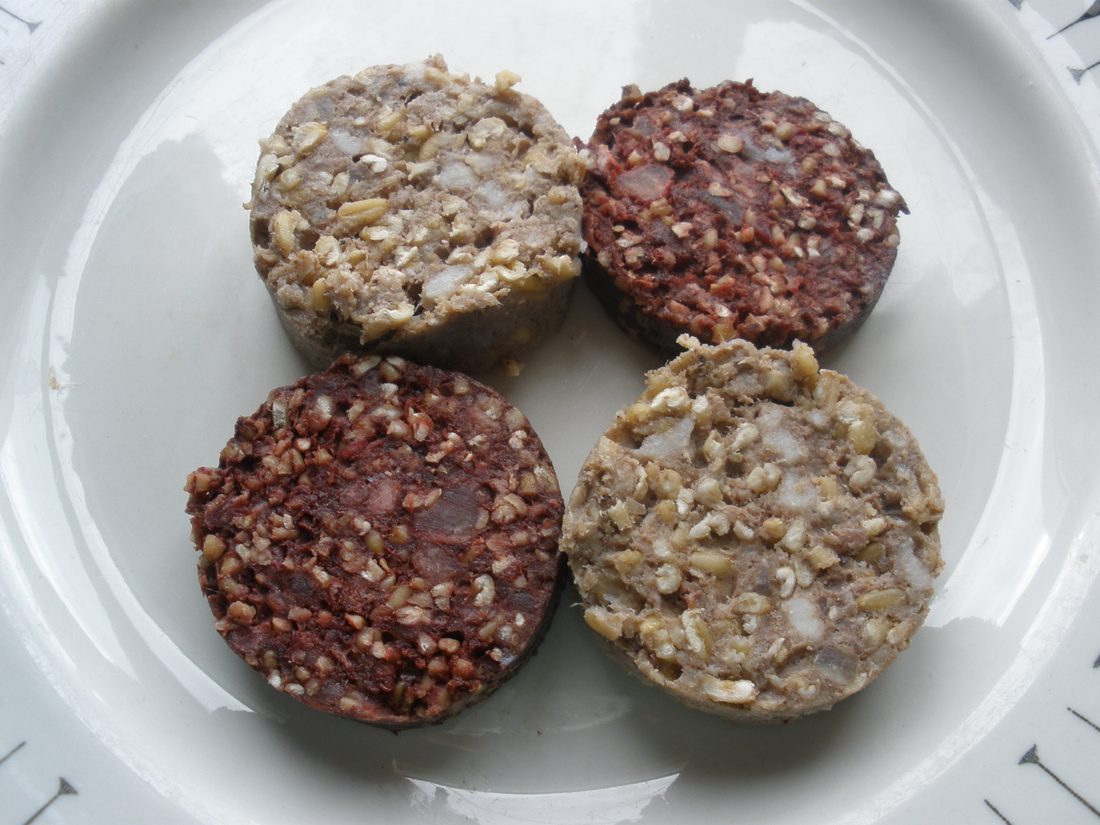
Pale grey-fawn, oaty, no blood. The ‘white’ was always relative — liver pushes it toward this colour.
What replaced the blood
Blood does two jobs in a black pudding: it binds (the proteins coagulate and set the loaf) and it supplies moisture and richness.
Take it out and both jobs need re-filling. In white pudding they’re filled by fat plus a much higher cereal load, bound by egg and the starch of the oats themselves — and, in the Irish version specifically, by meat and offal.
That’s the bit the lazy definition buries. Per Wikipedia, white pudding is “suet or fat, oatmeal or barley, breadcrumbs, and in some cases, pork and pork liver.” And on the Irish version specifically:
“In Ireland, white puddings also include a substantial proportion of pork or pork liver and pork fat.”
So here’s the honest formulation, and it’s a much better sentence than the one you’ll read everywhere:
Irish black pudding is a blood-and-oatmeal sausage. Irish white pudding is a PORK-and-oatmeal sausage.
They are not the same product with one ingredient removed. The Irish white has meat where the black has blood. Different animal entirely, so to speak.
| Irish black pudding | Irish white pudding | |
|---|---|---|
| Binder / moisture | Blood (coagulates) | Fat + oatmeal starch + egg |
| Protein | Blood; often little or no muscle meat | Substantial pork / pork liver |
| Colour | Dark brown-black, white fat cubes | Pale grey-fawn |
| Flavour | Mineral, ferrous, pepper-forward | Milder, oaty, savoury; mace and clove warmth |
| Cereal | Pinhead oatmeal | Oatmeal — proportionally higher |
The medieval survivor
This is my favourite thing about white pudding, and nobody talks about it.
White pudding “likely has medieval origins, possibly as a culinary descendant of medieval sweetened blancmange-type recipes.” Early versions carried offal, cream, eggs and breadcrumbs. Marianski notes historical versions included dates, currants, and Spanish saffron.
By the mid-18th century, recipes started dropping the liver and the sweet flavourings and drifting toward the savoury grain-based thing we have now.
Sit with that lineage a moment. White pudding is a survivor of the medieval sweet-savoury meat pudding — the same family that gave us mincemeat and Christmas pudding. Those cousins stayed sweet and became desserts. This one went savoury and ended up next to a fried egg.
Mincemeat still has the fruit and lost the meat. White pudding kept the meat and lost the fruit. They’re siblings that walked in opposite directions, and the fact that a Christmas pudding and a white pudding are relatives is the kind of thing that makes food history worth reading.
And there’s a neat irony on top: the Irish version kept the liver that the Scottish version dropped. The “older” feature survives in Ireland.
Scottish white pudding, and the boudin blanc trap
Scotland: the difference is meat
Scottish white / mealie pudding is oatmeal, onions and beef suet — and, per Wikipedia, “the same mixture simply fried in a pan is known as skirlie.” Scottish versions typically contain no pork meat. The Scottish butcher Simon Howie agrees: it “doesn’t usually contain pork meat and instead features a base recipe of oatmeal and lard with spices and onions or leeks.”
So the clean distinction most sources blur:
Scottish white pudding ≈ oatmeal + suet + onion — essentially a cased skirlie. Irish white pudding = that, PLUS a substantial proportion of pork and often pork liver.
Boudin blanc is a false friend — don’t equate them
Boudin blanc is not the French white pudding. It’s a different class of food entirely.
It’s an emulsified, cream-and-egg white-meat sausage — chicken, pork or veal with cream-soaked breadcrumbs, marjoram, sage, brandy — born in northern France in the 17th century. Fine-textured and delicate. White pudding is coarse and oaty.
A French source puts it flatly: “The boudin blanc must not be mixed up with the typical ‘white’ or ‘oatmeal pudding’ famous in Scotland and Ireland. The Irish speciality is made from lard chunks and oatmeal, and it is served sliced and fried.”
They share a colour and a name-shape. That’s all. Boudin blanc’s real relatives are quenelles and weisswurst — emulsified, delicate, a different craft.
⚠ A trap I nearly fell into
There’s a well-known published recipe titled “White Pudding with Oatmeal” in Marianski — which is the standard reference, and it’s a good formula. Here it is, per 1000 g:
| Ingredient | Weight |
|---|---|
| Beef suet | 400 g |
| Oatmeal | 600 g |
| Salt | 20 g |
| White pepper | 2.0 g |
| Cold water | 100 ml |
| Onion, chopped | 30 g (or leeks, 60 g) |
| Fresh egg | 1 |
Look at what that is: beef suet + oatmeal + onion. No pork.
By the distinction two sections up, that’s a SCOTTISH mealie pudding — despite the generic title. It’s a perfectly good recipe. It is not an Irish white pudding, and if I’d grabbed the most authoritative-looking formula with the right name on it, I’d have published a Scottish pudding as Irish and never known.
This is exactly the blur this whole section exists to fight, and the title of a trusted source enabled it. Worth remembering that “authoritative” and “correctly labelled” aren’t the same thing.
(For the record — Marianski’s method is sound and I’ve borrowed his parameters below: soak steel-cut oats in milk overnight; cut suet into ¼” pieces; stuff into 26–32 mm hog casings; simmer at 80–85 °C / 170–185 °F for 30 minutes; refrigerate; fry before serving. He also notes white pudding is often made with pork trimmings or bacon, and that cloves and mace are common additions.)
The recipe
To get an Irish white pudding, the pork has to go in. Built on Marianski’s cook parameters and salt loading, with pork and liver added per the Irish definition, and his mace/clove note.
Honesty label: this is a synthesized formula from sourced anchors, not a transcription of a tested house recipe. I’ve made white pudding; I haven’t made these exact numbers enough times to swear by them. Strong starting point, not scripture.
Makes ~1.4 kg
| Ingredient | Weight | Notes |
|---|---|---|
| Pork shoulder, ground coarse | 450 g | the Irish difference |
| Pork liver | 100 g | ~7% — assertive but not dominant; the medieval survival |
| Pork back fat, diced 6 mm | 250 g | dice, don’t grind |
| Pinhead (steel-cut) oatmeal | 350 g | dry; soak overnight in milk |
| Whole milk | 400 ml | soaking liquid |
| Onion, finely diced, sweated & cooled | 120 g | |
| Fine sea salt | 24 g | ≈1.5% |
| White pepper | 4 g | |
| Ground mace | 2 g | |
| Ground cloves | 0.5 g | restraint — cloves take over fast |
| Egg | 1 | binder |
Method
- Soak the oats in milk overnight, refrigerated.
- Keep pork, liver and fat at ≤2 °C throughout. Cold is not optional.
- Grind the pork coarse; grind or finely mince the liver. Dice the back fat by hand at 6 mm — do not grind it. You want visible fat, not a smear.
- Combine everything with the drained oats and the egg. Mix thoroughly.
- Either (a) stuff into 32–36 mm hog casings and poach at 80 °C / 176 °F to an internal 72 °C / 160 °F (~30–40 min), or (b) use the loaf-pan method exactly as on the black pudding page — lined pan, bain-marie, 160 °C, to 72 °C internal.
- Chill overnight. Same rule as black pudding: it must be cold and set before it will slice.
- Slice and fry to serve.
On the liver. ⚠ No source gives a canonical Irish liver percentage. The 7% here is my judgement, not a documented figure — flagging that rather than dressing it up. Liver browns the mix, so keep it low if you want a pale pudding; 7% will already push it fawn-grey. The “white” was always relative.
On the poaching temperature — same discipline as black pudding: 80 °C, never a boil. And the same reason to respect it.
You really can’t buy this one
I said on the black pudding page that Clonakilty isn’t sold in the US. White pudding is worse:
Nothing on a mainstream American shelf resembles Irish white pudding. There is essentially no substitute.
Black pudding at least has near-cousins — Spanish morcilla is a poor sub, French boudin noir a very poor one, but they exist and they’re blood sausages. White pudding has nothing. American breakfast sausage isn’t close. Scottish mealie pudding is the nearest cousin and it has no pork, which is the defining Irish ingredient.
There are US-made options — Jolly Posh Foods makes a white pudding (pork and oatmeal, no blood, onion and white pepper) in a USDA-inspected facility, and they’re admirably upfront that it’s made in America to traditional recipes with American meat, not imported. That’s the honest state of the market: what Americans buy as “Irish pudding” is overwhelmingly made in America.
So of the four meats on this plate, white pudding is the one you really do have to make. Which is a good outcome, because it’s the easiest of the four — no blood to source, no casings required if you use the loaf pan, no nitrite arithmetic. It’s ground pork, oats, fat and spice, poached gently in a bread pan.
If you’ve never made anything like this, start here. Then go get the blood.
Next: the breads, or jump to cooking the whole thing if you’re ready to assemble.
Sources & further reading
- Wikipedia, White pudding — the Irish pork/liver definition, the medieval blancmange lineage, and the Scottish skirlie link.
- Marianski, White Pudding with Oatmeal — sound method, Scottish-pattern formula under a generic title. The trap described above.
- Simon Howie / The Scottish Butcher, “What is white pudding?” — confirms the Scottish version carries no pork meat.
- French Gourmet HK, “Tiens, voilà du boudin” — explicit that boudin blanc ≠ white pudding.
- Jolly Posh Foods — black & white pudding, US-made and honest about it.
Comments (0)