The Sausage
I make sausage. I’ve got the grinder, the stuffer, the casings in the fridge, the whole business. So when I started reading about Irish breakfast sausages I expected to learn some technique.
Instead I learned that the most famous story in British food etymology is wrong, and wrong in a way I find genuinely delightful — not merely mis-dated, but inverted. Its premise is backwards.
Let’s do that first, because it’s the best thing on this page and I can’t sit on it.
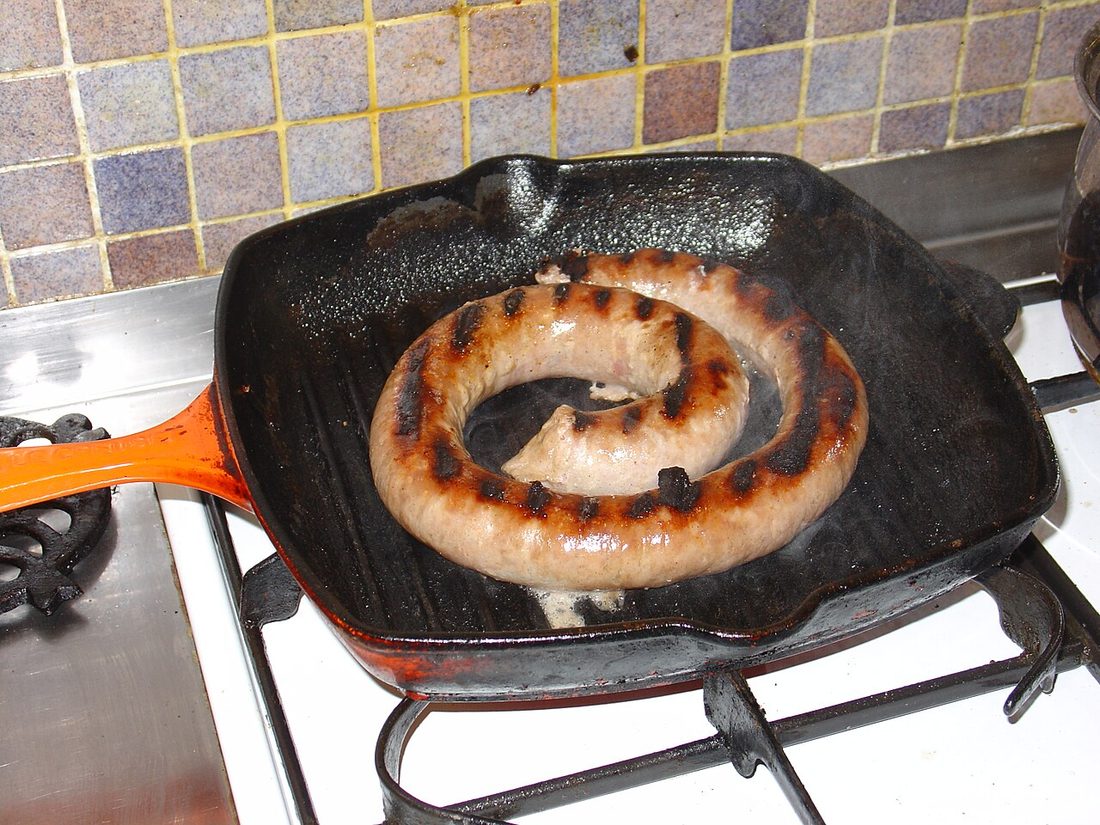
Note the colour. Fresh, uncured, heavy with rusk — it will never brown like an American breakfast sausage, and it isn’t supposed to.
The banger story is wrong
Here’s what you’ve been told, more or less everywhere:
Sausages are called “bangers” because during WWI (or WWII — the tellers can’t agree) rationing meant sausages were padded out with so much water that they exploded in the pan.
It’s on Wikipedia’s Bangers and mash page, sourced to Encyclopædia Britannica: “The term is said to have originated from the fact that sausages produced during the meat rationing of World War I were made with such a high water content that they were liable to explode when cooked.”
Wikipedia itself hedges the date — noting the word is “recorded in use at least as far back as 1919,” citing the Oxford English Dictionary, 2nd edition (1989).
Both the story and the date are wrong.
The etymology researchers at Word Histories have antedated the OED’s 1919 by fifteen years:
- 1904 — The Tatler (London), 27 July 1904. A midshipman writing home from China:
“We had bangers again and yet again; I feasted royally.”
- 1914 — Lewis Anselm da Costa Ricci, writing as “Bartimeus,” Naval Occasions and Some
Traits of the Sailor-man:
“Tinned sausages (‘Bangers’) and bacon, jam, sardines and bananas…”
1904. A decade before the First World War started. It’s British naval slang, and it was already established enough by 1904 that a midshipman could use it casually in a letter and expect to be understood.
So the scorecard:
| Claim | Verdict |
|---|---|
| ”Banger” originates in WWII | ❌ Wrong — even the OED’s own 1919 predates WWII by twenty years |
| ”Banger” originates in WWI rationing | ❌ Wrong — attested 1904, a decade before the war |
| First recorded 1919 (OED 2nd ed.) | ⚠️ Superseded — accurate lexicography for 1989, since antedated to 1904 |
| Named because water made them explode | ❌ Folk etymology |
And here’s the part that kills it dead
The exploding-sausage story requires bangers to be bad. Cheap, watery, adulterated, wartime. That’s the whole narrative engine: privation produced a defective sausage, and the defect gave it a name.
But the earliest bangers were good. Word Histories notes they “seem to have been good-quality sausages particularly savoured.” Bartimeus calls them:
“A delicacy peculiar to Gunrooms of the Fleet.”
A delicacy. Feasted upon royally. In 1904.
A cherished naval delicacy in 1904 cannot have been named for wartime adulteration in 1917. The story isn’t just mis-dated — its premise is inverted. It needs the sausage to be contemptible, and the earliest evidence has officers delighted to see them.
What’s the real origin, then?
Nobody knows. I want to be straight about this, because it would be easy to swap one tidy story for another.
Word Histories’ own title is “the unknown origin of ‘banger’.” The research establishes what the word is not from. It does not establish what it is from. The most defensible statement: it’s early-20th-century British naval slang, plausibly imitative — sausages do hiss and pop in a pan, and that’s a perfectly ordinary way for a word to happen. But the wartime-rationing narrative is a back-formed just-so story.
One honest gap: I could not check the OED’s 3rd edition entry to see whether OED has since revised its own first-citation date — the current entry is paywalled. Wikipedia is citing the 2nd edition from 1989. The 1904 antedating stands on its own evidence regardless, but if you have OED access, that would settle it properly.
And the sting in the tail
Irish people don’t call them bangers. As Marianski notes plainly: “People in Ireland don’t call their sausage ‘banger’.” It’s a British term, applied to Irish sausage mostly by outsiders.
An Irish breakfast has sausages. So the famous word attached to this plate is (a) not from the war, (b) not from exploding, and (c) not Irish. It’s a perfect little monument to how food writing works: a memorable story, repeated until it’s true, about a thing that isn’t even called that where you’re eating it.
What actually makes an Irish sausage Irish
Now the technique, which is where I had my own assumption corrected.
It’s the filler. That’s the defining trait, and it’s the thing Americans sneer at.
Marianski is blunt: “The crucial ingredient that separates British, Irish, and Scottish sausages from others is a filler which is applied at 20% or more.” These sausages are “about 70% meat and 30% filler,” and the traditional Irish composition is ground pork, a bread filler (around 20%), eggs and spices.
Rusk is not breadcrumbs
This is the detail I didn’t know, and it’s genuinely clever.
Rusk is a purpose-made, YEASTLESS dried bread. Wheatflour, salt, bicarbonate, water — baked twice until hard, then broken and graded by particle size for butchers.
Why yeastless matters, and almost nobody explains this: yeast-raised bread would keep staling, and it contributes gluten structure and fermented flavour you don’t want in a sausage. A chemically-raised, twice-baked, bone-dry crumb is inert. It behaves purely as a sponge. It has no opinions. That’s the entire design goal.
And it’s a very good sponge: rusk absorbs up to three times its weight in liquid, and it “acts as a binding agent… prevents the fats from separating during cooking.”
The thing I want to defend
Here’s where I’ll plant a flag, because I’ve been guilty of this myself.
Americans hear “filler” and hear cheating. Padding. Cheap bulking to stretch the meat. Our whole sausage culture treats meat percentage as a virtue score — 100% pork, no fillers, as if that were self-evidently better.
The filler is the point.
Rusk plus water isn’t merely economical — it produces the soft, yielding, juicy interior that makes these sausages what they are. It’s a textural choice that happens to also be cheap. A dense, all-meat, snappy continental sausage is a different and also wonderful thing, but it is a different thing.
A 100%-meat “Irish sausage” is not a better Irish sausage. It’s not an Irish sausage.
I say that as someone who has absolutely made the mistake of “improving” a recipe by taking the filler out and wondering why the result was dense and disappointing. I was correcting the recipe toward my own assumptions and away from the dish.
The pale colour
Irish breakfast sausages are noticeably pale — they don’t brown like an American sausage. That follows from three things: no cure (these are fresh sausages, no nitrite, so no pink cured colour), the high rusk-and-water dilution, and no paprika or heavy sage.
⚠ I’ll mark that honestly: I found no source explicitly explaining the pallor. The mechanism is sound and it matches what comes out of my pan, but that’s my inference, not a cited fact.
The legal bit, which has a nasty detail
A “pork sausage” requires a minimum 42% pork — firmly documented for England (Products Containing Meat etc. (England) Regulations 2014).
⚠ Reported as applying in Ireland too, but I could not confirm it against a primary FSAI document or Irish Statutory Instrument. Ireland has its own implementing legislation. Treat “42% in Ireland” as probable-but-unconfirmed.
Now the detail worth the price of admission: for labelling purposes, “meat” may contain up to 30% fat and 25% connective tissue and still count as meat.
So a legally-compliant 42% “pork sausage” can contain well under 30% actual lean muscle.
That’s not a filler problem. That’s a definition problem, and it’s a much better reason to buy from a butcher than any amount of anti-rusk snobbery.
The sage question — where I was wrong
My working assumption going in was that Irish sausage is not sage-forward — that sage is the American breakfast-sausage signature and the Irish profile is white pepper and mild herbs.
The sources only partly support me, and I’m correcting myself in public.
For my position: the pepper-and-mace profile does dominate Irish artisan descriptions. White pepper is universal across every recipe I found. And sage-forward genuinely is the American (and Lincolnshire) signature, so the contrast is real.
Against it: several published Irish sausage formulas do use sage. One Irish-style recipe runs 2.5 g dried sage alongside 2.5 g dried marjoram per kilo. Another explicitly adds “dried sage and fresh onion… to give traditional character.”
The honest resolution is degree, not exclusion. Irish sausage seasoning is mild and pepper-led, with sage present as a background note among several herbs — marjoram, thyme, nutmeg, mace — rather than the dominant voice it is in American breakfast sausage. Note the sourced formula uses sage and marjoram at equal weight: sage is one voice in a chorus, not the lead.
“Irish sausage has no sage” would be false. I’d have written it if I hadn’t checked.
The recipe
Sausage, Irish Breakfast (Rusk)
Anchored on a published Irish-style formula, scaled, with rusk substituted for breadcrumb. (There are already a couple of related recipes in the collection — Sausage, Irish and Sausage, Bangers — but neither is built on the rusk-and-water principle, which is the whole point.)
Makes ~1.3 kg
| Ingredient | Weight | % of meat |
|---|---|---|
| Pork shoulder (Boston butt), well marbled | 1000 g | 100% |
| Rusk (or dried yeastless breadcrumb) | 100 g | 10% |
| Ice-cold water | 150 g | 15% |
| Fine sea salt | 18 g | 1.8% |
| White pepper, ground | 3 g | |
| Light brown sugar | 5 g | |
| Ground mace | 1 g | |
| Ground nutmeg | 1 g | |
| Dried marjoram | 2.5 g | |
| Dried sage | 2.5 g | background, not the lead |
| Sheep casings (22–24 mm) or narrow hog (28–32 mm) | as needed |
⚠ The rusk-percentage trap — read this before you weigh anything
This formula says 10% rusk. Marianski says British/Irish filler is “20% or more.” Those conflict — and the reconciliation is the most useful thing on this page after the etymology.
They’re measuring different things:
- 10% of meat weight — 100 g dry rusk per 1000 g pork. That’s this recipe.
- But rusk absorbs ~3× its weight. So 100 g rusk + 150 g water = 250 g of hydrated filler in a 1250 g batch = 20% of the finished sausage. Which lands exactly on Marianski.
Both sources are right. Dry-rusk-on-meat ≈ 10%. Hydrated-filler-in-finished-product ≈ 20–30%.
A cook who reads “20% rusk” and adds 200 g of dry rusk per kilo will produce cake.
That’s a real trap with a real failure mode, and I’ve never seen anyone spell it out. (The arithmetic is mine; the 3× absorption figure is sourced. Check my math — I’d rather be corrected than believed.)
Fat. Pork shoulder runs roughly 20–25% fat as bought, which is the target. The rusk and water carry the juiciness, so this style doesn’t need the 30%+ fat of an all-meat sausage. Leaner pork? Add back fat to reach ~20–25%.
Method
- Cube the pork; chill to ≤2 °C. Freeze the grinder plate and blade. Cold is not optional — warm fat smears instead of cutting, and smeared fat renders out in the pan.
- Grind through a 6 mm / ¼” plate. Coarse. This is not an emulsion.
- Hydrate the rusk in the ice water, 5–10 minutes. It will swell dramatically. Respect this step; it’s the one doing the work.
- Mix pork, hydrated rusk, salt, sugar and spices 1–2 minutes, until it turns tacky and grabs your hand. That tackiness is myosin extraction and it’s what stops a crumbly sausage. Keep everything cold.
- Fry a test patty. Taste. Fix the salt and pepper now, not after stuffing. Nobody ever regrets the test patty.
- Stuff into natural casings — not tight. The rusk swells further as it cooks, and tight links burst. (Which, I have to admit, means the folk etymology isn’t physically absurd — an over-hydrated, over-stuffed sausage genuinely does split in the pan. It’s just historically false. The mechanism is real; the story is invented.)
- Link by twisting in alternating directions. Rest uncovered in the fridge overnight — it dries the casing and improves both colour and snap.
- Cook gently. Medium-low, 12–15 minutes, turning. Don’t blast them. Target 71 °C / 160 °F internal. High heat plus high water = burst casings and a dry middle.
These are FRESH sausages — no cure, no nitrite. Fridge, 2–3 days, or freeze.
If you’re buying instead
⚠ Do not substitute American breakfast sausage. It’s sage-forward, all-meat, and much denser — wrong on flavour and texture. It will taste like an American breakfast on an Irish plate, and you’ll conclude the Irish breakfast is overrated when what you’ve actually done is not made one.
Import shops sell “Irish bangers” (the name follows you around). They’re a real option. Otherwise: make them. The equipment pays for itself in about four batches, and the rusk trick transfers to every other sausage you’ll ever make.
Next: black pudding — the one everybody’s nervous about, and the one I found most interesting to make.
Sources & further reading
- Word Histories, “the unknown origin of ‘banger’ (sausage)” — the 1904 Tatler and 1914 Bartimeus antedatings. The key source on this page.
- Wikipedia, Bangers and mash — cites OED 2nd ed. (1989) for 1919 and Britannica for the folk etymology. Useful as the thing being corrected.
- Marianski, British, Irish and Scottish sausages — the 20%-filler rule, 70/30, and the “Irish don’t say banger” note.
- Design a Sausage, “What is Rusk?” — yeastless composition and the 3× absorption figure.
- Wikipedia, Rusk.
- Prepare and Serve, Irish-style pork sausages — the anchor formula, sage and all.
- GOV.UK, Meat products: sell them legally in England — the 42% figure and the fat/connective-tissue definition.
- FSAI, Guidance Note 17: Labelling of Meat — where to check the Irish figure I couldn’t confirm.
Comments (0)