Cooking the Whole Thing
Every page on this site will tell you how to make a component. Almost nothing anywhere tells you the actually hard part:
How do you get nine things hot, correct, and on one plate at the same moment?
That’s the real skill of a fry, and it’s why a B&B cook doing forty covers is doing something genuinely difficult while making it look like nothing. It isn’t cooking. It’s scheduling.
I’m going to give you the sequence I use. But first, the principle that makes the whole thing make sense.
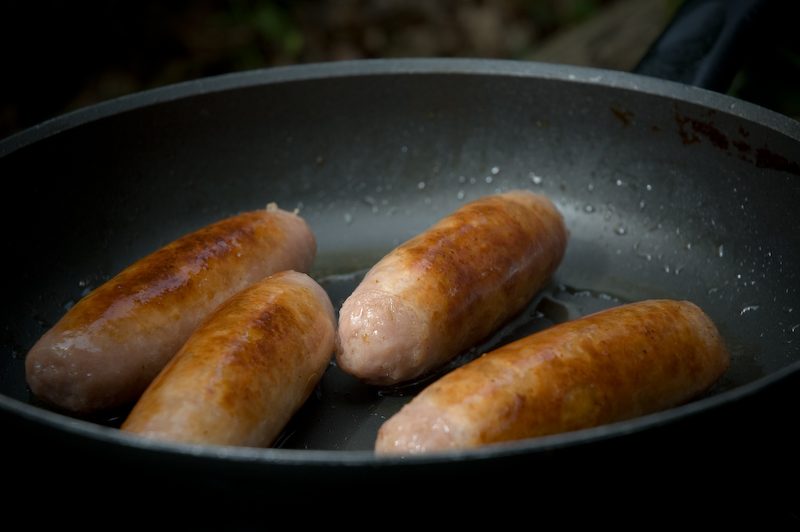
The sequence, mid-run — and this is step one. The sausages own the pan for twelve to fifteen minutes at medium-low while everything else waits. Rush them and the casings burst.
The one idea: the fat is the schedule
The fry is not a set of items cooked separately and arranged. It’s a sequence, and the thing tying it together is the fat.
The bacon renders → the sausages brown in that fat → the pudding crusts in it → the mushrooms drink it → the tomato softens in it → the farl goes down cut-side into it → the egg fries in what’s left.
Each component leaves something behind, and the next one picks it up. By the end of the sequence you’re frying bread in a fat that has bacon, sausage and black pudding dissolved in it. That farl is carrying the whole breakfast.
So the running order isn’t arbitrary and it isn’t just about timing. It’s about what you want in the fat when each thing goes in. Fat first, bread last. Everything else is detail.
This is also exactly why the hotel buffet version tastes flat — separate chafing dishes, each item cooked alone, nothing handed forward. And it’s why a modest fry in one pan at home beats an expensive one off a steam table. You’re not a worse cook than the hotel. You have a better pan.
The obstacle: everything wants a different heat
Here’s why this is hard, laid out honestly:
| Component | Wants | Time |
|---|---|---|
| Sausages | Medium-LOW, patient, turned | 12–15 min — the long pole |
| Rashers | Medium; render, brown edges, don’t chase crisp | 4–6 min |
| Black pudding | Medium; already cooked, just crusting | 2–3 min a side |
| White pudding | Medium; same | 2–3 min a side |
| Soda farl (making from scratch) | Dry griddle, medium-LOW | ~30 min total |
| Soda farl (split & fried) | Medium, in the fat | 2–3 min |
| Potato farl | Medium | ~3 min a side |
| Mushrooms | Medium-HIGH — they must not stew | 4–5 min |
| Tomato | Medium, cut side down | 4–6 min |
| Eggs | Medium-low, in the fat | 2–3 min |
| Beans | Warm. That’s it | whenever |
The sausages are the long pole and the most impatient-cook-proof item on the plate. They want 12–15 minutes at medium-low. Blast them and the casings burst — the rusk swells, the water turns to steam, and you get a split, dry sausage. (Which, as I note on the sausage page, is a real mechanism — it’s just not where the word “banger” comes from.)
The mushrooms are the opposite problem. They want it hot. Crowd them or cool the pan and they release water and stew into grey slugs instead of browning.
Those two requirements — patient-low for 15 minutes, hot-and-fast for 5 — are why one pan is a lie for a full plate. Which brings us to the honest bit.
How many pans, honestly
One pan is romantic and it works for a small fry — bacon, sausage, egg, a farl. Sequential, everything in the same fat, nothing lost. If you’re cooking for one or two, do this.
Two pans is the real answer for a full plate, and I’ll defend it. Pan one is the fat pan — the big cast iron that runs the whole meat sequence and finishes the bread and eggs. Pan two is the fast pan for mushrooms at a heat the fat pan can’t hold while sausages are on it.
The oven is your friend and it isn’t cheating. A low oven — 90–100 °C / 200 °F — with a plate in it is where cooked components wait. Everything on this plate holds fine for 10 minutes except the egg.
Anything more than two pans and a low oven is a restaurant, not a breakfast.
The sequence
Prep first, and do it properly — this is a 20-minute cook with no gaps for chopping:
- Rashers out of the fridge, patted dry. Wet meat steams.
- Pudding sliced ~1 cm.
- Tomatoes halved. Mushrooms whole or thick — thin slices are a mistake.
- Eggs cracked into a cup each. (Shell in the pan, mid-sequence, is how a breakfast dies.)
- Farls split, if using.
- Plates and the low oven ON. Cold plates ruin a fry faster than any cooking error.
- Beans in a small pot on the lowest heat where you’ll forget about them until you need them.
Then:
1. Sausages in first. Medium-low. (t = 0) They own the pan for the next 12–15 minutes and everything else works around them. Turn them occasionally. Do not rush this. Target 71 °C / 160 °F.
2. Rashers in beside them. (t ≈ 5 min) Now the fat starts. Render, brown at the edges, do not chase crisp — remember it’s mostly lean loin. 4–6 minutes. Out to the warm plate in the oven. The pan now has bacon fat in it, and that’s the whole point of everything that follows.
3. Mushrooms in the second pan. Hot. (t ≈ 7 min) Spoon a little of pan one’s bacon fat over. Medium-high, don’t crowd them, let them sit still and brown before you move them. 4–5 minutes. Warm oven.
4. Puddings in the fat pan. (t ≈ 10 min) Black and white, 2–3 minutes a side, until crusted. They’re already cooked — you’re building a crust and warming through. Handle them gently; both crumble, and black pudding especially will fall apart if you fuss it. Warm oven.
5. Tomatoes in, cut side down. (t ≈ 12 min) 4–6 minutes. Season them — this is the one component people forget to salt, and an unseasoned grilled tomato is just a hot wet thing.
6. Sausages come out. (t ≈ 14 min) Check temp, warm oven.
7. THE FARL. (t ≈ 15 min) Cut-side down into a pan that now contains rendered bacon fat, sausage fat, and dissolved black pudding. 2–3 minutes until the face is glassy, crisp and brown.
This is the moment the whole sequence has been building toward, and it’s why bread goes last. A farl fried in fat that’s only seen bacon is good. A farl fried in fat that’s seen everything is the best bite on the plate. Don’t waste it by frying your bread early.
8. Eggs, last. (t ≈ 17 min) Into the same fat, medium-low. Spoon fat over the whites if you like them set. 2–3 minutes. The egg is the only thing that will not wait, so it goes on last and it goes straight to the plate.
9. Plate immediately. Everything out of the oven, egg straight from the pan, beans in a small dish so they don’t flood everything. Tea already brewed — see the tea page, and don’t make it as an afterthought.
Total: about 20 minutes, of which the first 12 are mostly standing there not rushing the sausages.
If you’re making the breads from scratch too
Then the schedule changes completely, because a soda farl from raw dough is ~30 minutes on the griddle at medium-low — that’s twice the length of the entire fry sequence above.
Make the farls first, before anything else touches a pan. Griddle them dry, let them cool enough to split, then bring them back into the fat at step 7. Do not try to run raw farls and the fry at the same time, and do not turn the heat up to make them fit your schedule — that’s the classic failure: burnt outside, raw paste inside. The farl sets the timetable; the fry works around it.
Same with a soda loaf: it’s a 45-minute oven bake, so it happens well before, and its oven is not your warming oven.
The mistakes I’ve made
Genuinely, in my own kitchen:
Rushing the sausages. Every time. They look done long before they are, and the fix is a thermometer and patience, not more heat.
Frying the bread too early. I did this before I understood the fat sequence, and I couldn’t work out why my farls were merely nice. They were frying in bacon fat instead of everything fat. Bread last. It’s not tradition, it’s flavour accounting.
Crowding the mushrooms. They stewed. They always stew. Give them room or give them a second batch.
Not cooling the onions — that one’s from the black pudding page, and it’s a different lesson from the same character flaw: hot onion into blood equals grainy pudding, and I blamed the blood for a week.
Cold plates. The stupidest and most common one. A perfect fry on a cold plate is a lukewarm fry by the third bite, and this is a meal with a lot of fat in it — fat that congeals is not what you’re going for. Plates in the oven. Always.
The honest scaling problem
This works for two people. It gets hard at four, and at six you need a different approach — which is precisely what the B&B cook has, and it’s why they’re impressive.
If you’re feeding a crowd: sheet pans and a hot oven for sausages, rashers, tomatoes and mushrooms, and use the stovetop only for eggs and the farls. You lose some of the fat sequence — that’s a real cost and I won’t pretend otherwise — but you claw back some of it by tipping the sheet-pan fat into the farl pan.
That’s the compromise the buffet should make and mostly doesn’t. Take the fat with you.
That’s the whole thing. Go back to what’s on the plate, or read where you’d eat one if you’d rather have someone else do the scheduling.
Comments (0)