Where You Eat It
I’ve had a full Irish breakfast several times in Galway, and it is one of the best meals I’ve ever eaten anywhere.
I can’t tell you where. I didn’t write it down, I wasn’t taking notes, I was on holiday and I was hungry, and I’m not going to invent a café and a street and a charming proprietor for you the way half the internet would. What I remember is the shape of it: a plate obviously assembled by somebody who cooked it in one pan in the right order, everything tasting faintly of everything else, tea arriving in a pot that kept coming, and the specific feeling of a meal with no interest at all in being clever.
I cure my own bacon. I grind my own sausage. I make black and white pudding. So I have a fairly informed idea of how hard each component is to get right, and getting all of them right at once, before nine in the morning, for strangers, is genuinely difficult. That’s why this page exists. The where turns out to explain the why — and the answer isn’t “Irish people love a fry.”
The answer is a tourism grading matrix, a frozen-baguette supply chain, and a novelty song that outsold Shakira.
The B&B, and the state’s fingerprints all over the plate
Here’s the single most important structural fact about the full Irish, and I’d never seen it in any of the hundred articles I read before starting:
The “Full Irish Breakfast” is a semi-official category of the Irish state’s tourism grading system.
Not a law. Not a recipe. A category. Fáilte Ireland registers and grades accommodation under the Tourist Traffic Acts 1939–2016, and its Minimum Requirements and Classification Matrix for Approved Irish Home Bed & Breakfast (Feb 2013) contains a Breakfast section in the star matrix. Verbatim:
“Choice of a minimum of two other cooked options e.g. scrambled egg and smoked salmon, omelette or kippers, besides “Full Irish Breakfast”.” — required at 3★ and 4★
“Choice of a minimum of four cooked seasonal breakfast options besides “Full Irish Breakfast” e.g. Porridge with a choice of toppings, Pancakes with maple syrup and fresh fruit, Omelette made to order, Scrambled Eggs with Smoked Salmon, Eggs Benedict, fresh fish etc.” — required at 5★
Three things fall out of that, and every one of them is better than the thing you thought you were going to read.
(a) The state never defines it
Read the quotes again. “Full Irish Breakfast” appears in scare quotes, twice, in an official classification document — and the document never says what it is. No components, no list. It treats it as a known constant, the way a building code says “a door” without describing a door. The standardization is assumed, not specified.
And that’s the actual mechanism by which a folk dish becomes an institution: not by being defined, but by being taken for granted in a grading matrix. Somebody had to write a breakfast standard for thousands of B&Bs, and when they reached for the baseline, the baseline was already there. That’s a stronger form of canonisation than a definition would have been. A defined thing can be argued with. An assumed thing just is.
(b) There is no black pudding in the state’s own minimum requirement
This is the finding. Here’s the mandated list, verbatim:
“The following food items are to be provided for breakfast: selection of cereals, fruit juices, fresh fruit, yogurt, bacon, eggs, sausages, tomatoes, brown and white bread, toast, preserves, butter, tea and coffee and a minimum of 1 herbal tea.”
Bacon. Eggs. Sausages. Tomatoes. Brown and white bread. Toast.
No black pudding. No white pudding.
The component that every single tourist article, every listicle, every “what makes it Irish” explainer calls the definitive marker of Irishness on that plate — the thing I make from scratch, the thing that has its own page on this site — is not required by the Irish state’s own breakfast standard.
Careful about what that proves. It doesn’t prove pudding isn’t traditional; it obviously is. It proves the pudding is the thing the tourist literature is most confident about and the state is least concerned with — and when those two diverge that hard, the tourist literature is usually telling you about itself rather than about Ireland.
(c) The higher the star rating, the further from the fry
Look at what the matrix pushes toward as you climb. Three stars: two alternatives. Five stars: four alternatives, and the named examples are Eggs Benedict, fresh fish, smoked salmon, pancakes with maple syrup.
At 5★, the Full Irish is the baseline you must offer alternatives to. It’s the floor, not the ceiling — the thing you’re expected to be able to do, and then to do better than. That’s a quietly brutal piece of class positioning to find in a government PDF, and it’s the exact inverse of how the dish is marketed abroad, where it’s the destination.
Some structural rules, while we’re here, because they explain the room you’re eating in:
| Irish Home B&B | Guesthouse | |
|---|---|---|
| Bedrooms | 2–6 guest bedrooms | 7–30 en-suite bedrooms |
| Registration | Approved scheme | Must register with Fáilte Ireland |
| Breakfast | Per the matrix above | ”Should be provided” |
And: breakfast must be available for a minimum of one and a half hours, with service up to at least 10:00 a.m.
⚠ One thing I have to knock down, because it’s the obvious next sentence and it’s not supported. Bord Fáilte (established 1955) became Fáilte Ireland in 2003. It is very tempting to write “Bord Fáilte standardised the full Irish in the sixties and wrote the fry into law.” No primary Bord Fáilte-era breakfast document was found. The 2013 Fáilte Ireland matrix above is the earliest hard document available. So the codification looks emergent and commercial — thousands of B&Bs converging on a plate that met tourist expectation — rather than decreed. Don’t let anyone tell you the tourist board wrote it. Nobody has produced the paper. More on how the dish got here in the history.
The breakfast roll: par-baked bread, an economist, and Shakira
Right. This is the best material on this page and probably the best material in the whole dive, so I’m leading with the punchline:
In 2006, a novelty song about a petrol-station sandwich was the best-selling single of the year in Ireland, and it outsold Shakira’s “Hips Don’t Lie” by 500 copies.
Let me back up.
What it is
A bread roll or baguette filled with the components of a fry: sausages, rashers, black and white pudding, a fried egg, butter, and ketchup or brown sauce. The whole plate, handheld, from a deli counter in a filling station.
The enabling technology nobody mentions
The breakfast roll is not folk tradition. It’s a supply-chain revolution, and the mechanism is par-baked bread.
Cuisine de France was founded in 1989 by Ronan McNamee and Dr Pat Loughrey, based in Tallaght, Co. Dublin. They introduced the par-baked model: bread baked until brown, frozen, then finished in-store. That one change gave every petrol station and convenience store in the country hot fresh baguettes with minimal waste — and, crucially, the smell of baking bread, which is the most effective piece of retail marketing ever invented and costs nothing once the oven’s already on. IAWS acquired Cuisine de France in 1997 for £51m (£40m up front, £11m on profit targets).
Here’s the causal chain:
No par-bake → no hot fresh baguette in every forecourt → no breakfast roll.
That’s a better story than “Irish people like sandwiches.” An entire national food object exists because two people in Tallaght solved a freezing-and-finishing problem in 1989. That’s more interesting than any amount of folk-tradition guff, because it’s checkable, and because it’s how most food actually happens: somebody solves a logistics problem and a culture grows on top of it.
Breakfast Roll Man
The term “Breakfast Roll Man” was coined by the economist David McWilliams in The Pope’s Children (2005), alongside “Deckland” and “Kells Angels” and “HiCo” — stock characters used to describe the Celtic Tiger. Breakfast Roll Man is the archetypal sub-contractor, builder, tradesman of the credit-fuelled property boom: eating on the move, from a forecourt deli, on the way to a site, because the boom didn’t leave time to sit down.
He’s a real economic indicator wearing a sandwich as a costume. The character landed because everybody in Ireland had seen him. He was in the queue in front of them.
The song
“Jumbo Breakfast Roll” (2006) by the comedian Pat Shortt, performing in the guise of a showband singer called “Dicksie Walsh.” The narrator is a construction worker with no time for a proper breakfast, who buys a jumbo breakfast roll at the filling station.
- No. 1 in the Republic for six weeks.
- Best-selling single of 2006 in Ireland.
- Outsold Shakira’s “Hips Don’t Lie” by 500 copies.
I want to be clear that I checked this because I didn’t believe it. A comedy song about a petrol-station sandwich, sung in character as a fictional showband crooner, beat the biggest global pop single of that year in a national market. That is not a fun fact. That’s a country recognising itself so completely in a joke that it bought the joke.
The fall
There’s a real academic paper on this: “The Rise and Fall of the Jumbo Breakfast Roll: How a Sandwich Survived the Decline of the Irish Economy.”
⚠ I could not open it — it returned HTTP 403. The author, year, and venue are NOT FOUND. The paper reportedly contains the phrase “perhaps the ultimate symbol of our contemporary Celtic Tigerland,” and I’d love to use it, and I am not attributing that quote to any named person, because I don’t know who wrote it. If you see it attributed confidently somewhere, ask them how they opened the PDF.
What’s reported from the abstract, which I’ll pass on with the caveat firmly attached: JBR consumption declined sharply post-2010, and the male construction workforce fell roughly 58% from 2006 to 2010. The correlation is not subtle. Breakfast Roll Man wasn’t a food trend. He was a job. When the job went, the sandwich went with it — and the fact that the sandwich was a leading indicator of a construction crash is a better argument for taking food seriously than anything I could write.
⚠ Do not conflate it with the chicken fillet roll
This is where nearly every article goes wrong, so read this bit twice.
The widely-cited figures — “~10 million rolls”, “200 million a year” — are for the chicken fillet roll. A different sandwich. Not the breakfast roll. Articles blur the two constantly, usually because the chicken fillet roll has actual numbers attached and the breakfast roll doesn’t, and a number is more fun to write than a gap.
Hard breakfast-roll volume data: NOT FOUND. I have no sales figure, no revenue figure, no eating-frequency figure for the breakfast roll specifically. That gap is real and I’m leaving it visible.
Related, and correctly labelled: Centra reported record sales of €2.2bn in 2025 with deli up 7.4% — a real figure, from real trade press, about the deli counter generally. The ~10 million roll figure in that same coverage is chicken fillet.
Applegreen relaunched its breakfast roll using 100% Irish-sourced products and stunt-marketed it by couriering fresh rolls to Dublin newsrooms. ⚠ My source for that is an agency PR case study — a marketing page. I’ll use it for the fact that the campaign happened and for nothing else. Not market data. Not evidence of anything except that an agency got paid.
And the breakfast roll made the Washington Post in 2015, which is its own small comedy.
The hotel buffet, or: how to destroy a fry with logistics
The matrix even anticipates the buffet — “if breakfast buffet provided, items to be kept topped up and chilled as appropriate.” So the state has, in writing, contemplated the room where the Full Irish becomes a self-assembled plate from chafing dishes: sausages in one pan, rashers in another, pudding in a third, beans congealing gently at the end under a lamp.
⚠ Honest flag: this section is observational, not hard-sourced. I found no research on hotel buffet breakfasts specifically. What follows is me applying the one thing here I am sure about.
The fry is not a collection of items cooked separately. It’s a sequence, and the fat carries flavour forward through it. The bacon renders; the eggs fry in that fat; the farls go down in it; the mushrooms drink it; the tomato picks up the fond.
A buffet cannot do that. Not through malice — through logistics. It cooks in parallel, in bulk, ahead of time, and holds. Every component is present. None of them have met. You get a plate of adjacent foods, and because you can’t articulate what’s missing, you blame the sausage.
It isn’t the sausage. It’s the sequence — the full argument is on cooking it. That Galway plate worked because one person cooked it in one pan. The buffet is the same ingredients with the method removed, and the method was the dish.
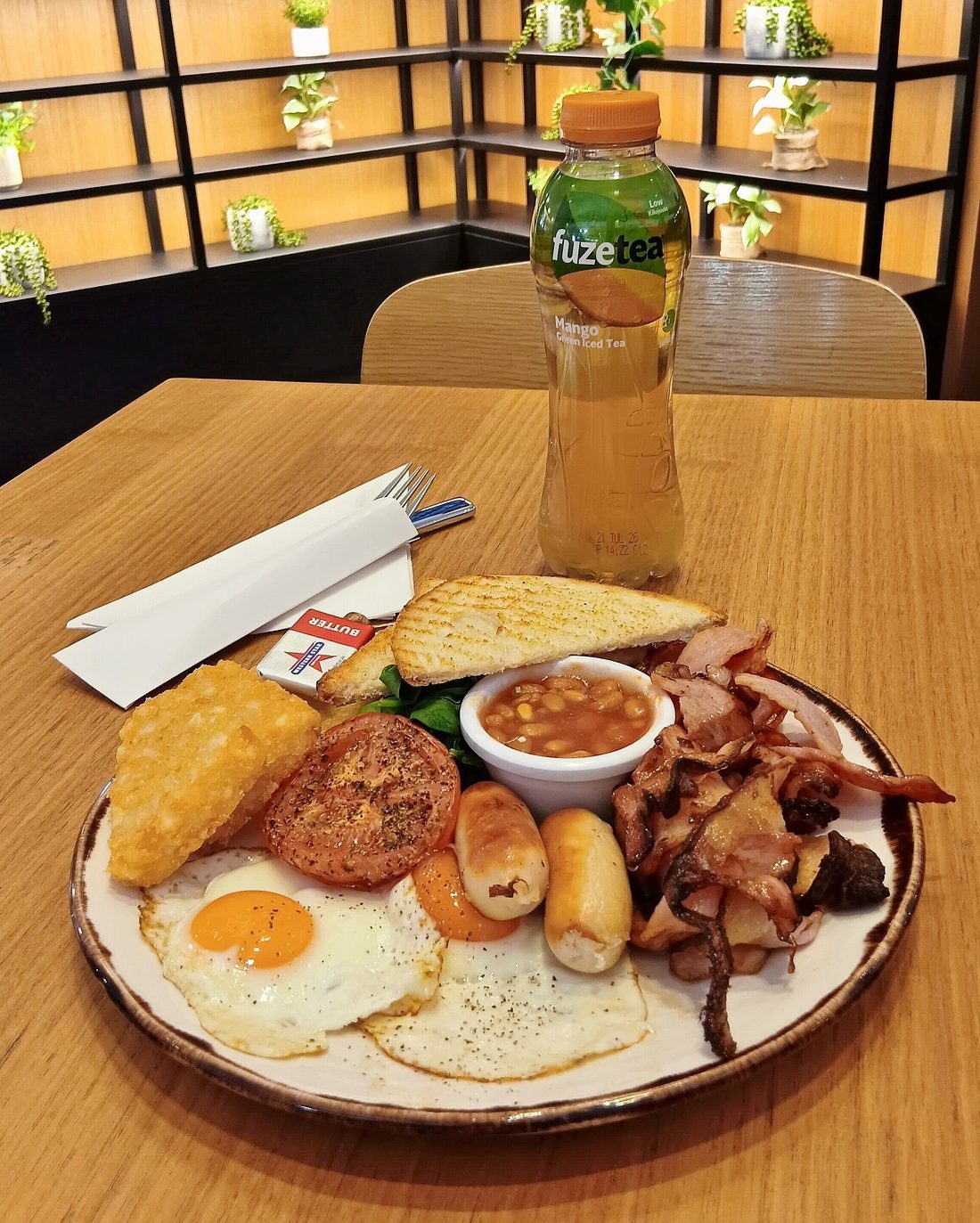
Where most people actually meet one: a table someone else cooked for.
Pubs, all day, and the hangover thing
The fry-as-hangover-cure is the most repeated claim in this subject and the worst-sourced. It lives in listicles, not in research. No historian dates it. I’m not saying it’s false — it’s obviously a real practice, I’d do it — I’m saying nobody has established when or how it became the framing, and everybody writes it like it’s ancient.
The genuinely good point, from a genuinely good source: Domini Kemp, in the Irish Times, notes the fry “tastes equally good eaten in the evening.”
Small sentence, resets the whole thing. The all-day breakfast is not a debasement. It’s the dish’s natural range. Nothing about pork, eggs, bread and fat is chemically morning food; the morning association is a schedule, not a property. And the hangover framing is downstream of that — it’s not that the fry cures anything, it’s that the fry is available at 2pm and it’s the right food.
⚠ Sunday-versus-weekday home consumption: NOT FOUND as survey data. There is a lovely, universal, completely unsupported belief in the “Sunday fry.” Nobody has surveyed it by day. Do not invent a Sunday fry statistic, and be suspicious of anyone who quotes one.
The demolishing bit: Irish people don’t eat this
Everything above is about hospitality. Here’s the part that reframes all of it.
Bord Bia’s research found the everyday Irish breakfast is toast.
| Midweek breakfast | Share |
|---|---|
| Bread / toast | 33% |
| Porridge | 25% |
| Cereals | 19% |
| Eggs | 18% |
| Fruit | 17% |
87% eat breakfast daily, rising to 89% at weekends. The cooked fry does not top any category.
⚠ The caveats, and they matter. The Bord Bia page returned HTTP 403 — I could not load it directly. The figures come from the search-index snippet of that page, corroborated by two independent trade-press reports. The exact percentages should be re-verified before anyone quotes them as hard numbers, and the year of the study is unconfirmed. The table’s here because the shape is robust across three sources; the 403 is here because you deserve to know how the sausage was made.
The shape is the finding, and it’s devastating to the tourist story:
The full Irish is a weekend, hospitality and tourist dish. Irish people mostly don’t eat it.
Which brings the whole page around. It’s in the tourism grading matrix because it’s a tourism dish. The B&B breakfast table was a stage. That doesn’t make it fake — I’ve eaten it and it’s magnificent — but it does mean that when I sat down in Galway and had one of the best meals of my life, I was eating a performance of Ireland, cooked by somebody who was extremely good at it, and not a slice of ordinary Tuesday. Ordinary Tuesday is toast.
I’d rather know that. It doesn’t make the meal worse. It makes the meal specific.
Two places that were open when I wrote this
Exactly two, and the caveat comes first, because the caveat is the point.
A closed recommendation is worse than no recommendation. Send someone across a city to a shuttered door and you’ve cost them a morning of a trip they saved for. The internet is full of confidently recommended Irish cafés that shut years ago, because nobody goes back and checks and a listicle earns the same either way. So: these were verified open as of this writing, and if you’re reading this later, check before you walk.
Bewley’s Café — 78–79 Grafton Street, Dublin 2. Opened 1927. Serves a full Irish. Reviews running to July 2026. ⚠ Bewley’s has closed and reopened multiple times historically — a well-publicised closure, a 2017 refurbishment, pandemic closures. Current signals are good. It is not a place I’d assume is open without looking, and neither should you.
Keogh’s Café — 1–2 Trinity Street, Dublin 2. Family-run for 30+ years. Opens 06:30, Monday to Saturday.
That opening time does more work than a paragraph of prose could. Nobody opens at half six in the morning for tourists. Tourists are asleep at half six. A 06:30 opening is hard, structural, unfakeable evidence of a working breakfast trade — people eating before a shift, not after a flight. It’s the same signal as Breakfast Roll Man, in a room with chairs.
⚠ What I’m not recommending: A. O’Reilly’s in the English Market, Cork — the drisheen stall, the last of its kind. Its 2026 status is unverified. My most recent hard source is 2022 and the trader himself framed the craft as one retirement away from extinction. I want it to be open. I am not going to send you there on a hope.
The diaspora: mostly slop
The last section, and it’s short, because the honest answer is short.
I wanted to write about the Irish breakfast abroad — the emigrant versions, what happens to the plate in Boston or Sydney. The literature is almost entirely SEO slop. Unsourced claims about avocado. Unsourced claims about artisan cheeses. Content farms citing each other in a circle, none of them having ever eaten anything. The research refused to cite it and so will I.
The one real source: Washingtonian, “9 Great Pubs for a Full Irish Breakfast Around DC” (12 March 2025) — a genuine city magazine, documenting the full Irish as a US Irish-pub weekend-brunch item, clustered around St Patrick’s Day.
That’s the finding. Small and true:
The diaspora full Irish is a pub brunch and a March phenomenon.
Not a living tradition carried in a suitcase. A menu item at an Irish-themed pub, ordered on weekends, spiking hard in one week of the year. Not a criticism — it’s what most diaspora food is. It’s just not the story the content farms are selling.
Australia: NOT FOUND in any credible source. I looked. There’s nothing.
And the number of full Irish breakfasts served annually: NOT FOUND. No source exists. I’m not estimating. Somebody will want a headline number for this page and there isn’t one, and I’d rather end on a hole than fill it with a guess. The hole is the honest finding. Everything else here is checkable, which is the only reason the holes are worth marking.
Sources & further reading
Official / primary
- Fáilte Ireland: Minimum Requirements and Classification Matrix for Approved Irish Home Bed & Breakfast (Feb 2013, PDF) — the document. The “Full Irish Breakfast” scare quotes at 3★/4★/5★, the mandated item list with no pudding in it, the 1.5-hour availability and 10:00 a.m. service rule, and the buffet clause. Quoted verbatim above.
- Fáilte Ireland: Irish Home B&B — 2–6 guest bedrooms.
- Fáilte Ireland: Guesthouses — 7–30 en-suite bedrooms, must register, breakfast should be provided.
- gov.ie: Opening a Bed and Breakfast — the Tourist Traffic Acts 1939–2016 framework.
The breakfast roll
- Wikipedia: Breakfast roll — what’s in it.
- Irish Times: “£51m in the baguette for French bakery” and Irish Times: “IAWS acquires Cuisine de France in deal worth £51m” — the 1997 acquisition, £40m up front plus £11m on profit targets.
- ARYZTA Ireland: Cuisine de France 35th anniversary — founded 1989 by Ronan McNamee and Dr Pat Loughrey, Tallaght, and the par-baked model.
- Wikipedia: The Pope’s Children and Wikipedia: David McWilliams (economist) — Breakfast Roll Man, 2005.
- Wikipedia: Jumbo Breakfast Roll and Irish Number Ones: Pat Shortt, “Jumbo Breakfast Roll” — six weeks at No. 1, best-selling single of 2006, the 500-copy margin over Shakira.
- “The Rise and Fall of the Jumbo Breakfast Roll: How a Sandwich Survived the Decline of the Irish Economy” (Academia.edu listing) — ⚠ HTTP 403, could not open. Author, year and venue NOT FOUND. The post-2010 decline and the ~58% fall in the male construction workforce 2006–2010 are from the indexed abstract. The “ultimate symbol of our contemporary Celtic Tigerland” quote is not attributed to anyone here, because I don’t know who said it.
- Irish Examiner: Centra 2025 results — record €2.2bn sales, deli up 7.4%. ⚠ The ~10 million roll figure in this coverage is chicken fillet rolls, NOT breakfast rolls.
- Cullen Communications: Applegreen breakfast roll campaign case study — ⚠ an agency PR page. Used only for the fact that the campaign happened.
- TheJournal.ie: the breakfast roll reaches the Washington Post (Oct 2015)
All day, and everyday
- Irish Times: Domini Kemp, “Fries, farls and bakes” (30 June 2012) — the fry “tastes equally good eaten in the evening.”
- Bord Bia: “The Breakfast Club” press release — ⚠ HTTP 403 to automated fetch. Figures via the search index, corroborated by Irish Examiner and Marketing.ie. Re-verify the exact percentages before quoting them as hard numbers; the year is unconfirmed.
Places
- Bewley’s Café, 78–79 Grafton St, Dublin 2 — Visit Dublin, OpenTable, Yelp. Opened 1927; reviews to July 2026. ⚠ Has closed and reopened multiple times historically.
- Keogh’s Café, 1–2 Trinity St, Dublin 2 — keoghscafe.ie, Visit Dublin, Hot Press. Family-run 30+ years; opens 06:30 Mon–Sat.
Diaspora
- Washingtonian: “9 Great Pubs for a Full Irish Breakfast Around DC” (12 March 2025) — the only credible diaspora source found.
Explicit negative results — stated because they’re part of the finding:
- No primary Bord Fáilte-era (pre-2003) breakfast document exists that I could find. NOT FOUND. Do not claim Bord Fáilte wrote the fry into law. The 2013 Fáilte Ireland matrix is the earliest hard document.
- Hard breakfast-roll volume, revenue, or eating-frequency data: NOT FOUND. The circulating “~10 million” / “200 million a year” figures are for the chicken fillet roll, a different sandwich.
- The JBR paper’s author, year and venue: NOT FOUND (403).
- Sunday-versus-weekday home consumption of the fry: NOT FOUND as survey data. Do not invent a Sunday fry statistic.
- The hangover-cure framing has no scholarly source and no historian dates it. It lives in listicles.
- Hotel buffet breakfasts: no hard sourcing found. That section is observational and labelled as such.
- The full Irish in Australia: NOT FOUND in any credible source.
- The number of full Irish breakfasts served annually: NOT FOUND. No source exists. Not estimated.
- A. O’Reilly’s drisheen stall, English Market, Cork: 2026 status UNVERIFIED (last hard source 2022). Deliberately not recommended.
Comments (0)