Farls, Fadge & Boxty
These are the best things on the plate and it isn’t close.
I’ll defend that. The rashers are excellent, the puddings are the interesting ones, but the griddle breads are the components that make an Irish breakfast structurally different from everything else in these islands — and they’re the ones that take the fat and give it back to you. A soda farl split and laid cut-side down in the bacon fat until the face goes glassy and crisp is, to my mind, the single best bite available at breakfast anywhere.
They’re also the entire technical identity of the Ulster fry. Everything else on that plate is negotiable. The farls are not.
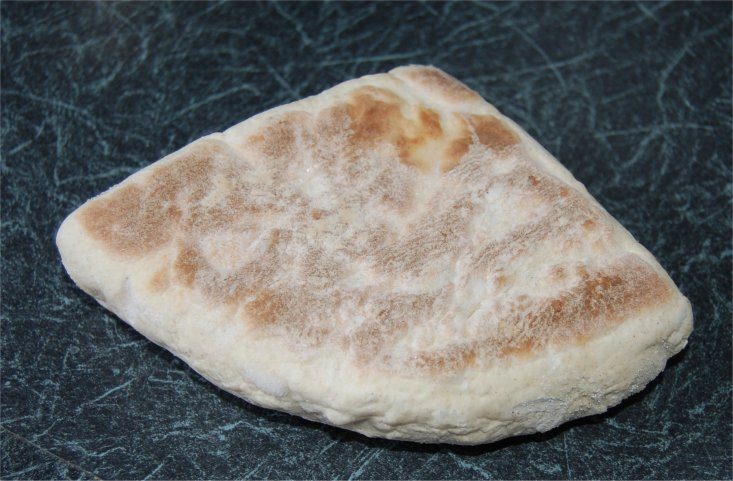
Griddle bread: thin, cooked dry on a pan, no oven involved. A griddle has no lid and no top heat, which is why these go thin and get quartered into farls.
The griddle problem
Go read the bastible section first if you haven’t, because this only makes sense as a contrast.
The bastible was a pot with a flanged lid you piled coals onto — heat from above and below. A real oven on a hearth floor. It gives you a deep, domed, crusted loaf.
The griddle is the other tool: a flat cast-iron plate hung over the fire. No lid. No top heat. Heat from one side only, by conduction.
That single constraint dictates everything about these breads. A deep round on a griddle burns on the base and stays raw paste in the middle. There’s no way around it — you cannot push heat through 5cm of dense unleavened dough from one face.
So the dough gets flattened thin, and then it gets cut into quarters so the heat can reach the centre and steam can escape from four exposed edges.
That’s what a farl is. And here’s the connection I really like: the quartering solves exactly the same problem the cross on a soda loaf solves — it just solves it harder. The cross is a compromise for a pot with top heat. The farl is what you do when you have no top heat at all. Same chemistry, same problem, different geometry, because the equipment is different.
The bread is the shape of the tool. Both times.
Farl, fadge, potato bread: the terminology is a mess
Let me sort this out, because the internet has genuinely garbled it.
“Farl” means a quarter. It’s from the Scots “fardel” — a fourth part, a three-cornered cake. The round gets cut in four; each piece is a farl. This is why Ulster-Scots heritage bodies lay claim to the word, and it applies to both soda farls and potato farls. Farl is a shape, not a recipe.
“Fadge” is the bread. Per Discover Ulster-Scots — a heritage body, and the best source here — fadge is the traditional Ulster-Scots word for potato bread. So: fadge is the bread; farl is the quarter you cut it into.
(There’s a recipe blog claiming fadge is a thicker, rectangular, southern version distinct from the northern farl. That contradicts the Ulster-Scots heritage source and I’d discount it. Noting the conflict rather than hiding it.)
And one flat error worth contradicting on the record: I found a recipe blog asserting that “potato farl is also known as boxty.” That is wrong, and it’s a common enough mistake that it deserves calling out.
Potato farl is cooked mashed potato + flour. Boxty’s defining ingredient is RAW GRATED potato.
They are different breads with different textures made by different methods. Conflating them is like calling a pancake a biscuit because both involve flour.
Soda farls
Same dough as a soda loaf. Genuinely — flour, bicarb, buttermilk, salt. The difference is entirely the cooking method: flattened, quartered, cooked on a dry griddle on the hob, never baked.
And remember from the soda bread page: in Northern Ireland, “soda bread” always means the skillet farl, never the oven loaf. When an Ulster person says soda bread they mean this. That’s terminology, not preference.
The recipe
- 125g plain flour
- 120g wholemeal flour
- 1 tsp bicarbonate of soda
- ½ tsp salt
- ~240ml buttermilk
Mix to a soft dough with the same rules as any soda bread — fast, minimal, stop early. Form a round, flatten to about 1.5cm / ½ inch, cut into four farls.
Dry griddle. Medium heat or just under. Not hot.
Cook about 15 minutes per side.
⚠ Read that cook time again, because it’s the whole game. Thirty minutes total. These are dense, slow, low-heat breads — not pancakes. Every recipe telling you three minutes a side is making something thinner than a farl. Too hot and too fast is the single most common way home cooks wreck these: burnt outside, raw paste inside. If your farl is browning quickly, your pan is too hot. Turn it down and wait.
A sourcing note: my recipe source here is a US blog working in cup measures, so the gram weights above are my conversions (AP flour ~125g/cup, wholemeal ~120g/cup, buttermilk ~240ml/cup). Treat them as approximate and trust the dough, not the scale.
Splitting and frying — the best part, and poorly documented
The classic Ulster move: take the cooked farl, split it horizontally through the middle, and fry the cut faces in the bacon and sausage fat until crisp and glossy.
This is what makes it fry bread rather than table bread, and it’s the thing I’d drive across a county for.
Honesty note, because I’d rather tell you than pretend: this practice is well-attested but poorly documented in citable sources. My best recipe source doesn’t cover it — it shows up in the comments and in general Ulster-fry descriptions, and the Ulster-Scots source confirms the analogous move for fadge (served with butter, or fried with bacon). So I’m stating it as practice, not as a sourced fact. Everyone does it. Nobody wrote it down properly.
Potato farl / fadge
The other Ulster fry bread, and explicitly a leftovers bread. That’s the entire point of it: Sunday’s boiled spuds become Monday’s breakfast. Thrift, not garnish.
The recipe
- 500g cooked mashed potato — ideally still warm
- 100–125g plain flour
- 25g butter
- ½–1 tsp salt
Mash the warm potato smooth. Melt the butter through it. Add flour and salt and bring together quickly — stop the instant it coheres. Roll on a floured surface to 1cm thick. Cut into farls.
Dry pan, medium, ~3 minutes per side until browned in patches. (Note how much faster this is than a soda farl — it’s thinner, and the potato is already cooked. You’re browning it, not cooking it through.)
Serve with butter, or fry it in the bacon fat.
The two failure modes — and they are different problems
This is the part worth the page, because blogs routinely mash these together into one vague warning about “gluey” potato bread. There are two independent causes and they need different fixes.
Trap 1 — too much flour. Potato farl is potato bread, not bread with potato in it. The flour is a binder, not the body. Push it up and you get a tough, bready, pasty result. Keep flour at roughly 20–25% of the potato weight — that’s the ratio that matters, about 1 part flour to 4–5 parts potato. Add the minimum that lets you roll it, and no more.
Trap 2 — abused starch. You’ll read that “if potatoes cool down they become difficult to mash and can become gluey.” That’s close, but the mechanism is stated wrong nearly everywhere. Gluiness comes from rupturing potato cells and releasing free starch. It’s caused by over-working the mash — made worse by cold potato, and made catastrophic by a food processor or blender, which will turn potato into wallpaper paste in about four seconds.
The fixes:
- Use a dry, floury potato — Maris Piper, King Edward, Queens. Waxy potatoes are wrong for this. (In the US: russets. Not red or new potatoes.)
- Mash it warm.
- Use a masher or, better, a ricer. Never a processor.
Two causes, one symptom, different remedies. Say which one you’ve got before you fix it.
Ulster-Scots variants
Nice colour from the heritage source, and I’d never heard of two of these:
- Plain fadge — potatoes, flour, salt.
- Rousel — oats worked into the mixture.
- Sparbled fadge — polenta replacing some of the flour.
That last one is tantalizing. Maize meal in an Ulster potato bread invites an obvious guess — “Indian meal” was the famine-relief maize shipped to Ireland in the 1840s. It’s a suggestive connection and I want it to be true. It is not sourced and I’m not asserting it.
Boxty
Boxty is the outlier, and it’s the one with the rhyme:
“Boxty on the griddle; boxty on the pan. If you can’t make boxty, you’ll never get a man!”
Note that the rhyme itself encodes the griddle/pan distinction below. That’s not decoration — it’s the taxonomy.
What defines it
Raw grated potato. That’s the line between boxty and every other Irish potato bread. The classic version combines finely grated raw potato + mashed cooked potato + flour, with buttermilk and soda.
The raw starch is what gives boxty its distinctive waxy, dense, slightly translucent chew. Nothing else on the plate eats like it. If you’ve only had potato farls, boxty is a genuine surprise — it’s much closer to a potato pancake in the German or Jewish sense than to bread.
Where it’s from
Leitrim, Cavan, Fermanagh, plus Mayo, Sligo, Longford and Donegal. North midlands, north Connacht, southern Ulster — it’s a border-counties food, not a national one. Anyone presenting boxty as a pan-Irish staple is overreaching. Boiled boxty is a Halloween tradition in the north midlands.
The four types
Most sources give you two. There are four:
- Boxty pancake — batter consistency, griddle-fried. The best-known form.
- Boxty bread / loaf boxty — stiffer dough, baked in a pan, sliced.
- Pan boxty — fried like griddle-cakes. Very popular in Leitrim and Cavan.
- Boiled boxty / boxty dumplings — called “hurleys”; boiled, then pan-fried. The Halloween form.
⚠ The boundary between (1) and (3) is genuinely muddy — both are pan-fried and the distinction is largely consistency and local usage. I’d rather flag that than fake a crisp taxonomy.
Is boxty actually a breakfast food?
I went in assuming this was a modern restaurant invention. I was wrong, and I’ll say so.
Boxty at breakfast is attested in 1854, in the Dublin University Magazine: boxty was “most popular served with a smear of butter for tea but was also eaten for breakfast.” That’s a hard citation and it predates basically everything else on this site’s Irish pages.
But — and both halves are true — boxty was a regional, all-day peasant food that was never a fixture of the national fry-up. What is modern is boxty as a menu headliner: Gallagher’s Boxty House, Temple Bar, opened February 1989 with 30 seats, the first restaurant to put boxty at the centre of the plate. It expanded into the building next door within six months.
So: boxty at breakfast is old and real. Boxty as a restaurant identity is 1989. Two different claims. Don’t let anyone merge them.
The etymology — which nobody actually knows
You’ll be told “boxty” is from arán bocht tí, “poor-house bread.” It’s everywhere.
It’s folk etymology and it is not verified. There’s a competing suggestion — bácús, bakehouse — and the honest state of play is that both are marked only as “likely,” with nothing cited. It’s exactly the sort of tidy backronym that food writing launders into fact by repetition. Contested. Unverified. I don’t know and neither does anyone quoting it at you.
The recipe — “the rule of three”
The traditional mnemonic: equal weights of raw grated, mashed, and flour.
- 300g raw potato, finely grated — wring it out hard in a tea towel
- 300g mashed cooked potato
- 300g plain flour
- 300ml buttermilk
- 1 tsp salt
- 1 tsp bicarbonate of soda
Griddle or pan-fry in bacon fat or butter, medium heat, until golden and crisp outside, fluffy within.
⚠ On the ratio, the honest truth: boxty is deeply regional and almost every family has its own ratios. Some run 1:1:1:1 raw:mashed:flour:buttermilk. Others use very little liquid and knead it like a dough. The rule of three is a starting point, not an authority, and any page presenting one boxty recipe as the boxty recipe is lying to you. (For contrast: Gallagher’s Boxty House uses grated raw potato and a little gluten-free flour — dramatically lighter on flour than the rule of three. That’s a modern restaurant reading, not the traditional ratio.)
Next: what else is on the plate, including the two most-argued items in Irish breakfast history.
Sources & further reading
- Discover Ulster-Scots, “Fadge” — a heritage body, and the best source on fadge, farls and the regional variants.
- Wikipedia, Boxty — carries the 1854 Dublin University Magazine citation, which is the best single find in this research.
- Gallagher’s Boxty House, Temple Bar — boxtyhouse.ie. Opened February 1989; chef Pádraig Óg Gallagher.
- Wikipedia, Soda bread — the farl/loaf terminology split.
- TU Dublin maintains an academic boxty collection — a university repository on exactly this dish. It’s on my list and it may well resolve the etymology question above.
Comments (0)