The History of the Full Irish
I’ve eaten a proper Irish breakfast several times in Galway, and it was genuinely one of the best meals I’ve had anywhere. So I went looking for its history expecting to find something ancient — monks and chieftains and a thousand years of bacon.
That’s not what I found. What I found was better, and a lot stranger.
Here’s the through-line, and I’ll spend the rest of this page backing it up:
The pig is ancient. The breakfast is not.
Ireland has eaten pork for nine thousand years. But the composed plate I ate in Galway — the rashers and sausages and the two puddings all landing together — is younger than the electric light. It descends from the Anglo-Irish Big House, not the cottage. It was named and sold to visitors like me in the 1960s. And it was sold as farm heritage at the exact moment real Irish farming was industrialising away from it.
None of that makes it worse. It made me respect it more. But it means most of what you’ll read about it online is wrong, and wrong in a way I can point at.
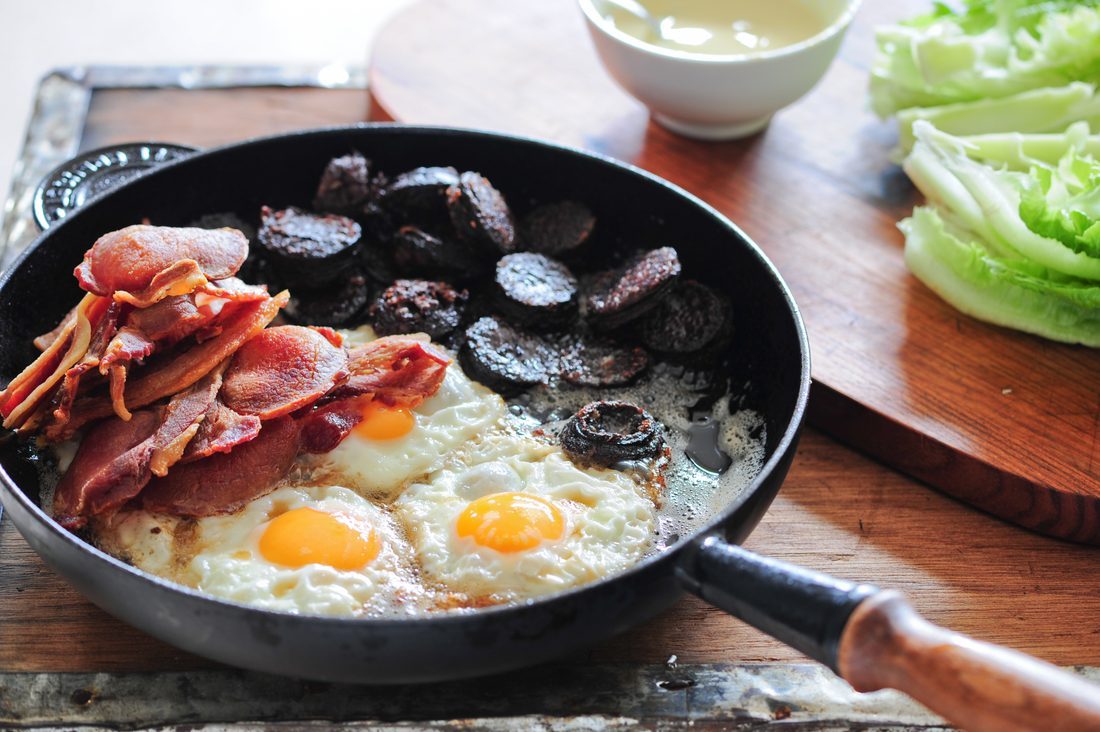
The fry this whole section is about. Mine in Galway looked much like this — but this is a stock photo, not my breakfast.
The myth, and exactly where it comes from
Search for the history of this meal and you’ll be told, over and over, that the fry-up “took shape in the 14th and 15th centuries among the gentry,” who saw themselves as guardians of the traditional country lifestyle and cultural heirs of the Anglo-Saxons.
That sentence is on hundreds of pages. It has one source, and it isn’t a historian.
It comes from a body calling itself the English Breakfast Society. I had the page pulled and read. It contains zero citations — every claim is bare assertion. It roots the meal in the Norman Invasion of 1066, while the same body is quoted elsewhere giving the 13th century and the 14th. That’s three mutually incompatible origin dates from one source that cites nothing. There’s one named author and no disclosed governance. It is styled to look like a learned society. It is not one.
The framing doesn’t even survive contact with the period it invokes. In the 1300s, English elites were performing Norman French identity and actively downplaying their Anglo-Saxon inheritance. The Anglo-Saxon revival is a largely Victorian fashion. The myth has 14th-century gentry cosplaying an identity that wouldn’t be fashionable for another five hundred years.
What actual scholarship says is the reverse. Large cooked breakfasts, in the words of UCL anthropologist Kaori O’Connor, “do not figure in English life and letters until the 19th century during the Victorian era, when they appeared with dramatic suddenness.” Before that, breakfast meant bread, jam, or porridge. O’Connor wrote the book on it — The English Breakfast: The Biography of a National Meal — and she works explicitly in the invention of tradition frame, which turns out to be exactly the right lens.
I’m being this blunt about a single website because of what it does downstream: any page that gives you a medieval date for the fry-up is repeating the English Breakfast Society without knowing it. That’s the tell. Once you know it, you can’t unsee it.
There’s a lovely circularity here I can’t resist. That same Society is the source of the widely-quoted sneer that the hash brown is “a lazy American replacement to bubble and squeak” — the self-appointed defender of tradition against modern corruption is the same body that invented the tradition it’s defending.
What the Irish evidence actually says
For Ireland specifically, the person to listen to is Regina Sexton — food and culinary historian at University College Cork, where she runs the postgraduate diploma in Irish Food Culture. She’s on the record in the Irish Examiner, and she doesn’t hedge:
“The history of the full Irish was really framed in the legacy of the aspirational, big house breakfast.”
The Big House. The Anglo-Irish gentry estate. Not the cottage, not the cottier, not the farm labourer’s dawn. The lineage runs gentry → aspiration → tourist plate — and the rural poor, the people the romantic version puts at the center of this story, weren’t eating it at all.
The middle class got there by imitation. Isabella Beeton’s Book of Household Management (1861) is the pivotal document — it carries fried ham and eggs and presents the cooked breakfast as an affordable, time-efficient version of what the country houses were doing. That’s the mechanism: a household manual teaching aspiring families to perform gentry practice on a budget. (Worth noting: the phrase “full breakfast” doesn’t actually appear in Beeton.)
The meal peaked in the Edwardian era — silver dishes, country houses. It reached the working class only in the 1950s, when refrigeration and cheap industrial bacon made it routine. That’s when it democratises. Not the 1300s. The 1950s.
One honest gap, stated plainly: I could not find a firm first-attestation date for the Irish fry as a named, composed dish, and there’s no Irish equivalent of Beeton documenting the plate. Nobody has that date. If you see one, ask where it came from. The defensible formulation is: Victorian in form, Big House in ancestry, 1960s in name.
The pig, though — the pig is real
Here’s where the “ancient” claim finally earns its keep. Just not for the breakfast.
Ireland has been eating pork since at least 9000 BP — wild boar, Mesolithic sites, before agriculture even arrives. Neolithic habitation sites are thick with pig bones. Excavations at Newgrange (c. 4000 BP) confirm cattle and pigs as the primary food animals, with pig bones the more dominant. The medieval Irish pig was the greyhound pig — pink and black, long-snouted, thin-spare, muscular and active, fattened on woodland mast, acorns and nuts. The Brehon Laws regulate pig-keeping in detail and value pork as both food and tribute.
Nine thousand years of pork. That part of the story is true, deep, and genuinely Irish.
Then the potato arrives, and the whole thing turns into an economy.
”The gentleman who pays the rent”
That’s what they called the family pig in early-19th-century Ireland, and it’s the most important phrase on this page.
After the potato spread through the 1600s and early 1700s, virtually every cabin in Ireland could feed a pig — on surplus potatoes, potato skins, and sour milk. Nothing else was required. For a smallholder on a few acres in Connacht or Munster, the pig was often the only reliable source of cash income in the household. The pig converted a subsistence crop into money.
And then the pig was sold. That’s what “the gentleman who pays the rent” means. The animal walked off the holding and the money paid the landlord for the potato plot.
So here’s the irony at the center of this whole dish: the cottier’s pig was a rent instrument, not a breakfast. The family that raised the pig ate potatoes. Bacon on the plate at dawn is precisely what the pig-keeping class did not have. The modern fry celebrates an animal that, for the people the romantic story puts at its heart, meant rent — not food.
The export trade made it worse, not better. Through the 18th century pork became a major export commodity out of Limerick, Waterford and Cork, feeding Britain and victualling ships bound for America and the West Indies. The consequence is counter-intuitive and worth sitting with: the export economy pushed domestic pork prices up, so that by the late 1700s pork was more expensive than other meats in Ireland. Export made the pig valuable and thereby pushed it further out of the reach of the person raising it.
(There’s a piece of folklore here I’ll flag rather than assert: the story that landlords charged extra rent for a sty, so families kept the pig indoors by the hearth to dodge the charge — the origin of the “pig in the parlour” stereotype. It’s plausible and consistently repeated, but I only found it in popular and heritage sources, never an academic citation. Treat it as tradition, not fact.)
Pigtown
The industrial side of this deserves its own paragraph, because it’s a real Irish manufacturing story that almost nobody tells.
Limerick was nicknamed Pigtown. Four great curing houses competed out of the city through the 19th and early 20th centuries:
| Firm | Founded | Notes |
|---|---|---|
| Matterson’s | 1816 | John Russell & J. Matterson, Roches Street |
| Shaw’s | 1831 | By 1892 the factory had electric light, lifts, a mini-railway and telephones |
| O’Mara’s | 1839 | James O’Meara of Toomevara, Co. Tipperary — across the road from Matterson’s |
| Denny’s | 1870s | Henry Denny, began as provision merchants, Upper William Street |
Look at Shaw’s again: electric light, lifts, an internal railway and telephones — in 1892. That’s a startlingly advanced plant. The Limerick Archives “Pigtown” project (Mary Immaculate College) collected the oral histories — the factory horns, the multi-generational employment, thousands of families linking the city to the county. The industry fed Ireland for 180 years and gave Limerick ham and bacon an international reputation.
And Henry Denny is the genuinely big deal nobody mentions. He patented curing and production methods through the 1820s–80s. His son Edward established processing plants internationally — and significantly aided the development of the Danish bacon industry. Read that twice: Irish curing technology helped build the competitor that would go on to dominate the British bacon market. That’s a hell of a footnote.
Mechanisation from the 1960s — Landrace breeds, artificial insemination — displaced the traditional small producers and the old houses.
The Famine, honestly
The web gets this backwards, so let me be careful.
Before the Famine, roughly 40% of the Irish population subsisted principally on the potato, taken with buttermilk, water, fish or whiskey. Breakfast for that 40% was potatoes. Not bacon. Not eggs. Not sausages. The oral history has them sitting round in a circle on stools, salt on another stool, noggins of buttermilk balanced in their laps or set on the earthen floor.
Here’s the part that surprised me: that diet was nutritionally adequate in calories and protein. The economic history — Cormac Ó Gráda’s work especially — keeps running into the contrast between the abject poverty of the Irish masses and their relatively high nutritional status. The rural poor of the west were healthier, with lower mortality, than urban dwellers, despite being poorer. They weren’t eating badly in the narrow nutritional sense. They were eating precariously — one crop away from catastrophe.
Then the crop failed, and the number that tells the story is this:
1841: ~1.4 million pigs in Ireland. By 1848: just over half a million.
A collapse of more than 60% in seven years. And the mechanism is brutal once you see it: the pig ate the potato surplus. No potato → no pig feed → no pig → no rent → eviction. The blight didn’t only take the food. It took the rent-payer. The cottier pig economy and the potato economy were the same economy, and they died together.
So what’s the honest relationship between the Famine and the modern fry?
There isn’t a line. There’s no continuity from a pre-Famine peasant breakfast to the full Irish, because the pre-Famine peasant breakfast was potatoes and the fry’s ancestor is the Big House. The fry didn’t survive the Famine. It wasn’t there to survive.
Meanwhile the export bacon industry didn’t merely survive — it consolidated and industrialised straight through the period. By 1860, Waterford alone supplied nearly two-thirds of the Irish bacon imported into London. Food exports from Ireland during the Famine years are their own charged and serious subject and I won’t reduce it to a line here, but the structural fact matters for this story: the bacon on the modern plate descends from the industrial export line, not from the cottier’s rent-pig.
If a page tells you the fry arose from Famine scarcity or post-Famine recovery eating, it’s unsourced. I went looking specifically. There’s nothing.
The Emergency: the anti-fry years
Ireland’s WWII neutrality period, 1939–45. Ration books to every household by 1942. Tea, sugar, butter and flour rationed; bread rationed in 1942.
The tea detail is remarkable. Ireland had the highest tea consumption in the world, and government research listed tea as the “principal item of food” for the Irish poor. In 1940 Britain allowed the Irish a quarter-ounce per person per week against the British full ounce. The deprivation was experienced as genuinely traumatic — which tells you something real about what tea is in this culture. (More on that in Irish Breakfast Tea.)
Then there was the black loaf — 100% wholegrain bread introduced to conserve wheat, trumpeted by health officials as more nutritious, and roundly detested. Standards of living fell, malnutrition-associated disease rose, rickets appeared in small children.
The Emergency matters here because it’s the anti-fry period — it suppressed exactly this meal — and it lands immediately before the revival. Part of the fry’s rise reads as simple relief from austerity.
1960s: the tradition gets invented
This is the actual origin story, and it’s Sexton’s.
The full Irish “emerged with tourism in the 1960s.” B&B operators trying to establish themselves offered visitors
“an experience of enjoying a top-heavy plate which was almost a representation of the farm they were staying on.”
Eggs, rashers, sausages, puddings — and maybe a tomato. Centred on the pig. The breakfast table became a stage.
And then Sexton delivers the line that reorganised this entire page for me:
“Irish agriculture was moving towards increased productivity at this time, so collecting your own eggs or curing your own rashers was almost a sign of underdevelopment.”
Sit with that. The plate was being sold to tourists as authentic farm heritage at the exact moment that doing it for real marked you as backward. The tradition was performed for visitors after it stopped being how anyone actually lived. That is textbook invented tradition, and it’s a far more interesting story than monks and chieftains.
I want to be precise about one thing, because it’s a claim I expected to find and didn’t. I went looking for a Bord Fáilte document formally defining the components of the full Irish breakfast. There isn’t one — Bord Fáilte became Fáilte Ireland in 2003, and no pre-2003 breakfast specification surfaced. If you read that Bord Fáilte standardised the full Irish, that’s an invention.
But what turned up instead is better, and it’s the best single document on this page.
Fáilte Ireland’s Minimum Requirements and Classification Matrix for Approved Irish Home Bed & Breakfast (February 2013) is a real state document, issued under the Tourist Traffic Acts, that grades every approved B&B in Ireland. It has a Breakfast section. And it says things like this, verbatim:
“Choice of a minimum of two other cooked options e.g. scrambled egg and smoked salmon, omelette or kippers, besides “Full Irish Breakfast”.”
Look at what’s happening there. The state never defines the Full Irish. It puts it in scare quotes and treats it as a known constant — a fixed point you must offer alternatives to. That is precisely how a folk dish becomes an institution: not by being specified, but by being taken for granted in a grading matrix.
And then the detail that genuinely stopped me. The same document does mandate specific items:
“The following food items are to be provided for breakfast: selection of cereals, fruit juices, fresh fruit, yogurt, bacon, eggs, sausages, tomatoes, brown and white bread, toast, preserves, butter, tea and coffee…”
There is no black pudding in that list. No white pudding either. The component every tourist article treats as the definitive marker of Irishness — the thing I’d have told you was the whole point — is not required by the Irish state’s own breakfast standard.
There’s a final irony in the star ratings: the higher the grade, the harder the matrix pushes away from the fry. At five stars you must offer four cooked alternatives — Eggs Benedict, fresh fish, smoked salmon. The Full Irish is the baseline you’re expected to transcend. And Fáilte Ireland now publishes a “breakfast toolkit” to help hoteliers innovate breakfast “for a new era” — the institution that codified the plate by assumption now trying to move operators off it.
The beans arrived in an advertisement
Baked beans are on that plate because of marketing, and the timeline is clean:
- 1886 — Heinz baked beans first sold in the UK, at Fortnum & Mason. A luxury item at ninepence a can.
- 1901 — sold throughout the UK.
- 1905 — first UK factory, Peckham.
- 1927 — the decisive move: a Heinz campaign promotes beans on toast and positions baked beans as an addition to the cooked breakfast.
The recipe was even anglicised on the way in — the original American formula was reformulated to a less sweet tomato sauce, dropping the maple syrup, molasses and brown sugar.
So the beans are an American product, placed on the British and Irish breakfast plate by an advertising campaign attributed to 1927. Not folk tradition. Marketing that stuck. (I’ll flag my own confidence honestly: the 1886/1901/1905 corporate dates are well documented; the 1927 pivot is attributed across sources but I never saw the primary campaign material. Take it as “attributed to,” not proven.)
Hash browns need a more careful sentence than they usually get. “Hashed brown potatoes” do appear in Victorian cookbooks — the dish is genuinely old, so anyone telling you they were invented in the 1980s is wrong too. But they weren’t part of the cooked breakfast until McDonald’s put one on the breakfast menu in 1982 and the 1990s freezer aisle made them ambient. The honest version: a Victorian dish that became a breakfast fixture only in the 1980s–90s, via American fast food and frozen potato.
Neither beans nor hash browns have an Ireland-specific arrival date. The timeline above is British and American and was almost certainly transferred, but no Irish source pins it. I’d rather tell you that than make one up.
Four percent
Two numbers from Bord Bia research finish the story:
Only 4% of Irish people eat a traditional cooked breakfast as their regular choice. 44% have one at the weekend.
Midweek, Ireland eats toast (33%), porridge (25%), cereal (19%), eggs (18%). Weekday breakfast has a strong health focus. But 27% pick their weekend breakfast specifically because it “feels like a treat.”
That contrast — 4% daily, 44% at weekends — is the whole arc in two figures. Whatever the fry once was, it is now ritual, not fuel. The decline is driven by health messaging and convenience food. And there’s a deeper Irish cause underneath, straight out of Sexton: the domestic production base for this meal dissolved as agriculture industrialised. Home-curing and your own eggs stopped being normal life and became either backwardness or, eventually, a hobby.
Which, I’ll note, is exactly what it is for me. I cure my own bacon and make my own sausage and puddings in Michigan in 2026 as a deliberate act. In 1960s Ireland that would have marked me as a man who hadn’t moved with the times.
One more honest gap: the fry as hangover cure is culturally universal in Ireland and Britain today and I found no historian who dates it. Not one. It would be easy to bolt it onto pub culture or the 1960s and it would sound right — which is precisely the kind of plausible invention this page exists to argue against. So: undocumented. I don’t know. Nobody I could find knows.
What I actually think
The full Irish is not a survival. It’s a performance of a rural past that was disappearing as it was being staged — assembled from a Victorian Big House template, plated for tourists in the 1960s, with American beans dropped on the side by an ad campaign and a McDonald’s hash brown showing up in the 80s.
And it is no less worth eating for any of that.
That plate in Galway was outstanding. The reason it was outstanding has nothing to do with whether a chieftain ate one in 1350. It was outstanding because good pork, cured well and cooked properly, with a black pudding made by someone who cares, on a morning when you’re hungry, is one of the great breakfasts on earth. It doesn’t need a fake pedigree. The real one — nine thousand years of pigs, an export empire run out of Limerick, a rent economy that ate potatoes, and a tourist board’s worth of B&B owners inventing a tradition on purpose — is a much better story anyway.
Now let’s go look at what’s actually on the plate.
Sources & further reading
- Regina Sexton, food historian, University College Cork — quoted in the Irish Examiner (link). Author of A Little History of Irish Food (Gill & Macmillan, 1998) and Ireland’s Traditional Foods (Teagasc, 1997). The single most important source on this page.
- Kaori O’Connor, The English Breakfast: The Biography of a National Meal, with Recipes (Bloomsbury). UCL anthropologist; works in the “invention of tradition” frame.
- Máirtín Mac Con Iomaire & Dorothy Cashman (eds), Irish Food History: A Companion — open access at arrow.tudublin.ie. The best place to go deeper.
- Cormac Ó Gráda, Ireland Before and After the Famine — pre-Famine nutrition and economy.
- Limerick Archives “Pigtown” project, Mary Immaculate College — limerick.ie and limerickslife.com.
- Pork in Ireland — Wikipedia, for the deep-time and pig-population figures.
- Bord Bia breakfast research (2016) — via TheJournal.ie.
- The Emergency — Ciarán Bryan, Rationing in Emergency Ireland, 1939–48 (PhD thesis, Maynooth); RTÉ Brainstorm on the black loaf and the tea ration.
Not a source, but an object of study: englishbreakfastsociety.com — uncited, internally contradictory, and the fountainhead of the medieval-origin myth. Quotable as an opinion in the discourse. Never as history.
Comments (0)