The Ulster Fry & the Neighbours
Sodium bicarbonate became a cheap industrial commodity in the 1830s. Before that, there was no such thing as a soda farl — you cannot make soda bread without soda. And since the soda farl is the one thing that makes an Ulster fry an Ulster fry rather than just a plate of fried pork, the Ulster fry has a hard technological floor underneath it. It cannot be older than a chemical plant.
That’s the whole argument on this page, and I’m putting it first because everything else follows from it. The tradition is in the farl, not in the fry.
I should say up front where I’m standing. I’ve eaten a fantastic Irish breakfast several times in Galway — which is in the Republic, hundreds of miles and one border from Ulster. I have not eaten an Ulster fry in Ulster. I’m not going to pretend otherwise, and I’m not going to write you a scene about a griddle in Belfast that I never stood in front of. What I can do is read the sources carefully, cure my own bacon, run a griddle, and tell you which parts of the internet’s Ulster fry story survive contact with a primary source. Most of it doesn’t.
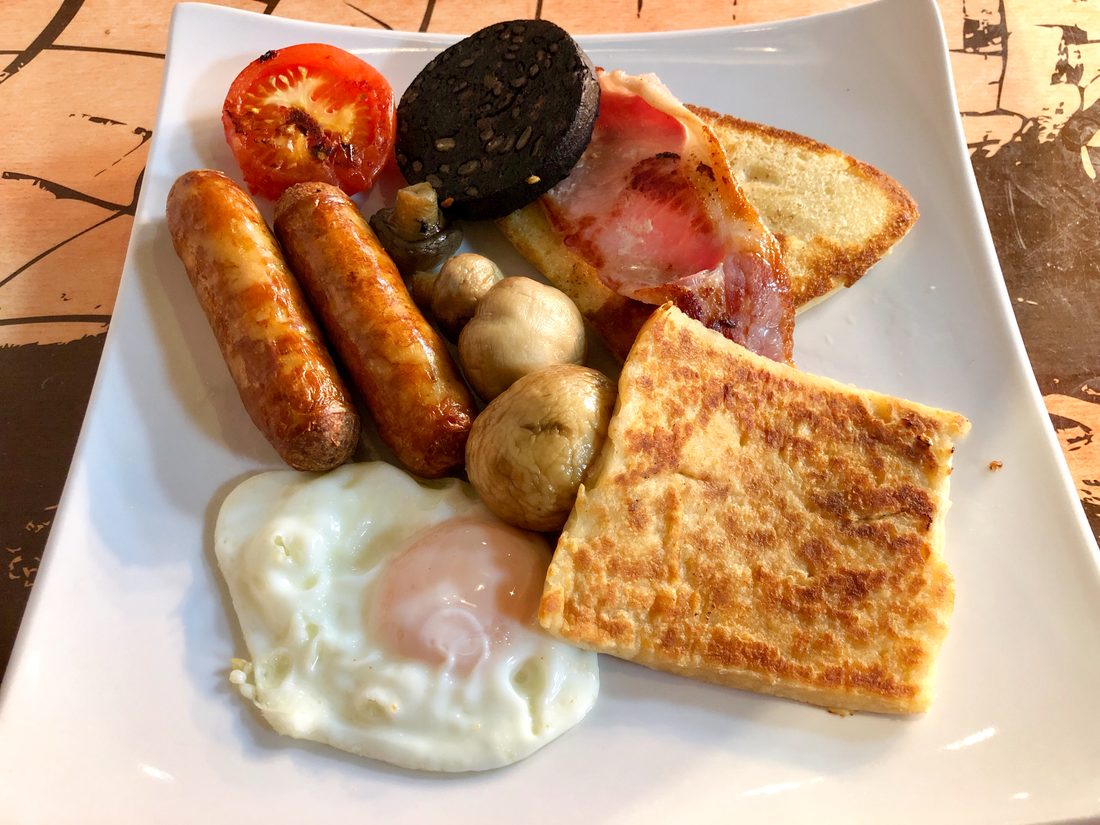
The southern shape of it. Swap that fried bread for a soda farl and a potato farl griddled in the fat and you’re in Ulster — that swap is the whole distinction.
The griddle breads are the entire dividing line
Wikipedia, drawing on the Northern Ireland Tourist Board, puts it plainly: the Ulster fry is “distinguishable from a full breakfast by its griddle breads — soda bread and potato bread.” Not the bacon. Not the sausage. Not the eggs. Those are on every plate from Cornwall to Donegal.
Two breads, both cooked on a hot flat surface rather than in an oven:
- Soda farl — soda bread dough (flour, bicarb, buttermilk), pressed into a round, cut into quarters, and griddled instead of baked.
- Potato farl / potato bread — mashed potato, flour, usually butter. Also griddled.
“Farl” is short for fardel, meaning a quarter — because you cut the round into four. That’s a small, checkable, genuinely satisfying etymology, and it tells you the shape came first and the name described it.
And here’s the part that matters: the farls go into the fat. Not alongside it, not after it, into it. You cook the bacon and the sausage, and the farls go face-down into what those left behind, and they drink it. Domini Kemp’s method in the Irish Times is exactly this — “add soda farls to absorb excess fat.” That’s not a garnish. That’s the design.
I’ve made a lot of griddle breads, and this is a real technique with a real result. A soda farl is a chemically leavened dough that’s been cooked by conduction on one face at a time, which means it’s got a dense, slightly gummy interior and two flat crusts. That interior is a sponge. Put it cut-side-down in bacon fat and it takes up the fat the way a biscuit takes up gravy. You are not frying bread. You are using bread as a delivery system for rendered pork.
That’s the dividing line. Everything else on the plate is negotiable and always has been. Full details on both breads are on farls and boxty and soda bread.
Fried, not deep-fried, and not grilled
Wikipedia states that the traditional Ulster fry ingredients are “fried in lard,” and that baked beans and hash browns are non-traditional or objectionable. So: fried. Genuinely, as a defining property, not as a cooking-method footnote.
But there’s a distinction inside “fried” that matters, and Kemp nails it: deep-fat-frying a soda farl is “a cardinal sin.” The farl is griddled or pan-fried in the fat. It is not submerged in it. If you drop a farl in a fryer you get a hot greasy dumpling, not a fry.
⚠ Where I’m going to stop short. There’s a tidy line available here — the south grills, the north fries — and I’m not going to make it, because the research file I’m working from flags it explicitly as unsourced synthesis. It’s plausible: southern hospitality kitchens do lean grill-and-oven for volume and for the health optics, and the Ulster fry is unapologetically a pan dish. But plausible isn’t sourced. If I told you “south grills, north fries” as a fact, I’d be inventing exactly the kind of tidy folk-truth this whole section exists to shoot down. So: that’s my hunch, labelled as a hunch, and nothing more.
It was not originally a breakfast
This is the one that should stop you.
Per the Northern Ireland Tourist Board, via Wikipedia, an Ulster fry —
“although not originally particularly associated with breakfast time, has in recent decades been marketed as Northern Ireland’s version of a cooked breakfast.”
Read that twice. It was an any-time meal. Its identity as breakfast is recent, and it is marketed. And note who the codifying authority is in that citation: a tourist board. Not a historian, not a cookbook, not a parish record. A marketing organisation.
Which is precisely the pattern on the other side of the border. The full Irish was codified by tourism in the 1960s, and the state’s own grading matrix treats “Full Irish Breakfast” as a known constant it never bothers to define — the whole argument is on the history page. North and south, the same mechanism: a folk food gets a name, a plate, and a fixed identity at the moment somebody needs to sell it to a visitor.
The components are old. The composed named breakfast plate is not.
The floor under the farl
And now the hard number, which is the most useful fact on this page.
Soda bread and soda farls date to roughly the 1830s–1870s, when bicarbonate of soda became commercially manufactured and cheap. Not before. There is no folk workaround — the chemistry is the chemistry. Buttermilk plus an alkali is the entire leavening system, and if you don’t have the alkali you have a flat unleavened disc, which is a different food.
So:
- The soda farl cannot predate industrial baking soda (1830s).
- The Ulster fry is defined by the soda farl.
- Therefore the Ulster fry cannot predate the 1830s.
Any page that gives you a medieval or “ancient Ulster” origin for this dish has failed a test it could have run in ten seconds. The potato farl is genuinely older in spirit — griddling mashed potato over a turf fire, wasting nothing, is a real and deep regional foodway. But the composed thing on the plate, with the name, is Victorian at the absolute earliest and mid-20th-century as a marketed identity.
⚠ What nobody can tell you: the first attestation of the term “Ulster fry.” Sources converge on a 1960s tourism-boom popularisation, but not one of them gives a first-use date or a citation. NOT FOUND. I’m not going to guess one.
The pig is ancient. The griddle is old. The breakfast is not.
Two institutions, quietly writing down a folk dish
The Ulster Fry World Championships were established in 2023. What makes them worth a paragraph is the rulebook: competitors are mandated to include only bacon, eggs, sausage, soda bread and potato bread — “to make things fair.”
That’s a de facto minimal canonical definition of the Ulster fry, written by a competition, in order to have something to judge. Five items. Note what isn’t on the list: black pudding, white pudding, tomato, mushroom, beans, anything.
⚠ Single-sourced. This comes to me via Wikipedia and nothing else. I could not corroborate it independently. Take it as reported, not as verified.
And the mirror is lovely. In the south, Fáilte Ireland’s B&B classification matrix names “Full Irish Breakfast” in scare quotes and mandates a component list (bacon, eggs, sausages, tomatoes, bread, toast — and, famously, no pudding). In the north, a championship mandates five items so the judging is fair. Two institutions, on opposite sides of a border, each quietly codifying a folk dish for administrative convenience — neither of them a historian, both of them now the authority. That’s how tradition gets made in practice: somebody needs a checkbox.
The Ulster Fry Index
This one is real, and it’s my favourite thing in the file.
Ulster Bank has tracked the Ulster Fry Index since 2007, compiled by chief economist Richard Ramsey. It prices a basket of cooked-breakfast items — bacon, eggs, sausages, butter, margarine, tomatoes, tea — as a consumer-facing inflation gauge for Northern Ireland. The logic is sound rather than cute: food is a large share of household spend, and agri-food is a keystone NI sector, so a breakfast basket is a legitimate proxy that people can actually feel.
Its most-reported finding: the fry rose about 7% in price since the Brexit vote (2019 reporting).
It’s a Big Mac Index for breakfast, run by a named economist at a real bank, with eighteen years of series behind it. A national dish that has its own inflation index is a dish that a country has decided to take personally.
Two traps
This is the most valuable section on the page, and it’s the reason I wrote it.
Trap one: theulsterfry.com is satire
theulsterfry.com is a parody news site. Its tagline is “The News As It Should Be.” It is not journalism, it has never been journalism, and it does not claim to be.
It also ranks highly for Ulster fry searches, and its posts are formatted like news and shared like news. If you search this topic, you will hit it, and if you’re skimming you will not notice. Do not cite it. I’m not citing it. I’m naming it here purely so you can recognise it when it comes at you sideways through a screenshot.
Trap two: the EU never tried to ban the Ulster fry
There’s a story floating around that the EU tried to ban the Ulster fry, or that a health lobby came for it, or that politicians rallied to defend it.
NOT FOUND. Repeated searching turned up no evidence of any of it. No ban attempt. No health-lobby row. No defend-the-fry campaign. What the searches actually surface is: (a) the satire site, (b) the Ulster Fry Index, and (c) an entirely unrelated 2024 EU ban on certain smoked flavourings.
The most likely explanation is that the satire site seeded it and the story escaped. That’s how it works — a joke headline gets screenshotted, the domain gets cropped off, and eighteen months later it’s something everyone remembers happening.
I want to be careful and blunt at the same time here. I am not saying it’s proven false. I’m saying that a story which everybody repeats and nobody can source to a primary document is exactly the failure mode worth flagging in print. A closed loop of citations is not evidence. It’s an echo. If someone can produce a primary source, I’ll put it on this page in an hour. Until then: unverified, unsourced, and probably a joke that got loose.
What is real folk culture
The beans dispute, on the other hand, is entirely genuine. There is an X account, @farls_not_farts, whose display handle is literally “An Ulster Fry Does •NOT• Include Baked Beans.” And a photograph of an Ulster fry once, per the Derry Journal, “sent Twitter into meltdown.”
That’s real. People care about this with their whole chest, and I respect it. The beans war is not a national boundary — beans are contested everywhere, standard on a full English, common in practice in the Republic, objectionable on an Ulster fry. It’s a taste war fought with the intensity of a border dispute, which is somehow more Irish than the border dispute.
Down the island: the variants that actually exist
Drisheen (Cork)
A blood pudding unique to Cork, made not from whole blood but from the serum — “the juice” — salted, piped into casing, and boiled to a soft, gelatinous set. That’s the whole point of it. It is texturally nothing like a crumbly black pudding. It’s a set custard that happens to be made of blood.
⚠ Correction, and it’s the kind that matters: drisheen is routinely described as “the sheep’s-blood pudding of Cork.” That’s the historic product. Sheep drisheen died out by the mid-1990s — the casings are fragile and regulation made fresh sheep’s blood hard to source. What’s made today is beef. Say “historically sheep, now beef,” or don’t say it.
The last maker is Donagh O’Reilly of A. O’Reilly’s, in Cork’s English Market — described in November 2022 as Ireland’s sole remaining drisheen producer. The stall has sold it for over a century. A serving cost €2 and demand barely covered the cost of making it. His own words: “as soon as I stop making it, that’ll be it, it’s finished.”
⚠ And here is where I stop. My newest hard source is November 2022. It is now 2026. I do not know whether A. O’Reilly’s is still making drisheen, and I am not going to print it as a recommendation. The honest reason: this is a craft that its last practitioner publicly described as one retirement away from extinction, four years ago. Sending you across an ocean to a stall on the strength of a four-year-old article, when the man himself told a reporter it ends when he stops — that’s not a recommendation, that’s a coin flip with your holiday. Status in 2026: UNVERIFIED. Phone the English Market before you go.
More on the pudding family generally: black pudding and white pudding.
Dublin coddle — never breakfast
Sausages, rashers, potatoes, onions. Boiled or stewed, famously pale and unbrowned. And it is not a breakfast, has never been a breakfast, and the sources are unambiguous about this.
It’s a supper dish, made from the week’s leftover meat. The documented timings are Thursday — using up rashers and sausages before Friday’s meat abstinence — and Saturday night, simmering while the husband was at the pub and reheated when he came back. It predates the takeaway as Dublin’s reheatable evening meal.
The contrast is genuinely beautiful, and it’s the best thing in this section: coddle and the fry are the same Dublin larder, cooked two opposite ways, at opposite ends of the day. Identical nouns — sausage, rasher, onion, spud. One is fried hard at dawn. The other is simmered pale at midnight. Same shopping list, inverted method, opposite hour.
⚠ One search result claimed coddle is “associated with breakfast, particularly in Joyce’s Ulysses.” I could not verify any such passage, and it is likely false. Bloom’s famous breakfast is a grilled mutton kidney. Treat the Ulysses-coddle claim as NOT FOUND.
Waterford blaa
A soft white floury-topped roll, and one of very few Irish breads with legal protection: “Waterford Blaa / Blaa,” PGI, registered with the EU on 19 November 2013. Made outside the area, it can’t be called a Waterford blaa.
⚠ Date trap. GOV.UK lists the registration as 31 December 2020, 23:00. That is not the original date — that’s the moment the name was carried into the UK’s own post-Brexit GI scheme at the end of the transition period. Anything citing 2020 for the blaa has misread the register. The EU date is 2013.
Two more corrections while we’re here. It is Waterford’s, not Sligo’s — there is no Sligo blaa. And ⚠ it is NOT established as a breakfast bread. It’s a daily local bread, eaten with butter, and yes it can carry a fry filling, but I found no authoritative source designating it a breakfast item. I’m not going to promote it to one because it would tidy up my paragraph.
Galway
NOT FOUND. No distinct Galway breakfast variant is documented anywhere I can verify. Galway’s food identity is oysters and the Saturday market. I’ve eaten a superb breakfast there several times and it was a full Irish, cooked well — not a Galway variant, because there isn’t one. I’m not inventing one just because it’s the place I’ve actually been.
The PGI headline nobody prints
Here’s a finding worth more than most of the internet’s Ireland content:
The two Irish breakfast items with EU legal protection are both puddings from small villages — Sneem Black Pudding (Kerry) and Timoleague Brown Pudding (Cork). The famous one, Clonakilty, has no PGI at all.
Clonakilty is a trademark and a family recipe from Edward Twomey’s butcher shop in West Cork, dating to the 1880s. It is excellent and it is not protected. Blogs conflate famous with protected constantly, because both words feel like prestige.
The Sneem detail is the good part. It’s uncased and tray-baked, then cut and sold in squares, not rings — which alone tells you it grew up outside the sausage-casing tradition everyone assumes black pudding belongs to. Deep red-brown. Free of artificial colours, flavours, bulking agents and preservatives. The recipe dates to the early 1950s. And it’s made by exactly two butchers in the village of Sneem.
Two butchers. That’s the whole protected industry.
The four nations, honestly
The web’s difference-lists are lazy. They give you a tidy table of exclusive items, and the reality is a gradient with a few genuinely sharp lines and a great deal of blur. Here’s my attempt at an honest one:
| The line that’s REAL | The lie the listicles tell | |
|---|---|---|
| Ulster fry | Soda farl + potato farl, griddled in the fat. The single hardest, most reliable distinction in these islands. | That it’s ancient. It can’t predate 1830s baking soda. And it wasn’t originally a breakfast at all. |
| Full Irish (Republic) | Soda bread — but baked as a loaf, not griddled. White pudding is commoner here and is the fair marker. | ”Potato farls are on the full Irish” is Wikipedia’s own [citation needed]. Farls in the Republic are a northern borrowing, not a national default. And white pudding isn’t even in the Irish state’s own B&B minimum requirement. |
| Full Scottish | Lorne / square sausage (square, casing-less) and the tattie scone. Genuinely Scottish, visually unmistakable. | Haggis is listed as occasional, not standard. The listicles promote it to definitional. It isn’t. |
| Full Welsh | Laverbread and cockles. Pureed seaweed, usually mixed with oatmeal and fried, plus shellfish. Genuinely nowhere else. | The “traditional breakfast of mine workers” line is uncited on Wikipedia. Nice story, no source. |
| Full English | Fried bread. That’s the English starch move, and it mostly holds. | ”Black pudding is Irish/Scottish, not English” is FALSE. It’s on the canonical full English. It’s just unpopular — 35% in a 2017 YouGov poll of “ideal” breakfasts, versus over 50% for every other component. The difference is enthusiasm, not presence. |
Two more corrections that deserve their own line, because they’re the ones I see most:
“White pudding is uniquely Irish” — overstated. It’s an occasional component of the full Scottish too. It’s a tendency, not a border.
“Soda bread is the Irish one” — true-ish, but the real relationship is better than that. Soda bread is an all-Ireland technology. The north griddles it into farls; the south bakes it into a loaf. Same chemistry, different geometry. That’s not two breads. That’s one bread and two decisions about heat.
For where any of this actually gets served, see where it’s served.
My argument, labelled as mine
Everything below this line is my synthesis, built on the sourced items above. It is not a fact I’m reporting. It’s the pattern I think the facts make, and you should weigh it as such.
These are five dialects of one Victorian sentence. Cured pork, eggs, a starch, and something made of blood. That’s the sentence. Every one of these breakfasts is speaking it.
And look at what actually varies. The pork is bacon and sausage in all five. The eggs are eggs in all five. The blood thing is a black pudding in all five — genuinely, including England, where they just don’t like it much. The nouns barely move.
The starch is what changes.
England fries its bread. Ulster griddles it into farls and feeds them the fat. Scotland turns the potato into a scone. Wales walks down to the shore and comes back with seaweed. The Republic bakes the soda bread into a loaf and adds a second, paler pudding.
Five answers to one question: what carbohydrate goes next to the pig?
I cure my own bacon and grind my own sausage, and I’ll tell you from the workbench that the meat side of these breakfasts is close to identical across all five nations. Same animal, same cure chemistry, same grind. If you swapped the bacon between a Belfast plate and a Cardiff plate, nobody would notice. Swap the farl for a slab of laverbread and there’d be an incident.
The argument is never about the bacon. It’s always about the carbohydrate.
Sources & further reading
- Wikipedia, Full breakfast — the base component lists for all five variants, the “fried in lard” statement, the 2017 YouGov figure, the Ulster Fry World Championships, and the [citation needed] on potato farls in the Republic. Used with care; flagged where weakly sourced.
- Wikipedia, Northern Irish cuisine — the griddle-breads definition and the Northern Ireland Tourist Board’s “not originally particularly associated with breakfast time” line.
- Irish Times, “Fries, farls and bakes” (Domini Kemp, 30 June 2012) — the farls-absorb-the-fat method, and the deep-frying “cardinal sin.”
- Irish Times, “Ulster fry jumps almost 7% in price since Brexit vote” — the Ulster Fry Index.
- Irish News, “Ulster Fry Index shows bacon is cheaper but butter costs more”
- Ulster Economix — Ulster Fry Index (Richard Ramsey’s blog) — the economist’s own workings.
- @farls_not_farts on X — “An Ulster Fry Does •NOT• Include Baked Beans.”
- Derry Journal, “A photograph of an Ulster fry has sent Twitter into meltdown”
- Echo Live, “I’m the last drisheen maker in all of Ireland” (14 Nov 2022) — Donagh O’Reilly; the sheep-to-beef correction; the “that’ll be it, it’s finished” quote.
- Taste Cork — Tripe, Drisheen & Crubeens
- Wikipedia, Drisheen
- Dublin City Council Library, “A Brief History of Dublin Coddle” — the Thursday/Saturday timings.
- Wikipedia, Coddle
- GOV.UK protected food names — Waterford Blaa / Blaa — and the source of the 2020 date trap.
- BakeryAndSnacks, “Waterford Blaa bread granted EU protection” (Nov 2013) — contemporaneous confirmation of the real 19 Nov 2013 date.
- British Baker, “Waterford blaa gains PGI status”
- FRKelly, “Sneem Black Pudding gets EU PGI status” — the two-butchers detail and the uncased, tray-baked, sold-in-squares description.
- Wikipedia, Sneem Black Pudding
- Agriland, “PGI status confirmed for Sneem Black Pudding”
- Clonakilty Black Pudding — notable for what it does not claim.
- Moya Watson, “A brief history of the potato farl” — fardel / quarter etymology.
- Not a source — an object of study: theulsterfry.com is a satire site. It is not linked here on purpose.
Comments (0)