Rashers & Bacon
If you take one fact from this entire section, take this one:
A rasher is not American bacon. It’s a different cut of the pig.
Not a different cure. Not a different thickness. A different part of the animal. Every American who has ever fried a rasher expecting it to behave like the strips from a supermarket package and ended up with a curl of leather has run into this, and almost nobody explains it.
This is the substitution that most changes the breakfast. You can fake a lot of the plate. You cannot fake this.
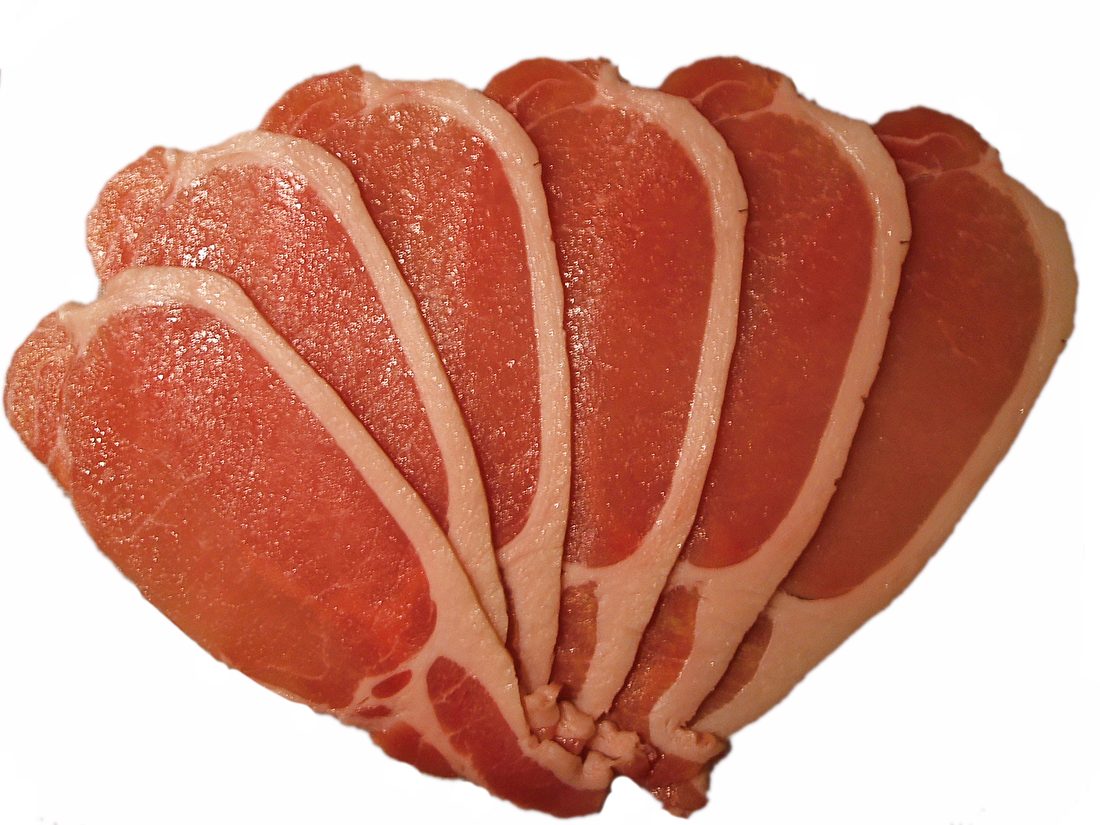
There it is: the two parts in one slice — the lean round eye of the loin, and the fattier tail of belly. That tail is the rasher. American bacon is the tail without the eye.
The cut
Here’s the anatomy, and once you see it you can’t unsee it.
A proper rasher is two parts in one slice: the lean, round “eye” of the pork loin, and a tapered, fattier “tail” from the pork belly. A full rack of British/Irish bacon is the pork loin with plenty of belly still attached to it — the loin section is the rasher, the belly section is the streaky.
American bacon is belly only. Invariably. That’s the whole thing — that’s why it’s all fat ribbons and lean stripes, and why it crisps into a shatter.
Middle bacon is the full loin-plus-belly slice: the lean eye plus a full-length fatty tail.
So:
| Cut | Behaviour | |
|---|---|---|
| Irish/UK rasher | Back bacon — loin eye + belly tail | Mostly lean; stays chewy-tender, browns at the edges |
| American streaky | Belly only | Fat-laced; renders and crisps to a shatter |
| Canadian bacon | Loin eye only — tail trimmed off | Lean, close-but-not-right; the fat tail is missing |
| Middle bacon | Loin + full belly tail | The whole rack in one slice |
The consequences matter more than the trivia:
A rasher is mostly lean, and it is not supposed to get crispy. It’s meant to stay tender, browned at the edges, and eaten with a knife and fork. The American failure mode is trying to make it crispy — you’re not undercooking it, you’re cooking a lean muscle like it’s a fatty one, and lean muscle held that long just dries out and toughens.
Canadian bacon is the nearest supermarket thing, and it’s still not it. It’s the loin eye with the belly tail trimmed away — so it’s missing precisely the fat that makes a rasher taste like a rasher, and it’s usually smoked harder and sliced thinner. Closer than streaky. Not close enough. (I’ll flag my own confidence: the loin-only characterization of Canadian bacon is consistent with every cut definition I found but I didn’t pin it to a single named authority.)
What I’ve actually done
I’ve cured bacon a lot of ways, because I like to experiment more than I like to settle. Belly and loin. Wet brine and dry cure. I’ve smoked belly bacon on the SmokinTex rigs and I’ve made plain unsmoked cures, and I’ve gone back and forth on which I prefer often enough that I’ve stopped pretending I have a final answer.
Here’s what that experimenting actually taught me, and it took embarrassingly long to see: for years I was making American bacon out of American cuts and thinking the differences I was chasing were about the cure. They weren’t. The cure is the small variable. The cut is the big one. You can dry-cure a belly with perfect technique and beautiful pepper and juniper and you will have made excellent bacon that is still not a rasher, because it’s the wrong muscle.
That reframe is worth more than any brine recipe I could give you.
The other thing worth saying plainly: the Irish default is unsmoked. “Plain” or “green” rashers. I own a cold smoker I’m fond of, and the honest answer is that for this plate it should mostly sit idle. About half of British bacon is smoked; Irish breakfast rashers commonly aren’t. Smoke is a thing I love that this particular breakfast doesn’t especially want.
Wet vs dry — and the terminology trap
The Wiltshire cure is the classic wet cure — traditionally done skin-on and bone-in, giving a slightly salty flavour and a distinctively meaty texture. It’s named for Wiltshire because John Harris opened the first bacon processing plant there.
Dry cure means rubbing the meat with salt and sugar and letting it cure over several days. It gives a more robust flavour and a firmer texture, because moisture is drawn out rather than added.
Now the trap, which trips up nearly every shopper:
“Dry cure” and “unsmoked” are different axes. They are not the same claim.
- Dry cure / wet cure = how the salt got in (rubbed vs brined or injected).
- Smoked / unsmoked = whether it ever met smoke.
These are independent. Dry-cured smoked, dry-cured unsmoked, wet-cured smoked, wet-cured unsmoked — all four exist. People treat “dry cure” as a flavour claim when it’s a process claim.
And here’s the commercial subtext, which is the actually useful part: wet-cured bacon is often pumped with brine, which adds weight and water. That’s why cheap bacon weeps white liquid and steams instead of frying — you’re boiling it in its own injected brine. So “dry cure” on an Irish or UK pack is largely a signal that the bacon hasn’t been water-injected, and that’s what you’re actually paying for.
(I’ll mark that honestly: the pumped-water explanation is well-established trade knowledge and it’s consistent with every texture description I found, but I didn’t source it to a named authority. Treat it as interpretation. It also matches what comes out of my own pan, for whatever one bench is worth.)
Nitrite: the section I’m not going to hand-wave
This is a food-safety number, so I’m using the regulation and a peer-reviewed extension publication, not a blog. If you take one thing from this page after the cut, take this.
Why nitrite at all. Per an AMSA-reviewed factsheet from the Pork Information Gateway — authored by Amanda Gipe McKeith PhD and reviewed by Dr Joe Sebranek (Iowa State), who is the leading academic authority on meat curing — nitrite is “effective at inhibiting pathogens, especially anaerobic spore formers including Clostridium botulinum,” and “there has been no known substitute for its ability to impart characteristic color, flavor and antimicrobial properties.” The same source: establishing a minimum in-going nitrite concentration is “considered critical to subsequent product safety.”
So nitrite isn’t decoration or colour. It’s botulism control. Anyone telling you to leave it out of a cured, cold-smoked, or slow-cured product is telling you to remove the safety system.
The legal numbers, from 9 CFR § 424.22(b):
| Bacon type | Max ingoing sodium nitrite |
|---|---|
| Dry cured bacon | 200 ppm |
| Immersion cured bacon | 120 ppm |
| Pumped and/or massaged bacon | 120 ppm plus 550 ppm sodium ascorbate/erythorbate |
| Nitrate in bacon | Not permitted |
All based on skin-free green weight.
⚠ And here’s a genuine trap I want to flag, because it could hurt someone. That same excellent AMSA-reviewed factsheet contains the line: “Dry-cured products are allowed to have 625 ppm sodium nitrite, in-going.” That’s true — for dry-cured products generally, meaning hams and the like. But 9 CFR 424.22(b) sets dry-cured BACON at 200 ppm.
For bacon, 200 ppm is the governing number. Do not apply 625 ppm to bacon. Read in isolation that factsheet line could lead someone to over-cure by a factor of three. Two good authorities, one dangerous misreading, and it’s exactly the kind of thing that never gets flagged.
Bacon is treated as a special case in the regulations specifically because of the concern about nitrosamine formation during frying — you’re taking a cured product to high heat in a pan, which hams don’t get. That’s why bacon gets its own tighter numbers.
One myth worth killing while I’m here. That “uncured — no nitrates or nitrites added” bacon at the fancy grocery store? It’s chemically cured. It’s cured with celery powder, which is a nitrate source. USDA labelling rules (9 CFR 319.2) require it to be labelled “uncured” and “no nitrates or nitrites added except those naturally occurring in…” — a labelling artefact that the factsheet says has “created significant confusion for consumers.” Worse: the same source notes “natural cures” have “a limited ability at inhibiting C. perfringens, which suggest that they may have a limited ability at inhibiting C. botulinum.” So you’re paying more for a product that is cured anyway and may be doing the safety job less well.
Why I’m not giving you a brine
There’s a well-known published rasher brine out there — half a gallon of water, half a cup of kosher salt, half a cup of sugar, ¾ oz of Cure #1, 3–4 days. It’s a real method and people make good bacon with it.
I’m not publishing it, and the reason is worth explaining.
It’s an over-strength immersion brine with a time limit, which means the nitrite the meat actually receives depends on how much brine it happens to absorb. You cannot compute the ingoing ppm. You’re relying on pulling it out at the right time.
For my own bench, fine — I’ve done plenty of wet cures and I like them. For a published recipe on a food-safety-sensitive topic, that’s the wrong tool. So the recipe below uses equilibrium (EQ) dry curing: every gram of cure you add ends up in the meat, so the ppm is exactly known and it cannot run away from you. Leave it an extra day and nothing bad happens, because the salt and nitrite physically cannot exceed what you put in.
That forgiving property is the entire reason to prefer EQ for a recipe someone else is going to follow unsupervised.
The arithmetic, shown so you can check it rather than trust me:
- Prague Powder #1 / Cure #1 = 6.25% sodium nitrite, 93.75% salt.
- At 0.25% of meat weight: 1000 g meat → 2.5 g Cure #1 → 2.5 × 0.0625 = 0.15625 g sodium nitrite = 156.25 mg/kg = 156 ppm.
- 156 ppm sits comfortably under the 200 ppm ceiling for dry-cured bacon, and it’s the long-standing industry-standard rate. ✅
- Want to hit the immersion-cured 120 ppm figure instead? 2.5 × (120 ÷ 156.25) = 1.92 g Cure #1 per kg (≈0.19%).
The recipe — dry-cured Irish rashers
Bacon, Irish Rashers, Dry-Cured
Honesty label: this formula is reasoned from sourced anchors, and the cure chemistry and ppm arithmetic are sound and checkable. I have not yet run this exact formula on this exact cut. I’ve dry-cured plenty of pork; I haven’t cured a loin-with-tail to these numbers and photographed it. When I do, this page gets the photos and any corrections. I’d rather say that than imply a bench test I haven’t done.
The cut is the hard part. Ask your butcher for a pork loin with the belly tail still attached — a full “back rack,” skin off, fat cap left on. If they look at you blankly, ask for a thick bone-in loin chop section and have the bone removed with all the fat left untrimmed. If you can only get loin, you’ll make Canadian bacon, not a rasher. The belly tail is the rasher.
Per 1000 g of trimmed meat — scale linearly, and weigh the meat, don’t guess:
| Ingredient | Amount | Rate |
|---|---|---|
| Pork loin-with-belly-tail, skin off | 1000 g | — |
| Cure #1 (Prague Powder #1, 6.25%) | 2.5 g | 0.25% → 156 ppm |
| Fine sea salt (non-iodized) | 20 g | 2.0% |
| Soft brown sugar | 10 g | 1.0% |
| Black peppercorns, cracked | 2 g | |
| Juniper berries, crushed | 2 g | optional |
| Bay leaves, crumbled | 2 | optional |
Method
- Weigh the trimmed meat precisely. Every number scales from it. A scale accurate to 1 g is mandatory. Do not use volume measures for Cure #1. This is the one step where a mistake actually matters.
- Mix cure, salt, sugar and aromatics thoroughly — pockets of concentrated Cure #1 are exactly what you’re avoiding.
- Rub over all surfaces. Bag it with all the cure — scrape in every grain. The ppm calculation assumes none is lost.
- Refrigerate at 2–4 °C for 5–7 days, turning daily and redistributing the liquid that draws out. Don’t discard that liquid — it holds cure. (Rule of thumb: ~1 day per 5 mm of thickness plus 2 days. ⚠ That rule of thumb is conventional wisdom, not something I could source to an authority.)
- Rinse briefly, pat dry.
- Pellicle: uncovered on a rack in the fridge, 24 hours, until the surface is dry and tacky.
- Unsmoked (“plain”/“green”) — the Irish default: stop here. Smoked: cold smoke under 30 °C / 86 °F for 3–6 hours. ⚠ Cold smoking has its own safety envelope — the meat is cured but uncooked, and time/temperature control matters. That’s beyond this page; see Smoking and do your homework.
- Chill thoroughly, then slice ~3–4 mm — noticeably thicker than American bacon. Part-freeze for 30–45 minutes and slicing gets far easier.
- Cook in cast iron over medium. Render the fat, brown the edges, do not chase crisp. Knife and fork.
Keeping: cured and unsmoked, refrigerated, roughly 1–2 weeks; freeze beyond that. ⚠ Not verified against an authority — hedge accordingly.
If you’re not going to cure it
Fair enough. The honest ranking:
- Buy loin-with-belly-tail and cure it. The only way to get the real thing.
- Canadian bacon. The nearest supermarket item. Loin-only, no tail. It’ll read as close.
- An Irish/British import shop. Real rashers, priced accordingly.
- ⚠ American streaky bacon — the wrong cut entirely. It’ll be delicious. It will not be an Irish breakfast; it’ll be an American breakfast wearing a hat.
Of everything on this plate, this is the substitution that changes the meal most. The puddings are the exotic ones, but the rasher is the one you’ll notice every single bite.
Next: the sausage, where the word “banger” turns out to have a much better story than the one you’ve been told.
Sources & further reading
- 9 CFR § 424.22 — the federal regulation on nitrite limits in bacon. Cornell LII · eCFR. (Cornell was used as a verbatim mirror during research; eCFR blocked automated access. Confirm against eCFR if you’re relying on it commercially.)
- McKeith, A.G., “Alternative Curing,” Pork Information Gateway PIG 12-05-10, reviewed by Sebranek (Iowa State) & Sindelar — meatscience.org (PDF). The source for the botulism framing, the “uncured” labelling artefact, and the 625 ppm line that must not be applied to bacon.
- The Paupered Chef, “A Guide to Bacon Styles and How to Make Proper British Rashers” — the cut anatomy, and the brine method I’ve deliberately not reproduced.
- Bacon By The Box, “Guide to Bacon Rashers” — the Wiltshire cure and John Harris.
- Carne Atlas, Back bacon.
Comments (0)