Soda Bread & Brown Bread
I bake a lot. I run a sourdough starter, I’ve got a Rofco B40 in the shop, and I’ve spent real time chasing the long, slow, gluten-development side of bread — the side where you wait.
Soda bread is the opposite of all of that, and it’s a genuinely humbling thing to make. There is no fermentation. There is no gluten development. There is no waiting. The clock starts the instant the buttermilk hits the flour, and everything you know about handling dough is not just unnecessary — it’s actively harmful. You have about sixty seconds and the correct move is to stop touching it.
It’s also one of the great pieces of applied chemistry in food history, and the reason it exists is more interesting than the bread.
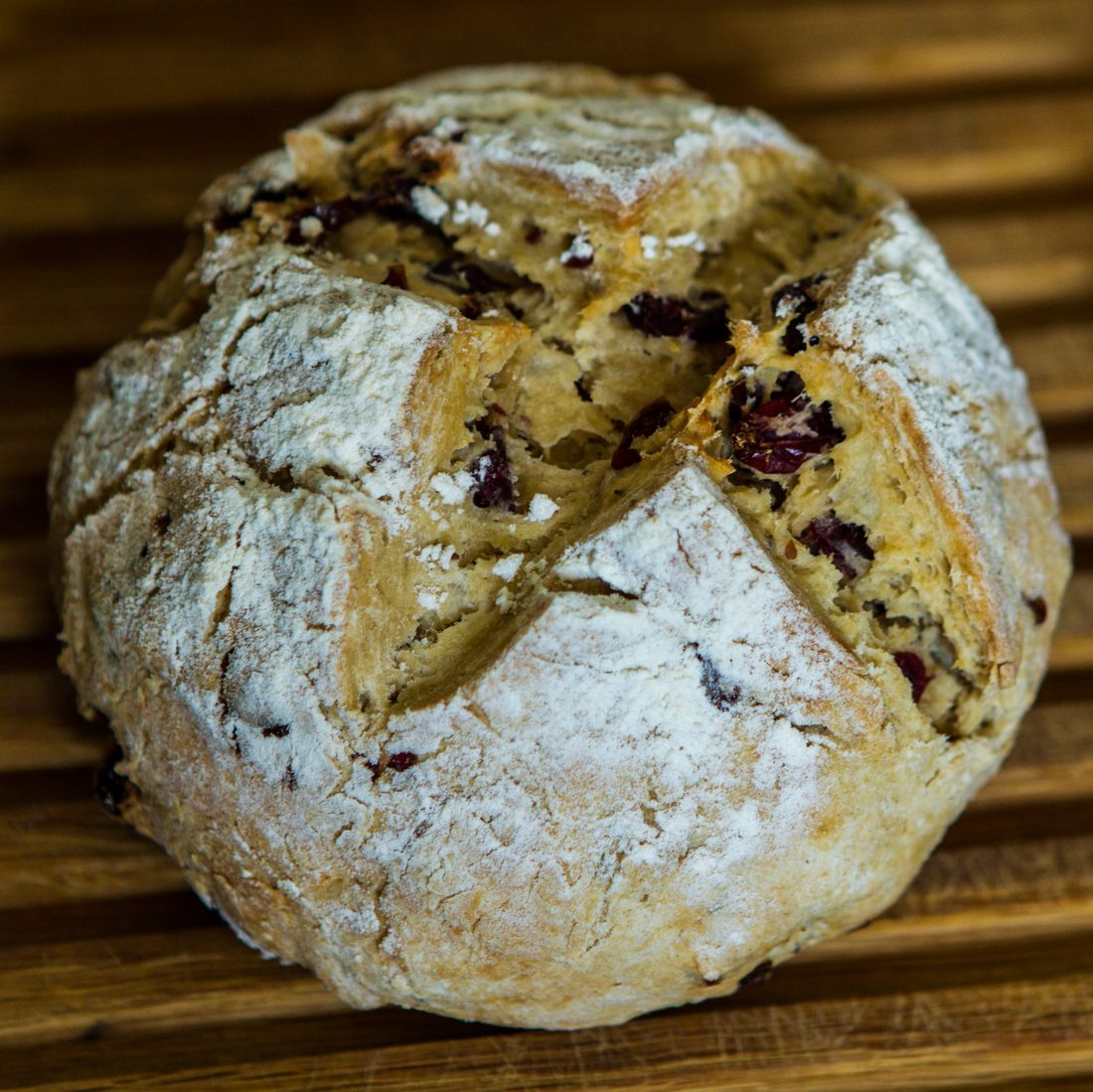
The round, domed shape is the shape of the bastible it was born in. The bread is the shape of the pot. And the cross is folklore that the chemistry later justified.
Three locks, one key
Here’s the thing I didn’t appreciate until I read the history: soda bread didn’t catch on in Ireland because it was tasty. It caught on because Ireland had three separate problems that made yeast bread nearly impossible, and bicarbonate of soda solved all three at once.
Lock 1: the wheat was wrong. Irish wheat was soft — low in protein, low in gluten. Soft wheat can’t build the elastic gluten network you need to trap fermentation gas over hours. It makes a lousy yeasted loaf. But it’s ideal for chemical leavening, where the gas arrives all at once and the bread sets fast, before the structure has to hold anything up for long.
Lock 2: there were no ovens. This is the part that reframes everything. Rural Irish households didn’t have ovens. There was no village bakery, no bread oven, no baker. Bread was made on the hearth or it wasn’t made.
Lock 3: there was no reliable yeast. Especially in the Famine era, yeast and good flour were both hard to come by.
Soda needed no oven, no yeast, no strong flour, and no time — and its acid was buttermilk, the sour waste liquid left over from churning butter, which every dairying household already had for free. It went from unknown to universal in roughly one generation. Of course it did.
The chemistry, honestly
Bicarbonate of soda (NaHCO₃) + acid → CO₂. The gas inflates the dough. That’s it. No biology, no fermentation, no time.
The acid is buttermilk — naturally rich in lactic acid. And the crucial practical consequence is this: the reaction starts immediately and is already dying by the time the loaf reaches the oven. Every technique rule follows from that one fact. Work fast. Mix minimally. Bake immediately. Every minute you spend kneading is a minute of leavening you’re throwing away — you’re literally degassing the only rise you’re going to get.
Coming from sourdough, this took me a while to internalize. In sourdough, handling builds the bread. In soda bread, handling destroys it.
There’s a lovely historical footnote here too. The 1836 recipe trail shows the acid wasn’t always buttermilk — the early chemical approach involved dilute hydrochloric acid, and the switch to sour milk happened because it was practical, not because it was better chemistry. The peasant kitchen won on convenience. It usually does.
The date: 1836, and be careful with the rest
You’ll read everywhere that baking soda arrived in Ireland in the 1830s. That might be right, but the sources genuinely conflict:
| Source | Claim |
|---|---|
| Jp McMahon (Irish chef/food writer) and most blogs | soda available in Ireland 1830s |
| Society for the Preservation of Irish Soda Bread | ”around the 1840s”; the mechanism of introduction “yet to be unraveled” |
Both agree on the anchor that actually matters, and it’s a good hard one:
The earliest known Irish soda bread recipe is November 1836, in the Newry Telegraph — “a pound and a half of good wheaten meal” (~680g), salt, super-carbonate of soda, and “very sour buttermilk,” formed into a cake.
So: 1836 is documented. “The 1830s” as an arrival date is contested. I’d rather give you the document than the round number.
Two more things from that trail worth knowing. Soda-leavened bread was being experimented with in the British Isles from 1817 (London), and Royal Baking Powder existed from 1835 — so Ireland specifically chose bread soda over baking powder. That’s a real, under-reported choice, and the Folklore Commission interviews of 1937–39 are where that finding comes from.
One caveat on my source. The Society for the Preservation of Irish Soda Bread is a real, unusually well-sourced body — it cites the Newry Telegraph (1836), The Farmer’s Magazine (1836), the Dublin Quarterly Journal of Medical Science (1850), Church & Dwight company records, and the Irish Folklore Commission. I’m relying on it for the primary-source trail. But it is American, and it is an advocacy organisation with a thesis — it exists to argue that the American version isn’t Irish. I’ll cite it for its documents. I won’t launder its opinions as neutral history.
The bastible: the bread is the shape of the pot
If you take one thing from this page, take this. The bastible — the pot oven — is the piece of kit that makes the entire story work, and almost nobody explains it properly.
It’s a cast-iron pot with a lid, set directly onto the coals of an open hearth. The lid is sunken or flanged, which is the whole trick: you heap hot coals on top of the lid as well as underneath the pot.
Heat from above and below. That’s an oven. A woman with no oven, no chimney bread-oven and no bakery within a day’s walk could produce a properly crusted, domed loaf on the floor of her own hearth. That’s not a compromise. That’s an ingenious piece of equipment, and it ran the household’s entire baking — soda bread, potato cakes, boxty, all of it.
And here’s the payoff, which I love: the round, deep, domed shape of a soda loaf is the shape of the pot. The bread looks the way it looks because of the vessel. Once you know that, you can’t look at a soda loaf the same way again.
The alternative kit was a flat cast-iron griddle hung over the fire — no lid, radiant heat from one side only. Which is precisely why the griddle breads had to be thin, quartered and flipped. That’s the whole subject of the farls page, and it’s the same problem solved a different way.
As someone with a shelf of cast iron and a whole section about it, the bastible is the most satisfying thing I found in this research. It’s a Dutch oven doing exactly what a Dutch oven does — and it was doing it as the primary bread technology of a country.
The cross — and why the usual explanation is backwards
Every blog gives you the same tidy line: practically, the cross lets heat in; folklorically, it lets the fairies out. Science versus superstition, neatly sorted.
Both halves are true. The framing is wrong.
The practical reason is real. Slashing a dense, unleavened, 4–5cm-deep round lets heat penetrate the thickest part and lets it expand. That’s genuine baking science and it matters.
The folklore is real too. “To let the devil out of the bread,” “to let the fairies out” — these were real rural Irish expressions, and the cruciform had obvious Catholic resonance. Crossing the bread. Giving thanks.
But here’s the point that kills the tidy version: bakers were marking crosses on loaves for centuries before bicarbonate of soda ever reached Ireland.
So the science explains why the cross is useful. It does not explain why the cross is there. The practice predates the chemistry entirely. The cross was inherited by soda bread, not invented for it — and the heat-penetration story is a post-hoc justification of an older custom, which is a very different claim from the one you’ll read everywhere.
Darina Allen’s method preserves a detail almost every modern recipe drops: cut the deep cross and prick the four corners. That’s not a baking step. It’s the blessing.
The raisin correction — which is true, and overstated
You’ve probably heard this one: real Irish soda bread has no raisins; the sweet stuff with sugar, egg, butter and caraway is Irish-American.
That’s substantially right. The everyday Irish loaf is four ingredients: flour, buttermilk, bicarbonate of soda, salt. The American St Patrick’s Day loaf is a different animal.
But the correction has been repeated so often it’s calcified into something cruder than the truth, and three things complicate it:
1. Enriched soda breads are genuinely Irish. Spotted Dog — also called Railway Cake or Curnie Cake — is white soda bread with sultanas, an egg and a little sugar. It’s a real Irish bread. Darina Allen teaches it at Ballymaloe. It isn’t an American corruption; it’s a separately named Irish bread. Even the Society’s framing concedes this: additions make it “a Tea Cake, Railway Cake, Spotted Dog, etc.” — a different named bread, not a fake one.
2. Caraway went the other way. There was a tradition of caraway seed in bread in Donegal and Leitrim, and the likelihood is that emigrants carried it to America — not that America invented it and sent it back.
3. Ballymaloe’s own brown soda bread contains egg and butter. That’s the Irish cookery school, teaching the Irish loaf, with egg and butter in it. So “egg and butter = American” is flatly wrong.
The honest version: the four-ingredient loaf is the everyday Irish bread. Enriched versions exist in Ireland, but they’re separately named and they were occasional — raisins, sugar and egg were harvest-time luxuries, added by the woman of the house as a treat for working men when she could spare them. What’s actually Irish-American is (a) collapsing all of it under one name, (b) the sugar level, and (c) treating a cake-like celebration loaf as the everyday staple.
The name is the corruption, not the raisin. That’s a better sentence than the one everyone repeats, and it has the advantage of being true.
White vs brown — and an inversion that got me
Brown (wholemeal) soda bread was the everyday bread. Coarse stone-ground wholemeal, bran and germ included, dense and nutty.
White soda bread was the luxury. Darina Allen recalls white soda bread in her childhood as “a treat for special occasions” — because white flour cost more than brown.
Sit with that for a second, because it’s completely inverted from how we think now. Today brown bread reads as artisan and premium; white reads as cheap and industrial. In traditional Ireland it was exactly the reverse. The wholemeal loaf wasn’t a health choice. It was what you could afford.
Regional naming, which trips people up constantly:
| Ulster / Northern Ireland | South / Republic | |
|---|---|---|
| Wholemeal soda loaf | wheaten bread (often sweetened) | brown bread |
| ”Soda bread” means | the white griddle farl | the white oven-baked loaf |
In Northern Ireland, “soda bread” always means the skillet farl, not a loaf. That’s terminology, not preference, and it causes endless confusion. Ulster wheaten and southern brown bread are nearly identical — Ulster’s is just sweeter.
One sourcing note for Americans: “Irish-style wholemeal flour” is a real, distinct product — coarse, stone-ground, and genuinely different from US whole wheat. American whole wheat will give you a tighter, tamer loaf. It’ll be fine. It won’t be the same.
The recipes
Both of these are Darina Allen’s, via Ballymaloe. She’s the authority and I’m not going to pretend to improve on her.
(There were already a couple of soda breads in my collection — Bread, Irish Soda and Bread, Brown, Irish — and they’re fine. But they’re not Ballymaloe’s, and since I’m quoting her method I’d rather give you her actual numbers than imply she wrote something she didn’t.)
Bread, Soda, White (Ballymaloe) — the white loaf, and the four-ingredient historical baseline.
- 450g plain white flour
- 1 tsp bicarbonate of soda
- 1 tsp salt
- 350–400ml buttermilk or sour milk
Oven to 230°C / 450°F. Sieve the dry ingredients, make a well, pour the milk in all at once. Mix with one hand, fingers stiff, in a full circular movement from the centre outward — that’s the actual Ballymaloe technique and it’s most of the recipe. Soft but not sticky. Do not overmix. Pat into a round 4cm deep, deep cross, prick the four corners. 15 min at 230°C, then 30 min at 200°C / 400°F.
Darina’s rule, which is the whole thing: “The trick with all soda breads is not to overmix the dough — mix the dough as quickly and as gently as possible, keeping it really light and airy.”
Bread, Soda, Brown (Ballymaloe) — the everyday loaf. Note the egg and butter. It’s still traditional.
- 225g stone-ground wholemeal flour
- 225g plain white flour
- 1 tsp salt
- 1 tsp bicarbonate of soda
- 12–25g butter (or 2 tbsp cream)
- 1 egg
- 300–325ml buttermilk, with the egg whisked in — top the combined liquid to 325–350ml
Same oven, same one-handed mix. Rub the butter in first to breadcrumb texture. 5cm round, deep cross, prick the corners. 10 min at 230°C, 25 min at 200°C, then flip the loaf over for 5–10 min to guarantee the base. Tap the bottom — hollow. Cool on a rack; wrap it in a tea towel while hot for a soft crust, leave it bare for a crisp one.
On the buttermilk quantity — a real cook’s note, not an error I’m hiding. My two Ballymaloe sources give 300–325ml and 400–425ml for the same flour weight. That’s not a contradiction to paper over; it’s the truth about this bread. Buttermilk quantity genuinely varies with the absorbency of your flour and the thickness of your buttermilk. Learn the target — soft, not sticky — and ignore the number.
And the modern-buttermilk trap. Ballymaloe notes that for lower-fat supermarket buttermilk, “the butter and cream are essential additions.” The cultured stuff in the carton is not the fatty, live churn by-product the tradition assumed. The butter is fat being added back in. That’s worth knowing before you decide the enriched version is inauthentic — it’s compensating for an ingredient that changed underneath the recipe.
Now go read about the griddle breads, which is where this same chemistry gets genuinely clever.
Sources & further reading
- Darina Allen / Ballymaloe — RTÉ Soda Bread Masterclass and the Ballymaloe Festival of Food. The authority on these recipes.
- Society for the Preservation of Irish Soda Bread — sodabread.info. Excellent primary-source trail (Newry Telegraph 1836; Irish Folklore Commission 1937–39). American, and advocacy-driven — cite the documents, attribute the opinions.
- Jp McMahon, “A Short History of Soda Bread” — Irish chef and food writer, on the soft-wheat argument.
- Wikipedia, Soda bread — for the Ulster/Republic naming split.
- Regina Sexton, A Little History of Irish Food (Gill & Macmillan, 1998) — the chapter “breads from hearth” is the right source on the bastible. I’m working from secondary accounts; the book itself is on my list.
Comments (0)