What Is a Sausage?
I’ve been making sausage for something over forty years, and I could not have given you a defensible definition of the word for most of them. I could make one. I could tell you what had gone wrong with one. But if you’d stopped me at the bench and asked what is this thing, exactly, I’d have said something about ground meat in a casing and moved on, and I’d have been wrong in about four different directions.
The reason it’s worth slowing down for is not pedantry. It’s that the wrong definition makes you make bad sausage. If you think the casing is the thing, you’ll fuss over casings and ignore temperature. If you think “sausage” means “cooked pork in a link,” half the world’s sausage becomes invisible to you. The definition is a map, and a bad map sends you to the wrong place.
Here’s where this page lands, and then I’ll spend the rest of it earning the claim:
A sausage is comminuted meat, salted, and given a shape.
Broken down, seasoned, bound, formed. Everything else — the casing, the cooking, the smoke, even, arguably, the meat — is a variable.
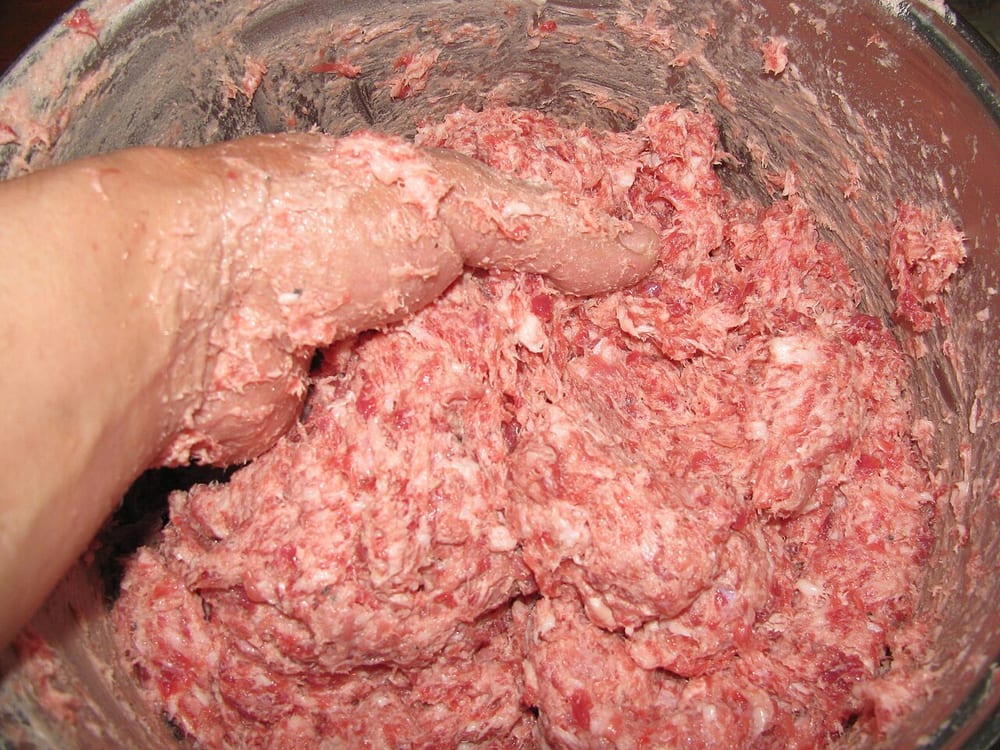
Every part of the obvious definition falls apart
Ask ten people and you’ll get some version of: ground meat, seasoned, stuffed into a casing, and cooked. Let’s take that apart clause by clause, because three of the four clauses are optional and the fourth is negotiable.
The casing is optional
This is the easiest one to dismiss and the one people cling to hardest, probably because the casing is the only part you can see.
A breakfast patty is a sausage. Nobody argues about this. It’s the same farce as the link — same grind, same salt, same spices, same bind — pressed into a disc instead of pumped into a hog gut. Bulk sausage is a sausage that hasn’t been given its shape yet; you give it one in the pan when you break it up.
Then it gets more interesting. Ćevapi — the little skinless fingers from the Balkans, and another of my favorites — are formed by hand or extruded and grilled naked. No casing has ever been involved. Nobody in Sarajevo has ever wondered whether they count.
A crépinette is wrapped in caul fat, which is a membrane, not a gut — a lace of fat that melts into the sausage as it cooks rather than containing it. Is that a casing? It’s a wrapper that disappears. Boudin blanc and black puddings are frequently set in a loaf pan and sliced, which is what I’d tell most Americans to do the first time, because you can usually source blood or casings but rarely both on the same afternoon. A falukorv is a fat coil; a bologna is a sausage the size of a fire hydrant; Lorne sausage is a square you slice off a brick.
So the casing isn’t definitional. It’s a forming and cooking strategy. It gives you a shape that holds itself, it lets you cook by moist heat inside a self-contained envelope, and in dry-curing it’s the semi-permeable membrane that lets water out at a controlled rate. Those are three genuinely important jobs. None of them is what a sausage is. There’s a whole page on this — casing or not — because the choice changes the food more than you’d expect even though it doesn’t change the category.
The cooking is optional
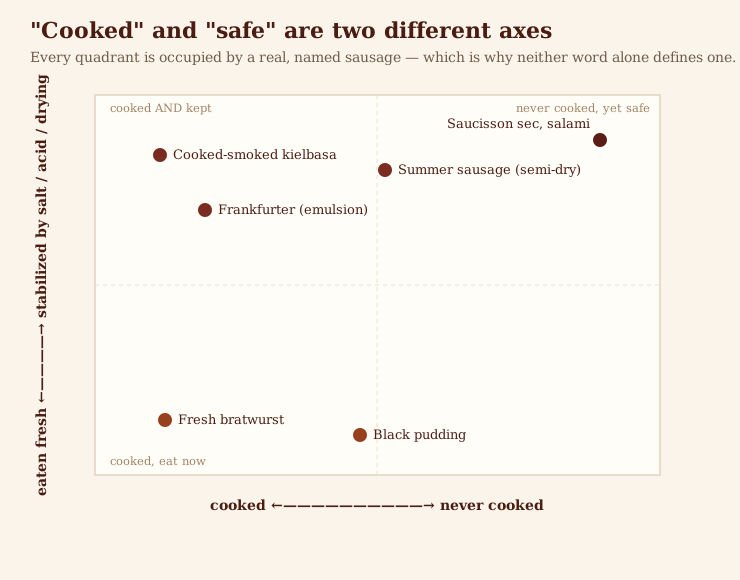
A fresh bratwurst is raw. You buy it raw, you keep it cold, you cook it, and if you don’t cook it you get sick. A saucisson sec or a Hungarian salami is also never cooked — and you eat it raw, off the board, with no heat applied at any point in its life, and it is safe because it was made safe by other means entirely: salt, nitrate, a fermentation that drops the pH, and weeks of controlled drying that pulls the water activity down below where things can grow.
Those two products are at opposite ends of the same craft. Between them sit cooked-smoked sausages like my grandfather’s kielbasa; emulsified sausages like a frankfurter, cooked in the smokehouse; semi-dry sausages like summer sausage, which are fermented and cooked; and the whole blood and offal branch, cooked twice — once to set it and once to serve it.
If “cooked” were definitional, every dry-cured sausage in the Mediterranean would be disqualified, which is absurd. What’s actually going on is that something must make it stable and edible — heat, or acid, or salt and time, or a combination — and heat is only the most common of several answers.
The meat is, arguably, optional
This is the one that surprised me, and it’s the one that makes the definition honest.
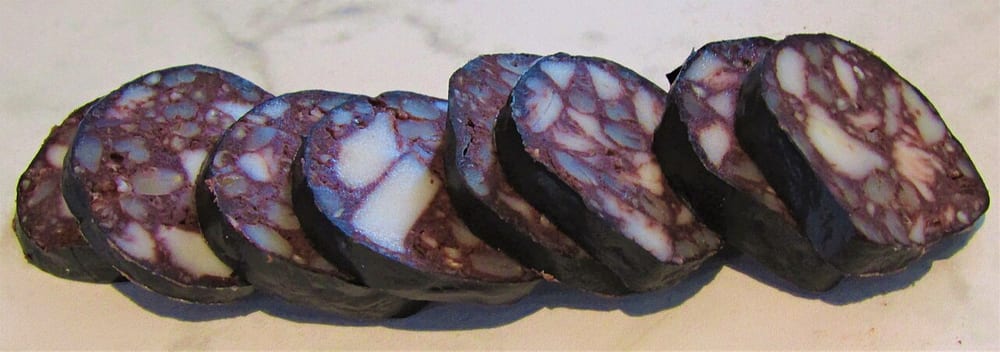
Start with the puddings. A black pudding is, by weight, mostly grain and fat and blood. The oat or barley or rusk isn’t an adulterant or a wartime stretch — it’s structural, it’s been there as long as the form has, and in a good pudding it’s most of what you’re chewing. Push a little further and you get kishka, where the grain is even more of the point; the Scottish white pudding or mealie pudding, which is oatmeal, suet and onion and may contain no muscle meat at all; and any number of grain- and offal-extended puddings across Europe that exist because the meat was the scarce thing and the casing was the abundant one.
And people call them sausages. They’re sold on the sausage counter, made with sausage equipment by sausage makers. My hand is not going to be the one that tells a Scot his mealie pudding isn’t a sausage.
Then there’s blood itself, which isn’t muscle. Then there are the vegetarian analogues, which I’ll be straight about: I don’t make them and I’m not going to pretend to expertise I don’t have. But structurally they are doing exactly the same thing — comminuting a protein source, salting it, building a bind out of something (gluten, methylcellulose, soy protein, egg), and forming it. The technique is the sausage. The substrate is a variable.
So the definition has to be robust to a pudding that’s half oats and to a thing with no animal in it. That’s why I ended up where I did.
The real definition: comminution, salt, a shape
Comminution is a word I’d never have used at the bench and it’s the right one. It means reduction to small particles — and crucially it’s agnostic about how. Chopped with a knife on a board, minced through a plate, sheared to paste in a bowl chopper, pounded in a mortar. All comminution. That word covers a hand-chopped Norcia salami and a hot dog with the same breath, which “ground” does not.
Salt is not seasoning here. I’ll spend the next section on it because it is the single most misunderstood ingredient in this craft, but the short version is that salt is what turns a pile of meat particles into one continuous material. Take the salt out and you don’t have under-seasoned sausage. You have meat crumbs in a tube.
A shape is the part people leave off and it’s what separates sausage from mince. Ground beef in a bowl is not a sausage. The same beef salted, worked until it binds, and formed — into a link, a patty, a coil, a loaf, a stick, a hand-rolled finger — is. The shape is not decoration; it’s what makes the thing a discrete food you can cook and portion and hand someone. A sausage is a unit.
Three things. Break the meat down, salt it, give it a form. Everything else on the other eighty-odd pages of this program is elaboration on those three moves.
What salt actually does
Most sausage writing says salt “seasons and preserves.” That’s true and it’s the least interesting thing about it. The reason your first tablespoon of salt matters more than anything else in the bowl is protein extraction.
Muscle is built out of myofibrils, and the two proteins that matter to us are myosin and actin (bound together in dead meat as actomyosin). These are salt-soluble proteins — they will not dissolve in plain water, but they will dissolve in a salt solution once the ionic strength gets high enough. When you add salt to ground meat and work it, the salt goes into the water that’s already in the meat, that solution reaches the ionic strength where myosin goes into it, and myosin starts migrating out of the muscle fibers and onto the surfaces of every particle.
What you see, if you’re watching your hands rather than the clock, is the mixture turning tacky. It starts as crumbly damp strands that fall apart, and somewhere in the mixing it becomes sticky — it clings to the side of the bowl, it clings to your palm, and a handful turned upside down doesn’t drop. That tackiness is dissolved myosin. That is the sausage becoming a sausage, and you can watch it happen.
That surface layer is the primary bind. When you cook the sausage, those dissolved proteins coagulate and gel, and they weld every particle to every neighboring particle into one continuous matrix. That matrix is what holds the fat in place, holds the water in place, and gives a good sausage that slight resistance and then clean snap when you bite it instead of falling apart into wet gravel.
This is why the salt goes in at mixing and not at the table. It’s also why “I’ll just cut the salt in half, it’s too salty” is a texture decision, not a health decision, and people who do it and then complain their sausage is crumbly have found the answer without noticing. There’s a whole page on the arithmetic — salt — including the percentage ranges by product type and why measuring kosher salt by volume lies to you (the flake shape means a cup of one brand is not a cup of another; weight is the only honest unit).
The other consequence of salt worth naming here: water-holding capacity. Salted, worked meat holds onto its moisture through cooking far better than unsalted meat does. Part of why a well-made sausage is juicy is not fat — it’s water the protein matrix refused to let go of.
And a word on the puddings again, because it’s the case that proves the rule. A black pudding has no myosin bind. There isn’t enough muscle protein in it and the process doesn’t extract what there is. It sets on something else entirely — coagulating blood proteins, the gelatinization and swelling of the grain, and set fat. That’s why a pudding behaves nothing like a bratwurst in the pan: it doesn’t spring, it crumbles at the edges, and it will collapse if you overcook it. It’s a different structural system wearing the same shape. If you want that story properly told, the Irish breakfast dive already went deep on it, and I’m not going to repeat it here.
Grinding is not chopping
The second of the three moves is the one that looks most mechanical and is actually the most subtle. Grinding is not “making the pieces smaller.” If it were, a food processor would be a grinder, and it is not — a food processor makes an excellent mush and a terrible sausage.
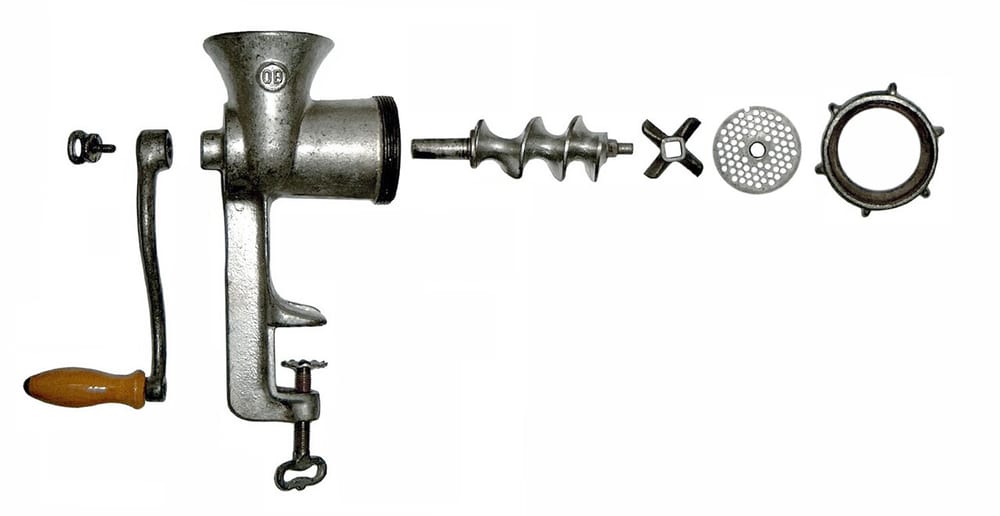
A meat grinder is a shearing machine. An auger pushes meat forward under pressure, and at the head a rotating knife sweeps across the face of a fixed perforated plate. Meat is extruded into the holes and cut off cleanly. What comes out is a strand with intact structure — in a good coarse grind you can see the strands, and the fat as distinct white flecks.
A food processor blade doesn’t cut, it beats. It bruises and tears and smashes, it ruptures fat cells everywhere, and it heats the mass while it does it. You get particles, sure. You also get free fat coating everything, which is precisely what you must not have.
This is the point of the plate chart, and it’s why my own notes have one. The plate is not a setting, it’s a decision about the finished food:
| Plate | Grind | What it’s for |
|---|---|---|
| 1/8” | Fine | Bologna, franks, forcemeats, jerky |
| 3/16” | Medium | Breakfast sausage, Polish, Italian |
| 1/4” & 5/16” | Coarse | Salami, summer sausage, pepperoni, bratwurst |
| 3/8” | Coarse | First grind; chili meat, chorizo |
| 1/2” | Very coarse | First grind; chili and stew meat |
| 3/4” | Very coarse | First grind, or chunking |
That’s off my own bench notes for the Weston #12, and the thing to notice is how many entries say first grind. Most good sausage is ground twice — a coarse pass to break the primal down and distribute fat roughly, then a second pass to the finished size. Two moderate passes do less damage than one aggressive one, because each pass is asking less of the knife.
For my grandfather’s kielbasa I go the other way and stop early. A quarter-inch plate is the smallest I’ll use, and coarser is fine. That’s deliberate. A coarse grind is the whole character of that sausage: you should be able to see the meat, see the fat, and get texture under your teeth that tells you an animal was involved. Grind it to 3/16” and you’ll have made a perfectly good sausage that is not the one I remember smelling on the way out of church on a Sunday morning. The plate is the recipe as much as the marjoram is.
Two mechanical failures ruin more sausage than any seasoning mistake, and both are here:
- A dull knife, or a knife that doesn’t sit flat against the plate. If the knife doesn’t shear cleanly it pushes meat through the holes instead of cutting it. You’ll see it as a paste coming out with fat separated into ribbons. Knife and plate are a matched, mated pair — they wear against each other and should live together and be sharpened as a set.
- Warmth. Which brings us to the rule that governs everything.
The cold rule, and why it’s the whole game
Start with cold meat. 30°F is perfect.
That’s the first line in my own notes and it deserves to be, because it is the single most important number in sausage making and the one most beginners ignore. Thirty degrees Fahrenheit — below freezing, meat firm and stiff at the edges, crunchy if you squeeze a cube, but not frozen solid. “Almost frozen is best.”
Here’s why. Pork fat at refrigerator temperature is soft. Pork fat at room temperature, worked under pressure, starts to render and spread. When that happens in the grinder, the fat stops being discrete particles and becomes a film that coats every meat particle in the batch — and a meat particle coated in fat cannot bind to its neighbors, because the protein surfaces never touch. That’s smear.
Smeared sausage is unmistakable once you’ve made it. It looks greasy and slightly gray in the bowl instead of bright and distinct. It won’t get tacky no matter how long you mix. And in the pan, the fat that was never properly held simply runs out, so you get a shrunken, dry, crumbly sausage swimming in its own grease. All of the fat and none of the juiciness. It is the most common failure in home sausage-making and it is almost never a seasoning problem, an equipment problem, or a recipe problem.
Fat smear is a temperature failure first. A dull knife and a warm room together will get you there faster, but temperature is the mechanism. Cold meat holds fat as solid particles that survive the plate and get suspended in the matrix, which is exactly what you want: fat that renders in the pan, inside a protein web strong enough to hold the melt until you bite it.
So: meat cubed and into the freezer until the edges are hard. The grinder head, the auger, the knife and the plate in the freezer too — cold metal is a heat sink. A bowl sitting in ice to catch the grind. And if a batch starts to feel warm or greasy mid-process, stop and put the whole thing back in the freezer for twenty minutes. Nothing is lost by waiting. Everything is lost by pushing on.
The bind, and the difference between bind and mush
Mixing is where the sausage is actually made, and it’s the step with a ceiling on both sides: mix too little and you have no bind, mix too much and you’ve destroyed it.
Too little is easy to diagnose. The mix is crumbly, it won’t hold a ball, and stuffed sausage has visible voids and a texture that falls apart when sliced. Not enough myosin came out. Keep going.
Too much is the interesting failure. Push past the bind and two things happen. The particles break down further — you lose the coarse structure you chose your plate for and end up with an accidental emulsion nobody wanted. And you put energy in, which means heat, which means smear again, arriving by the back door.
Here’s my grandfather’s kielbasa recipe on the point, in the words I actually wrote down:
Knead the mixture until it is well mixed. Do not knead too long or the heat from your hands will start to melt the pork fat — that gets messy and changes the final texture.
Your hands are 98°F. The meat is 30°F. Every second of contact is a heat transfer, and hands are the worst tool available for the job because they’re the warmest thing in the kitchen. For years I mixed in short bursts with the bowl set in ice, or with a wooden spoon, or wearing gloves — anything to cut the contact. Now I don’t touch it at all: I use a Vevor BMM-10 sausage mixer, throw its drum and paddles in the freezer first, load the cold meat, and crank the handle. It’s better than hands not because it’s stronger but because it’s cold, and it stays cold — my body heat never reaches the fat.
The test is tactile and it’s the only one you need at first: turn a handful upside down. If it clings to your palm and hangs there, you’re bound. If it drops, keep going. There’s a more diagnostic version — fry a small patty of the mix and taste it, which checks both the bind and the seasoning before you’ve committed a whole batch to casings — and the full treatment of both lives on mixing and the bind.
There’s a real distinction hiding here that this program comes back to repeatedly: bind is structure, mush is the absence of it. An emulsified sausage — a frankfurter, a bologna, a weisswurst — looks like mush and isn’t. It’s a genuine emulsion where fat is dispersed as microscopic droplets stabilized by extracted protein, and it has a strict temperature ceiling (push it too warm during chopping and it “breaks,” dumping free fat exactly as smear does). That’s an engineered structure, not a failure. The difference between a frankfurter and a ruined bratwurst is not how fine the particles are. It’s whether protein is holding the fat or the fat is coating the protein.
The same farce, different foods
Once you accept comminution + salt + shape, something clarifies: an enormous amount of the world’s sausage variety comes from what you do after the bowl, not what’s in it.
Take one batch of coarse-ground pork at roughly 70/30, salted to about 1.5–2%, with garlic and marjoram and black pepper — the kielbasa farce. Split it five ways:
| Do this next | You get |
|---|---|
| Press into patties, fry fresh | A breakfast-style patty |
| Stuff into hog casing, cook fresh | A fresh Polish sausage |
| Add cure #1, stuff, smoke at 130→190°F, finish in water, ice-bathe, bloom | Grandpa’s smoked kielbasa |
| Add cure #1, stuff into fibrous casing, ferment then cook | Something in the summer-sausage family |
| Add cure #2, stuff, ferment, hang for weeks to 30–40% weight loss | A dry-cured sausage |
Five foods. One bowl. That is not a rhetorical trick — it is genuinely how the craft works, and it’s why the family tree is organized by process rather than by country or by meat. Nationality tells you the spice cabinet. Process tells you the food.
A caution attached to that table, because this program takes it seriously: those cures are not interchangeable and the last two rows are not a matter of patience. Cure #1 and Cure #2 have different compositions and different jobs, and Morton Tender Quick is a third thing again. Cure #2 carries a nitrate reservoir precisely because dry-curing runs for weeks on product that will never be cooked. Substituting them is a safety error, not a style choice, and it gets its own page rather than a parenthesis on this one.
Why the definition earns its keep
I said at the top that a bad definition makes you make bad sausage. Here’s the payoff.
If you define sausage as meat in a casing, then when your sausage comes out crumbly you go looking at your casings and your stuffer. You’ll find nothing, because the casing was never the problem.
If you define it as comminution, salt, and a shape, then a crumbly sausage has exactly three suspects and you can check them in order. Was the comminution right — right plate, sharp knife, clean shear, not beaten to paste? Was there enough salt, worked in long enough, to pull myosin out and get real tack? And was everything cold enough throughout that the fat stayed particulate instead of coating everything and blocking the bind? Nine times out of ten it’s the third one, and the tell is that the mix never got sticky.
That’s the diagnostic tree for most of what goes wrong at the bench, and it comes straight out of the definition. Which is the argument for bothering with definitions at all.
Where the word came from, and one thing worth reading
The English word runs back through Old North French saussiche to Late Latin salsicia, from salsus — salted. That’s not a cute etymological aside. Every language that named this food independently named it after the salt or after the gut, and the ones that named it after the salt were pointing at the right thing. The Latin root says the same thing this page has spent three thousand words saying: the salt is the transformation.
As for how old it is — I’m going to disappoint anyone hoping for a superlative. There is a great deal of confident internet writing about the oldest sausage in the world and almost none of it survives being asked for a source, so this program doesn’t make that claim anywhere. What I will point at is a genuine, citable, unambiguous piece of text. In Book XX of the Odyssey, Odysseus, unable to sleep, is compared to a man turning a stomach stuffed with blood and fat over a blazing fire, impatient for it to be done. It’s a simile, which is the best kind of evidence: Homer expected his audience to know exactly what that looked like and how badly you want it off the fire. Blood, fat, a stomach, and heat. A blood pudding, described in passing, because it was ordinary.
That’s the earliest thing in Western literature I’m willing to put my name to. It also happens to be a pudding — no casing in the modern sense, no muscle meat to speak of, blood and fat and a bag. Which is a fitting place to end a page arguing that the casing, the cooking and the meat are all negotiable.
Next, the taxonomy that everything else in this program hangs off: the family tree.
Comments (0)