Forty Years of Making Sausage
Every Sunday when I was a small boy, I went to a church across the street from my grandma and grandpa’s house — Grandma and Grandpa Murawski, my mother’s parents. The first thing I could smell walking out of that church was Grandpa’s Polish sausage on the boil. It filled the air.
That is the whole origin. Not a cookbook, not a class, not a video — a smell crossing a street. Everything on this page came out of trying to get back to it.
One honest wrinkle before we go any further: Grandpa boiled his kielbasa, and that plain simmer is exactly what threw the smell across the street. I make a different choice — I smoke mine — and it turned out to be its own kind of wonderful, not the sausage he made and not trying to be. So this page is really two stories braided together: chasing the memory of a boiled sausage, and the smoked sausage I built while chasing it.
It is the strangest kind of recipe development there is. I was not reverse-engineering a written formula that had been lost — there was no card. What I had was a sense memory from a small boy, which is the least reliable evidence a person can work from, and forty years of trying to build something that would produce it again. When I finally wrote my kielbasa down, I ended the note this way:
It took me years to finally replicate my Grandfather’s homemade Polish sausage and although it may not be exact, it is certainly extremely close.
I have thought about that sentence a lot. It is the most accurate thing I know how to say about the whole business. May not be exact — I have no way to check. Certainly extremely close — I know it when I smell it. Those two clauses sitting next to each other, refusing to resolve, is what forty years of making sausage actually feels like. You get very good, and you never get proof.
The recipe is short. The learning was not.
My kielbasa is nine ingredients and fits on half a page. Pork butt, back fat, ice water, garlic, kosher salt, marjoram, coarse black pepper, dry mustard, ground coriander. Medium hog casings. That is it.
You could read that list in twenty seconds and make something inedible. I know, because I did, repeatedly. The list is not the recipe. The recipe is the temperature, the grind, the hands, and the smoke schedule. What the years bought me was not a spice blend — it was a set of things I now refuse to do differently.
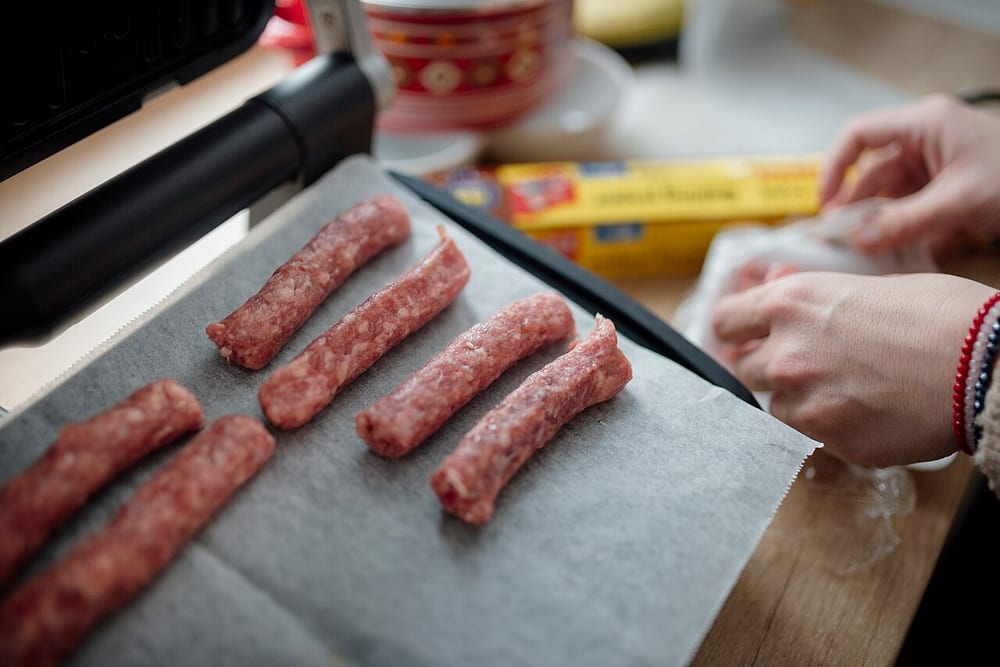
Cold. Colder than you think.
If I could hand a beginner exactly one sentence, it would be this one, and it is already written in my own notes: start with cold meat — 30°F is perfect.
Thirty degrees is below freezing. That is not a typo and it is not carelessness. Meat is mostly water with dissolved salts, so it does not freeze solid at 32°F the way a tray of water does; at 30°F pork butt is firm, slightly crunchy at the edges, and it goes through a grinder plate as strands instead of as paste. In the kielbasa note I wrote it a second way, less technically and probably more usefully: “make sure the meat and fat are very cold (almost frozen is best).”
Almost frozen is best. Everything downstream is downstream of that.
The failure it prevents is smear, the single most common way a home batch dies. Warm fat does not cut — it deforms. It smears across the face of the plate and across the meat particles, coating the protein in grease so the batch cannot bind. You will not see it as it happens. You will see it later: a sausage that renders out into the pan and leaves a dry, crumbly interior with a pool of grease around it. People blame the recipe. It was the temperature.
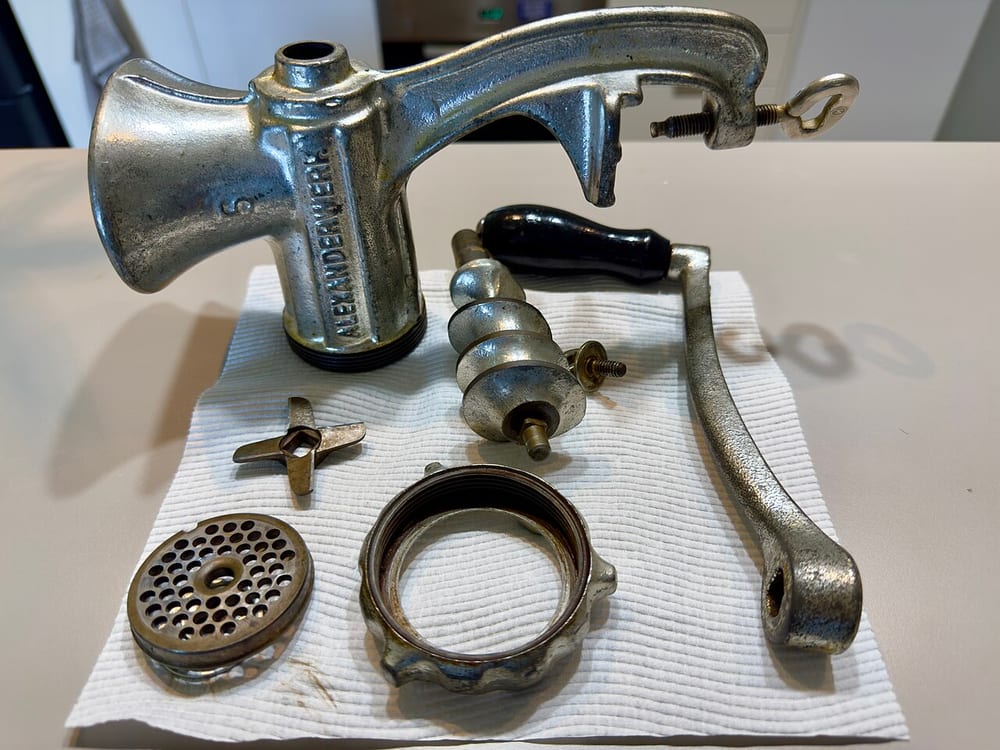
I put the grinder head, the auger, the knife, and the plate in the freezer too. Cold steel keeps cold meat cold, and a room-temperature grinder head will warm the first pound that passes through it.
The coarse plate is a choice, not a shortcut
My kielbasa note says: “Grind meat very coarse. The smallest plate I would use would be a 1/4 inch plate.”
That is not laziness and it is not an equipment limitation. It is the single decision that most defines what the sausage is. I keep a full plate chart on my own notes page, and the short version runs like this:
| Plate | Grind | What it’s for |
|---|---|---|
| 1/8” | Fine | Bologna, franks, forcemeats, hamburger, beef jerky |
| 3/16” | Medium | Breakfast sausage, hamburger, Polish and Italian sausage |
| 1/4” and 5/16” | Coarse | Hamburger, salami, summer sausage, pepperoni, bratwurst |
| 3/8” | Coarse | First grind, chili meat and chorizo |
| 1/2” | Very coarse | First grind, chili meat, stew meat, vegetables |
| 3/4” | Very coarse | First grind, or chunking meat |
Notice something: the conventional slot for Polish sausage on that chart is 3/16”, medium. And I go coarser than the chart says — a quarter inch, minimum, and I would rather err upward.
That is a deliberate departure, and one of the places where the memory did the deciding. A fine grind gives you a smoother, more uniform, more commercial link. It is easier — it binds more readily, slices more cleanly, and it is what most supermarket kielbasa is. It is also not what I remember. What I remember has texture: you can see the meat in it, and the fat sits in visible flecks rather than disappearing into the matrix.
So the plate chart is the general case and my kielbasa is the exception, and I know exactly why I make the exception. That is the difference between following a recipe and owning one. More on plate selection at /sausage-equipment/jeffs-bench/.
Your hands are the enemy of your fat
Step four of my kielbasa reads: “Knead the mixture until it is well mixed. Do not knead too long or the heat from your hands will start to melt the pork fat and that gets messy and changes the final texture.”
I learned that the expensive way. There is a real tension here, and beginners almost always resolve it in the wrong direction. You need to mix — the salt has to dissolve and pull myosin out of the muscle, and that extracted protein is the glue that makes a sausage a sausage instead of a tube full of gravel. Under-mix and it crumbles. So the instinct, when you read “mix until it binds,” is to keep going.
But human body temperature is 98.6°F and pork back fat starts giving up somewhere in the 90s. Your hands are a heat source pressed against the one component of the batch that cannot tolerate heat. Every extra minute of kneading buys bind at the cost of fat definition, and past a certain point you are paying more than you get.
“Well mixed” and “gets messy” are the two ends of it. There is a window, it is narrower than people expect, and the ice-cold water in the formula — a half cup, four ounces, going in cold on purpose — is partly there to widen it.
For years my answer was to work fast with one hand and a spoon, or in a bowl set over ice, or to split the batch and do it in halves — anything to keep warm hands off cold fat. What finally solved it was buying the problem out of existence. I mix in a Vevor BMM-10 now, a hand-crank sausage mixer whose drum and paddles I throw in the freezer first. The cold meat goes in, the cold steel keeps it cold, I crank the handle, and the batch comes together more evenly and far more easily than my hands ever managed — with my body heat never once touching the fat. Do not just muscle through and hope. Fat smear is a temperature failure long before it is an equipment failure — and the mixer is the cleanest way I’ve found to keep the two apart.
The smoke schedule, in stages
This is the part of my kielbasa that people copy and the part I would least like them to skip. It is not “smoke it.” It is four hours in four steps:
| Hour | Chamber temperature |
|---|---|
| 1 | 130°F |
| 2 | 150°F |
| 3 | 170°F |
| 4 | 190°F |
Hickory. Pull between 155 and 165°F internal.
Twenty degrees per hour, up a ladder. The reason is protein. My own thermal processing notes put the principle plainly: you want to start low and stay near the animal’s living temperature so you do not shock the proteins. A hog runs right around 101°F, so starting around 120°F puts you about twenty degrees above where that meat has spent its whole life. Slam a cold, wet, raw sausage into a 190°F box and the proteins on the outside contract violently while the center is still cold, and you get a hard rind, a shrunken interior, and rendered fat pooling under the casing. Everything you did with the temperature discipline at the grinder gets undone in the first twenty minutes of the cook.
The other thing that first hour is doing is drying. This is the step that gets skipped most often and it is not optional:
The other thing we want to do at the start is to dry the outside of the product. For most home smokers this will simply mean opening the top and bottom dampers to allow air to travel through the chamber and dry the surface of the product. This drying stage should usually last around an hour. If you skip this step you will have problems with smoke adhesion and you might end up with a streaky appearance on the surface of your sausage. If you are planning on using a water pan in your smoker I recommend that you NOT add it during this first hour.
No water pan in the first hour. That is counterintuitive to anybody who barbecues, where the water pan goes in at the start as a matter of course. But smoke does not stick to a wet casing — it beads and runs, and you get streaks. Dry the surface first, then smoke it.
I will admit the limit of my own setup here. Relative humidity matters enormously during the cook, and a commercial smokehouse controls it with a psychrometer reading wet bulb and dry bulb. I do not have one. Like most people at home I put a pan of water in, which as I have written elsewhere in my own notes “is better than nothing but it is a shot in the dark.” Forty years in, that is still a shot in the dark. I am not going to pretend otherwise.
The full staged-smoke argument, and what changes when you scale it, lives at /sausage-curing-smoking-cooking/hot-smoke/.
The water bath, the ice, and the two hours of doing nothing
Three finishing steps, and none of them are optional in my kitchen.
The water bath. After four hours of smoke I move the sausage into a hot water bath held at 165°F and leave it until the internal temperature reaches 160°F — about twenty minutes. For years I did this in a turkey roaster: not a specialty rig, just a big pot with a thermostat that I already owned, holding a stable low-temperature bath large enough for a batch. It worked well for a long time. I have since traded up to a large bin with a sous-vide immersion heater dropped into it — the same idea done better, because the sous vide holds the water dead-on 165°F instead of cycling a few degrees around it, and I no longer stand there babysitting a thermometer.
The point is that finishing in water is nearly impossible to overshoot. Air at 190°F can drive the internal temperature past your target in the time it takes to answer the phone. Water at 165°F cannot take the sausage above 165°F no matter how long you leave it, so a target of 160°F sits in a comfortable margin instead of on a knife edge. It also stops the casings from hardening in the last stretch.
The ice bath. Straight out of the bath and into ice water for ten to thirty minutes. My own note says why: “This stops the cooking process, keeps the sausages plump and keeps the skins from wrinkling/shriveled.” All three are real. A sausage pulled at 160°F and left on a counter keeps climbing, and the shriveling is a genuine cosmetic ruin — you can do everything right for five hours and end up with wrinkled, sad-looking links because you skipped a bucket of ice water. My summer sausage notes give the same instruction: twenty minutes in ice, then room temperature for an hour, then vacuum seal and freeze.
The bloom. Then two to three hours of hanging at room temperature doing absolutely nothing. This is the step that requires the most patience and delivers the most visible payoff. Blooming deepens the color — you go from a pale, slightly gray, faintly disappointing link straight out of the ice into a deep rich brown. It is the same product. It just needed air and time.
I mention the bloom to everybody who asks me why their homemade sausage looks homemade. Usually it is because they ate it an hour too early.
A Weston, not a Walton
Small thing. My notes actually say it in these words: “I have a Weston (not Walton) #12 Meat Grinder.”
I wrote the parenthetical because I got tired of the confusion. Walton’s is a supplier — they sell casings and seasonings and cure, and make some genuinely good instructional videos, a couple of which are linked in my own notes. Weston is the manufacturer of my grinder. The names look alike and people mix them up constantly, including people who assume I own a Walton grinder because they have seen me cite a Walton video.
I keep the correction because it is the sort of small factual thing that is easy to fix now and impossible to fix once fifty people have repeated it. A #12 will take a batch without complaining, and the plate set covers everything on the chart above. Details of the bench and the rest of the kit are at /sausage-equipment/jeffs-bench/.
Two inheritances, two methods
The kielbasa is one side of what I inherited. The other is a card.
My mother’s summer sausage is in my collection under her recipe cards, and I make it as written, which means I make it in a way I would not otherwise choose. Four pounds of 80/20 hamburger, one pound of 70/30 ground pork, four tablespoons of Morton Tender Quick, garlic salt, mustard seed, black pepper, and liquid smoke. Mix, wrap in plastic, three to four days in the refrigerator. Then roll into two-inch tubes, put them on a foil-lined cookie sheet, and bake at 200°F for five hours. Cool and slice.
No casing. No smoker required. No stuffer. An oven.
It is worth being precise about why this is a different school and not just a simpler version of the same thing, because the difference is chemistry and not convenience.
Morton Tender Quick is not Cure #1. They are not interchangeable, and the substitution is not a matter of taste. Tender Quick is a salt-based curing mix in which the nitrite is a small fraction of the total — dosed by the tablespoon into pounds of meat, carrying most of the batch’s salt at the same time. Cure #1 is 6.25% sodium nitrite carried on salt, dyed pink so nobody mistakes it for table salt, and dosed in grams with a scale, separately from the salt. Swap one for the other by volume and you will either badly under-cure or badly over-salt. Her recipe is proportioned around Tender Quick doing both jobs.
The packaging differs too. Hers cures in plastic wrap in the refrigerator and then cooks naked on a sheet pan. My summer sausages go into fibrous casings — pre-stuck, soaked thirty minutes in warm water, crimped with a hog ring and hog ring pliers — with Cure #1 and a smoker. Two genuinely different products at the end: hers has surfaces that dry and darken in the oven, mine has a casing that holds shape and takes smoke.
I make both. I have not tried to modernize hers and I do not intend to. She wrote “Yummy!” at the end of the method, right after noting it can also be done in a smoker for five to six hours, and that exclamation point is part of the recipe as far as I am concerned.
Chorizo: the other reason people start making sausage
Inheritance is one motivation. Absence is the other, and it is at least as strong.
I used to eat chorizo in Mexico all the time — chorizo and eggs with a little salsa verde, wrapped up in a tortilla. Then I came back to the States and discovered it is hard, nearly impossible, to find good chorizo here. So I came up with my own recipe.
That is the entire story, and I think it is the most common story in this hobby. A large fraction of everybody who owns a grinder owns it because something they loved was not available where they lived.
My chorizo is not smoked, not cured, and not stuffed — I say so in the recipe itself: you can put it in casings, but there is no point, because you are going to squeeze it back out when you use it. It is bulk pork, 70/30, with cayenne, coriander, cloves, white pepper, oregano, cumin, garlic, kosher salt, cider vinegar, ancho, chipotle, and smoked paprika, mixed by hand and left a day or two in the refrigerator to let the flavors marry. It is spicy because that is how I like it.
Two things worth saying plainly, since this is where the confusion lives. Mexican chorizo and Spanish chorizo are different categories, not variants of each other. Mexican chorizo is fresh, usually bulk, seasoned with chiles and vinegar, and it is cooked before you eat it. Spanish chorizo is dry-cured, firm, sliceable, colored and flavored by pimentón, and it is not cooked at all. Mine is unambiguously the first kind. And the vinegar is not incidental — the acid is doing structural work in a fresh chorizo, not just adding a note.
Also: do not touch your eyes after mixing this. That warning is in my recipe for a reason.
Ćevapi, and liking things for no reason at all
Not everything I make is an inheritance or a replacement for something missing. Some of it is just that I like sausage.
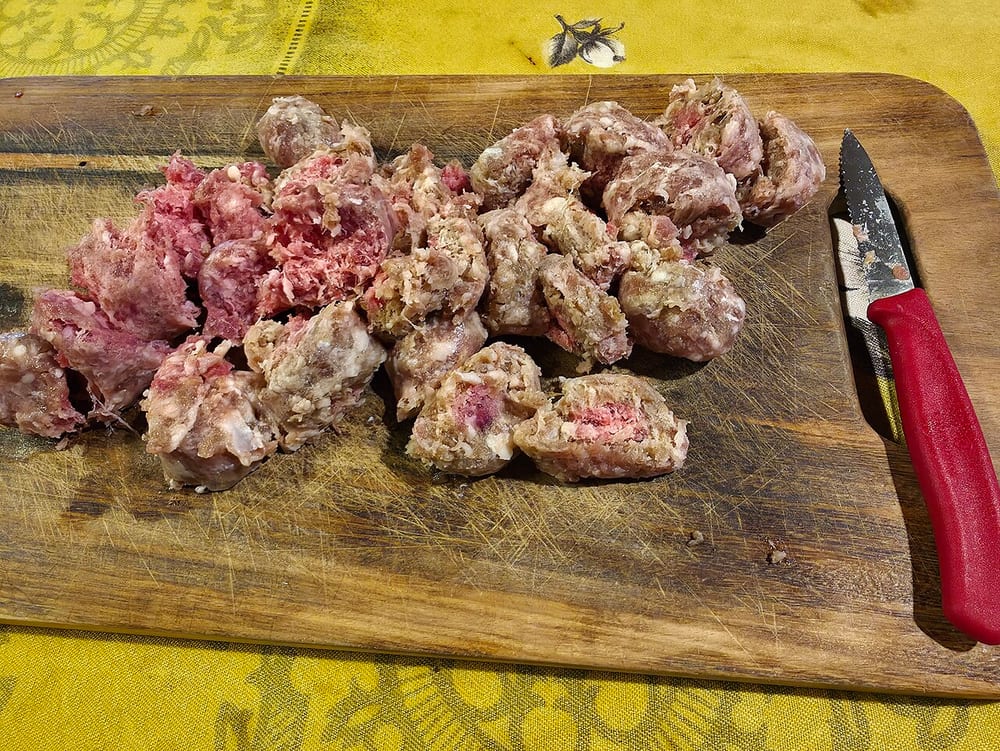
As I have written elsewhere: I love all kinds of sausages, and this little sausage from Serbia is another of my favorites. Ćevapi — ćevapčići — are finger-length, about three quarters of an inch thick, made from pork and beef and lamb with an egg white, garlic, onion, and a teaspoon of baking soda. No casing at all. Formed by hand, rested in the refrigerator anywhere from an hour to a day so the mixture firms and the flavors settle, then grilled.
The very best way to cook them is over charcoal. You can do them on cast iron indoors or in a fry pan and they will be good, but charcoal is what they are for.
I bring them up because they are the counterexample to everything else here. No cure. No smoke. No stuffer. No plate chart. No temperature ladder. A bowl, your hands, and a grill. Forty years of learning the disciplined version of this craft has not made me think less of a sausage that requires none of it.
What forty years actually teaches
Let me try to say the honest version of this, and let me be clear that the following is reflection rather than any specific event I am reporting.
Most of what I know, I know from failures. Nothing on this page was arrived at by reasoning. I did not deduce that 30°F was correct; I made grainy, greasy sausage until somebody’s chart made me suspicious of my meat temperature. I did not deduce the drying hour; I made streaky sausage. The recipes read as if they were designed. They were the residue left after everything else was eliminated.
Temperature discipline is the whole craft. If I had to compress forty years into one idea, it would be that almost every sausage failure is a temperature failure wearing a different costume. Smeared fat: too warm at the grinder. Crumbly texture: too warm at the mix, or under-mixed to compensate for being too warm. Streaky color: too wet, too soon, too hot. Rendered-out interior: too hot too fast in the smoker. Wrinkled casings: no ice bath. Overshot internal temperature: no water bath. It is the same lesson six times.
I buy my spices rather than growing romantic about them. I get seasonings from PS Seasoning online. There is a strain of this hobby that insists everything be toasted and ground at home, and I have no argument with anybody who enjoys that. But a consistent, correctly ground spice supply is one fewer variable in a process that already has plenty, and I would rather spend my attention on the temperature ladder than on my pepper.
Things I still have not mastered. Humidity control, as I said above — I own no psychrometer and my water pan is a guess. And the honest one: I have never been able to verify the thing this whole page is built on. My kielbasa may not be exact. There is no card, no surviving link, no one to hand me a slice and say yes, that’s it. I have gotten extremely close by the only instrument I have, which is a memory from a boy walking out of a church on a Sunday morning, and that instrument does not come with a calibration certificate.
I have made my peace with it. Forty years is long enough to notice that the not knowing is not a defect in the project — it is the project. If somebody handed me the original tomorrow and it turned out I had the marjoram wrong, I am not certain I would change it.
Where to go from here
The family this sausage belongs to, and everything it is related to, is laid out at /sausage/the-family-tree/. The equipment I actually use is at /sausage-equipment/jeffs-bench/, and the staged smoke gets its own full treatment at /sausage-curing-smoking-cooking/hot-smoke/.
And if you just want the recipes themselves — the kielbasa, my mother’s summer sausage, the chorizo, the ćevapi — they are in the collection: /recipes/?q=polish%20sausage.
Start colder than you think you need to. Everything else follows from that.
Comments (0)