Hot Smoking
This is how most of the sausage I make gets finished, and it’s the path I’d point a beginner at without hesitation, because it ends in a real kill step. Everything the food safety page frets about — the validated-lethality gap, the hurdle stack that suppresses rather than kills — a verified internal temperature simply removes.
The general hot-versus-cold distinction is on hot vs. cold smoking in my smoking section, and the smokers themselves are on smokers and smokers and gear. This page is the sausage-specific schedule.
The one thing that makes it work: step the temperature
The single biggest mistake in hot-smoking sausage is putting it in a hot smoker.
You are not roasting. You’re taking a delicate protein-and-fat emulsion from refrigerator temperature to a safe internal temperature without breaking it, and the way you do that is a staircase — start low, climb in stages over hours, and let the interior keep up with the exterior.
Go in hot and three things happen at once: the fat renders and runs out, the protein contracts and squeezes water out, and the casing sets before the middle is anywhere near done. What comes out is greasy, shrunken and dry — a “fat-out,” and it’s not recoverable.
Start about 20°F above the animal’s living temperature
This is the framing that finally made the low start make sense to me, and it comes from the Walton’s thermal-processing material I keep in my notes:
To avoid putting too much stress on the proteins we want to stay around 20 degrees from the animal’s living temperature. A hog’s temperature is a little warmer than a human’s, right around 101°F, so we want to start our smoking process around 120°F.
That’s a genuinely useful way to think about it. You’re not “warming it up gently” as a vague courtesy — you’re staying close to the conditions the proteins were built in, and then leaving slowly.
The first hour: dry, dampers open, no water pan
The part almost everyone skips, and the one with the most visible consequence:
The other thing we want to do at the start is to dry the outside of the product. For most home smokers this will simply mean opening the top and bottom dampers to allow air to travel through the chamber and dry the surface of the product. This drying stage should usually last around an hour. If you skip this step you will have problems with smoke adhesion and you might end up with a streaky appearance on the surface of your sausage. If you are planning on using a water pan in your smoker I recommend that you NOT add it during this first hour to get the full benefit from the drying phase.
Smoke does not stick to a wet casing. It beads and runs, and you get blotches instead of an even mahogany. So: first hour at low temperature, dampers open, nothing generating steam, until the surface is dry to the touch — what the old books call a pellicle. Then the smoke goes on.
If you take one thing from this page, take that hour.
My schedule
This is what I actually run, for smoked kielbasa and summer sausage, over hickory:
| Stage | Chamber | Smoke | Duration | What’s happening |
|---|---|---|---|---|
| 1. Dry | 120–130°F | none | ~1 hour | Surface dries. Dampers open. No water pan. |
| 2. Smoke | 140°F | heavy | 2 hours | Color and flavor go on |
| 3. Climb | 160°F | light | 1–2 hours | Interior comes up |
| 4. Finish | 170–190°F | none | to temp | Drive to a verified internal 160°F |
Temperature, never the clock. The times above are what it usually takes; the finish condition is the internal reading. A 32 mm link and a 3-inch summer-sausage chub live on completely different schedules.
Watch the last stage. Above about 190°F chamber you’re into fat-out territory on a fine-textured sausage. If it’s climbing too fast, drop the chamber rather than opening the door.
Poultry sausage goes to 165°F, not 160°F.
Where the hot-water finish comes in
For anything thick, I don’t finish in the smoker at all — I pull it and finish in a hot-water bath, which is far gentler and much harder to overshoot. That’s its own page: the hot-water finish.
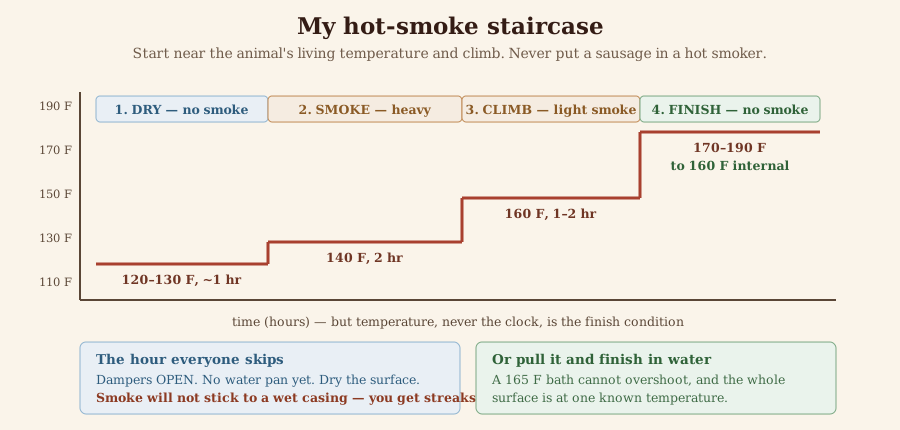
The staircase, and the hour at the bottom of it that decides whether smoke sticks.
Cure is not optional here
Anything hot-smoked needs Cure #1.
A fresh sausage that goes straight into a pan doesn’t, as the fresh and fast page argues. But a hot smoke holds meat for hours in exactly the warm, low-oxygen, slow conditions C. botulinum wants. That’s the window nitrite exists for.
0.25% of the meat block = 156 ppm ingoing nitrite. The arithmetic is on curing salts; weigh it on a 0.01 g scale.
And the corollary people trip over: a cured sausage stays pink at every temperature. The pink-juice test is meaningless here. Use a thermometer.
The stall, and humidity
Sausage stalls like any smoked meat — the internal temperature parks itself and refuses to climb, because evaporation from the surface is cooling it as fast as the chamber heats it. It’s the same physics as a brisket stall and I write about it on tips and tricks.
Don’t chase it by cranking the heat. Either wait, or raise the humidity so evaporation slows.
Which is the useful half of the humidity story, and my notes are honest about the limits of the home version:
Relative Humidity is the water holding capacity of the air, and being able to increase that can speed up your cooking process and give you a juicier finished product. Most people at home do not have a way to control the relative humidity in their smokers and just put a pan of water in there, which is better than nothing but it is a shot in the dark. A psychrometer is something that a commercial smokehouse would have, that will have both a Dry Bulb and a Wet Bulb, and by getting those two readings it can give you the relative humidity.
That’s exactly right and I’ll own the gap: I run a water pan, I do not own a psychrometer, and so my humidity control is qualitative. It works. It isn’t measured.
Just remember the water pan goes in after the first hour, not at the start — otherwise you’ve defeated the drying stage you needed for smoke adhesion.
Measuring it
A leave-in probe in the thickest link, not the smallest, and not touching the fat pocket or the rack. I use a Meater for the convenience of not opening the door; any leave-in probe works.
Don’t peek. Every door-open dumps the chamber temperature and adds time, and the temptation is worst in the last hour when you’re closest.
Verify with a second thermometer if the batch matters. A probe that’s drifted is worse than no probe, because you’ll believe it.
What goes wrong
| Symptom | Cause |
|---|---|
| Greasy, shrunken, puddle on the rack | Fat-out. Chamber too hot, or climbed too fast |
| Blotchy, streaky color | Surface was wet when the smoke started. The first hour |
| Pale patches | Links touching. Space them; daylight between every one |
| Wrinkled, loose casing | No ice bath, or cooled too slowly — see the ice bath and bloom |
| Bitter, acrid, ashtray | Too much smoke, or dirty white smoke instead of thin blue |
| Interior still under at the surface’s “done” | Chamber ran too hot for the diameter. Step it |
Thin blue smoke, not white clouds. White billowing smoke is unburnt particulate and it tastes acrid. If you can’t see through it, the fire is choked. That argument in full is on tips and tricks.
After the smoker
Straight into an ice bath — 20 minutes — then room temperature for about an hour, then refrigerate or vacuum-seal and freeze. Skipping the ice bath is why sausages come out wrinkled, and the reasoning is on the ice bath and bloom.
Part of Curing, Smoking & Cooking. Next: wood — what actually suits a sausage, and the German answer nobody in America reaches for.
Comments (0)