My Smokers & Gear
People ask me why I have so many smokers, and the honest answer is that each one does something the others can’t. Different rigs are good at different jobs — precise and set-and-forget, big and traditional, or cool enough to smoke cheese in July. I’ve ended up with five smokers plus the gadgets that make them precise, and here’s the whole lineup and what each one is for.
The two families of smoker
Before the specifics, it helps to know the landscape. Every smoker is really one of a handful of designs:
- Electric smokers — an insulated cabinet with an electric heating element and a wood pan. Dead simple, very stable, and the easiest to modify for precise temperature control. Mine are the backbone of my hot smoking.
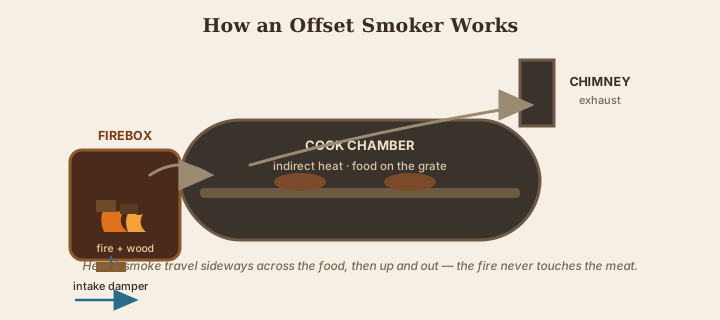
- Offset smokers — a cook chamber with a separate firebox off to one side, so the fire never sits under the food. The traditional, hands-on choice.
- Pellet grills — a hopper feeds wood pellets to an auger and a fan, all controlled by a little computer. Convenient and consistent.
- Cold smokers — any chamber kept cool while an external generator feeds it smoke, for cheese, fish, salt, and the like.
- Kettles, drums, and kamados — round charcoal cookers that can be set up for indirect smoking. Great all-rounders I’ll mention but don’t lean on.
Here’s the classic offset design, since it’s the one whose geometry teaches you why indirect heat works:
My rigs, one by one
Two SmokinTex electrics — modified for precision
The heart of my hot smoking is a pair of SmokinTex electric smokers — one standard-size and one large. Out of the box they’re excellent insulated cabinets, but I’ve modified both with PID controllers and digital readouts fed by RTD thermometers so I can hold a temperature within a few degrees for hours. A PID controller doesn’t just switch the element on and off around a setpoint like a cheap thermostat — it constantly measures the error and trims the power to hold rock-steady, and the RTD (a resistance-temperature probe) gives it a far more accurate reading than a typical thermocouple. The result is a smoker I can dial to exactly 225°F and walk away from. For long overnight cooks like brisket and pork, that precision is everything.
I’ve also added a Smoke Daddy cold-smoke generator to the side of the small SmokinTex, which lets that cabinet pull double duty: hot smoking with the element on, or cold smoking with the element off and the Smoke Daddy feeding cool smoke.
A large offset smoker
For when I want to do it the traditional way, I run a large offset smoker. This is hands-on cooking — you’re managing a real fire in the firebox, feeding splits, and working the dampers to hold temperature — but there’s a depth of flavor and a satisfaction to a stick-burn that the electrics can’t quite match. It’s my choice when the cook is the point.
A stainless grill + pellet cold-smoke tube
I’ve got a large stainless grill that I press into service as a cold smoker using a pellet cold-smoking tube. The tube is a perforated stainless tube you fill with pellets and light at one end; it smolders for hours, throwing a thin, cool smoke with no added heat from the grill itself. It’s the simplest cold-smoke setup I own, and it’s perfect for a tray of cheese on a cool day.
A cold smoker I built from scratch
My favorite piece of gear is a cold smoker I built myself around a Smoke Daddy cold-smoke generator. The whole idea of a dedicated cold smoker is to separate the smoke source from the food, so the smoke has time to cool before it ever reaches the chamber. Mine is built for exactly that — mainly for cheeses and lox. Here’s the principle it’s built on:
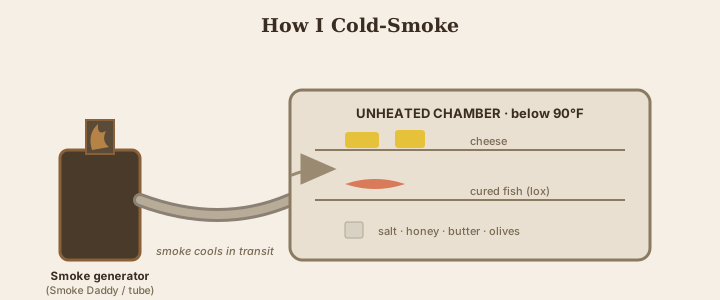
Because the chamber never heats up, I can run it in the danger zone safely for foods that belong there — cheese, smoked salt, honey, butter, nuts, olives — and, with properly cured fish, make real cold-smoked lox. (The why-you-must-cure story is on the Hot vs. Cold page.)
The gadget that ties it all together — Meater Pro XL
Whatever I’m cooking on, I watch it with a Meater Pro XL and its four wireless probes. Being able to track four pieces of meat at once — each probe reading both the internal meat temperature and the ambient temperature at the grate, with no wires running out of the smoker — has changed how carefully I can cook. I can put a probe in each of four pork butts, see them all on my phone, and know the instant any one of them hits its target or stalls. In hot smoking, the meat’s internal temperature is the whole game, and the Meater lets me play it without ever opening the door and losing heat.
What I reach for, and when
| The job | The rig |
|---|---|
| Precise, set-and-forget hot smoke (brisket, pork, overnight) | PID-modded SmokinTex electrics |
| Traditional hands-on fire, maximum flavor | Large offset |
| Quick cold smoke of cheese on a cool day | Stainless grill + pellet tube |
| Serious cold smoking — cheese and lox | The cold smoker I built (Smoke Daddy) |
| Cold or hot in one cabinet | Small SmokinTex with the added Smoke Daddy |
| Watching internal temps on anything | Meater Pro XL, 4 probes |
The rigs are only half of it, though. The other half is knowing what to do with them — the stall, the bark, the smoke ring, and all the little tricks that took me years to learn. That’s My Tips & Tricks.
Comments (0)