The History of Smoking
Smoking food is one of the oldest things humans do. Long before anyone thought of it as a hobby, it was survival — a way to keep meat and fish edible through a winter with no refrigerator in sight. I find that history genuinely useful at the smoker, because every technique I use is an echo of some very old, very practical idea. So here’s the long story of how we got from a fire in a cave to the smoker in my backyard.
It started as preservation, not flavor
For most of human history, people smoked food to keep it. As soon as our ancestors were cooking over fire, they noticed that meat and fish hung in the smoke lasted far longer than fresh — and tasted good besides. That’s not a small observation; before refrigeration, food preservation was the difference between eating and starving.
Smoke works as a preservative through a few mechanisms at once:
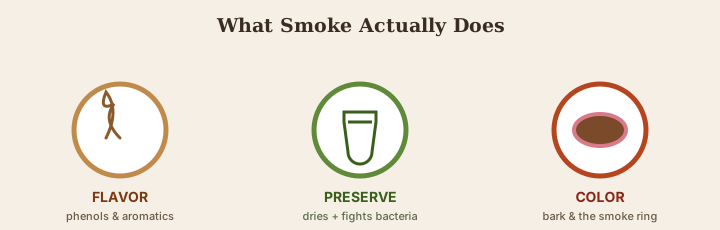
- It dries the food’s surface, lowering the water that bacteria need to grow.
- It deposits phenols and other compounds that are naturally antimicrobial and antioxidant — they slow the bacteria and also keep the fats from going rancid.
- Combined with salt (curing) and often air-drying, it turns perishable meat into something that keeps for months.
That trio — salt, smoke, and time — is behind an enormous amount of the world’s traditional food, and it’s exactly the same chemistry I rely on when I cold-smoke and cure lox today.
Everybody did it, everywhere
Smoking isn’t one culture’s invention; it grew up independently all over the world, wherever people had fire and food to preserve. I’ve been lucky enough to travel to every state in this country, most of them many times, and to more than thirty countries, and I’ve eaten smoked food nearly everywhere I’ve gone. A few of the great traditions:
- Northern Europe built entire cuisines on smoke — smoked herring, salmon, eel, and the cold-smoked fish of Scandinavia and the British Isles.
- Indigenous peoples of the Americas smoked and dried fish and game for the long haul, including the smoked, pounded provisions that fueled long journeys.
- China has ancient smoking traditions — tea-smoked duck, smoked tofu, and the smoke-cured meats of Hunan and Sichuan.
- Central and South America gave us the barbacoa — the whole-animal pit cook over coals and smoke — that became American barbecue.
- Across Africa and Southeast Asia, smoke-drying fish was, and still is, a cornerstone of preserving the catch.
Everywhere I looked, the same idea kept reappearing with local wood and local flavor. That’s a big part of what got me hooked: smoking is a universal human language spoken in a hundred regional accents.
American barbecue and the smokehouse
In America, two threads came together. The Caribbean and Central American barbacoa — cooking a whole animal low and slow over smoky coals — spread through the South and became “barbecue,” with the distinct regional styles I write about on the BBQ Sauces pages. At the same time, nearly every farm had a smokehouse, where hams, bacon, and sausage were cold-smoked and cured to last the year. Country ham, smoked bacon, and the whole tradition of American cured pork come straight out of that smokehouse world.
Refrigeration changed the whole point
Here’s the pivot that created the hobby I love. Once home refrigeration arrived in the 20th century, people no longer needed to smoke food to keep it. And that’s exactly when smoking became about something else entirely: flavor. Freed from preservation, smoking turned into a craft you do because the results are delicious, not because you’ll starve otherwise. The smoke ring, the bark, the perfect thin-blue-smoke brisket — those are pleasures, not necessities.
The backyard-smoking boom
In the last couple of decades, backyard smoking has absolutely exploded, and I’ve watched it happen in real time. A few things drove it:
- Affordable, capable smokers — good electric cabinets like my SmokinTex units, pellet grills, and cheap offsets put competition-grade results within reach of anyone.
- Competition barbecue and star pitmasters — organized circuits and a wave of celebrated pitmasters turned barbecue into a craft people study, not just eat.
- The internet — forums, videos, and communities meant the hard-won secrets that used to live only in a pitmaster’s head were suddenly available to everyone. (This site is my own small contribution to that.)
- A hunger for making things by hand — in a world of instant everything, spending 14 hours tending a brisket is its own kind of luxury.
The wonderful irony is that we’ve come full circle. We smoke food for exactly the opposite reason our ancestors did — for pure pleasure instead of survival — using the very same techniques they figured out thousands of years ago. Every time I light the smoker, I’m doing something almost unimaginably old, just for the joy of it.
From here, dig into the craft itself: the woods, the hot-vs-cold split, my rigs, and everything I put in the smoke.
Comments (0)