Drying
Drying is the hurdle that finishes the job, and it’s the one home recipes are vaguest about. “Hang in a cool place.” “Dry until firm.” I’ve written both of those myself and they are not instructions — they’re hopes with a confident tone.
This page is the number, the failure, and the honest limits of doing this at home.
Water activity is the real quantity
The thing that actually determines whether something can grow in your sausage is not how dry it feels. It’s water activity — written aw — which is the proportion of the water in the food that is chemically available rather than bound up by salt, sugar and protein.
Pure water is 1.00. Fresh meat is about 0.99. Every organism has a floor below which it simply cannot grow, and those floors are what the whole preservation craft is built on:
| Organism | Won’t grow below about |
|---|---|
| Clostridium botulinum (proteolytic) | aw 0.93 |
| Most spoilage bacteria | aw 0.90 |
| Staphylococcus aureus | aw 0.86 — the toughest of them |
| Most molds and yeasts | aw 0.70–0.80 |
S. aureus is the one that sets the bar, because it tolerates dry and salty conditions better than its competitors. aw ≤ 0.85 is the widely-used shelf-stability threshold for a dried product standing on water activity alone.
This is why “dryness” is the wrong word. Two sausages can feel equally firm and sit either side of a line that matters. Salt and sugar bind water without removing it, so a saltier sausage is safe at a higher moisture content than a less salty one. The feel of the thing tells you almost nothing.
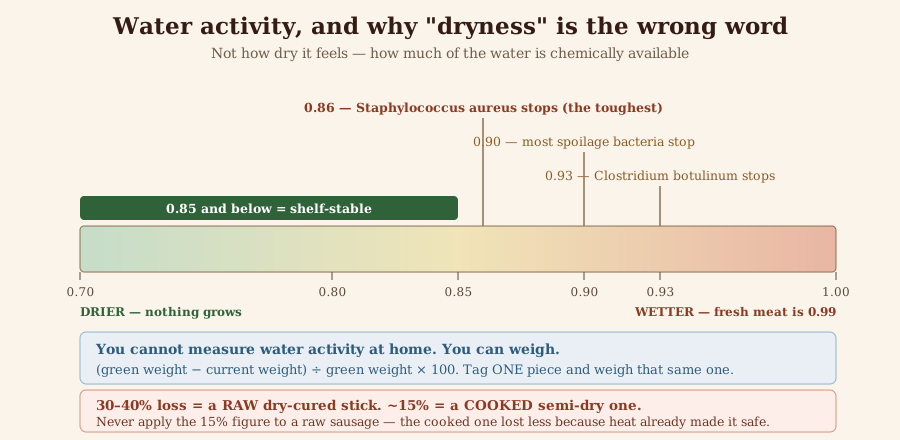
The thresholds the whole preservation craft is built on — and the home proxy for measuring against them.
Weight loss: the number you can actually use
A water-activity meter is a real laboratory instrument and I don’t own one. Almost no home maker does.
What you can do is weigh. Water leaving the sausage is the weight leaving the sausage — the fat and protein aren’t going anywhere — so percentage weight loss is a usable proxy for how far the water activity has fallen.
(green weight − current weight) ÷ green weight × 100
The targets:
| Product | Weight loss | Why |
|---|---|---|
| Raw dry-cured (salami, traditional Landjäger) | 30–40% | The dry is the safety; nothing cooked it |
| Cooked semi-dry (American Landjäger, summer sausage) | ~15% | The cook already made it safe; the dry is texture |
| Whole-muscle (coppa, bresaola) | 35–40% | Same logic as a raw salami |
🔴 Never apply the 15% figure to a raw stick. This is the confusion I most want to head off, and it comes from Landjäger being loosely described as “semi-dry” — a texture word that describes both products. The cooked one loses ~15% because heat already made it safe. The raw one has to lose 30–40% because the drying is doing the work. Pull a raw stick at 15% and you have an under-dried raw sausage that looks finished.
Tag one piece and weigh that one
Tie a numbered tag onto one link or one pair at stuffing time. Weigh it. Write the number on the batch sheet. Weigh that same piece as it dries.
Weighing a different link each time tells you nothing, because links vary. This is a two-minute habit that converts the whole process from guesswork to arithmetic, and it’s the single thing I’d press hardest on anyone drying their first salami.
The scale, not the calendar. Time is an estimate; weight is a measurement.
The conditions
Two stages, in sequence, and the chamber page covers building a box that delivers both.
Ferment — warm and very humid: 68–75°F, 90%+ RH, one to three days. See fermenting.
Dry — cool and moderately humid: 54–60°F at 75–85% RH, easing toward 65–70% as it finishes. Weeks.
If you remember one setting, 55°F and 75% is the classic dry-curing climate. But the craft is running the two stages in sequence — warm wet ferment, then cool steady dry — and stepping down rather than jumping. The Alpine Butcher’s schedule does this explicitly: ferment warm, then 64°F, then 61°F after 48 hours, then a 50–57°F hold.
Airflow: gentle and intermittent. A small fan on a cycle timer. Still air grows mold in pockets; a constant breeze case-hardens.
How long
Governed by diameter, not by batch size — a point that catches people out when they scale up. Doubling the number of sausages changes nothing; changing the casing changes everything.
| Casing | To 30–40% loss |
|---|---|
| Sheep 22/24 mm | ~3 weeks |
| Hog 28/32 mm | 4–5 weeks |
| Beef middle 55–60 mm | 2–3 months |
| Whole muscle | 3+ months |
Case hardening — the failure that wastes the most time
What happens: the surface loses moisture faster than the interior can migrate outward. The outer few millimeters dry and contract into a hard, relatively impermeable shell, and now the inside can’t dry at all. Rock-hard rim, a distinct ring, soft wet center. From the outside it looks finished.
Causes: humidity too low, airflow too high, or a sudden change from a wet ferment to a dry chamber.
The fix, which works more often than you’d expect: wrap it in butcher’s paper — not plastic — and refrigerate for a week or more. The moisture equalizes through the sausage; the wet center gives water to the dry rim. Then re-hang and carry on. It costs a week and usually saves the batch.
Prevention is high steady humidity, gentle airflow, and stepping the conditions down rather than jumping.
What “done” looks like, honestly
- The tagged piece has lost 30–40% of its green weight. This is the answer.
- It feels firm through the middle, not just at the surface — squeeze along its length. A soft spot is a wet spot.
- Cut one. The face should be even from rim to center, with no wet core and no dry ring. This is the check nothing replaces, and it costs you one sausage.
What I don’t have, and what that costs
I do not own a curing-and-drying chamber, and I don’t own a psychrometer. That’s the honest hole in my kit and I’d rather say it than write this page as though I run a temperature-and-humidity-controlled box.
I’ve dried by weight loss, in the coolest stable place I have, watching it like a hawk, cutting one to check. That works, and it has produced good sausage. What it doesn’t produce is repeatability — two batches in different weeks are two different experiments, and when one goes wrong I can’t always tell you why.
Building the box is the next real upgrade on my list. Until then I weigh, and I’d rather tell you that than imply a precision I’m not running.
The limit of what drying does
One thing to carry forward, because it’s easy to read this page as “dry it enough and it’s safe.”
Drying is a genuine and powerful hurdle — it’s the one that makes the sausage shelf-stable and stops essentially everything from growing. But it is a growth barrier, not a kill step. Organisms already present don’t necessarily die; they stop multiplying.
That distinction is the whole subject of the “hole in the hurdle stack” section on food safety, and USDA is explicit that hitting aw 0.85 is not on its own validated to reduce Salmonella. Read that before you decide drying alone has finished the argument.
Part of Curing, Smoking & Cooking. Next: mold — the white bloom you want, and the fuzzy green you don’t.
Comments (0)