Food Safety
This is the page the rest of the program answers to.
Everywhere else in these sections I’ve told you what to do — 156 ppm of cure, pH 5.3, 30–40% weight loss, 160°F internal. This page is where those numbers come from, what each one is actually protecting you against, and — the part that took me longest to understand and that most home writing gets wrong — what they do not protect you against.
I want to be plain about my own position before I start. I am not a food scientist. I have made sausage for forty years, I read the primary regulatory documents rather than the blogs, and I have changed my mind about several things on this page while writing it. Where the evidence is solid I’ll say so. Where I’m relying on inference I’ll say that too. And there is one thing on this page that genuinely surprised me and that changed how I talk about raw dry-cured sausage — it’s in the section called “The hole in the hurdle stack,” and if you read nothing else here, read that.
The hurdle concept
Nothing in a raw cured sausage is sterile, and nothing you do at home makes it sterile. What you are doing instead is stacking barriers — hurdles — each of which makes the sausage a slightly worse place for something dangerous to live. No single one is sufficient. The stack is the point.
For a sausage the hurdles are:
| Hurdle | What it is | What it stops |
|---|---|---|
| Curing salt | Nitrite, and in Cure #2 a nitrate reservoir | Clostridium botulinum |
| Acid | A fast fermentation to pH ≤ 5.3 | Staphylococcus aureus |
| Water activity | Drying to 30–40% weight loss | Almost everything, eventually |
| Salt | 2.5–3% in the meat block | Raises the bar for all of it |
| Cold | 30°F through the whole process | Buys you time on all of it |
| Heat | A verified internal temperature | Salmonella, STEC, Trichinella, living cells of everything |
⭐ Two of those hurdles are numbers you have to read off an instrument, and both instruments have to be right. A thermometer everyone owns; a pH meter most people do not, and the pH hurdle is the one that fails silently. Measuring pH is the companion page — including why strips cannot do this job at all, since 5.3 is well above the 4.0 ceiling the regulation puts on them.
Read that last row carefully, because the shape of this whole page is in it. Heat is the only hurdle that kills broadly. The others suppress, inhibit, and outcompete. That distinction is the difference between the two ways of making a sausage, and it is not a small one.
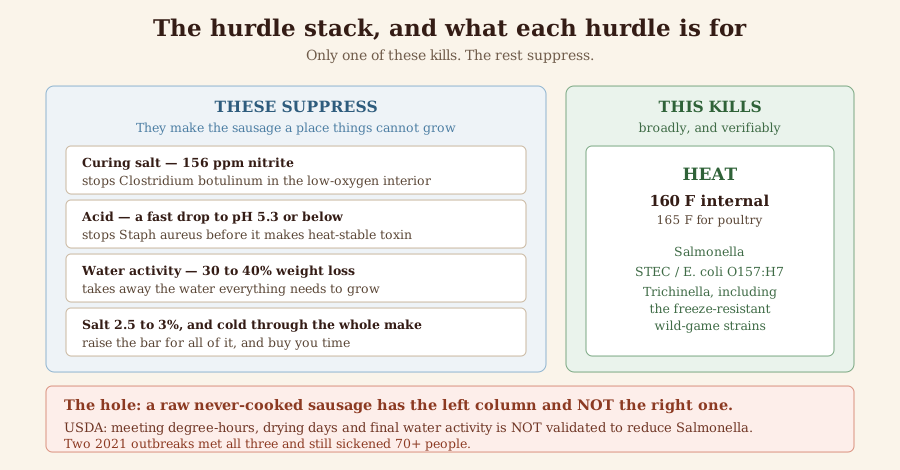
The shape of the whole page. Four hurdles suppress; only heat kills.
The organisms, one at a time
Clostridium botulinum — the reason cure exists
Botulism is the hazard people have heard of, and it’s the one the pink salt is for. C. botulinum is anaerobic — it grows where there is no oxygen — and the interior of a stuffed sausage is exactly that. Its spores survive ordinary cooking. What it produces is one of the most potent toxins known.
Nitrite is the specific barrier, and it’s why curing salt is not optional in anything cured, stuffed, and slow. At 156 ppm ingoing nitrite — which is what 0.25% of Cure #1 or #2 delivers, and the arithmetic is worked on curing salts — you have the protection the whole American curing system is built around.
Two things worth knowing: the toxin (unlike the spores) is heat-labile and destroyed by real boiling, and C. botulinum won’t grow below about water activity 0.93, which any properly dried sausage is well under. But neither is something to rely on. The cure is the barrier. Weigh it on a 0.01 g scale.
Staphylococcus aureus — the fermentation hazard, and the nastier one
This is the organism that actually decides how you ferment, and the one most home writing under-rates.
S. aureus is salt-tolerant in a way most pathogens aren’t — it grows in conditions that stop its competitors, which means the salty, curing environment you’ve built doesn’t inhibit it much. It grows from about 60°F upward. And here is the part that matters:
It produces a heat-stable enterotoxin.
Heat-stable means what it says. Once the toxin is in the sausage, no cook step removes it. You cannot fix it later. You cannot smoke it out, dry it out, or cook it out. This is the one failure in sausage making that is genuinely unrecoverable, and it’s why I’m insistent about verifying the ferment rather than assuming it.
The defense is speed: drop the pH to 5.3 or below, fast, before the organism has time to multiply and excrete. The industry expresses that limit as degree-hours — hours spent above 60°F multiplied by the degrees over 60°F, accumulated until the sausage reaches pH 5.3:
| Fermentation temperature | Maximum degree-hours to reach pH 5.3 |
|---|---|
| Below 90°F | 1200 |
| 90–100°F | 1000 |
| Above 100°F | 900 |
The hotter you ferment, the fewer degree-hours you’re allowed — because the heat helps S. aureus too. A slow cool ferment around 70°F has a generous window; a hot fast one does not.
⚠ A correction I need to make here, because I’ve repeated the error myself. You will often see it written — and I wrote it on the Landjäger craft page — that “Canada is stricter, at 665 / 555 / 500.” That is wrong. Those are Celsius degree-hours. Multiply by 1.8 and you get 1197 / 999 / 900 — the same limits as the US figures, expressed in a different unit. Canada is not stricter; it’s the identical standard in metric. I’ve fixed it on that page too.
Salmonella and STEC — and the hole in the hurdle stack
Here is the section that changed how I talk about this craft.
Everything above — the cure, the fast acid drop, the long dry — is a genuine, validated control stack. But look carefully at what each hurdle is validated for: nitrite for botulism, degree-hours for S. aureus, drying time for Trichinella, final water activity for shelf-stability.
None of that is validated to kill Salmonella.
I did not want this to be true, and I checked it against the primary source rather than a forum. USDA FSIS puts it about as directly as a regulator ever puts anything. Their guidance for ready-to-eat shelf-stable fermented, salt-cured and dried products recommends a process achieve at least a 5-log₁₀ reduction of Salmonella — and of shiga-toxin-producing E. coli for anything containing beef — and then says plainly that “the typical process steps/hurdles may not be as effective as cooking.”
And then there’s this, which is a question-and-answer in their own document and which reads like it was written for exactly the person making a salami in their basement:
Question: What if I meet the degree-hours and dry my product following one of the methods in FSIS’s Guideline for the Prevention and Control of Trichinella and dry to a reduced water activity such as to a water activity below 0.85, isn’t that enough to show biological hazards are addressed?
Answer: No. This combination of controls has not been validated to achieve any particular reductions in Salmonella, and products often have to be fermented to pH’s lower than 5.3 and dried longer than needed to achieve a water activity below 0.85 to get significant reductions in Salmonella.
This is not theoretical. In 2021 two salmonellosis outbreaks sickened more than 70 people, and FSIS’s own lesson-learned is that the establishments involved met the degree-hours, met the drying days, and met the final water activity — all of it — and still made people ill, because none of those controls had been validated against Salmonella. They also found that small-diameter products may need longer drying than a study done on a fatter one would suggest, which is worth holding onto if you make thin sticks.
So the honest statement, which I’d rather give you than a comfortable one: the hurdle stack in a raw, never-cooked sausage is a real and effective control for botulism, for S. aureus, for Trichinella in pork, and for shelf-stability. It is not a validated kill step for Salmonella or STEC. A commercial producer closes that gap by validating their specific process against published science. At home you cannot validate anything.
What you can do:
- Start with better meat than the process assumes. This is the one lever with real leverage at home, and it’s a large part of why I source within thirty miles from people I know. The hurdle stack doesn’t reduce the load much, so the load you start with is roughly the load you finish with.
- Ferment lower and dry longer than the minimum. FSIS says so in that answer: below pH 5.3, past aw 0.85. The minimums are minimums for shelf-stability, not optima for safety.
- Consider a post-fermentation low-temperature heat step. This is the real technical answer and it’s how commercial producers get lethality without turning a dry-cured sausage into a cooked one. The FSIS document cites a validated parameter of an internal 128°F held for one hour (Hinkens et al., 1996) as a post-fermentation step. It is gentle enough that the product is still recognizably a dry-cured sausage.
- Or make the cooked version. There is no shame in this and I want to say it clearly: a cooked sausage taken to a verified internal temperature has a real, broad kill step that the raw one does not. Everything else on this page is about managing a risk that the cook simply removes.
I still make raw dry-cured sausage. I make it knowing the above rather than believing the stack is complete, and I think that’s the only defensible way to do it.
Trichinella — and the game rule you must not get wrong
Only relevant if you’re eating meat raw and dry-cured with no cook.
Commercial US pork is very low-risk, and the strain it can carry is killed by freezing on a published schedule — 9 CFR 318.10, for pieces under 6 inches: 5°F for 20 days, −10°F for 10 days, or −20°F for 6 days.
🔴 Wild game is completely different and this is the single most dangerous confusion on this page. The Trichinella strains circulating in North American wildlife — bear above all, also wild boar — are freeze-resistant. Freezing does not reliably kill them. Neither does curing, salting, smoking, or drying. The only reliable kill for at-risk game is heat, to a verified 160°F throughout.
Which means: a raw, never-cooked bear sausage has nothing acting on the parasite at all. Don’t make one. Venison is a much lower-risk vector but the same logic applies — the venison Landjäger carries its own safety block for exactly this reason rather than borrowing the pork one. The full argument is on meat.
Listeria monocytogenes — the after-the-fact one
Worth a paragraph because it’s the one that gets you after the process. Listeria grows at refrigerator temperatures, and the risk on a ready-to-eat product is recontamination after processing — from the slicer, the board, the hands, the vacuum bag. It’s why a finished dry-cured sausage should be handled as the ready-to-eat food it is: clean surfaces, clean knife, and don’t let it share a board with the raw block you’re grinding tomorrow.
The numbers, in one place
| Number | What it is | Where it’s worked |
|---|---|---|
| 156 ppm | Ingoing nitrite. 0.25% of Cure #1 or #2 on the meat block | Curing salts |
| pH ≤ 5.3, fast | The S. aureus hurdle. Verify it; don’t assume | Fermenting |
| 1200 / 1000 / 900 | Max degree-hours to reach pH 5.3, by ferment temperature | above |
| 30–40% weight loss | The water-activity hurdle, on a tagged, weighed piece | Drying |
| ~15% weight loss | The cooked semi-dry figure. Never apply it to a raw stick | Hot smoke |
| 40–140°F | The danger zone. Minimize cumulative time in it | The cold chain |
| 160°F internal | Verified kill step. Mandatory for at-risk game | The hot-water finish |
| 0.01 g | The scale resolution cure requires | Thermometers and scales |
What each kind of sausage is actually relying on
This is the table I’d tape inside the cabinet if I could only keep one thing from this page.
| Product | What makes it safe | What it does NOT have |
|---|---|---|
| Fresh (brat, breakfast) | Cold chain, then a full cook before eating | Nothing else — treat it like raw ground meat |
| Cooked / hot-smoked (kielbasa, summer sausage) | A real kill step — verified internal temperature | Nothing missing; this is the safe path |
| Cooked semi-dry (American Landjäger) | The cook, plus a modest dry | Nothing missing |
| Raw dry-cured (salami, traditional Landjäger) | Cure + fast acid + full dry + salt | No validated Salmonella/STEC lethality. No cook. |
| Raw dry-cured GAME (venison) | The same stack | The above, plus no control on freeze-resistant trichinae |
| Spreadable raw fermented (Mett, Teewurst) | In commercial production: validated process | At home: don’t. See below. |
The one I won’t give you a recipe for
Raw spreadable fermented sausage — Mettwurst, Teewurst — is a genuine German tradition and I’m not sniffy about it. But it is fermented, never cooked, and barely dried, which removes the water-activity hurdle entirely and leaves you leaning on cure and acid alone.
The 1995 Garibaldi outbreak in South Australia — a fermented mettwurst — killed a four-year-old girl and sickened dozens. The infectious dose of E. coli O157:H7 implicated was estimated at around one organism per 10 grams of sausage. That is not a margin any home process can measure, let alone control.
So I’ve written no home formula for these in this collection and I don’t intend to. That’s a deliberate omission, and it’s the only one.
When to throw it out
I’d rather be blunt than diplomatic, because the whole reason this page exists is that some of these failures aren’t merely disappointing.
Throw it out if:
- A fermented sausage’s pH did not drop to 5.3 or below. There is no fix. The toxin risk is heat-stable and a later cook does not help.
- It smells sour in the wrong way, putrid, cheesy, or of ammonia.
- It’s slimy, or carries fuzzy green, gray or black mold (a white powdery bloom is fine and desirable — see mold).
- It spent hours in the 40–140°F range during processing.
- You are not certain the cure was weighed correctly on a batch that needed it.
- It’s a raw never-cooked bear sausage. Cook it to 160°F and eat it as something else.
Don’t throw it out for: a broken emulsion (make pâté), a crumbly bind (make patties), a burst casing (cut and carry on), white bloom, or a merely over-salted batch. There’s a real difference between worse than you wanted and unsafe, and confusing the two either wastes food or hurts somebody.
Where I’ve landed
The craft is not dangerous. It is unforgiving of assumption, which is a different thing.
Every number on this page exists because somebody got hurt and then somebody measured why. The cure number, the pH number, the weight-loss number, the freezing schedule, the degree-hours — none of it is folklore, and all of it is cheap to comply with once you own a scale, a pH meter and a thermometer.
What I’d ask you to carry away is the shape rather than the digits: the hurdle stack suppresses; only heat kills. Build the stack properly, verify it instead of trusting it, and be honest with yourself about which of the two sausages you’re making.
Part of Curing, Smoking & Cooking, and the page the whole of Sausage answers to. Next: fresh and fast — the sausages with no cure at all, and why they’re the safest thing in this section.
Comments (0)