The Balkans and Turkey: One Empire's Spice Line, a Dozen Names for the Same Sausage
I make ćevapi. Out of everything on this whole tour of the old world, this is the page where I stop being a tour guide and admit I’m a fan, because I wrote it down myself years ago on my own food blog: I love all kinds of sausages, and this little sausage from Serbia is another of my favorites. That’s the recipe I keep coming back to — pork, beef (I like to sneak in veal), a little lamb, garlic, an egg white to bind, a pinch of baking soda for spring, formed into fingers about three-quarters of an inch thick and grilled, charcoal for preference. Five to ten of them on a plate in a warm flatbread, a spoon of kajmak, some raw onion. I have made these enough times that my hands know the size without a scale.
So I came to this page already loving the food. What I did not know, until I chased the history properly, is that the little grilled finger I make is not really Serbian, or Bosnian, or even Balkan in origin at all. It’s the westernmost drop of a wave that started in Central Asia and rode an empire across two continents. And once you see that wave, the whole region snaps into focus — because the same thing keeps happening, over and over, in a dozen languages, and popular food writing keeps mistaking a name for a thing.
That’s the lesson of this entire eastern half of the old world. I hammered it on the Poland page: kiełbasa isn’t a sausage, it’s the Polish word for sausage. Here it comes back with a vengeance, because in the Balkans and Turkey there’s a single sausage that wears at least eight spellings across eight languages and is, underneath, one word. Learn to see that and you’ve learned how to read the whole region.
The Ottoman spice line
Here’s the frame to hold the rest of this page inside.
For roughly six centuries — from the 1300s to the early 1900s — the Ottoman Empire stretched from Anatolia up through the Balkans, around the Black Sea, and down across the Levant and North Africa. It was a Turkic empire built on a Turkic and Anatolian foodway, and that foodway had two habits I care about as a sausage maker: it preserved meat by drying and spicing it, and it grilled minced meat over live coals. Both of those habits traveled with the empire. Wherever Ottoman administration, Ottoman soldiers, and Ottoman merchants went, the techniques went too, and they settled into the local kitchen and picked up a local name and a local spelling.
This is not a story about conquest so much as a story about distribution. It’s the same mechanism I described for the Habsburgs on the Austria-Hungary page — an empire as a network that carries a food across a huge multiethnic space and lets it acquire a new name in every province — except the Ottoman version ran longer, reached farther, and left its descendants under more different alphabets. A stuffed dried sausage in Istanbul, a stuffed dried sausage in Sofia, a stuffed dried sausage in Yerevan and Athens and Beirut and Bucharest: same idea, same root word, eight sets of letters.
And there’s a fork in that road, one that reorganizes the meat itself. The Ottoman Empire was Muslim, and its core meat traditions are halal — no pork. So along the spice line, the meat you find in the sausage tells you the religion of the people who kept making it. In the Muslim heartland and among Muslim Balkan populations, the sausage is beef and lamb, full stop. Cross into an Orthodox Christian or Catholic corner of the same region — Serbia, Croatia, Romania, Bulgaria’s Christian villages — and pork walks back into the recipe, because there’s no longer a reason to keep it out. Push east into the Turkic steppe of Central Asia, where the animal that matters is the horse, and the same sausage gets stuffed with horse meat. The idea is constant. The flesh inside it is a map of belief. I dig into the mechanics of that fork — what the halal rules actually forbid and why it deletes an entire branch of the sausage family — on the kosher and halal page; here I just want you to watch it operate.
Two products carry this whole story, and they sit at opposite ends of the sausage craft. One is a hard dried keeping sausage — sujuk. The other is a fresh caseless grill — ćevapi, my ćevapi. Let me take the older one first.
Sujuk: the sausage older than the empire that spread it
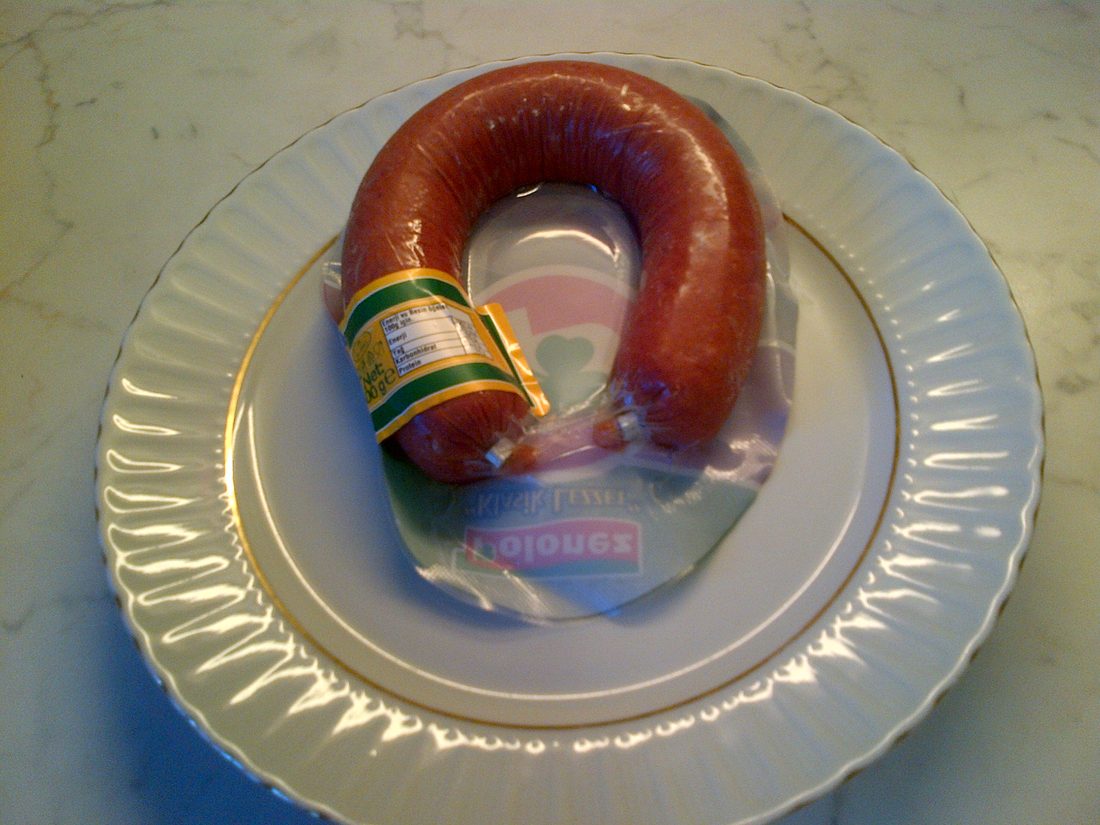
Sujuk (Turkish sucuk) is a dry, spiced, fermented sausage — classically beef or lamb, worked hard with cumin, garlic, red pepper, and sumac, stuffed tight, and dried for weeks until it’s firm enough to slice thin and eat without cooking. If you know Rohwurst from the German scheme, sujuk is squarely in that family: raw meat made safe by curing, fermentation, and drying, never by heat. It’s the Turkic cousin of salami, and it’s excellent.
Now the correction that makes it worth its own section. Sujuk is usually filed under “Ottoman food,” and that’s not wrong as a distribution story — the Ottomans did carry it everywhere. But the sausage itself is older than the Ottoman Empire. It’s Turkic, and it predates Ottoman power by centuries.
The anchor here is unusually good, and I want to give it to you straight because most “ancient sausage” claims fall apart the moment you ask for a source — I spent the whole origins page clearing out phantom Sumerian tablets and imaginary Pompeii specimens. This one holds. In the 11th century, the Kara-Khanid scholar Mahmud al-Kashgari compiled the Dīwān Lughāt al-Turk — the “Compendium of the Languages of the Turks,” a dictionary of Turkic written for an Arabic-speaking audience around 1072–1074. In it he describes spiced meat stuffed into casing. The word he’s glossing traces back to Old Turkic suğut (also written sugut), meaning roughly “the dried thing.” A dried, stuffed, spiced meat, named and written down almost a thousand years ago, three hundred years before there was an Ottoman sultan to spread it. That is a genuinely early textual anchor, and I’ll take a real 11th-century dictionary entry over a hundred confident blog posts about 3000 BCE any day.
So the honest sequence is: the sausage is old and Turkic; the reach is Ottoman. The empire didn’t invent sujuk. It delivered it.
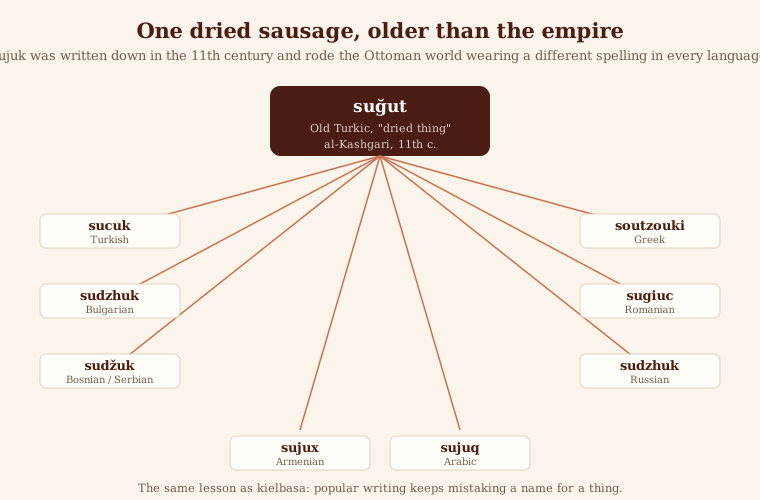
One word, eight spellings
And here is the kielbasa lesson, back for a second helping. When sujuk traveled the spice line, the word traveled with it — and unlike most loanwords, it barely changed. You can practically hear it survive intact across languages that share nothing else, not even an alphabet. This is the single clearest illustration on the whole tour of “one thing, many names,” so I’m going to lay it out as a table, the way I did the Polish sausage types:
| Language / place | Spelling | Notes |
|---|---|---|
| Turkish (Turkey) | sucuk | The reference form; beef/lamb, halal |
| Old Turkic (11th c.) | suğut / sugut | ”dried thing” — al-Kashgari’s root |
| Bulgarian / Russian | sudzhuk (суджук) | Balkan and Black Sea |
| Bosnian / Serbian / Croatian | sudžuk / sudžuka | Ex-Yugoslav space |
| Albanian | suxhuk | |
| Armenian | sujux (սուջուխ) | Also the sweet grape-and-walnut confection of the same name — same word, different food |
| Arabic | sujuq (سجق) | Levant and Egypt |
| Greek | soutzouki (σουτζούκι) | And soutzoukakia, the Smyrna meatballs |
| Romanian | sugiuc |
Look at that column of spellings. That is not eight sausages. It is one sausage, carried west and north and east by one empire’s traffic, spoken into eight phonologies and written in five alphabets. When a food writer tells you their country has a “unique traditional sausage called sudžuk,” what they’ve actually got is the Ottoman spice line passing through their grandmother’s kitchen. The uniqueness is the spelling. The sausage is shared.
I made exactly this point on the Poland page — that in the Baltics, skilandis and kindziukas are two names for one pear-shaped smoked sausage — and it’s worth saying why it keeps recurring. A sausage is a portable technology. It moves with people. And when a technology moves faster than the word for it can be translated, the word just goes along for the ride, getting slightly reshaped at every border. Trace the spelling drift and you’ve traced the migration. Sucuk → sudzhuk → sudžuk → sugiuc is a map of the Ottoman Balkans written in one noun.
You’ll find sujuk and its cousins in my collection under more than one spelling — search sucuk too, because that’s how half the recipes label it.
Where the meat splits
Sujuk is also the cleanest place to watch the halal fork operate, because the sausage stays otherwise identical while the flesh inside it changes with the map. In Turkey and among Muslim Balkan populations, sujuk is beef and lamb — always, by rule. In the Orthodox and Catholic Balkans, you’ll find versions with pork worked in, because there’s no longer a religious reason to leave it out. And out on the Central Asian steppe — Kazakhstan, Kyrgyzstan — the prestige sujuk is made of horse meat, because the horse is the animal that region banks its winter on.
Same casing, same cumin, same weeks of drying. Beef here, pork there, horse further east. The recipe is a constant and the meat is a variable, and the variable is set by belief and by which animal a place actually keeps. That’s the halal thread in one sausage, and it’s why I keep sending you to the kosher and halal page — that dietary law isn’t a footnote to this history, it’s one of the main forces shaping the tree.
Ćevapi: the caseless sausage I actually make
Now the one I love.
Ćevapi — or ćevapčići, the diminutive, “little ćevapi” — are caseless grilled fingers of minced meat, and they are the reigning example of a sausage with no casing at all. When I built the casing-or-not discussion for the hub, ćevapi is the product I reached for to make the point that a casing is optional. This is a sausage in every sense that matters — seasoned forcemeat, shaped and cooked — except that nothing holds it together but the bind of the meat itself and a careful hand on the grill. No gut, no collagen, no fibrous wrapper. Just the mince, salted and worked until it’s tacky enough to stay in a log over the fire.
They’re the national dish of Bosnia and Herzegovina and of Serbia, and they’re eaten everywhere across the former Yugoslavia and well beyond it — Croatia, Montenegro, Slovenia, North Macedonia, Bulgaria, Romania, and up into Austria and the Italian borderlands. As my own recipe note says, this “little sausage from Serbia” turns up under one name or another across half of southeastern Europe. Which should already tip you off: a dish that’s the “national dish” of two countries and a beloved staple in ten more did not spring from one national soil. It came from somewhere upstream of all of them.
The kofta connection
That somewhere is the Ottoman kitchen, and the parent dish is kofta — the spiced minced-meat preparation that runs, in a hundred variants, across the whole former Ottoman and Persian world. The very name gives it away: ćevap comes, by way of Ottoman Turkish kebap, ultimately from the Arabic kebab. Ćevapi are, etymologically and genealogically, a Balkanized kebab — grilled minced meat, the Ottoman caseless-grill idea, settled into the South Slavic kitchen and shrunk to finger size. The lineage is solid and it’s right there in the word.
So when did the specific thing I make — these particular little fingers, this size, this seasoning, eaten this way — crystallize out of the general Ottoman kofta tradition? Here we can get pleasantly precise, and it’s a good story.
The modern ćevapi is tied to two places and one moment. The first is Leskovac, a town in southern Serbia that was under Ottoman rule until it was taken and annexed to Serbia in 1878 — a genuine frontier of the empire, where the grilled-mince tradition was living Ottoman practice right up to the handover. Leskovac still stakes a serious claim to ćevapi and throws a grill festival around it. The second is Belgrade in the 1860s, where the kafanas — the old coffee-house taverns — were serving them; the Serbian writer Branislav Nušić recorded ćevapi at the Rajić kafana in that era, which gives us a datable literary sighting in the exact window when the Ottoman frontier was receding and the dish was settling into its modern Serbian form.
Put those together and you get a real, datable Balkan crystallization in the second half of the 1800s, right along the retreating Ottoman edge. That’s history you can point at.
But not an invention — a crystallization
Here’s where I have to correct the story even as I tell it, because the popular version overreaches. You’ll read that ćevapi “originated in Leskovac,” or “were invented in Belgrade,” as if the dish began there. It didn’t. The Ottoman kofta tradition was already grilling caseless minced meat across that entire region for centuries before Leskovac was annexed to anything. What happened in Leskovac and the Belgrade kafanas in the 1800s wasn’t invention — it was crystallization: a long-running, widely shared Ottoman technique settling into a specific, named, local form at a specific, documentable time and place.
That distinction matters, and it’s the same discipline I try to hold everywhere on this tour. “This town crystallized the modern version” is true and provable. “This town invented the dish” is an overclaim that erases six centuries of Ottoman grilling. Ćevapi are an inheritance that acquired a hometown, not a local invention that conquered a region. Hold that, because the next dish tells the identical story with a much more famous fib attached.
The regional forms — and how I make mine
The fun of ćevapi across the region is that every place has welded its own habit onto the same little sausage:
- Sarajevo style: served in a fresh somun (a soft, puffy flatbread), the ćevapi tucked inside with raw onion and a generous spoon of kajmak — a rich clotted-cream cheese that melts into the hot meat. This is, to my taste, the platonic version.
- Banja Luka style (northern Bosnia): the ćevapi are pressed and grilled joined together in little slabs of four, then separated to serve — a different geometry entirely.
- Leskovac style: the southern Serbian original, often larger and more assertively spiced, from the town that fought the Ottomans for the recipe and won the festival.
My own version is the mixed-meat, pork-in Serbian school, which tells you exactly which side of the halal fork my recipe sits on — I’m not cooking to a dietary law, so I use pork and beef and lamb together the way the Christian Balkans do. I bind with an egg white and I put a pinch of baking soda in the mix. That baking soda is worth a word, because it’s the one non-obvious trick and it does real work: it nudges the meat’s surface pH up, which loosens the proteins and lets the mince hold water and stay tender and springy instead of tightening into a dense little bullet on the grill. The Romanians, as we’re about to see, lean on the exact same trick and made a whole texture out of it.
I shape them by hand to about three-quarters of an inch and a finger’s length, rest them in the fridge for at least an hour — a full day is better — so the flavors settle and the mix firms up enough to hold on the grate, and I grill them over medium-low charcoal, turning, for something like half an hour. Cast iron indoors works, a fry pan in a pinch, but charcoal is the point; the smoke is half the flavor. Then somun or pita, chopped onion, kajmak or ajvar (the roasted red-pepper relish that’s the standard partner), and that’s the meal. My full recipe is in the collection if you want the amounts.
Mititei: the same story, with a better lie attached
Cross the Danube into Romania and you meet mititei — “the little ones” — almost always called mici in everyday speech, which means the same thing. They’re caseless grilled rolls of minced meat, usually beef, often with some lamb or pork, seasoned hard with garlic and — there it is again — bicarbonate of soda for that characteristic springy, juicy bounce. If you’re squinting and thinking “that’s ćevapi,” you’re not wrong. They’re first cousins, both children of the Ottoman caseless-grill family.
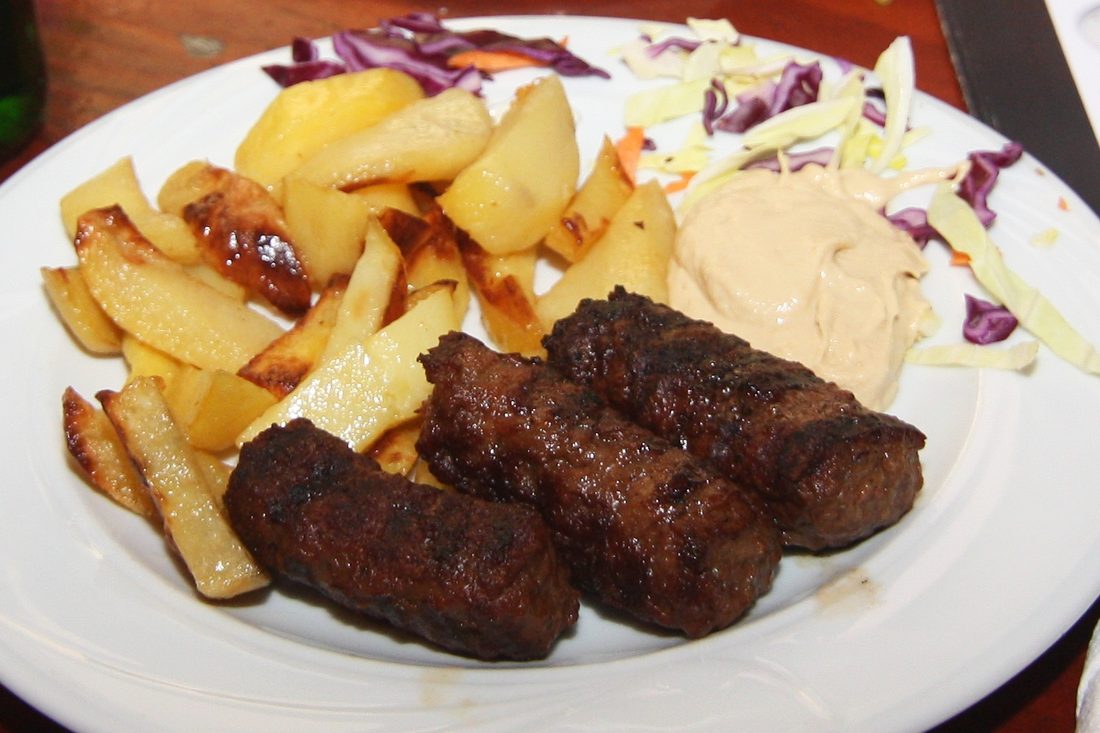
And mici come with one of the most beloved origin legends in all of sausage folklore, so let me tell it and then take it apart, because taking apart good stories is most of what this history is for.
The legend: in 19th-century Bucharest there was a tavern in the old center — the La Iordachi inn, run by one Iordache Ionescu, on Covaci Street — famous for its grilled sausages. One busy night the kitchen ran out of casings. Rather than turn customers away, the cook shrugged, grilled the naked seasoned forcemeat straight on the grate, and discovered the caseless grilled roll was better than the cased sausage had ever been. Thus, by happy accident, mici were born.
It’s a wonderful story. It’s the kind of origin tale that feels true — the harried cook, the improvisation, the accident that turns out to be an improvement. And I would love to tell it to you as fact. But I can’t, because the honest verdict on it is that it’s folklore. The sources that repeat it also flag it plainly as unsupported by much evidence. There’s no contemporary record of Iordache running out of casings; there’s just a lovely just-so story that got repeated until it hardened into something people state as history.
What we actually have that’s firmer: a mici recipe claimed for around 1872, and a documented association with the famous Caru’ cu Bere beer hall by 1902. Those are real documentary anchors, and they put mici solidly in late-19th-century Bucharest — the exact same window in which ćevapi were crystallizing a few hundred miles southwest. Which points at the real answer.
The honest truth: mici are not a Romanian invention at all. They’re a Romanian adoption of the Balkan and Ottoman caseless-grill tradition — the same family as ćevapi, arriving in Romania the same way the spice line reached everywhere else, and settling into a local form with a local name in the late 1800s. The “ran out of casings” tale isn’t the origin of the caseless grill; the caseless grill was already the Ottoman way, region-wide, for centuries. The legend is a charming national just-so story papered over an inheritance.
And that is the centerpiece of this whole page.
The correction, stated plainly
Here’s the thing to walk away with, because it ties the page’s two grilled sausages together and separates them cleanly from its one dried sausage.
Neither the ćevapi “born in Leskovac” story nor the mici “ran out of casings at the Iordache inn” story is a real origin. Both are local crystallizations of one older, shared, Ottoman caseless-kofta tradition — the same grilled-mince idea, settling into a named local form at a datable moment in the 1800s, in two different countries, under two different names, with two different founding myths. The myths compete for a paternity that belongs to neither of them. The father is the Ottoman kitchen, and it fathered a dozen of these across the region.
The one product on this page that does have a genuine deep origin — a real, early, textual anchor — is sujuk, and it isn’t even Ottoman. It’s pre-Ottoman Turkic, written down by al-Kashgari in the 11th century, three centuries before the empire that carried it existed. That’s the irony worth savoring: the sausage everyone files under “Ottoman” is older than the Ottomans, while the two dishes with dramatic “here’s exactly where it began” origin stories are the ones that actually just crystallized, late and locally, out of a much older shared pool.
This is the same intellectual honesty I’ve tried to hold on every page of this tour. A dish that’s beloved as a national symbol has enormous gravitational pull toward a heroic single-origin story — invented here, by us, in this moment. The truth is almost always messier and more interesting: a technology that moved with people across a huge space, dropped a descendant in every valley, and picked up a new name and a new founding legend at each stop. Trace the spellings — sucuk, sudžuk, sugiuc — and trace the grilled fingers — ćevapi, mici — and you’re tracing the same thing: one empire’s spice line, running from an 11th-century Turkic dictionary to the little sausage I grill on my own charcoal in Michigan, forty years and half a world downstream.
That’s the whole page, really. I came to it loving ćevapi as “this little sausage from Serbia.” I leave it knowing it’s a Balkanized Ottoman kebab that crystallized out of a Central Asian meat-grilling tradition older than most of the countries that now claim it — and I love it exactly as much. Knowing where a food actually comes from has never once made it taste worse.
Part of the old-world history of sausage. The Ottoman spice line touches the Austria-Hungary page too — that’s the road paprika took into Hungarian sausage — and the halal fork that decides beef-or-pork along the whole line is the subject of the kosher and halal page, which also picks up sujuk from the dietary-law side. For how one word survives across a dozen tongues, see the parallel case in Poland and the East; for the caseless idea that makes ćevapi a sausage without a wrapper, see casing or not. Next, the tour turns to Italy and the salami that anchors the whole dried-sausage family. The full shape of the tree is on the family tree.
Comments (0)