Kosher and Halal: Subtract Two Ingredients, Get a Dozen Cuisines
Everywhere else in this section, sausage grows by addition. Rome adds a word, the guilds add a rule book, Poland adds thirty named varieties to a single noun. This page is the one place the tree grows by subtraction — and it turns out subtraction is the more powerful engine of the two.
Here is the setup. Almost everything I do at my bench, and almost everything the last four pages have described, rests on two ingredients that most of Eurasian sausage-making treats as free: pork and blood. Pork because the pig is the sausage animal — fatty, cheap to keep, slaughtered whole in the fall, every scrap usable. Blood because it is the most perishable thing to come off a carcass and the oldest thing anybody ever stuffed into a gut; the very first sausage in Western literature, the one Homer reached for on the origins page, is a blood sausage. Take those two away and you have removed the foundation under most of the craft.
Two of the world’s great religious food laws take them both away. Kashrut, the Jewish dietary law, forbids pork and blood — and adds a third rule, no meat cooked with dairy, that turns out to matter more to a sausage-maker than you’d think. Halal, the Islamic law, forbids pork and blood as well. So you would expect these to be the two traditions where sausage simply doesn’t happen. A whole craft built on pig and blood, run into a wall that outlaws pig and blood.
That is not what happened. What happened is that the wall forced whole new sausages into existence — all-beef cured lines that owe nothing to pork salami, lamb sausages red with chili, dry-fermented beef and horse sausages older in the written record than most of the pork ones, and a strange, wonderful grain-and-fat stuffing that is a sausage in shape and a dumpling in soul. Subtract two ingredients, and instead of losing sausage you get a dozen cuisines that would never have existed otherwise.
I want to be careful and precise on this page, more than on any other. This is scripture and it is living religious practice for a great many people, and I’m a Michigan sausage maker, not a rabbi or an imam. So I’ll cite the verses as my sources give them, I’ll flag the dates that are shaky, and I’ll stay in the lane I actually know: the engineering. Because as an engineering problem — design a sausage tradition with pork and blood deleted from the parts bin — this is one of the most elegant solved problems in all of food, and it deserves to be looked at that way, with admiration, not as a list of things people can’t eat.
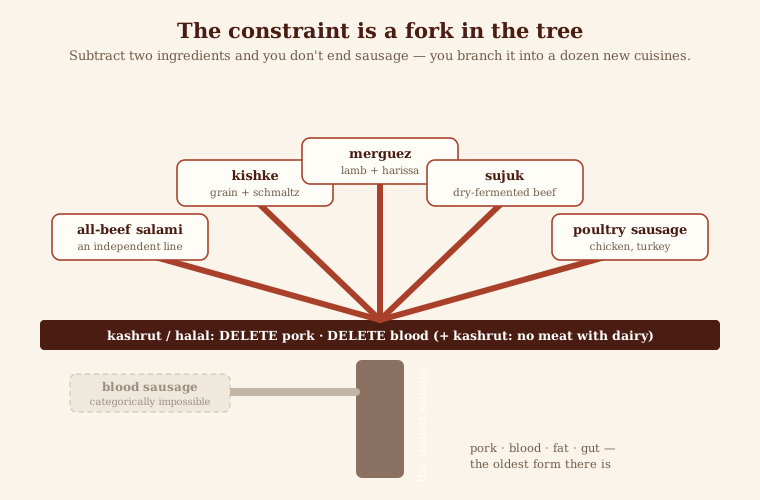
The first constraint: no blood
Start with blood, because it’s the one that reorganizes the whole tree.
The Jewish prohibition is stated flatly and more than once. Leviticus 17:10–14 is the core of it — the text repeats the same reason three times in five verses, which is the biblical way of underlining: the life of the flesh is in the blood. You are not to eat the blood of any creature, “for the life of all flesh is the blood thereof.” This is not a health footnote or a preference; in the text it’s a statement about what blood is. And it has a direct, physical consequence in the kitchen: the meat has to have its blood removed before it’s cooked. The traditional method is kashering — salting and soaking, sometimes broiling, to draw the blood out of the muscle. Salt, pulling water and blood out of meat, is the exact same tool I lean on for preservation; here it’s doing a different job, but it’s the same physics, and I find that satisfying.
The Islamic prohibition lands in the same place from a different text. The Qur’an names blood among the forbidden things in several passages my sources cite together — 2:173, 5:3, and 6:145 — alongside carrion and swine. And the method of slaughter, dhabīḥah, is built around draining the blood: the throat is cut and the blood is allowed to run out. Drained blood is not collected to be eaten; it’s the thing being deliberately removed.
Now put your sausage-maker’s hat on and look at what that does. Blood sausage is not a minor style you can skip. It is the oldest and most fundamental sausage there is — the one that solves the hardest preservation problem, because blood is the single most perishable thing off the animal. You either use it in the first hour after slaughter or you throw it away; there is no middle ground. Every blood sausage on earth, from Homer’s roasting paunch to Polish kaszanka to the Irish black pudding I make, is a race against the clock at the killing floor.
Kashrut and halal don’t restrict that sausage. They delete it. Not “make it differently” — remove it from the category of possible foods entirely. And this is exactly the promise I made back on the origins page: I said that when we got here, the deletion of Homer’s blood sausage would reorganize the whole tree, and this is the moment. The oldest, most preservation-driven, most universal sausage form there is — gone, in one clause of Leviticus and one of the Qur’an. Everything else on this page grows in the hole that leaves.
The second constraint: no pork
Pork is the more famous prohibition, and it’s the more obvious one for sausage, so I’ll keep it tight.
Kashrut permits only animals that both chew the cud and have fully cloven hooves — Leviticus 11, restated in Deuteronomy 14. The pig has the cloven hoof but does not chew the cud, so it fails the test and is out. (So, incidentally, is the camel, which chews the cud but doesn’t have the right hoof — the rule cuts both ways and the pig just happens to be the animal that matters most to a sausage maker.) Halal excludes the pig by the same Qur’anic verses that handle blood — 2:173, 5:3, 6:145 — where swine flesh is named directly.
For sausage, losing the pig is losing the default. The pig is the animal the whole European craft is optimized around: the right fat-to-lean ratio, fat that’s soft enough to emulsify, a docile animal you can keep cheaply and kill in quantity. Take it away and every sausage has to be rebuilt around a different animal — beef, veal, lamb, mutton, goat, poultry. And those animals don’t behave the same. Beef fat is harder and higher-melting than pork fat, which changes how you grind and bind and cook it. Lamb and mutton bring their own strong flavor that has to be worked with, not masked. This isn’t a substitution; it’s a redesign. A kosher or halal sausage maker isn’t making “pork sausage without the pork.” They’re making a fundamentally different object that happens to share a shape.
The third constraint, kashrut only: no meat with dairy
This one is invisible to most people and it’s the one I find most interesting as a maker, because it’s a live technical problem in a modern sausage kitchen — not just an ancient rule.
The source is a single short line, repeated three times in the Torah: Deuteronomy 14:21, and twice more in Exodus, you shall not boil a kid in its mother’s milk. Rabbinic law built that out into a full separation of meat and dairy — they aren’t cooked together, eaten together, or (in a fully observant kitchen) handled with the same tools. For a sausage, the consequence is specific and modern: no dairy binders.
Here’s why that matters at the bench. A huge amount of contemporary sausage-making, especially in commercial and emulsified products, uses non-fat dry milk powder as a binder — it holds water, it holds fat, it firms up the bite, it keeps a hot dog from weeping grease. It is one of the most common tools in the industrial sausage toolbox. And a kosher meat sausage can’t touch it, because milk plus meat is forbidden. So the kosher sausage maker has to hit the same targets — water retention, fat binding, texture — using something else entirely: soy protein, egg, starches, or just a better mechanical emulsion and more care. It’s a real constraint that real people design around today. When I read a kosher hot dog label and see the binder system it uses, I’m not looking at a compromise; I’m looking at somebody solving the same emulsion problem I solve, with one of my favorite tools taken off the table. That’s a harder problem than mine, and they solved it.
Halal has no equivalent meat-and-dairy rule, which is worth stating plainly so I don’t blur the two traditions together — they overlap on pork and blood, and they diverge here. That divergence is exactly why kosher and halal sausages, though they start from a similar deletion, don’t end up in the same place.
What grew in the hole: kishke
Now the good part — the sausages that exist because of the cut, not in spite of it. Start with the strangest and most instructive one.
Kishke — spelled kishka in a lot of American-Jewish kitchens — is Ashkenazi stuffed derma, and it is a sausage that has quietly thrown away the meat. The casing is beef intestine (that’s what “derma” means — the gut). But the filling is not a meat emulsion at all. It’s matzo meal or flour, schmaltz — rendered poultry or beef fat — onion, and spices, packed into the casing and roasted or simmered, often right alongside a cholent or a brisket so it takes up the drippings.
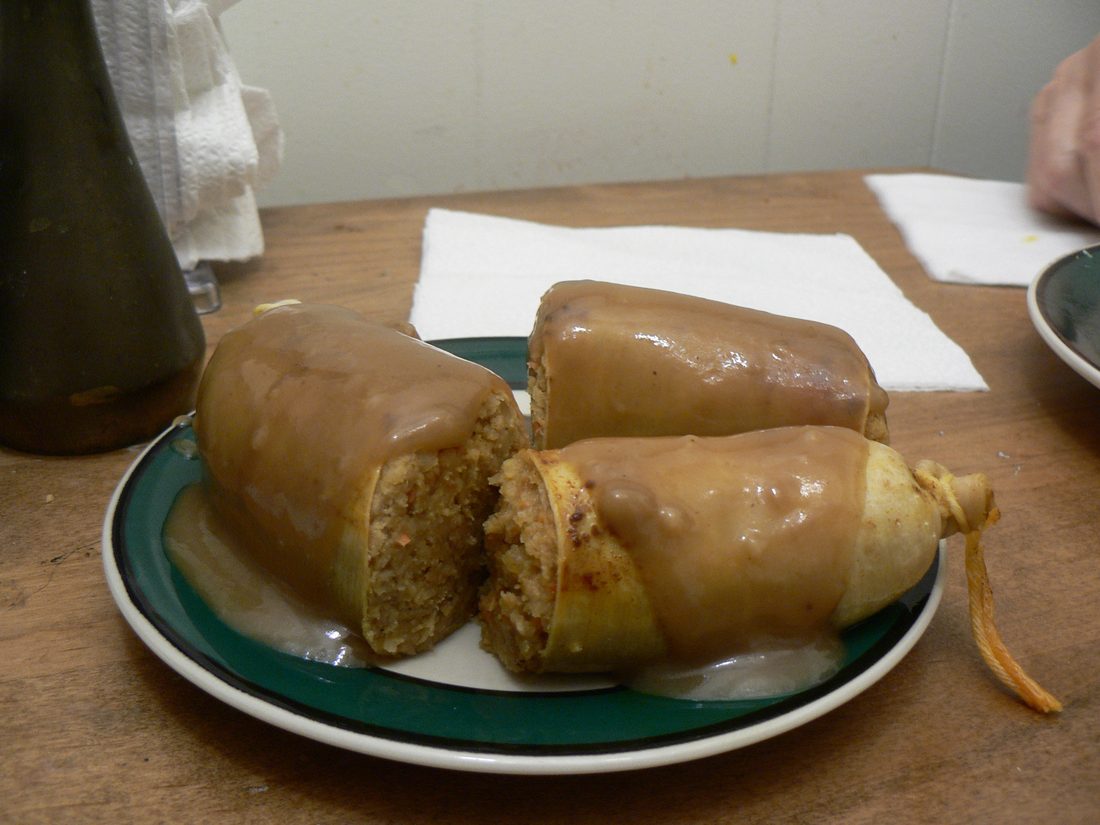
Sit with that for a second, because it’s a beautiful piece of constraint-driven design. When you can’t fill a gut with blood and you can’t fill it with pork, and beef is expensive and lean and doesn’t emulsify like pork, what do you reach for? You reach for what’s cheap and abundant: grain and fat. Kishke is the sausage reconceived as a starch-and-schmaltz delivery system rather than a meat product. It keeps the entire architecture of a sausage — the casing, the stuffing, the poaching or roasting, the slicing — and swaps out the one thing we think of as the whole point. It’s the sausage as a vehicle, and what it carries is bread and fat. I love it precisely because it proves that “sausage” was never really about the meat. It was about the form — the stuffed, cooked, sliceable gut — and the form survived even when the filling changed completely.
The name is worth a note, because it ties this page back to the last one. Kishke is a Slavic word for “gut” or “intestine” — the casing named the food. And if you read the Poland and the East page, you already met its cousin: Polish kaszanka, which American-Polish families call kiszka, is a grain-bound blood sausage — buckwheat and pig’s blood in a casing. Same Slavic root, gut, sitting under both words. Now watch what the constraint does. The Polish kiszka and the Ashkenazi kishke start from the same shared world, the same word, the same idea of a grain-filled gut — and kashrut splits them. Take the blood and the pork out of kiszka and you get kishke: same grain-bound stuffing, same casing-word, but now it’s matzo meal and schmaltz instead of buckwheat and blood. Two sausages, one name, forked apart by a dietary law. That’s the fork in the tree made about as literal as it gets — two foods that are etymologically the same object, driven into two cuisines by what one of them was allowed to contain.
One detail on modern kishke I want to flag honestly, because I’ve seen it stated with more confidence than it deserves. You’ll read that natural beef-intestine casings have been effectively barred in the United States since 1958 — a post-war USDA rule — which is why so much American kishke today is made in synthetic casing or just baked in a loaf pan with no casing at all. The loaf-pan version is real and common; that part’s not in doubt. But the specific 1958 date rests on a single source, and I couldn’t run it back to the rule itself, so I’m not going to hand it to you as a fact. What I’ll say for certain is the shape of it: at some point American food-safety regulation made beef-casing kishke harder to make, and the tradition adapted by moving into synthetic casings and loaf pans — which is the same guild-and-regulation story from the medieval page, just wearing a 20th-century American face. Regulation reshapes the sausage; it doesn’t end it.
What grew in the hole: kosher all-beef salami
The next one is the one most Americans have actually eaten, and the framing on it is the whole point.
Because pork salami is off the table, Ashkenazi communities built an all-beef salami — cured, seasoned, fermented and dried on the same principles as any dry sausage, but never with a gram of pork. In 20th-century Jewish America it became a deli cornerstone; Hebrew National and its competitors put a kosher all-beef cured sausage into ordinary grocery cases nationwide, and a hard salami hanging in a Jewish deli is as much a fixture as the pastrami.
Here’s the framing I insist on, and it’s the reason this sits on a page about invention rather than restriction: kosher beef salami is not an imitation. It is not “salami, but they had to use beef.” It’s an independent cured-sausage line that exists only because the pork version was forbidden, and it developed its own character — its own spicing, its own texture from beef’s harder fat and leaner muscle, its own place in a cuisine. Nobody making a good all-beef salami is apologizing for the missing pork. They’re making a different, complete thing. When I think about the discipline it takes to dry-cure beef well — beef fat is less forgiving than pork fat, the flavor is different, the fermentation has to be managed just as carefully — I have nothing but respect for the makers who turned a prohibition into a category. This is what “the constraint is the mother of the invention” actually looks like on a deli slicer.
What grew in the hole: merguez
Now cross to the halal side of the tree and go to North Africa, because the Maghreb answers the pork question with a completely different animal and a completely different color.
Merguez is a spicy fresh sausage of the Berber and Bedouin world — the Atlas Mountains, the Maghreb — made from lamb or mutton, sometimes beef, and stained a deep brick red by harissa and chili. The Arabic is mirqāz or mirkas. It’s fresh, not cured; you grill it hard and fast, and the fat and the chili and the cumin and garlic do the work. If you’ve had it off a North African grill, or in France where the Maghrebi diaspora made it a national street food, you know it — it’s unmistakable, that red coil spitting fat over coals.
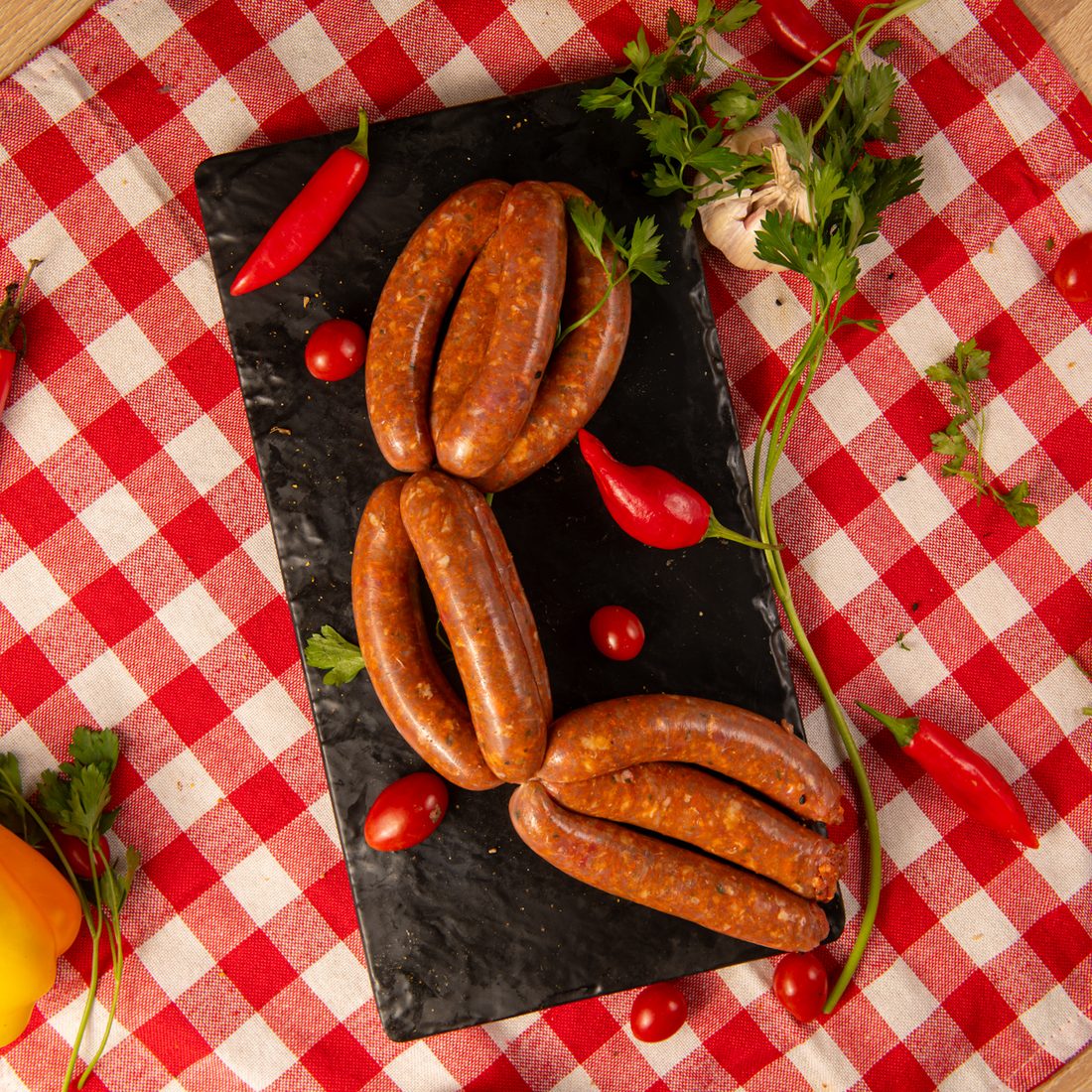
Merguez is about as pure an expression of the thesis as exists: it’s what you make when you herd sheep and you can’t eat pork. The animal is the one the land gives you. The prohibition removes the pig. So the sausage is lamb, and it’s built to flatter lamb — the harissa and the spice aren’t decoration, they’re the design, married to a strong meat that can carry them. Some of the early versions used offal, in the same waste-nothing spirit that drives every good sausage tradition: the sheep is killed, and every usable part goes into a casing. It is halal by its nature — lamb, no pork — not halal as an afterthought.
On the dating I have to be straight with you, because my source is. You’ll see merguez placed in roughly the 12th to 13th century, and that’s the number I’ll repeat — but it’s a weak, secondary date, not something anchored to a dated text. The tradition is solid and the halal logic is solid; the specific century is soft, and I’d rather you know that than carry a confident number that can’t back itself up. If you want to make it — and you should — the recipe collection has merguez to start from, and the thing to get right is the fat: lamb fat is what makes it, so don’t lean it out.
What grew in the hole: sujuk
The last of the born-from-constraint sausages is the one with the best paper trail, and it lets me hand you off to another page.
Sujuk — sucuk in Turkish — is a dry, spicy, fermented sausage that runs across the Turkic world and out into the Balkans, the Middle East, and Central Asia. It’s usually beef; in Central Asia, where the horse is the wealth animal, it’s often horse. It’s cured and air-dried for weeks, heavily spiced with cumin, garlic, sumac, and red pepper, and pressed into its characteristic flattened curve. In any Muslim region it is beef or horse by definition — halal — and pork versions of it exist only where non-Muslim populations make them.
What makes sujuk special for a history page is that it has an unusually early and specific textual anchor. It’s documented in the 11th century by Mahmud al-Kashgari, in his Dīwān Lughāt al-Turk — the great compendium of the Turkic languages. That’s a real, dated, written source from the 1000s, which is earlier and firmer than a lot of the sausage history in this whole section; most of what we’ve covered is either much older but vague (Homer, “ancient”) or much younger and precise. Sujuk sits in a rare spot: early and documented. I’m not going to do it justice here, because it gets a proper treatment on the Balkans and Turkey page, where the whole Ottoman spice line that carried it — and may even have carried the word kiełbasa west — gets the space it deserves. For this page, sujuk is here to make one point: a halal-by-nature, all-beef, dry-fermented sausage isn’t a modern workaround. It’s in the written record a thousand years ago, doing everything a great dry sausage does, with the pig never once in the picture.
The word that survived the constraint
I want to close on a thread that runs underneath this whole page, because it’s the kind of thing that makes me love this history: the meat changed, but the word survived.
Go back to the Rome page for a second. The Roman sausage lucanica seeded sausage-words across half of Europe and the Mediterranean — Italian luganega, Greek loukaniko, Spanish longaniza, Portuguese linguiça, on and on. Two of the descendants land right here, in traditions that deleted the very pork the Roman sausage was full of. Arabic has maqāniq and naqāniq — a mutton-and-semolina sausage whose name comes straight down from lucanica. And Modern Hebrew took the same root: naknik, נקניק, is simply the word for sausage in Hebrew today.
Think about what that means. The Roman lucanica was a pork sausage — pounded pork, plenty of fat, hung in the smoke. The word for it traveled east into the Arabic-speaking and Hebrew-speaking worlds, into cultures where that exact sausage, with that exact filling, is forbidden. And the word made the journey intact even though the thing had to be completely rebuilt on the way. The Arabic maqāniq is mutton and semolina; the Hebrew naknik is beef or lamb or chicken; neither is the pork sausage the Latin originally named. The name outlived the recipe. The vocabulary of the sausage was portable in a way the pork never could be — it slipped across the prohibition that stopped the meat cold.
That’s the whole page in one word, really. Kashrut and halal took the two ingredients the craft was built on, pork and blood, and cut them out. What they couldn’t cut out was the idea of the sausage — the stuffed, cooked, sliceable, portable, waste-nothing form — and the word that named it. So the idea and the word crossed the line, and on the far side they grew a new set of branches: kishke’s grain and schmaltz, all-beef salami, merguez’s lamb and harissa, sujuk’s fermented beef. Not fewer sausages. More cuisines. The constraint didn’t prune the tree. It made it fork.
I said at the top that subtraction is the more powerful engine, and this is why. Addition gives you variety within a form. Subtraction — a hard rule that removes the foundation and forces everyone to rebuild from something else — gives you whole new forms, arrived at by people who had to think their way past a wall the rest of us never hit. As an engineer of stuffed guts, I can’t think of a higher compliment than that. These traditions were handed a harder version of my problem and they solved it so completely that the solutions became beloved foods in their own right, eaten by millions who never think about the deletion that created them. That’s not a limitation. That’s the best kind of invention there is.
This is the last page of the old-world history of sausage — the place where a rule reorganized the whole family tree. Head back to the sausage hub to see how all of this fits together, or to the family tree for the shape of it in one view; the deleted branch this page is built around gets its own treatment in blood and offal. And where the sausage went next — out past the old world entirely, into the Americas, Asia, and beyond — is the wider-world history.
Comments (0)