The Nordics and Baltics: Banking the Animal Against Winter
Every sausage is a preservation machine — I said that on the origins page and I meant it as the through-line of this whole history. But the farther north you go, the less that idea is a metaphor and the more it is arithmetic. In the far north the winter is long, the growing season is short, and the animal you slaughter in the fall has to feed you through months when nothing grows and nothing can be raised. So the sausage stops being a nice way to use up the trimmings and becomes the plan — the way you take a whole pig or a side of beef and turn it into food that will still be food in March.
That is the logic that ties this page together, and it explains why the northern sausages lean so hard on the same short list of tools: smoke, salt, blood, and grain. Smoke and salt do the keeping. Blood gets used because it spoils within hours and you cannot afford to waste it. And grain — rye, barley, potato — goes in because in a lean climate the meat is precious and a cheap starch stretches it across more meals and more mouths. A Mediterranean sausage can afford to be all pork and fat and paprika. A northern one, historically, could not. It had to make the animal go further.
I keep my own cold chain at 30°F because I have a refrigerator and a chest freezer and a probe thermometer, and I still treat the whole process as a race against the meat warming up. Strip all my instruments away and stand me in Sweden or Finland or Lithuania four hundred years ago, and the instinct is exactly the same one: get the animal cold, get it salted, get it smoked, get the perishable parts used now, and build something that will keep. The gear changed. The problem did not. These northern sausages are that problem, solved by hand, in the cold, generation after generation.
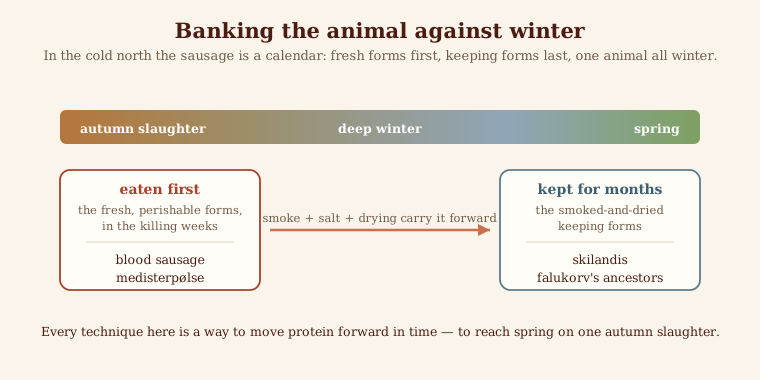
Let me take four of them, because between them they cover the whole northern method: a Swedish sausage whose famous origin story turns out to be folklore, a Finnish blood sausage that is the pride of a whole city, a Lithuanian keeper built to survive a season, and a Danish-Norwegian Christmas sausage that the research on my desk frankly can’t tell me enough about — so I won’t pretend otherwise.
Falukorv: the copper mine, the ox hides, and the ropes that may never have existed
Start with falukorv, because it is the most famous northern sausage and it comes with the most beautiful origin story I know, and I have to do that story honestly, which means telling you it is probably not true.
Here is the tale as it is told. In the copper mining town of Falun, in central Sweden, the great Falun copper mine ran for centuries — it was one of the most important industrial operations in early modern Europe, and at its height it supplied a huge share of the continent’s copper. Down in a mine you need rope, and lots of it, for hoisting ore and men and water. The story says the miners made their hoisting ropes from ox hides, cut into strips and twisted — leather rope being stronger and more forgiving in a shaft than the vegetable-fiber rope of the day. And that left a lot of ox meat with nowhere to go. So — the story continues — the leftover ox meat was salted and smoked into a sausage, and that sausage became falukorv, the “Falun sausage.”
It is a wonderful story. It has everything: heavy industry and thrift, a named place, a clean cause-and-effect, hides going one way and meat going the other. And it is exactly the kind of story I have learned to distrust, because the tidiness is the tell. Real food history is almost never that clean.
So I went looking, the same way I went looking for the Sumerian sausage tablet on the origins page and couldn’t find it. And here is what the honest state of the question is: the oxhide-rope origin is not documented to any solid standard. The core sentence of the story, on the very Wikipedia page where most people read it, carries a [citation needed] flag — which is the encyclopedia’s own way of admitting that nobody has produced a source. It is a tradition, repeated widely and told with confidence, but it is folklore, not established fact. I am not going to state it as history, because it isn’t, and a page that can’t tell a source from a good story isn’t worth your time.
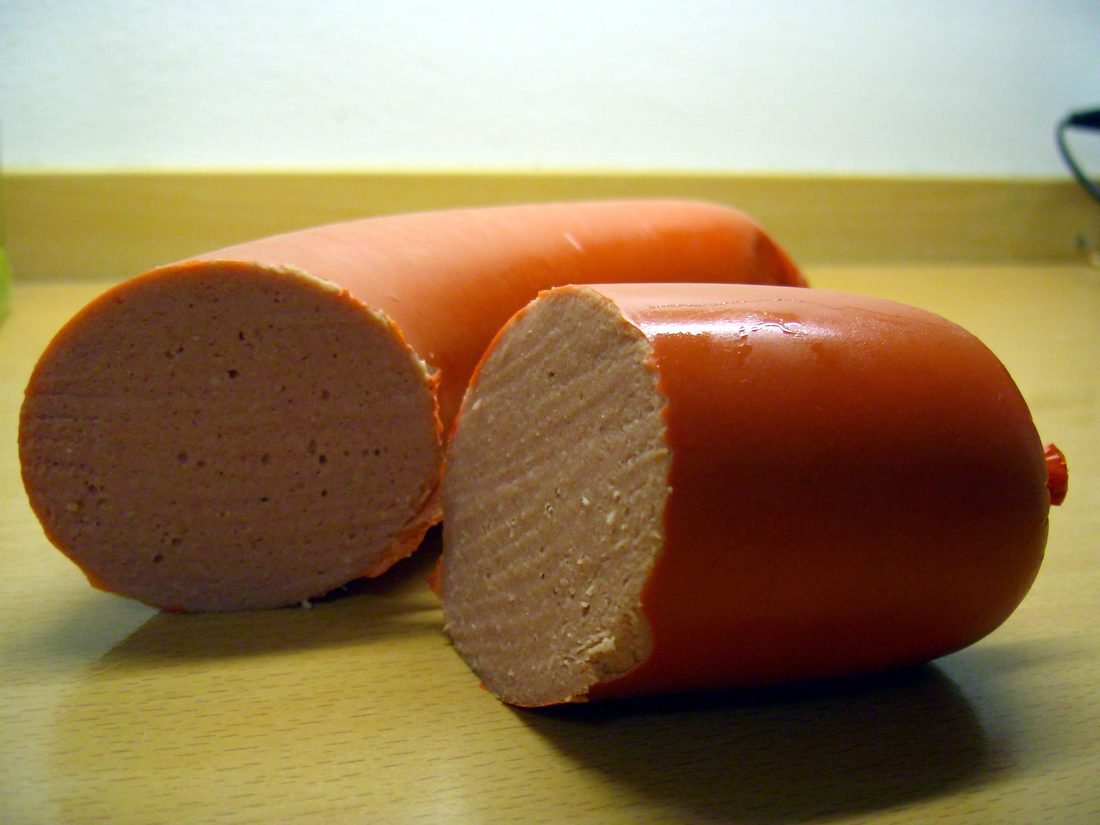
What is better supported is quieter and less romantic. Falukorv appears to descend from the Lyoner type — a German-style scalded emulsion sausage, a Brühwurst in the classification scheme I lay out on the Germany page, where finely ground meat is worked into a smooth batter and then cooked so it sets into that springy, sliceable bind. And the plausible route by which a German sausage type reached a Swedish mining town is the same route by which a lot of technical knowledge reached Falun: German miners. Germans were central to the technical workforce at the Falun mine for a long stretch of its history, and where the miners went, their food went with them. That is a weak-to-medium claim — it is stated across sources but not nailed to a primary document — but it is a lot more credible than the rope shop, because it doesn’t require a special just-so mechanism. It just requires people bringing their sausage with them to work, which is what people always do.
And then there is the part we actually know, which is modern and documentary and solid:
- The modern falukorv — the pork-and-beef (or veal) sausage you buy today — was standardized by a butcher named Anders Olsson in the late 1800s. That is the sausage in the Swedish refrigerator case, and it is a nineteenth-century product, not a sixteenth-century one.
- “Falukorv” was legally protected in Sweden in 1973. The name means something specific under Swedish rules.
- It now holds EU Traditional Speciality Guaranteed (TSG) status — the same kind of recipe-and-name protection that Polish kabanosy carries, which I get into on the Poland page. The TSG spec is strict about a couple of things in particular: only potato flour may be used as the binder — no other starch — and there is a minimum meat content.
On that minimum meat content I have to flag a genuine disagreement, because the sources don’t agree and I’m not going to paper over it. Some put the floor around 40%, others around 45%. That is a real conflict in the material I have, not a rounding difference, and the honest move is to say so: the minimum is somewhere in the low-to-mid forties, and if you need the exact figure you should pull the EU TSG specification itself rather than trust a secondary source.
So here is falukorv, told straight. The oxhide-rope tale is a good story with a citation-needed tag hanging off it — enjoy it as tradition, the way you’d enjoy any campfire origin, but don’t file it as fact. The documented falukorv is a Lyoner-descended scalded sausage, probably carried to Falun by German miners, standardized by a named butcher in the late 1800s, protected in Sweden in 1973, and TSG-registered with a potato-flour-only binder and a meat floor in the low forties. That’s less romantic than the ropes. It’s also true, and true is better.
There is a nice technical footnote in the potato-flour rule, and it’s the kind of thing a maker notices. Potato starch as a binder in an emulsion sausage isn’t an accident of thrift — it’s a good functional choice. It gels at a lower temperature than wheat or cornstarch, it’s neutral in flavor, and it holds water well in a scalded batter. That the rule insists on potato flour and forbids the rest tells you this was a place where potato was the cheap, abundant starch — which it was across the north — and where the sausage tradition wrote its local agriculture right into the legal spec. The extender isn’t a compromise the rule tolerates. It’s part of the definition.
Mustamakkara: blood, rye, and the pride of a whole city
If falukorv is the northern emulsion sausage, mustamakkara is the northern blood sausage, and it is about as pure an example of the cold-climate logic as you could ask for. The name is Finnish and it means, plainly, “black sausage” — musta, black; makkara, sausage — and the black is the blood.
It comes from Tampere, in the Finnish interior, and calling it “a local specialty” undersells it. Mustamakkara is the pride of Tampere, a genuine civic food, sold hot from stalls at the city’s market halls — the Kauppahalli and the Laukontori market square — the way you’d expect a city to sell something it’s actually proud of. People make trips for it. It is a sausage with a hometown, and the hometown is loud about it.
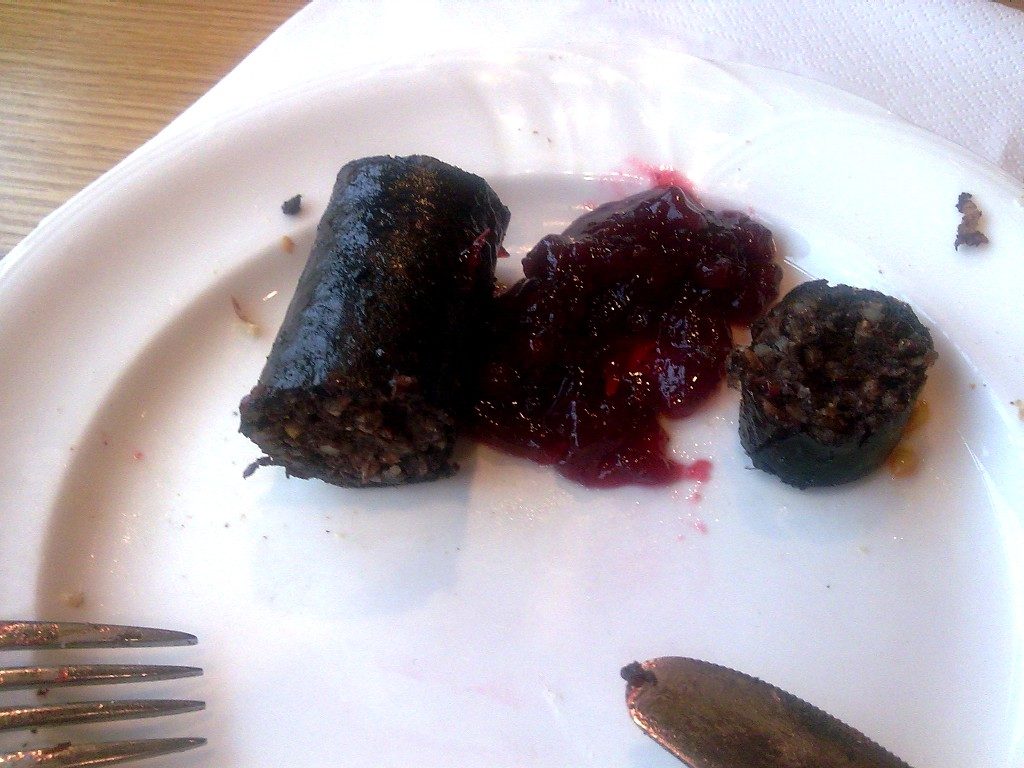
The build is the northern method in one casing. Pork and pig’s blood — that’s the black — mixed with crushed rye and flour, stuffed into intestine. Look at what that recipe is doing. The blood is the most perishable thing that comes off a slaughtered animal; it clots within hours and is useless the moment it does, so a blood sausage is by definition a now food, made in the hours around the killing or not at all. That’s the same timing that governs Polish kaszanka and Irish black pudding and every other blood sausage on earth — you make it at the slaughter, because there is no other time to make it. And the rye is the grain extender doing exactly the job I described up top: stretching a precious animal across more servings with a cheap northern grain, while also giving the sausage body and a coarse, hearty texture that a pure-blood sausage wouldn’t have. Blood plus grain plus intestine casing: a cold-climate, grain-extended, whole-animal sausage in one line. It’s a textbook.
The eating is where mustamakkara gets its signature, and it’s the detail everybody remembers. You eat it hot, and you eat it with lingonberry jam — the tart, bright red northern berry preserve — smeared right alongside the dark, mineral, iron-heavy sausage. That sweet-savory pairing is the whole thing. The lingonberry cuts the richness and the metallic edge of the blood the way a good tart accompaniment always does, and it’s such a fixed part of the dish that a mustamakkara without lingonberry would read as incomplete to anyone from Tampere. If you’ve ever eaten black pudding with something sweet — apple, brown sauce, a fruit chutney — you already understand the instinct. The north just made it lingonberry and made it non-negotiable.
On dates I’ll be careful, because the research is careful. Mustamakkara — or blood sausage of this general type — has been eaten in the region since around the 16th century, with industrial production arriving in the 19th, and today big producers like Tapola and Savupojat turn it out at scale. I’ll flag one honest hedge in there: it isn’t perfectly clear whether that “16th century” pins mustamakkara specifically or blood sausage in the region generally, and the difference matters if you care about firsts. Either way, the point that matters for this page holds solidly: a blood-and-grain sausage has fed the Tampere region for centuries, and it’s still the thing the city is proudest to hand you hot off a stall with a spoonful of red jam.
There’s a broader thing worth saying here, and it connects back to Homer’s paunch of fat and blood on the origins page and to the whole blood and offal branch of the family. Blood sausage is the oldest, most preservation-driven form there is, and it survives most stubbornly exactly where the preservation pressure was highest and the thrift ethic ran deepest — which is the cold north. Mustamakkara isn’t a quaint regional oddity. It’s the base-layer sausage, the one closest to the original problem, still being eaten with pride in the kind of climate that made it necessary in the first place.
Skilandis and kindziukas: one keeper, two names
Now cross the Baltic to Lithuania, for the sausage that is the northern keeping logic taken to its logical extreme — and, as a bonus, for a lesson we’ve already learned once on the Poland page and are about to learn again.
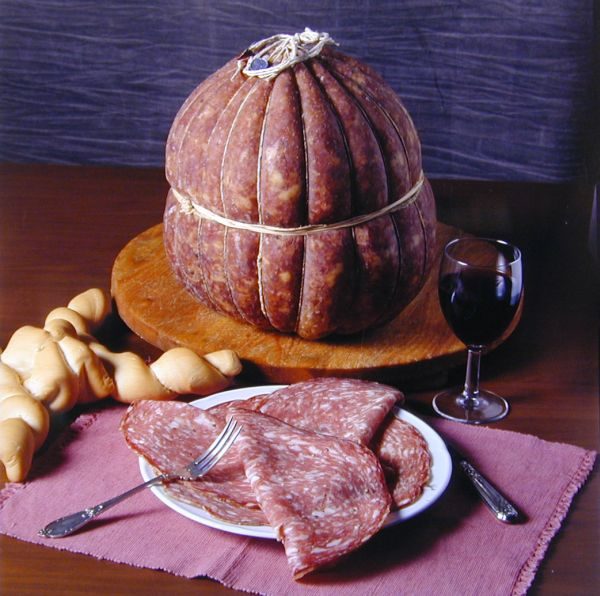
The sausage is skilandis. It’s pear-shaped and big — not a link, not a ring, but a fat rounded object — and it’s built from coarsely chopped pork and beef with bacon fat worked through it, seasoned with garlic and pepper. The casing is the giveaway that this is a serious keeper: not a slim intestine but a pig’s bladder or a cow’s cecum, a big natural pouch that holds a large mass of meat. And then comes the process, which is where you see the whole northern method compressed into one product:
- Cold-smoked for around 15 days. Not a quick hot smoke to cook it — a long, cool, patient smoke that lays down antimicrobial phenols and slowly dries the surface over the better part of two weeks.
- Then air-dried for two to three months. After the smoke, it hangs and loses water for a season, its water activity dropping until bacteria simply can’t work in it.
Read that schedule as a maker and you see what it is: a big casing so there’s a large keeping-mass inside, a long slow cold smoke to build the protective, dried, phenol-laden rind, and then months of drying to bring the whole thing down to a shelf-stable water activity. It is engineered — by tradition, by trial and error over centuries — to survive. This is the sausage you make in the fall and cut into in the deep of winter, the physical embodiment of banking the animal against the cold months. It dates to at least the 16th century, and today it carries EU Protected Designation of Origin (PDO) status, which — unlike the TSG that protects falukorv’s recipe anywhere — ties genuine skilandis to its Lithuanian region of production. It’s also carried on Slow Food’s Ark of Taste as a tradition worth keeping alive. A big casing, a long cold smoke, a long dry: everything about it says keeper.
And now the lesson, because it’s the same one that anchored the whole Poland page. This exact sausage — this pear-shaped, cold-smoked, long-dried Lithuanian keeper — goes by another name too: kindziukas. Not a different sausage. A different word for the same object, a dialectal variant. If you learned one name you might reasonably think you’d found two products; you haven’t. You’ve found one thing wearing two names.
I keep returning to this because it is one of the deepest, most repeated patterns in the whole old-world story, and popular food writing keeps tripping over it. On the Poland page it was the big one — kiełbasa isn’t a sausage, it’s the word for sausage, a whole category flattened by Americans into one ring in a grocery case. Here in the Baltics it’s skilandis and kindziukas, one keeper under two names. And when we get to the Balkans and Turkey it’ll be the biggest version of all — one Turkic dried sausage, sujuk, surviving almost unchanged as sucuk and sudžuk and soutzouki and half a dozen more across an entire continent’s worth of languages. Every time, the mistake is the same: someone reads a name and thinks they’ve found a distinct thing, when what they’ve actually found is the same object seen through a different language’s window. A name is not a thing. Skilandis and kindziukas are one sausage. Hold onto that, because you’re going to meet it again.
Medisterpølse: the honest gap
I want to end this page with one where I don’t have enough, because pretending otherwise would betray the whole point of doing this history carefully.
Medisterpølse is a fresh, spiced, minced-pork sausage — the skin taken off, the meat cooked or fried — and it’s a Danish and Norwegian staple, associated especially with Christmas, where it’s a fixture of the holiday table. That much is well known and I’m confident in it: a fresh (not cured, not dried) pork sausage, seasoned and cooked soon, eaten as a family and festive food across Denmark and Norway, most beloved around the winter holidays.
But here is where I have to be straight with you: the research I have on medisterpølse is thin. The dossier this page is built from found only passing confirmation of it — the dedicated search came back nearly empty — and firm dates and origin detail simply aren’t in front of me. So I’m going to do the thing I’d want any honest writer to do, which is tell you its well-known character and then stop, rather than invent a lineage or a date to make the section feel complete. I could dress this up with a confident-sounding history. It would be padding, and some of it would probably be wrong.
What I can say fits the page’s logic cleanly, and it’s worth noticing precisely because medisterpølse is the counterweight to everything else here. Skilandis and mustamakkara and falukorv’s ancestors are the keeping forms — smoked, dried, or blood-based, built to survive months. Medisterpølse is the fresh form, the sausage you make from the same slaughtered pig and eat soon, in the killing weeks, before the long preservation even begins. In the “bank the animal against winter” schedule at the top of this page, medisterpølse sits at the front — the fresh eating that comes right off the slaughter, while the smoked and dried keepers get hung up for later. Both are part of the same whole-animal, whole-winter plan. One is what you eat now; the other is what you save. That’s a real and useful place for it in this story, and it’s as far as I’ll take it without better sources.
What the north teaches
Put the four together and the northern chapter of the sausage story reads clearly. Falukorv is the scalded emulsion, a German type that took root and became Swedish, its romantic mine-rope origin dissolving under a look while its real nineteenth-century history holds up fine. Mustamakkara is the blood-and-rye base layer, the oldest form, still the proud civic food of a Finnish city and still eaten the way it’s always been eaten, hot with a spoon of lingonberry. Skilandis is the extreme keeper, a big pouch cold-smoked for two weeks and dried for a season, built for nothing but survival — and reminding us, under its second name kindziukas, that one sausage often wears many.
And medisterpølse is the fresh one, the front of the schedule, the meal you eat off the slaughter before the saving begins — and the reminder that sometimes the honest thing is to say what you don’t know.
Underneath all four is the same engine I run at my own bench, just under harder constraints than I’ll ever face. Get the animal cold. Salt it. Smoke it if it needs to keep. Use the blood now, or don’t use it at all. Stretch the precious meat with the cheap local grain. Hang the big keepers where the air moves and let time and dropping water activity do the work. I do all of that with a thermometer and a chest freezer and a full refrigerator behind me. The north did it because the alternative, for a very long time, was not making it to spring. That’s the thing to carry off this page: the northern sausage isn’t a curiosity. It’s the preservation machine of the origins page running at full pressure, in the cold, exactly where the winter made the machine matter most.
Part of the old-world history of sausage. This page’s “one thing, many names” lesson — skilandis and kindziukas — was born on the Poland and the East page, and it reaches its fullest form next, in the Balkans and Turkey, where a single Turkic sausage survives under a dozen names across a whole continent. For the blood-sausage thread that runs through mustamakkara, see blood and offal; for how all of these fit together, the family tree.
Comments (0)