France: A Licensed Profession, and the Word That Means Three Different Sausages
Here is the thing that took me a while to understand about French sausage, and it reorganizes everything once it clicks: in France, sausage was never really folk craft. Everywhere else in this old-world tour, you get a farmer, a pig, a knife, and a tradition handed down a valley — and the law shows up late, if it shows up at all, to write down what the folk were already doing. France ran it the other way. In France a law came first and built the profession, and the profession then built the sausages. The man who made your cooked pork was a licensed tradesman working inside a legal box drawn for him by a royal charter, and the box shaped the craft the way a mold shapes a casting.
I made peace with this because I work from a book — Ruhlman and Polcyn’s Charcuterie, which sits on my bench with the spine cracked and the pages fanned with pork fat — and that book is, when you get down to it, a modern licensing board in paper form. It tells me what a saucisson sec has to be, what a boudin noir has to be, where the line runs between one French pork thing and the next. When I make Toulouse or Morteau-style or rosette, I’m not improvising a peasant tradition. I’m working to a spec somebody wrote down, and the whole reason there is a spec is that French charcuterie grew up under people whose job was writing specs.
I’m not going to re-litigate the guild story here, because it has its own page and it’s a good one — how the Paris charcutiers got their 1475 charter, and how being told they could sell cooked pork but not raw meat drove a whole profession straight into technique. Go read that first if you haven’t; it’s the foundation this page sits on. What I want to do here is show you the products that regulatory spine produced, and then spend most of the page on the single best teaching example in all of sausage: the word andouille, which today names three completely different sausages on two continents, and which trips up nearly everyone who says it.
The regulatory spine, and why French sausages come with borders
Before the products, the one idea to carry through the whole page. When a profession is defined by law — when there’s a charter saying who may make the thing and what the thing must be — the sausages that come out the other end tend to be legally defined objects rather than loose regional habits. They have edges. They have rule books. And that instinct, born in a medieval Paris guildhall, never died; it just changed jurisdiction and became the EU’s protected-name system, the PDO and PGI stamps you’ll see on the good stuff today.
You’ll feel this the moment you try to make these sausages honestly. A Cumberland sausage is a shape and a spirit — coil it, spice it heavy, you’ve got the idea. But a Saucisse de Morteau is a legal document with a smokehouse, a wood species, a minimum smoking time, and a wooden peg attached, and the second you can’t meet one of those clauses you are, by the rules’ own logic, making something else. That’s not French snobbery. That’s the guild logic — who, what, where — still running seven hundred years later. Keep it in mind as we walk the products, because it’s why I keep having to say “-style” about my own versions instead of claiming the real name.
Saucisse de Toulouse: the plainest sausage in the tradition, and that’s the point
Let me start with the one that has the least to prove, because it teaches something by being humble. Saucisse de Toulouse is a fresh, coarse, mild pure-pork sausage from the southwest of France — coarsely chopped pork, salt, pepper, sometimes a little garlic, a little wine, stuffed into a wide casing and left long, not twisted into tight links. It shows up on the Toulouse markets from the eighteenth century, and it is the backbone of cassoulet, that slow bean-and-meat casserole of the southwest that I would put near the top of the list of dishes worth building a winter afternoon around.
What I love about Toulouse is that it is deliberately, almost stubbornly plain. No cure, no fermentation, no smoke, no long spice list, no paprika, no chili. It’s coarse pork and seasoning and that’s the whole story — the sausage stripped back to what a sausage fundamentally is before anyone gets clever with it. Ruhlman and Polcyn’s version is a lesson in restraint: get good pork with the right fat ratio, keep everything cold, grind it coarse so you can see the grain, season it so the pork is still the loudest thing in your mouth. That’s it. If you can’t make a good Toulouse you can’t make a good anything, because there’s nowhere to hide — no smoke to cover a mistake, no cure tang to distract you, no chili to bury a bland grind. It’s the sausage that shows you whether your fundamentals are sound.
When I get to Spain and Portugal, I’ll put Toulouse next to the Catalan botifarra, because they’re cousins in the same key — the plain, fresh, unpaprika’d pork sausage of the western Mediterranean, the “before” picture in a region that a New-World ingredient was about to redraw. Hold Toulouse in your head as that baseline: this is what a fresh pork sausage is when nobody has smoked it, cured it, or spiced it into a regional flag. Everything else on this page is a departure from it. Want to make one? Start at /recipes/?q=toulouse.
Saucisse de Morteau: the sausage that needs a building
Now a departure in the other direction — a sausage so tied to a specific place and a specific machine that I can’t honestly claim to make the real thing, and I’ll tell you exactly why.
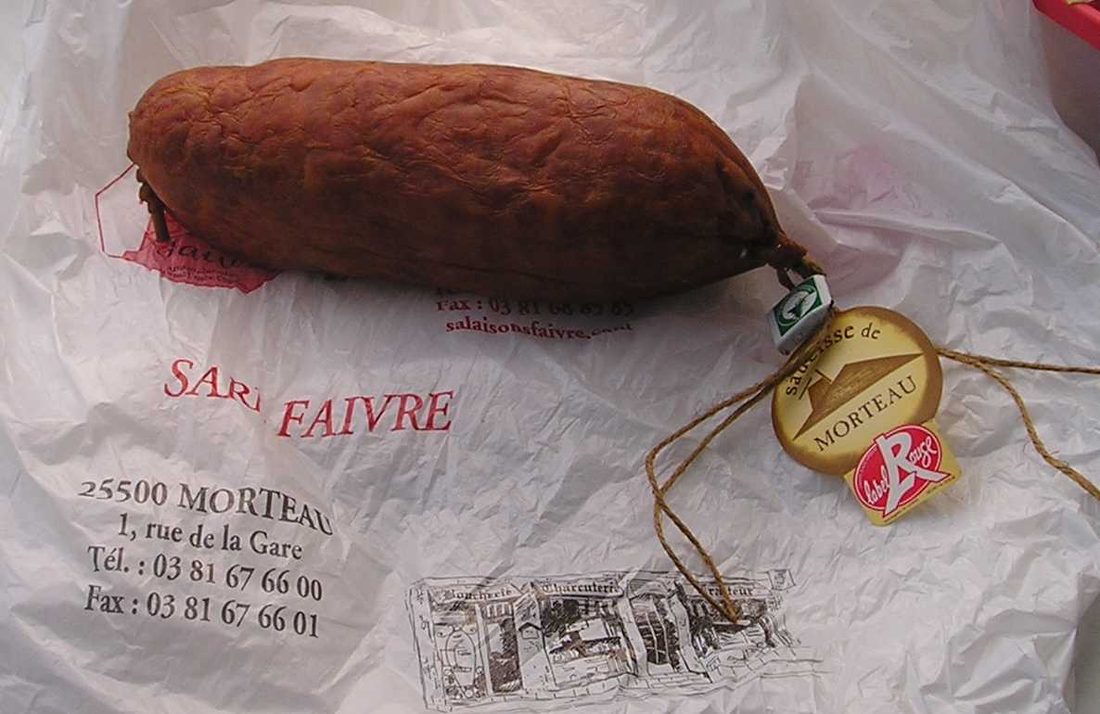
Saucisse de Morteau comes from the Franche-Comté, the Jura and Doubs country up against the Swiss border, and it is defined not by a spice but by smoke — a particular smoke, made in a particular building. That building is the tuyé: a giant pyramidal farmhouse chimney, a smokehouse the size of a room, twelve to fifteen meters tall — call it forty to fifty feet — that appeared in the region in the sixteenth century. Picture a farmhouse whose entire upper structure is one enormous tapering smoke hood, blackened inside by centuries of fires, with the sausages and hams hung up in the rising smoke of the household hearth. The tuyé isn’t an accessory to the sausage. The tuyé is the sausage’s reason for existing in that form.
The rules are specific in the way this whole French tradition is specific. A real Morteau is cold-smoked for at least forty-eight hours over conifer sawdust — spruce and fir — with juniper thrown in, which is a resinous, aromatic smoke very different from the fruit-and-hardwood smoke most of us reach for. It’s sealed at one end with a wooden peg — a cheville — and string, and that little wooden dowel poked into the end of the sausage is the authenticity mark you look for, the visible signature that says this came out of a tuyé, not a cardboard box. It got PGI protection in 2010, and production is fenced to the Jura and Doubs, traditionally the higher ground above six hundred meters.
Here’s where I have to be straight with you, and it’s the honest ceiling on this one. A true Morteau isn’t just a smoking technique I could copy. The pigs matter — the real thing runs on the whey-fed pigs of the Franche-Comté, animals raised on the by-product of the region’s cheese-making (this is Comté and Morbier country; the whey has to go somewhere, and for centuries it went into the pigs). That whey-fed pork, that resinous conifer-and-juniper smoke, that specific building — I have none of the three in Michigan. I can cold-smoke a sausage. I can even scrounge some juniper. But I cannot make a Morteau, and anyone selling you a “homemade Morteau” recipe that pretends otherwise is skipping the part that makes it what it is.
So what I make is a Morteau-style sausage, and I call it that on purpose, for exactly the reason this whole page is about: the name is a legal object with a place and a pig and a building attached, and I’ve got none of them. What I can do is chase the spirit — a hearty smoked pork sausage, cold-smoked long and slow over the most resinous wood I can justify, sealed and hung — and be honest that the spirit is what I’m after and the letter is out of reach. That gap between what I can do and what the real thing requires is, weirdly, my favorite thing about making this sausage. It keeps me honest about the difference between a technique and a place.
Rosette de Lyon: the dry-cured saucisson
Swing over to Lyon, France’s great food city, for a completely different discipline — not fresh, not smoked, but dry-cured, which is the hardest and most patient corner of the whole craft.
Rosette de Lyon is a large dry-cured saucisson: pork, sea salt, whole or cracked peppercorns, garlic, stuffed into a wide beef bung — the largest casing that comes off the animal — and hung to cure and dry for about a month. The name comes from the color, that deep rose of a good cured-pork cut, and from the rosy face of a slice when you cut into it. It’s in the same family as saucisson sec, which I make regularly and which is on my short list of the most satisfying things you can do with pork, a knife, salt, and time.
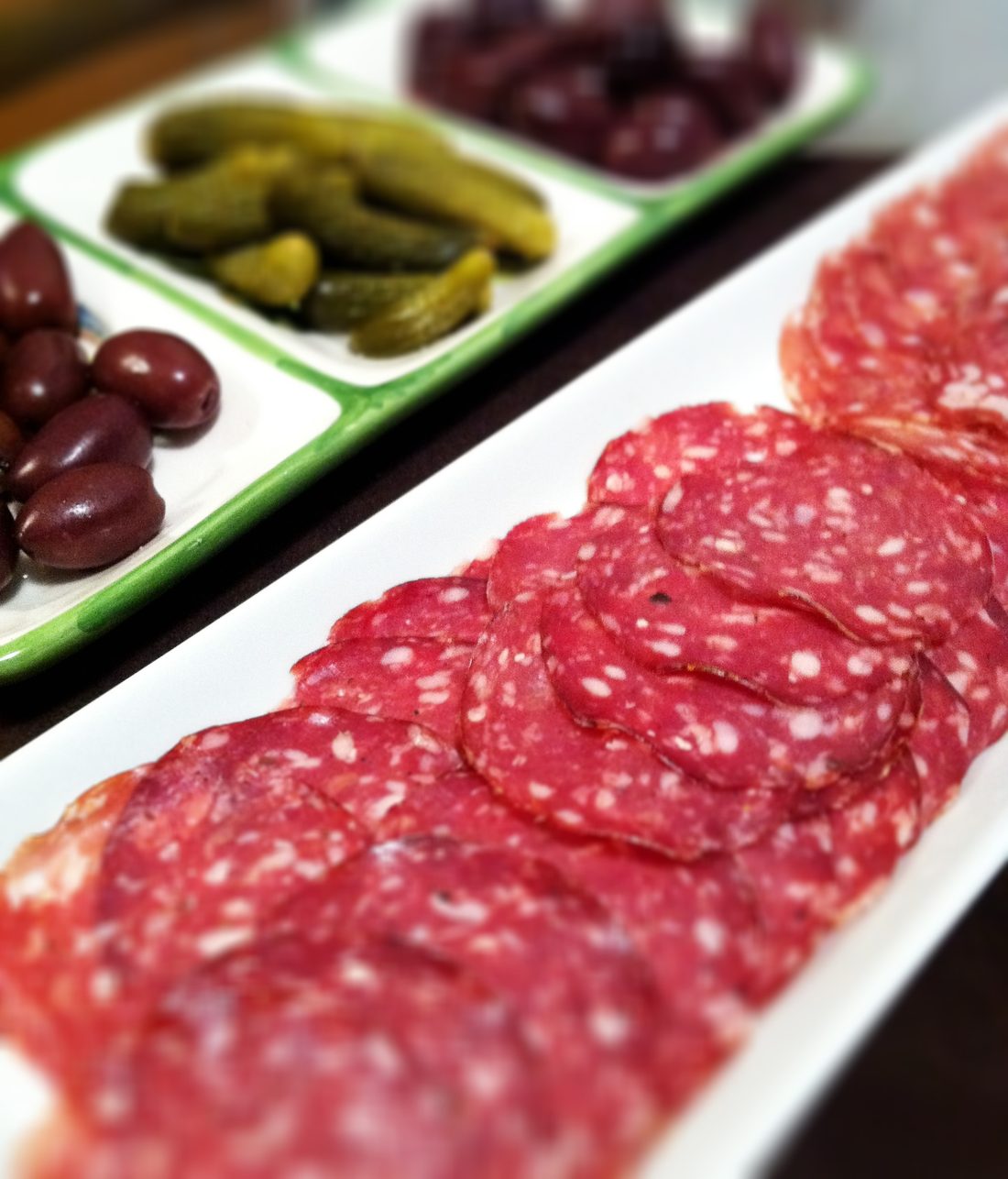
I’ll keep this one short because dry-curing is a whole discipline that lives in the science pages of this dive, not here — the water-activity math, the fermentation, the mold, the slow controlled loss of moisture that’s the real preservation mechanism (it’s water activity, not “dryness,” that keeps you safe, and 30 to 40 percent weight loss is how you know you’re getting there). What matters for this page is that rosette is another card in the same French deck: a specific cut, a specific casing, a specific cure, a specific place. The beef bung is doing real work — a big, slow casing gives you a big slow cure and a bigger, rounder slice than the skinnier saucissons. That’s the whole personality of the thing: patience at scale.
If you want to try the cured French style, start at /recipes/?q=saucisson and read the science before you hang anything — dry-curing is the one place in sausage-making where a shortcut can actually hurt you.
Boudin noir: the French blood sausage
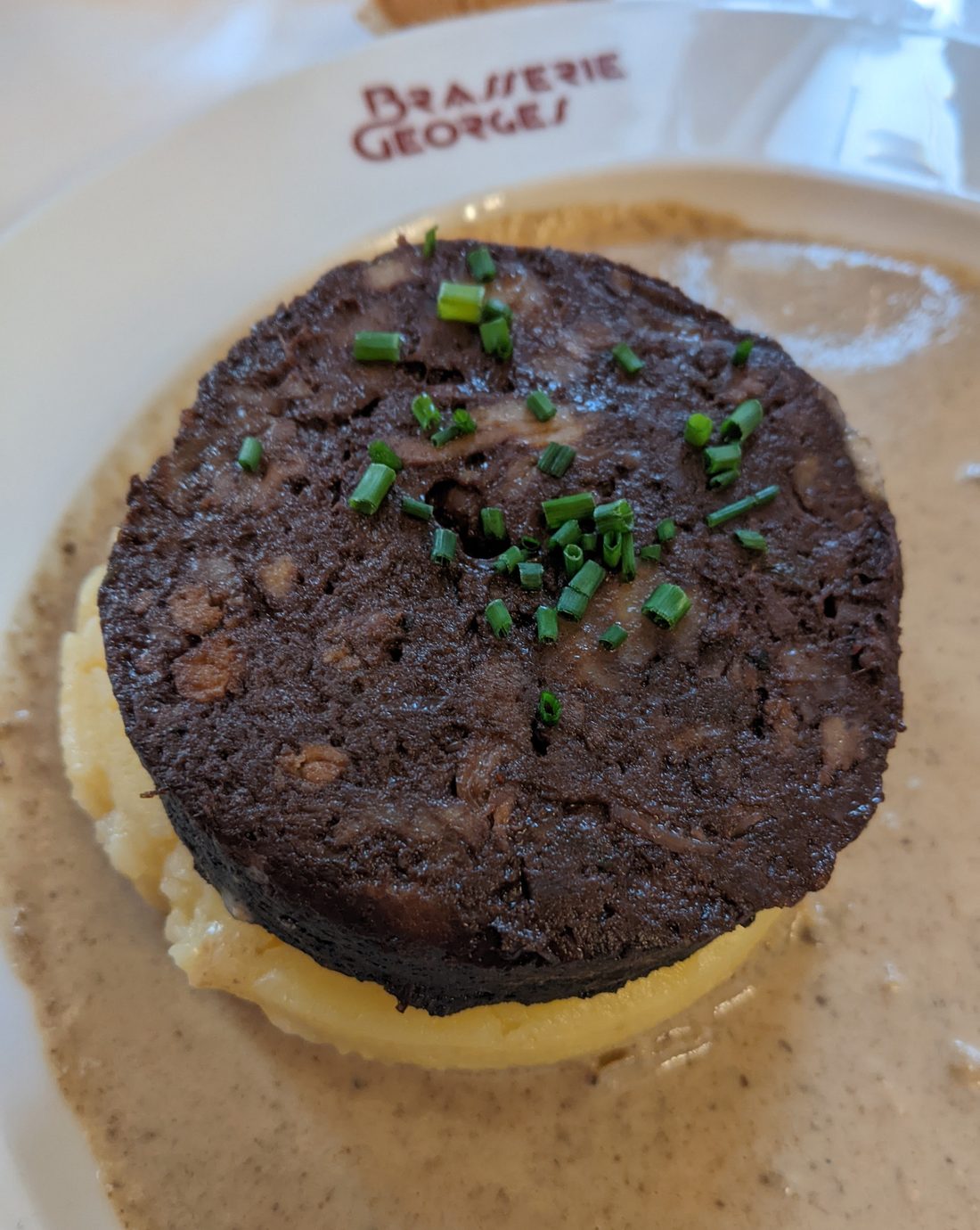
I’ll keep boudin noir brief here too, because blood sausage has its own home in this dive and I’d rather point you there than repeat it. Boudin noir is the classic French blood sausage — pork blood, pork fat, and seasonings, often with onions cooked down soft, and in some regions apples, which is a combination worth sitting with because the sweetness of cooked apple against the iron of the blood is one of the great pairings in all of charcuterie. It’s an old form, one of the oldest — the blood sausage is the crudest, most preservation-driven sausage there is, the one that uses the single most perishable part of the animal within hours of slaughter or not at all (that’s the very first sausage in Western literature, Homer’s paunch full of fat and blood roasting on a fire — a blood sausage in everything but the name).
The whole blood-and-offal family — boudin noir, the Spanish and Portuguese morcillas, the British and Irish black puddings, and the Cajun boudin that is a different animal again — gets its proper treatment on the blood and offal page. Make one at /recipes/?q=boudin, but read that page first: working with fresh blood has its own rules and its own short clock.
The centerpiece: one word, three sausages, and a correction almost everyone needs
Now the reason this page exists. If you take one thing from all of French sausage history, take this, because it’s the cleanest example I know of how a single word can fool everyone into thinking three unrelated things are the same thing.
The word is andouille, and it comes down from Low Latin inductilia, from the verb inducere — “to lead into, to put in.” That’s a beautiful etymology for a sausage, when you think about it: the andouille is, at root, the stuff that was led into the casing, the filling introduced into the gut. (It’s the same instinct as the Roman farcimen from farcio, “to stuff” — the sausage named for the act of stuffing it. Half the sausage words in Europe are just some language’s way of saying “the stuffed thing.”) One root, inducere. And from that one root, three sausages grew up that share almost nothing but the name.
Here they are side by side, because this is exactly the kind of collision a table is built for:
| French andouille (de Vire, Normandy) | Andouillette (Troyes / Lyon) | Cajun andouille (Louisiana) | |
|---|---|---|---|
| What’s in it | Tripe and chitterlings — pig intestine and stomach, coarsely layered | Coarse chitterlings and pork stomach | Pork shoulder — coarse-ground muscle meat |
| The gut | Is the sausage (offal-forward, rustic) | Is the sausage (offal-forward, pungent) | Dropped entirely — kept the word, lost the guts |
| Smoke | Cold-smoked | Usually not smoked | Heavily smoked, often twice |
| Served | Cold, sliced, showing its layered rings | Hot, and famously, powerfully pungent | Hot, in gumbo, jambalaya, red beans |
| Documented | Vire’s fame asserted, not firmly dated | Troyes documented 1590 | Perfected late-19th/20th c. |
| Protected by | Regional tradition | The AAAAA (since 1970) | Louisiana custom (LaPlace) |
| Lineage | French offal craft | French offal craft | French word, partly German technique |
Walk them one at a time.
1. French andouille (andouille de Vire)
The original. French andouille, most famously the andouille de Vire from Normandy (Brittany and Guémené have their own), is a tripe-and-chitterling sausage — pig intestine and stomach, cut and coarsely layered so that when you slice it cold you see concentric rings, the layered guts in cross-section. It’s cold-smoked and eaten cold, sliced thin, and it is proudly, unmistakably offal. This is not a muscle-meat sausage that happens to be in a gut casing; the guts are the meat. It’s rustic in the deepest sense — a sausage built entirely out of the parts a squeamish cook throws away, transformed by cutting, layering, salting, and smoke into something you’d put on a board with cheese and cider. Very Norman: apple country, cold-smoke country, use-the-whole-animal country.
2. Andouillette: the little one you eat hot
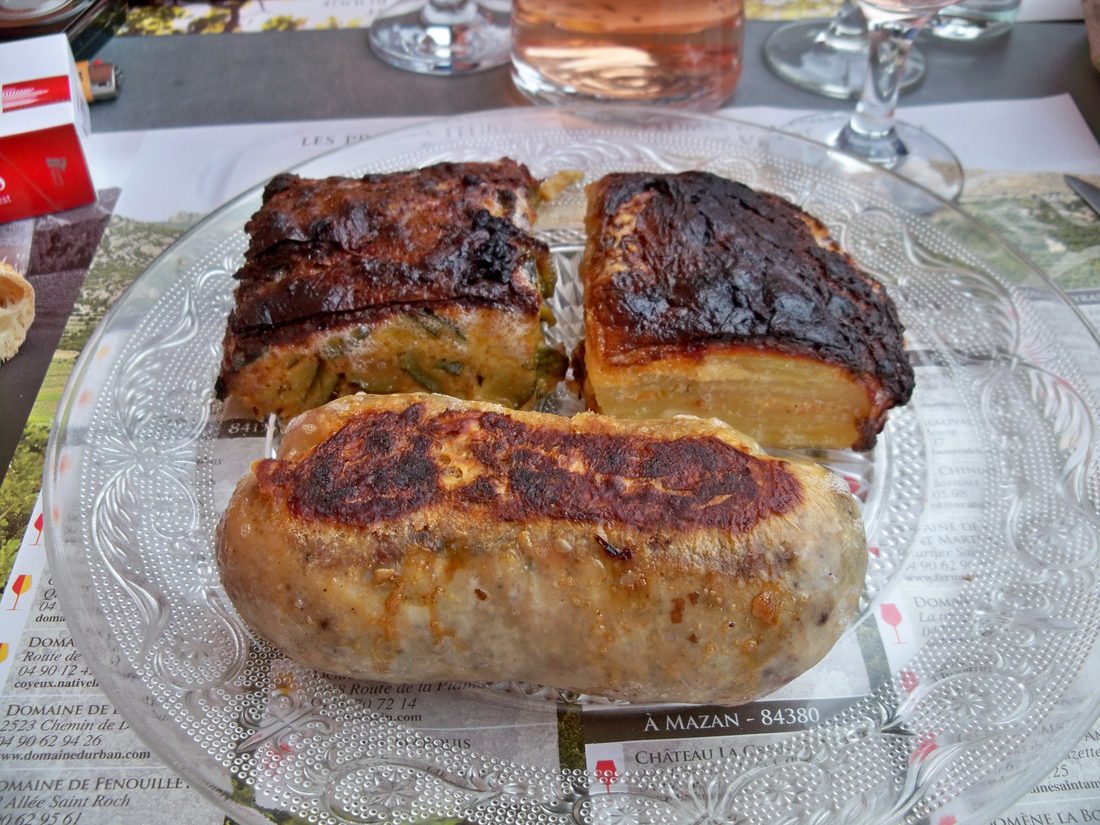
The andouillette — literally “little andouille” — is the andouille’s hot-served cousin, and it is the one with the reputation. Associated above all with Troyes in Champagne and with Lyon, it’s a coarse chitterling and pork-stomach sausage, and unlike the andouille it’s eaten hot, griddled or grilled, and it is famously pungent. This is the sausage that gets described in words I won’t fully repeat here — it smells and tastes emphatically of what it’s made of, and the French who love it love it precisely for that barnyard intensity, while plenty of French people can’t get near it. It’s a genuine love-it-or-flee-it food, and there’s no middle. Troyes andouillette is documented from 1590, and it’s protected and promoted today by one of the great institutions in all of food: the AAAAA — the Association Amicale des Amateurs d’Andouillette Authentique, the “Friendly Association of Lovers of Authentic Andouillette,” founded in 1970, whose five-A quality mark on a menu tells you a real one is coming.
I want to flag one honest gap here, because the brief I worked from and the sources behind it agree on it and I’d rather tell you than fake it: I could not find a trustworthy, standard formula for what percentage of an andouillette has to be chitterling versus stomach versus other pork. You’ll see numbers thrown around online. I don’t trust any of them, and I’m not going to synthesize one for you and pretend it’s a rule, because a made-up percentage in a sausage this specific is exactly the kind of confident-sounding fake fact this whole dive exists to not do. If you want to make one, work from a real charcuterie source and know going in that the “official ratio” you may have read is probably somebody’s guess dressed up as law.
3. Cajun andouille: the word crossed the Atlantic, the sausage didn’t
And now the correction, the payoff, the whole reason I made you read the etymology.
You will hear — I have heard it many times, I’ve probably half-believed it — that Cajun andouille is just French andouille that crossed the Atlantic. Same word, French Louisiana, French colonists, case closed. It’s wrong. It’s one of those explanations that’s tidy and satisfying and completely misses what actually happened.
Cajun andouille is a coarse, heavily smoked pork-shoulder sausage. Read that again next to the table: it is made of muscle meat — pork shoulder, ground coarse — and it is not a chitterling sausage at all. It kept the French word and dropped the French thing. The offal identity that defines both the andouille de Vire and the andouillette — the tripe, the chitterlings, the guts as the main event — is simply gone from the Louisiana version. What’s left is the name and a general idea of “coarse, smoky, rustic pork sausage.”
And here’s the part that makes it a genuinely great story instead of just a correction. The Cajun andouille we know — the intensely peppery, double-smoked one that goes into gumbo and jambalaya and red beans and rice — was perfected by German immigrant butchers in LaPlace, Louisiana, a town on the Mississippi that still calls itself the andouille capital. The peppery heat and that characteristic double smoke are a German boucherie inheritance, not a French one. So the honest genealogy of Cajun andouille is: a French word, wrapped around a pork-shoulder sausage that owes its defining technique to German butchers working in a French-Louisiana place. Three cultures in one link, and the tidy “it’s just French andouille that emigrated” version erases two of them.
I care about this one more than the average correction, and I’ll tell you why: I have six Cajun andouille recipes in my own collection. I make it, I love it, it’s in heavy rotation, and it is nothing like an andouille de Vire — I’ve never put a chitterling in one and never will. So when I say the name collision matters, I mean it matters at my own bench, where “andouille” means a smoky pork-shoulder sausage for the gumbo pot and has meant that my whole cooking life. The Cajun branch is a whole story of its own — the German butchers, the LaPlace tradition, the double smoke, how it sits in the Cajun and Creole kitchen — and it gets its full treatment in the wider-world section, where the sausages that left Europe and became something new all live. Here, on the French page, the point is narrower and sharper: same word, different sausage, partly German lineage. Don’t let the shared name fool you into thinking they’re the same food. They share a spelling and almost nothing else.
If you want the Louisiana version — the one I actually make — it’s at /recipes/?q=andouille. Just know that you’re searching for the great-grandchild of a French word, not a French sausage.
What I take from all this to my own bench
I make French sausage in Michigan from a book, with a grinder and a smoker and no charter and no guild anywhere in sight, and you might reasonably ask what a fifteenth-century Paris licensing scheme and a Norman tripe sausage have to do with a Tuesday grind day. More than you’d think. Two things from the French tradition sit at my bench every time.
The first is the discipline of the defined object — the guild instinct, still running. French charcuterie taught the world that a sausage becomes a real, repeatable thing the moment somebody writes down what it has to be: this cut, this casing, this cure, this place. It’s why I can open Ruhlman and Polcyn and make a saucisson sec that is actually a saucisson sec and not just “a dry sausage I felt like making.” And it’s why I’m careful to say Morteau-style instead of Morteau — because I respect that the real name is a legal object with a pig and a building and a smoke I can’t reproduce, and calling my version by the protected name would be a small lie. The French tradition trained me to know the difference between honoring a spec and counterfeiting a stamp.
The second is the andouille lesson, which is bigger than one sausage. It’s a warning about how much a name can hide. Three sausages, one word, and the word actively misleads — it tells you they’re related when two of the three share basically nothing but an etymology and a spelling. That’s the whole reason this deep dive keeps stopping to say actually, here’s what’s true: because food is full of these collisions, where a confident-sounding shared name papers over a completely different reality. Kielbasa is just the Polish word for sausage. Spanish and Mexican chorizo are different categories, not variants. And Cajun andouille kept a French word while quietly becoming a German-influenced pork-shoulder sausage on the Mississippi. Learn to hear the name and then ask but what is it actually made of, and who actually made it what it is — and half the myths in food history fall apart in your hands, which is a better sausage education than any single recipe.
That’s France: not a folk craft the law caught up with, but a licensed profession the law brought into being, whose sausages still carry borders because the people who invented them thought in borders. A Toulouse you can make anywhere and a Morteau you really can’t; a rosette that’s all patience and a boudin noir that’s all speed; and one small word, inducere, “to lead into,” that led into three different casings on two continents and fooled almost everyone about what came out.
The whole sprawling family of sausage — how France fits with Italy and Spain and Germany, and how the Cajun branch grew from that French word — is laid out on the family tree. And the guild history under all of it, the 1475 charter and the profession it built, is right here if you skipped it.
Part of the old-world history of sausage. Next: Spain and Portugal — where one New-World ingredient, pimentón, walks off a ship after 1493 and redraws the entire Iberian sausage map, and where the plain fresh pork sausage you just met as Toulouse shows up again as the Catalan botifarra, the “before” picture in a region about to turn red.
Comments (0)