Poland and the East: Kielbasa Is Not a Sausage
Let me start this one with the correction, because it’s the whole page and it’s personal. My grandfather made Polish sausage, and the smell of it cooking is the reason I’ve spent forty years at a grinder. So I have some standing to tell you the single most repeated mistake in American sausage vocabulary:
Kielbasa is not a sausage. It’s the word for sausage.
Kiełbasa is simply the Polish noun for “sausage,” full stop. “Polska kiełbasa” means “Polish sausage” — a whole category, the way “American cheese” is a category and not a specific block. In Poland, if you ask for kiełbasa, you’ve asked for essentially nothing; you have to say which one, out of dozens. The specific object that Americans point to when they say “kielbasa” — the U-shaped, smoked, garlic-forward ring in the grocery cold case — is in Poland one named variety among many: kiełbasa wiejska, the farmhouse ring, most likely, but it could be a dozen others. Calling that ring “kielbasa” is like flying to Italy, pointing at one specific salami, and calling it “sausage” as if that were its name. It’s not wrong exactly. It’s just the category standing in for a member, and it hides how big the category is.
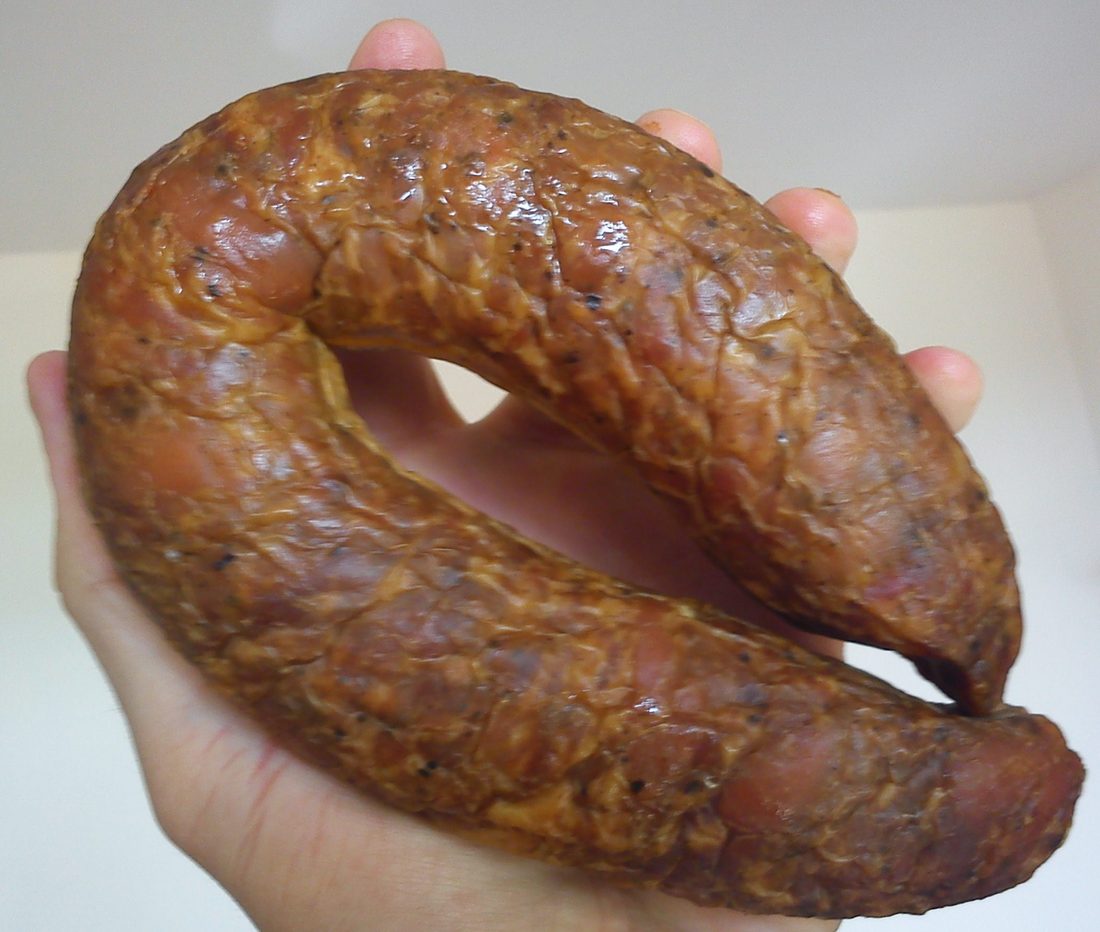
Once you know that, the Polish shelf opens up, and it’s enormous.
The real Polish sausages
Here are the ones worth knowing by name, because each is a genuinely distinct product and not a synonym for the ring.
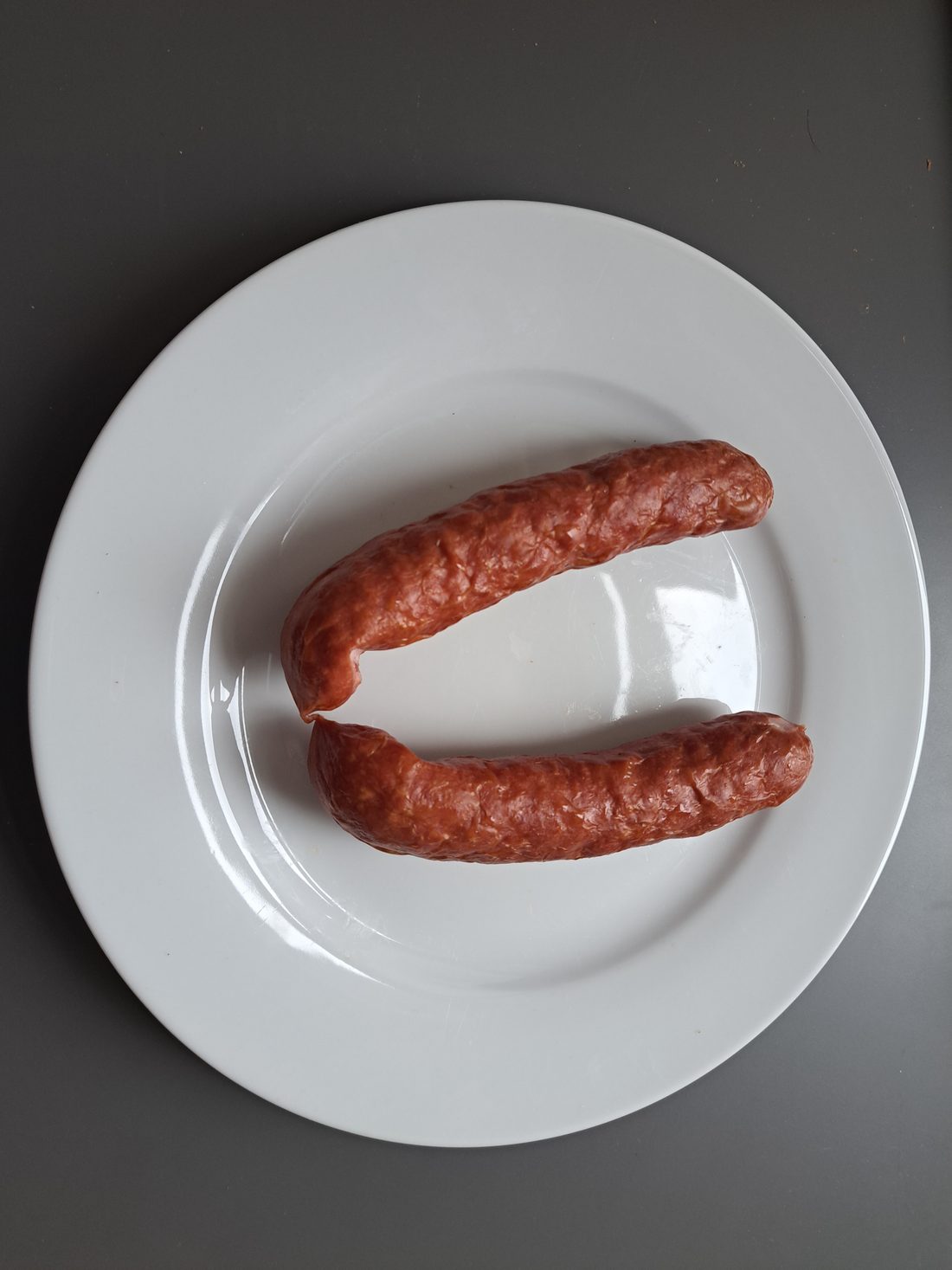
Kabanos — the pencil. Long, sometimes two feet, barely a centimeter thick, dried and smoked hard, folded double, snapped off like jerky. The name comes from the Turkic kaban, “hog.” Kabanosy got EU Traditional Speciality Guaranteed protection in 2011, and the registration is a good story in itself: Germany, Austria, and the Czech Republic all objected, because thin smoked snack sticks are made all across that region and nobody wanted to concede the name to Poland. Poland won the name — but TSG protects the recipe and the word, not the geography, so a German butcher can still legally make “kabanosy” to the spec. The fight tells you how mobile these sausages are; the border between “Polish” and “not” is a legal line drawn across a continuous tradition.
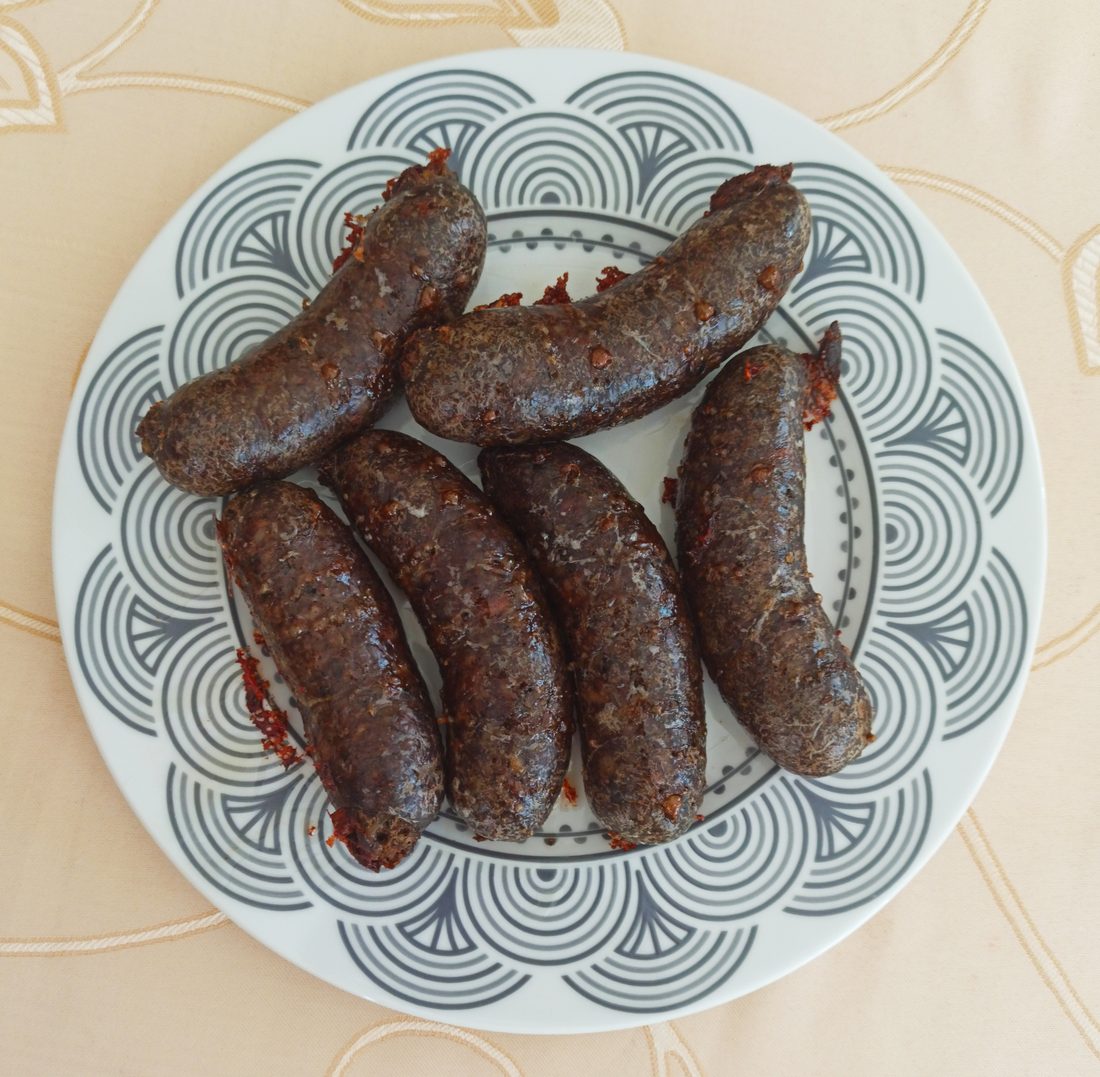
Kaszanka, which many American-Polish families call kiszka — the blood sausage. Pig’s blood and offal, bound with buckwheat (sometimes barley), onion, marjoram, black pepper, in a natural casing. This is a grain blood sausage, cousin to the German Blutwurst mit Graupen and to the Irish black pudding I make — the filler tells you the country, and in Poland the filler is buckwheat. It was historically made at the świniobicie, the home pig slaughter, in the few hours when fresh blood was available. That timing is the whole logic of blood sausage everywhere: you make it now, at the killing, or you don’t make it at all.
Myśliwska — “hunter’s sausage,” lightly smoked and dried pork sticks scented with juniper, built to keep in a coat pocket through a day in the woods. Given how much of my own collection is wild game, this is the Polish sausage I feel most kinship with — a keeping sausage designed by and for people who spend the cold months outdoors.
And then the long tail, each a real named thing: krakowska, the Kraków cold cut; biała, the fresh white sausage that goes into Easter żurek; jałowcowa, another juniper one; lisiecka, which carries its own regional protection. Dozens more. A category, not a sausage — which is the point I’ll keep making, because it’s the thing the American cold case flattens.
Where the etymology actually comes from — which is to say, nobody’s sure
I like to give you the honest state of a question rather than a confident guess, and the origin of the word kiełbasa is a genuinely open one. English took it straight from Polish, and Polish inherited it from Proto-Slavic *kъlbasa. But where Slavic got it is unsettled, and the two leading candidates are both interesting:
- From Turkic kül-bastı, roughly “pressed” or “grilled” — which would fit the pattern of Turkic food words moving into Slavic and Balkan languages, the same current that carried sujuk and ćevapi west.
- From Hebrew kolbasar, “all flesh,” supposedly via medieval Jewish butchers — which would be a lovely thread tying back to the kosher tradition, if it’s true.
You’ll also see a confident “it means hand-pressed” going around. That’s a third folk guess dressed up as fact. The truth is the deep etymology is uncertain, and I’d rather tell you that than pick the prettiest option and pretend it’s settled. A history that launders guesses into facts isn’t worth your time.
The sausage crossed the Atlantic, and it landed near me
Here’s how the Polish ring got from a village smokehouse to my grandfather’s kitchen, and it’s documented history, not sentiment.
Polish mass immigration to the United States ran from roughly the 1870s to the First World War, and it poured into the industrial Midwest — the mills and the auto plants. In metropolitan Detroit the anchor was Hamtramck and the old Poletown, and the magnet was work: when the Dodge Main plant opened in Hamtramck in 1910, Poles came for the jobs in enormous numbers. At its peak, Hamtramck was something like three-quarters Polish. This is not a small footnote to American food history; it’s one of the densest transplantations of a European foodway onto American soil that ever happened, and it happened in Michigan, which is where I am.
What kept the sausage alive on this side of the ocean was the parish and the butcher. The Archdiocese of Detroit founded St. Florian — named for the patron saint of Poland — in 1907, and its great neo-Gothic church became the gravity well of the neighborhood. Around a church like that grows an ecosystem: the parish hall, the Polish-language Mass, the corner market, the butcher who makes his own smoked ring, the deli where you buy kielbasa and pierogi on a Saturday. That ecosystem is why Polish sausage in America stayed a living food and didn’t become a museum piece. Places like Bozek’s market still smoke their own rings today. And the single strongest ritual anchor is Easter — the Święconka, the basket of food blessed at church on Holy Saturday, in which a coil of kielbasa sits beside the eggs and the bread as a matter of course.
That is the world my grandfather’s kielbasa came out of. I’ve written the whole story of trying to reverse-engineer it — the years, the sense memory, the smell out of the church door — on the forty years page, so I won’t repeat it here. But there’s one detail that belongs on this page, because it’s a piece of Polish sausage history hiding in a family recipe: Grandpa boiled his. He didn’t smoke it. That plain simmer is exactly what threw the smell across the street on a Sunday morning, and it’s the older, more home-and-parish way — a fresh or lightly-cured kielbasa, poached, eaten soon. The smoked keeping-ring that the American grocery sells is the market form of Polish sausage; the boiled home version is the kitchen form, and my grandfather made the kitchen form. When I chose to smoke my own version of his recipe, I wasn’t correcting him — I was moving it from the kitchen tradition into the smokehouse tradition, both of them genuinely Polish, both of them real.
The “kielbasi” wrinkle, and why it’s charming
One last small thing, because I’m from a part of the country where you hear it. In a lot of American-Polish communities — heavy around Pittsburgh and the Great Lakes — people say “kielbasi,” as if it were the plural or the natural form: pass the kielbasi. It isn’t standard Polish grammar; it’s a diaspora colloquialism, a word that drifted a little on the boat and settled into a new shape in the neighborhoods. I love it precisely because it’s wrong in the way living language is wrong — it’s the sound of a word being owned by the people who eat the thing, three generations after anybody in the family last stood in Poland. That’s what a diaspora does to a food and its name. It keeps them, and it changes them, and both at once.
The rest of the East — the Balkans, the Baltics, the Ottoman spice line that seeded half of it — gets its own pages. But Poland is where the category is biggest and the correction is sharpest, and, for me, it’s where the whole thing started: with a word that means “sausage,” a grandfather who boiled his, and a smell I’ve been chasing ever since.
Part of the old-world history of sausage. See also Germany — the neighbor with the classification scheme that outclasses the English one — and the Balkans and Turkey, where the Ottoman spice line that may have given “kiełbasa” its name runs. My grandfather’s story is on forty years at the bench.
Comments (0)