Ireland: The Provisions City and the Sausage of the Poor
I’ve already written a whole dive about the Irish breakfast — the full plate, the rashers, the black and white puddings, right down to how I cure my own bacon and where I found frozen blood near the MSU campus to make the puddings myself. So I’m not going to walk you around a plate of eggs and beans again. If you want the breakfast, it’s over there, and it’s thorough.
This page is about the part of Ireland’s sausage identity that isn’t the breakfast — and it turns out to be a stranger, older, more interesting thing than the fry-up. Because before Ireland was a country that ate a cooked breakfast for tourists, it was, for about a century and a half, the place that killed and salted the meat for half the British Empire. The single most important fact in Irish sausage history isn’t a recipe. It’s a slaughterhouse. And the sausage it produced is one of the most distinctive blood puddings in Europe, made in exactly one city, and almost unknown outside it.
Let me be honest with you up front, the way I try to be on every one of these pages: Ireland’s non-pudding sausage tradition is thin in the written record. If you want a country with a dense map of named regional sausages, each with its own protected status and its own founding legend, that’s Britain next door, or Spain and Portugal, or Germany. Ireland doesn’t have that, and I’m not going to invent it for you. What Ireland has instead is a blood-and-offal tradition rooted in one enormous historical fact — the provisions trade — and one genuinely great civic specialty that came out of it. So that’s what this page is. Quality over a padded regional inventory that doesn’t exist.
Cork was the slaughterhouse of Ireland
Here’s the fact everything else on this page hangs from. From roughly 1680 to 1825, the city of Cork was the beating heart of the international salt-provisions trade — the business of killing cattle and pigs, salting the meat into barrels, and shipping it out to feed navies, merchant crews, plantations, and armies across the Atlantic world. Cork had the harbor, it had the hinterland full of cattle, and it had the timing. When the age of sail needed protein that would survive months in a ship’s hold, Cork sold it by the barrel.
The city earned nicknames that tell you exactly what it was. “The slaughterhouse of Ireland.” The “Ox-slaying City.” These aren’t poetic exaggerations — they’re a job description. At the peak of the trade, Cork’s slaughtering and packing operation was killing animals on an industrial scale that a modern person, standing in the pretty tourist city today, would find hard to picture. Tens of thousands of cattle a season, broken down, salted, and barreled for export.
Now think about what a slaughterhouse that big generates as a byproduct. The valuable cuts went into the barrels for export — that was the whole point, that’s where the money was. But every one of those animals also produced blood, and offal, and tripe, and heads, and trotters, and all the fifth-quarter parts that don’t salt well and don’t ship well and had to be eaten locally, fast, or wasted. And in a working port city, “eaten locally, fast” means eaten by the people who did the killing — the poor.
This is the engine of the whole page, and it’s the same engine that drives blood sausage everywhere, which I keep coming back to across this section: you make blood food now, at the killing, or you don’t make it at all. In Cork, the killing never stopped. So the blood food never stopped either. A city drowning in blood and offal, and a working population that needed cheap protein — that’s not a shortage, that’s a specialty waiting to be born. Cork turned the poor’s leftovers into a civic dish with a name.
That dish is drisheen.
Drisheen: the gelatinous blood pudding that only Cork makes
Drisheen is one of my favorite entries in this whole old-world survey, because it is genuinely unique — not “a regional variation of a thing you already know,” but its own animal. It’s a blood pudding, yes, but if you know black pudding and you expect drisheen to be a Cork accent on the same idea, you’ll be surprised at the first bite. They are built on opposite principles.
Here’s what drisheen is: a blood pudding made from beef and sheep’s blood (sometimes with pig’s blood in the mix), combined with milk, salt, and fat, then boiled, sieved, and filled into casings. Sometimes it’s flavored with tansy, a bitter wild herb, which is a wonderfully archaic touch — tansy is one of those old European kitchen-and-medicine herbs that’s mostly fallen out of use, and finding it in a living recipe is like finding a word from Chaucer still in someone’s mouth.
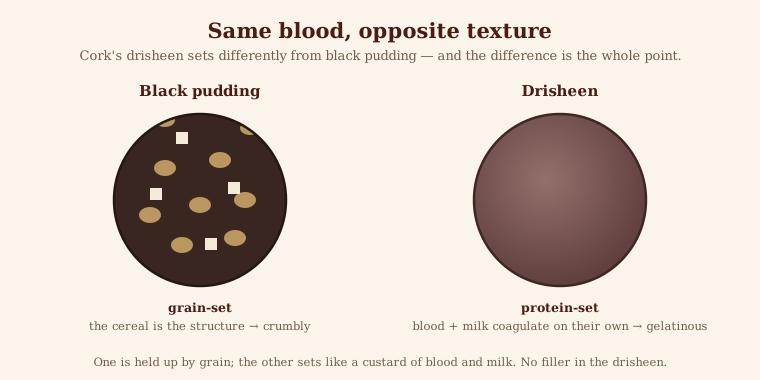
But the thing that actually defines drisheen — the property you’d notice with your eyes closed — is the texture. Drisheen sets gelatinous. Soft, wobbling, almost custardy or jellied, sliceable but yielding. It is emphatically not crumbly.
And that is the whole contrast with black pudding, so let me draw it clearly because the difference isn’t cosmetic — it comes from two completely different setting mechanisms.
| Black pudding | Drisheen | |
|---|---|---|
| Sets via | Cereal grain — oatmeal or barley — swelling and binding | Blood proteins (and milk) coagulating on their own |
| Texture | Crumbly, grainy, holds a firm slice | Gelatinous, soft, wobbling, custard-like |
| Blood | Usually pig | Beef and sheep (sometimes pig) |
| Filler | The grain is the structure | Milk and fat; no cereal doing the load-bearing work |
| Where | All over the British Isles and beyond | Cork, essentially only |
The Polish kaszanka I wrote about, the British black pudding, the German Blutwurst with barley — those are all grain blood sausages. The filler carries the structure; the country is told by which grain. Drisheen throws that whole template out. It doesn’t lean on a cereal to set. It sets on the coagulating proteins of the blood and milk themselves, which is why it comes out jellied rather than grainy. If you’ve only ever had the crumbly grain-set kind, drisheen is a small revelation: same raw material, opposite result, because the physics of the set are different.
Tripe and drisheen, and the English Market
Drisheen has a classic partner, and the pairing is a piece of Cork working-class food history in three words: “tripe and drisheen.” Tripe — the stomach lining, another cheap offal cut straight out of that same slaughterhouse economy — simmered up together with drisheen, often in a milky, peppery broth. For generations this was a genuine Cork dish, poor people’s food that became city people’s food and then became heritage food, the way these things do when a city decides to be proud of what it once ate out of necessity.
The place to see it is the English Market, Cork’s great covered food market, where drisheen was and is sold, and where the tripe-and-drisheen tradition is kept alive by the stalls that still carry it. I haven’t stood in that market myself — I’ve been to Ireland, but I ate my full Irish in Galway, on the other side of the country — so I’m not going to pretend I have a memory of a Cork market stall I’ve never seen. But I can tell you what it represents: a direct, unbroken line from the “Ox-slaying City” of 1750 to a food counter you can walk up to today. The provisions trade is three centuries gone. The blood pudding it created is still for sale.
That continuity is the reason drisheen matters more than its obscurity would suggest. Most food that came out of that kind of industrial-slaughter economy vanished when the industry did. Drisheen didn’t. It’s a fossil of the provisions trade you can still eat.
Blood as identity: Clonakilty and the rest of Cork
Stay in County Cork, because the blood-food theme has a second, more famous chapter — and it’s a modern one that proves the theme is still alive.
Clonakilty, a town in West Cork, has given its name to what is probably the single most recognized Irish black-and-white pudding brand in the world. If you’ve bought Irish pudding outside Ireland, there’s a real chance the label said Clonakilty. And what I find worth sitting with is why a place name became a pudding brand — because it’s the same story as drisheen, one town further along.
There’s actual academic writing on this, on the social and cultural history of blood as food in Ireland and specifically on how it wound itself into local identity around Clonakilty. And the through-line is exactly what we’ve been building: in a place where blood pudding was made because blood was what the poor had, the pudding eventually stopped being a marker of poverty and became a marker of place. A source of civic pride. A thing you’re from. The town’s name on the casing isn’t marketing that got attached to a food from outside — it’s a food that got so bound up with where it came from that the place and the pudding became the same word.
That’s the deeper point about Ireland’s whole blood-and-offal tradition, and it’s why I’d rather give you this than a fake list of regional bangers. Blood food in Ireland is identity food. It started as the cheapest possible protein — the literal runoff of an export slaughter economy, eaten by the people who had nothing better. And it ended up as the thing towns are proud of and put their names on. Drisheen is Cork. Clonakilty pudding is Clonakilty. The poor’s food became the civic emblem. That transformation is the real Irish sausage story, and it’s a good one.
I make black pudding myself, from that dive’s loaf-pan method — which, if you read the Irish Breakfast pages, you’ll know I settled on because most American cooks can get either blood or casings but rarely both. So I come at Clonakilty as a maker who’s had blood on his hands trying to hit the same set. Getting a blood pudding to bind correctly is genuinely hard; getting it to become the pride of a town is a different kind of achievement entirely.
The Irish banger: coarse, herby, and honestly not that documented
Now the part where I have to be straight with you about the thin record.
Ireland does have its own everyday sausage — the breakfast sausage, the Irish banger — and it shares its basic architecture with the British banger: it’s a cereal-bound sausage, held together with rusk or breadcrumb, which is the defining feature of the whole British-Isles sausage school. That binder is what gives these sausages their soft, tender, non-chewy bite; it’s not just cheap filler, it’s a deliberate textural choice, and I laid out the whole rusk story on the Britain page — go read it there, because the binder is the single most important thing to understand about why a sausage from this corner of the world eats the way it does.
The Irish twist, such as it is: Irish bangers tend to run coarser in the grind and herbier in the seasoning than their English cousins. Milder than a heavily-spiced Cumberland, coarser than a fine emulsion, with a fresh, savory, herb-forward character. That’s the honest generalization.
But here’s where I stop, because here’s where the record stops. I went looking for the Irish equivalent of Britain’s named regional sausages — a Cork sausage distinct from a Galway sausage distinct from a Dublin sausage, each with its own herb signature and its own protected name. It isn’t really there. Ireland has far fewer protected sausages than Britain or the Continent. There’s no dense regional-variety map for me to draw. The breakfast sausage is a real and beloved thing — I sent you to the breakfast dive’s sausage page for how it actually eats and how I build one — but its written history as a named regional tradition is genuinely thin compared to the black pudding tradition sitting right next to it on the same plate.
I could pad this out. I could find three towns, assign each a plausible herb, and write you a confident paragraph that reads like history. Plenty of food writing does exactly that. I’m not going to, because a regional-variety map I invented would be worse than no map at all — it’d be the kind of laundered guess I spend these pages correcting. The truthful version is: Ireland’s fresh-sausage identity is real but modest and coarse and herby, its blood-pudding identity is deep and distinctive and civic, and the asymmetry between those two is itself the interesting fact. Ireland is a blood-and-offal sausage country far more than it’s a fresh-link sausage country, and that traces straight back to the slaughterhouse.
The modern chapter: the spice bag, and why it’s in the dictionary
I want to end on something that is emphatically not a sausage, and I’m flagging that plainly so you don’t think I’ve lost the thread — but it belongs here because it’s the genuine modern chapter of Irish food identity, and because it’s such a good correction to the instinct that “traditional Irish food” all comes from some misty past.
The spice bag is not traditional. At all. It is a 21st-century invention, and a very specific one: it was born in an Irish-Chinese takeaway, credited to the Sunflower takeaway in Templeogue, a suburb of Dublin, somewhere around 2006 to 2010 (sources genuinely disagree on the exact year — you’ll see 2006 in some tellings and late 2008 or 2009 in others, so I’ll give you the range and not fake a precision nobody actually has). It’s a bag — a literal takeaway bag — of chips (fries), salt-and-chili shredded chicken, fried peppers and onions, all tossed together with a Chinese-style spice mix. Fast food, off-menu, invented by a takeaway to use what was on hand and give the regulars something new.
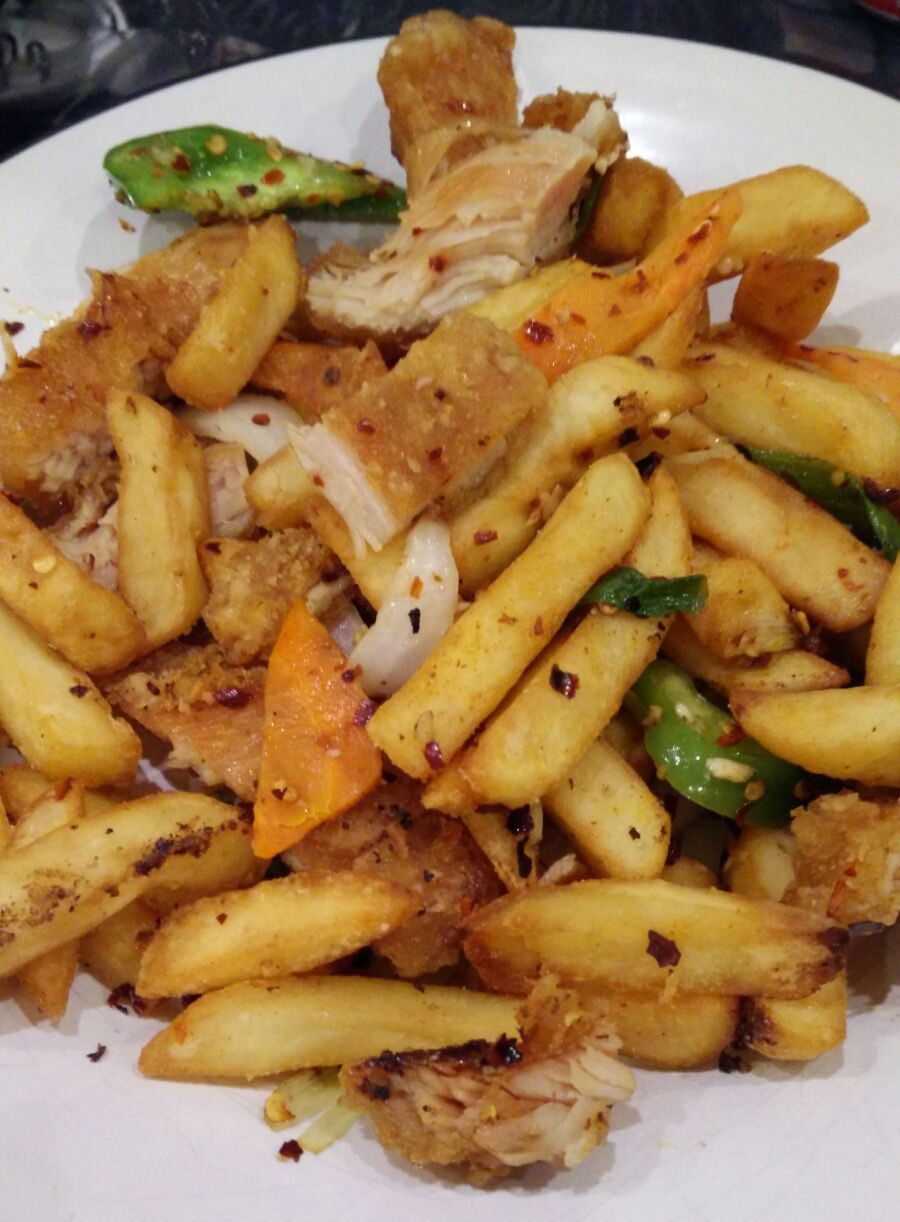
And in about fifteen years it went from one shop’s off-menu improvisation to a national dish — genuinely iconic across Ireland, sold everywhere, argued about, ranked, defended. The proof of how thoroughly it arrived: the spice bag was added to the Oxford English Dictionary. A takeaway snack younger than the iPhone, in the OED, as an Irish thing.
Why does this belong on a sausage-history page at all? Two reasons. First, because it’s the perfect corrective to the whole nostalgic frame these history pages can accidentally fall into. Not every beloved national food is old. Some of them were invented the year before last, in a suburb, by immigrants running a chip shop, and became “traditional” by being loved, not by being ancient. The spice bag earned its place at the Irish table in real time, and watching a food get canonized that fast is a gift — it shows you the exact process that, run for three hundred years, turned drisheen from slaughterhouse runoff into a civic emblem. Same mechanism. Different speed.
Second, because it tells you what Irish food identity actually is right now, which is not a museum. The provisions trade made drisheen. Immigration and the chip shop made the spice bag. Both are Irish. Both are real. And a food history that only honored the old one would be missing half of what’s actually on the island’s plate — the same way the breakfast dive had to reckon with beans (American) and hash browns (also American) sitting on a plate everyone calls timelessly Irish. Living food doesn’t stay still. It keeps eating the world and calling the result its own.
What Ireland actually adds to the tree
So here’s the honest summary of where Ireland sits in the family of sausage, stripped of romance:
Ireland is not a great fresh-sausage nation. Its everyday banger is a coarse, herby, rusk-bound member of the British-Isles cereal-binder school, good on a plate but thin in the record as a named regional tradition. What Ireland genuinely owns — what it contributes that nobody else does — is a blood-and-offal identity forged in the fires of the Cork provisions trade, and specifically drisheen: a gelatinous, protein-set blood pudding that stands apart from every crumbly grain-set black pudding in Europe, made essentially in one city, born from the century and a half when Cork slaughtered the Empire’s meat and its poor ate the blood.
That’s a smaller contribution than Germany’s or Spain’s, and I’m not going to inflate it. But it’s a real one, and it’s a clean one: a distinctive product, a documented economic origin, an honest arc from the food of the poor to the emblem of the city. And it comes with a lesson I keep relearning at my own bench — that the best sausages almost always start as the answer to a problem, usually the problem of not wasting the part of the animal that spoils first. Cork had more of that problem than almost anywhere on earth. Drisheen is the answer it gave, and it’s still on the counter at the English Market three hundred years later. For a page I warned you would run short, that’s a pretty good thing to have found.
Part of the old-world history of sausage and its blood-and-offal branch. For the Irish breakfast plate itself — rashers, the two puddings, how I cook and cure them — see the full Irish Breakfast dive. Next: the Balkans and Turkey, where the Ottoman spice line seeded sausages from Serbia to the steppe — including the little ćevapi I love enough to make my own.
Comments (0)