Rome: One Sausage, and the Word That Spread Across a Continent
Here is a thing that took me a long time to appreciate, and it has nothing to do with technique. If you want to know where the Romans took a sausage, you don’t dig for a specimen. You listen to the words people use for sausage today, and you draw a line connecting them, and the line lands on a map. It runs from a small mountain region in southern Italy out to Greece, up into Bulgaria, west across Spain and Portugal, down into the Arab world, and — this is the part that stopped me cold the first time I saw it — all the way into modern Hebrew. That whole spread comes off of one Roman sausage. The word-map is the migration map. Where the legions and the Latin went, the sausage-word went, and a surprising number of those words are still in daily use twenty centuries later.
That sausage is lucanica, and this page is about two things it left behind. The first is real, documentable, and genuinely astonishing: the vocabulary of half the Mediterranean’s sausages descends from it, and we can trace the whole family tree from a first-century primary source. The second is the most famous “fact” about Roman sausage — that the emperor Constantine banned it in 320 CE — and I’m going to take that one apart on the bench, screw by screw, because it’s folklore wearing the costume of history, and the origins page promised you the full teardown here. Both things sit right next to each other in the popular story. One of them is the real Roman legacy. The other is a rumor that never stops getting repeated. A sausage history that can’t tell them apart isn’t worth reading, so let’s do it properly.
Varro names the source, and he names it early
Start with the anchor, because everything on this page hangs off it and it happens to be a genuine primary citation — the kind you can go check.
Marcus Terentius Varro was a Roman scholar of the first century BCE — a contemporary of Cicero, the most learned Roman of his generation by reputation, a man who wrote about farming, language, and just about everything else. In his work on the Latin language, De Lingua Latina, at book 5, section 111, he’s doing what he does best: explaining where a word comes from. And he tells us plainly that the Romans got this sausage — and its name — from the Lucanians, the people of Lucania, the mountainous region of southern Italy that’s the modern Basilicata, the instep of the boot. Minced meat, packed into a casing. The Romans learned it there, and they called it after the place: lucanica.
That’s it. That’s the whole seed. A regional specialty from a rugged corner of southern Italy, picked up by Roman soldiers and Roman cooks, and carried out along the roads and the supply lines of an empire that eventually wrapped the entire Mediterranean. Cicero and Martial both mention it too, so it wasn’t some obscure curiosity — it was a known, named thing in the Roman kitchen, the way we’d say “a bratwurst” or “a kielbasa” and everyone knows roughly what you mean.
I want to flag one honest caveat before we build on this. The attribution — that Varro says the word comes from Lucania — is solid and repeated consistently across the sources. But if you ever see me or anyone else quote Varro’s exact Latin wording, treat that with a grain of salt unless it’s checked against a proper Loeb edition; paraphrases of the passage drift a little from telling to telling. The fact is rock-solid. The verbatim Latin is the kind of thing worth confirming before you carve it into a caption.
The word-map is the migration map
Now the payoff. Once lucanica is loose in the Roman world, it doesn’t stay put and it doesn’t stay one thing. It becomes the root word for “sausage” — or for a specific important sausage — in language after language, following the reach of Rome and, later, the reach of the trade and conquest that flowed through the same channels. Here’s the family, and I’d encourage you to read it as a route, not a list:
| Language / region | The word | What it is today |
|---|---|---|
| Latin (the root) | lucanica | The Lucanian sausage of Varro, Cicero, Martial |
| Italian (Lombardy, Veneto) | luganega / luganiga | A long, coiled fresh pork sausage, still made and still named |
| Greek | loukaniko (λουκάνικο) | The everyday Greek sausage, often scented with orange peel |
| Bulgarian / Balkan | lukanka | A flattened, dry-cured salami-type sausage |
| Spanish / Latin America / Philippines | longaniza | A long thin sausage — the word rode the Spanish empire around the globe |
| Portuguese | linguiça | The garlicky smoked Portuguese sausage — and yes, the same root |
| Basque | lukainka | The Basque sausage, name intact |
| Arabic | laqāniq / naqāniq / maqāniq | A sausage, often mutton with semolina — the word crossed the language line |
| Modern Hebrew | naknik (נקניק) | The generic word for “sausage” itself |
Look at what that table is actually telling you. Loukaniko is on every taverna menu in Greece — go search my collection for loukaniko and you’re eating a word Varro explained two thousand years ago. Longaniza is in Mexican kitchens, in Filipino kitchens, in Spanish kitchens, because the Spanish carried both the sausage and the name across an ocean — try longaniza. Linguiça — the smoky Portuguese link I love in a pot of beans — linguiça, same root, filed down by Portuguese phonetics until you’d never guess it was cousins with the Greek. Lukanka in Bulgaria. Lukainka among the Basques, who kept nearly the whole Latin word intact.
And then the two that get me every time. The word crossed out of the Roman-Latin world entirely and into Arabic as laqāniq / naqāniq / maqāniq — I’ll come back to the Arabic branch on the Jewish and halal page, because there the recipe changes meat (mutton and semolina, no pork) while the word survives the constraint — and it landed in Modern Hebrew as naknik, which isn’t the name of one sausage. It’s the word for sausage, full stop. A modern Israeli asking for a hot dog is reaching, without knowing it, for a word that traces back to a mountain tribe in southern Italy by way of a Roman antiquarian’s etymology.
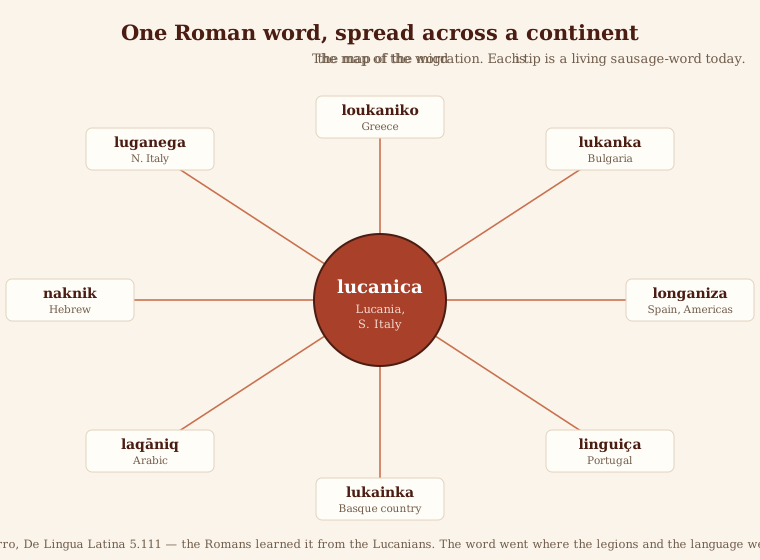
This is the thing to hold onto: the sausage word-map is one of the cleanest pieces of documentable Roman food history there is. You don’t have to trust a legend or an unsourced date. You can lay the modern words side by side, read the sound-shifts, and watch a single Roman product fan out across a continent and a couple of language families. That’s real. Nobody has to embroider it, and I’m going to spend the second half of this page tearing down a story precisely because the real one is this good and doesn’t need the fake one propping it up.
What the Roman sausage actually was — Apicius still has the recipe
We’re not guessing at what these sausages were, either. A Roman cookbook survives — Apicius, De Re Coquinaria, “On the Subject of Cooking,” compiled in the form we have it around the fourth or fifth century CE from older material — and it has sausage recipes in it. Real ones. With a spice list I could hand a modern maker.
Here’s the lucanica as Apicius gives it, and I’ll walk it the way I’d walk any formula:
- Pound together pepper, cumin, savory, rue, parsley, and bay-berry — that’s the aromatic base, and it’s a serious spice bill, more assertive than most fresh sausage I make.
- Work that into pounded meat, and loosen the whole thing with liquamen — Roman fermented fish sauce, their salt-and-umami backbone, the ingredient that stood in for salt-plus-savoriness in half of Roman cooking (think of it as their soy sauce, or their Worcestershire).
- Then fold in whole peppercorns for pops of heat, plenty of fat because a lean sausage is a sad sausage in any century, and pine nuts.
- Stuff it into casings drawn thin, and — here’s the line — hang it in the smoke.
Hang it in the smoke. Stop on that clause, because it’s the whole preservation thesis of this entire section compressed into three words of a Roman recipe. On the origins page I made the case that a sausage is a decision about time — a technology for carrying a whole animal’s worth of perishable meat and fat through a season without a cold room — and that the two hurdles doing the work are salt and smoke. Here’s a Roman writing it down as a cooking instruction, matter-of-fact, as if it were the most obvious thing in the world, which to him it was. Stuff it thin so it dries fast and evenly; hang it in the smoke so the phenols land on the surface and the whole thing dries and keeps. I do the same thing in my smokehouse with a thermometer and a book on the chemistry, and Apicius did it with a fire and a rafter and centuries of accumulated feel. That continuity — the Roman line and my line being the same line — is why I bother with any of this history.
The pine nuts and the fish sauce are the parts that read as “ancient” to a modern eye, but don’t let them fool you into thinking this is some alien food. Swap the liquamen for salt, drop the rue (it’s bitter and a little medicinal — the Romans loved it, we mostly don’t), and you have a peppery, fatty, smoke-hung pork sausage that would be entirely at home on a curing rack today. It’s a luganega in embryo, which is exactly what the word-map already told us it was.
Apicius has other sausages worth naming, because they map onto categories I keep coming back to across this whole dive:
- Botellum — a blood sausage. Which means the Romans made the oldest, most preservation-driven form of sausage there is, the same category Homer reached for and the same one the kosher and halal traditions would later delete entirely. If you want to see where blood sausage sits in the whole family, that’s on the blood and offal page.
- Isicia — forcemeat preparations, closer to what we’d call meatballs or fine-ground stuffings. The famous one is isicia omentata, a patty wrapped in caul fat, which food writers love to call “the Roman hamburger.” It’s the emulsion-and-forcemeat end of the craft.
- Farcimen — the general Roman word for a sausage, from farcio, “to stuff.” That verb is the root of “farce” (a stage play stuffed into the gaps of a longer program) and of “forcemeat,” the word every charcutier still uses. Etymologically, a sausage is simply the stuffed thing — which is as honest a one-word definition of the craft as you’ll ever get.
So between Varro’s etymology and Apicius’s recipes, we have a Roman sausage tradition documented from two directions at once: what it was called and where the name went, and what actually went into it and how it was made. That’s a solid, checkable body of history. Which brings me, finally, to the thing that isn’t.
The Constantine sausage ban: a folklore teardown
Here’s the story you’ll find repeated everywhere, told with total confidence:
The Romans loved lucanica — the fatty, pine-nutted pork sausage — and they ate it at Lupercalia, the wild mid-February fertility festival. Because Lupercalia was a pagan, licentious affair, the Christian emperor Constantine I banned sausages in 320 CE. But the people loved their sausage too much, so a black market sprang up, and eventually the unenforceable ban collapsed.
It’s a great story. Pagan orgy food, a disapproving Christian emperor, a defiant populace, a sausage speakeasy — it’s got everything, which is exactly why it spread. And it is, as far as anyone can actually demonstrate, folklore. Not “probably exaggerated.” Not “the date’s a little off.” There is no good reason to believe it happened at all, and there are several specific reasons to believe it didn’t. Let me lay them on the bench one at a time, because how this myth falls apart is more instructive than the fact that it does.
One: even the best source hedges. The most serious, most reputable book you can cite on this subject is Gary Allen’s Sausage: A Global History (Reaktion Books, 2015) — a real food historian, a real academic-popular press. And when Allen tells this story, he tells it with the words “legend has it” and “allegedly.” That’s the tell. A historian who could cite the actual law would cite the actual law — it’s the whole point of the job. When even your most careful source reaches for “legend has it,” the correct reading is not “well, a careful person told me, so it’s probably true.” It’s the opposite: the most careful person in the room is signaling, in the polite language of his trade, that he can’t stand behind it as fact. He’s passing along a good story and flagging it as a story. Everyone downstream drops the flag.
Two: there is no primary text. None. This is the one that ends it for me. The Romans were magnificent bureaucrats. Fourth-century imperial legislation is not lost to the mists — a great deal of it survives, collected in the Codex Theodosianus, the compilation of imperial law from Constantine forward. If Constantine had issued an edict banning a food, there is a specific, known place that edict would live. It isn’t there. There’s no entry banning sausages. And it’s not just the law codes: no contemporary writer mentions it either — not the Christian authors cataloguing the triumph of the faith over pagan custom (who’d have loved the anecdote), and not the hostile pagan writers who carefully recorded every Christian restriction they resented (who’d have complained about it). A sausage ban dramatic enough to spawn a black market, and not one Roman on either side of the culture war wrote it down? That’s not a gap in the record. That’s the absence you’d expect if it never happened.
Three — and this is the one that actually breaks the story’s own logic — the timeline is impossible. The whole tale hangs on Lupercalia: sausages get banned because they’re the food of this disreputable pagan festival, part of Constantine’s Christian campaign against pagan excess. Fine. Except Lupercalia wasn’t abolished in Constantine’s day. It ran on. It was still being celebrated in Rome more than 170 years later, and it wasn’t suppressed until around 494 CE, by Pope Gelasius I — not by Constantine, and not anywhere near 320. So the story asks you to believe that Constantine banned the sausage in 320 to strike at a festival that would go on being openly celebrated for another century and three-quarters after his death. The causal chain runs backward through time. The festival the ban supposedly targeted outlived the emperor who supposedly banned its food by five or six generations. You cannot ban the appetizer to kill the party and then have the party keep going for 170 years. The internal mechanism of the legend contradicts the actual chronology, and no amount of retelling fixes that.
Four: the vehicle it usually rides in on is also disputed. The sausage ban almost always shows up bundled with the “Lupercalia became Valentine’s Day” story — the claim that the Church absorbed the February fertility festival into the feast of St. Valentine. That pipeline is itself contested by historians; History.com’s own follow-up reporting concludes there’s no real evidence Valentine’s Day replaced Lupercalia. So the sausage myth is riding piggyback on another shaky just-so story. When two unsupported claims travel together, holding hands, that’s not corroboration. It’s just the same folklore packaged for two different holidays.
Add it up: the best source says “legend,” there’s no law and no witness, the timeline is internally broken by 170 years, and the whole thing is bundled with a second disputed myth. Every direction you push on it, it gives. That’s not a fact with some fuzzy edges. That’s a story.
Why I bother taking it apart
I don’t do this to be the guy who ruins the good anecdote at the cookout. I do it because this is a perfect worked example of how food history goes wrong, and once you see the shape of it you’ll spot it everywhere.
Look at why this particular story is so sticky. It’s plausible. Every piece of it is individually believable: the Romans did eat sausage, Lupercalia was a real and genuinely raucous pagan festival, Constantine really was a Christian emperor who really did move against some pagan practices, and religious authorities really have restricted festival foods throughout history. Take four true-ish, vibe-consistent facts, arrange them into a satisfying narrative with a moral (pagan indulgence, Christian crackdown, plucky resistance), and you’ve built something that feels true — feels truer, honestly, than the dry reality of “a word from Lucania spread along Roman roads.” And because it feels true and tells well, it gets repeated. And repetition is the only credential a myth ever earns. Every retelling cites the last retelling; nobody cites a Roman. It hardens into “fact” through nothing but sheer mileage.
That’s the trap, and it’s the same trap that produced the 3000 BCE Sumerian sausage tablet that isn’t there and the Pompeii sausage specimen nobody can produce. A confident number, a satisfying story, a source that turns out on inspection to be another copy of the same story. The corrections aren’t me being a killjoy. The corrections are the history — the discipline of asking “who actually saw this?” is the only thing separating a food history from a pile of folklore, and the answer for the sausage ban is “nobody, ever, in any surviving Roman source.”
And here’s the thing I keep coming back to: the real story is better. You don’t need Constantine and a black market to make Roman sausage interesting. You’ve got a mountain-tribe recipe that Varro traced by name, an emperor’s-worth of geographic reach turning one word into a dozen living languages, and Apicius writing “hang it in the smoke” in a sentence that’s the entire logic of food preservation in three words. The documentable Roman legacy — the lucanica word-map — is genuinely one of the most remarkable things in the whole history of any food. The ban is the myth sitting right next to it, borrowing its glamour. Keep the word-map. Compost the ban.
What Rome actually handed forward
So set the legend aside and here’s the ledger, honestly kept. Rome gave the sausage two things that outlasted the empire by a long way.
It gave it a vocabulary. Not a metaphor — an actual, traceable spread of a single word from Lucania into Italian, Greek, Bulgarian, Spanish, Portuguese, Basque, Arabic, and Hebrew, carried on the roads and supply lines and later the ships that all ran through the same Roman-seeded channels. When you search my collection for loukaniko or longaniza or linguiça, you’re not finding unrelated sausages that happen to rhyme. You’re finding the branches of one tree, and the trunk is a first-century BCE etymology you can go read.
And it gave it a written technique — Apicius’s recipes, which show a sausage craft already mature: a real spice program, fat handled on purpose, fish sauce for salt and depth, casings drawn thin, and smoke for keeping. Blood sausage, forcemeat, and the general word farcimen that still lives inside “forcemeat” today. The Roman didn’t invent the sausage — it was already ancient when Homer reached for it — but Rome is where a stuffed gut first got written down with a spice list and a hang-it-in-the-smoke instruction, and where it acquired a family of names that would outlast Rome itself.
What Rome did not do is regulate it into the sharply-bordered, legally-defined regional objects we know now. A lucanica is a type; a Nürnberger Rostbratwurst or a Toulouse is a legally-defined thing with a rulebook and a town behind it. That transition — from “a kind of sausage” to “a sausage a guild charter says you may and may not make like this” — is the medieval story, and it’s the next page. But the raw material the guilds inherited, the named and written and smoke-hung Roman sausage, came out of Lucania and went out along the roads. The word-map is the proof, and it’s still on the menu.
Part of the old-world history of sausage. Next: the medieval guilds, where a stuffed gut becomes a legally defined regional object — where regulation didn’t restrict sausage style but manufactured it, town by town. The Roman word-map runs on into Italy, Spain and Portugal, the Balkans and Turkey, and — carrying the word but changing the meat — the Jewish and halal traditions. The whole family is laid out on the family tree.
Comments (0)