Italy: Salumi Is Not Salsiccia, and Other Grammar English Gets Wrong
There’s a word problem sitting under the whole Italian section of this dive, and it trips up nearly every English speaker who wanders into an Italian deli, so let me clear it before we do anything else. It’s the difference between salumi and salsiccia, and it is not a small one. English collapsed the two into a single borrowed word — “salami” — and in doing that it lost the entire organizing principle of Italian cured meat.
Here’s the split. Salumi is the whole category — the umbrella term for cured, salted, preserved pork goods of every kind. Salame is a salumi. So is prosciutto. So is mortadella, so is ‘nduja, so is soppressata, so is the guanciale in your carbonara. Salumi is the family. Salsiccia, on the other hand, is one specific thing: a fresh sausage — ground meat and fat and seasoning packed into a casing, meant to be cooked, not cured. It’s what a maker like me spends most of his life doing. It’s the wet, perishable, tomorrow’s-dinner end of the craft.
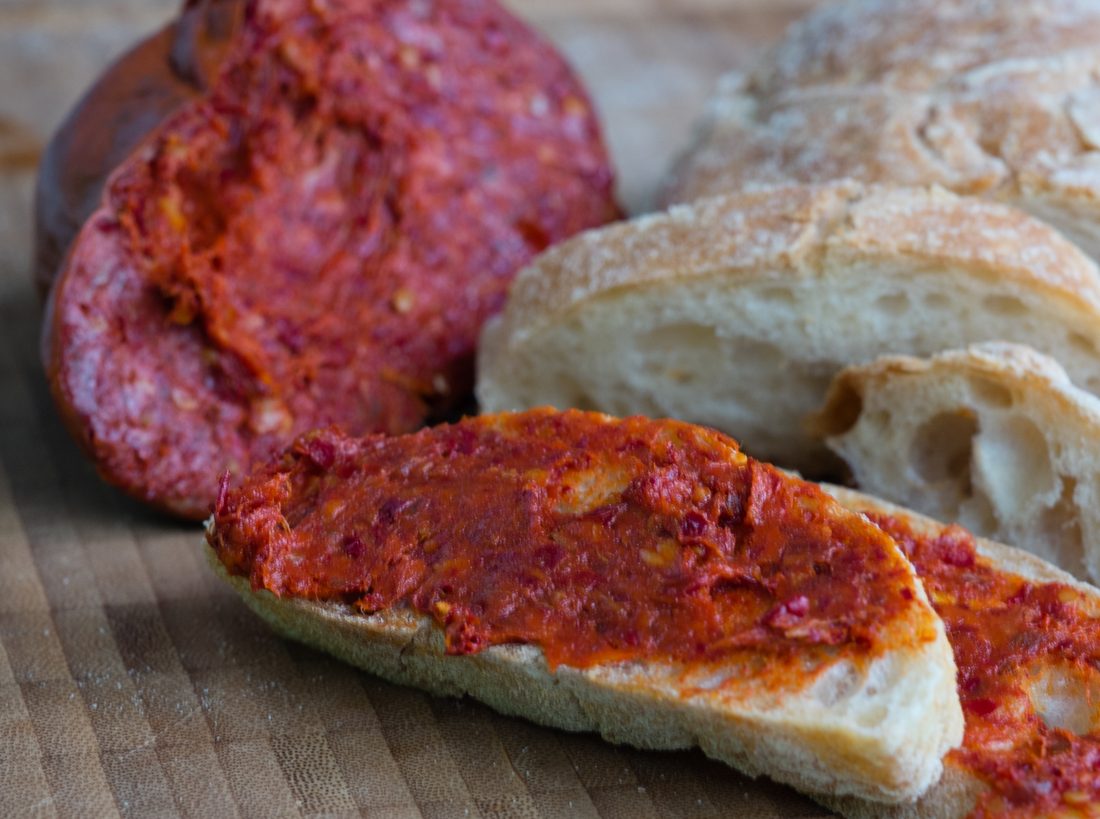
So when English took “salami” and made it stand in for the whole world of Italian cured meat, it grabbed one member of the salumi family — a specific dry-cured, fermented, sliceable sausage — and let it swallow the category name. Salami is not salumi. Salami is a salumi, the way a wren is a bird but “bird” is not “wren.” It’s a small mistranslation that hides the actual shape of the thing. Once you see the salumi/salsiccia line, the whole Italian map organizes itself around it, and I’m going to spend this page walking that map region by region, correcting a few good stories along the way.
The norcini: when a town’s name becomes the word for the craft
Before we fan out across the regions, you have to meet the people who kept this whole tradition alive, because their story is the single best answer to “who actually made all this?”
Go to Umbria, to the middle of Italy, and find a small mountain town called Norcia. The Romans called it Nursia — it’s ancient, it’s the birthplace of St. Benedict, and it sits up in the Apennines where the winters are hard and the pigs are good. The butchers of Norcia, the norcini, built a reputation over centuries for one thing above all: breaking down a pig and turning every part of it into cured meat that would keep. And here’s the piece that tells you how good that reputation was — the town’s name became the word for the craft itself. In Italian, a norcineria is a pork-butcher’s shop, a place that makes and sells salumi, anywhere in the country. The word doesn’t mean “a shop in Norcia.” It means “a shop that does what Norcia does.” A whole profession is named after one town. That’s the linguistic fossil of a reputation so total that the place-name got promoted to a common noun — the same move that turned Lucania into half the sausage-words in the Mediterranean, just running through butchery instead of vocabulary.
What made the norcini legendary wasn’t only skill — it was that they were itinerant. Winter is slaughter season, always has been; you kill the pig when the cold will help you keep the meat, the same “decision about time” that starts this whole history. And the norcini traveled. They’d leave Norcia when the cold came on and go town to town, farm to farm, all over central Italy, hiring out as the expert crew who came in, killed your pig, and broke it down into hams and salami and sausage before the meat could turn. A family kept a pig all year; once a year it had to be converted, all at once, into a larder that would last until the next one — a specialist job where a mistake means you lose the whole animal to spoilage. So you paid for the people who did it best, and the people who did it best came down out of the mountains around Norcia with their knives.
I find this genuinely moving as a maker, because it’s my job, professionalized eight hundred years early. When an Italian says norcineria today, standing in Milan or Palermo, they are invoking a mountain town in Umbria without thinking about it, the way an American says “he’s the Cadillac of plumbers” without picturing Detroit. Keep the norcini in mind through the rest of this page. Every regional specialty below is something their kind of hands made keep.
The regional map, at a glance
Here’s the fan-out, and then I’ll take the interesting ones one at a time. Read this as a starting index, not the whole story — the corrections are in the sections below.
| Region | The salumi (or salsiccia) | The signature — what makes it that and nothing else |
|---|---|---|
| Umbria (Norcia) | the whole craft — norcineria | the itinerant winter pig-butchers whose town-name became the word |
| Tuscany | finocchiona | fennel salami — and the fennel was a money-saving pepper substitute |
| Emilia-Romagna (Bologna) | mortadella | fine emulsion, cubed fat, pistachio; codified by a 1661 proclamation |
| Emilia-Romagna (Modena) | cotechino & zampone | fresh cooking sausages of rind and pork; the stuffed pig’s-trotter |
| Calabria (around Spilinga) | ‘nduja | soft, spreadable, fiercely hot; built on Calabrian peperoncino |
| the South (Basilicata, Puglia, Calabria) | soppressata | a pressed dry salame — flattened under weight as it cures |
| Lombardy & the Veneto | luganega / luganiga | the long coiled fresh sausage — Rome’s lucanica, still on the menu |
That last row is the through-line from the previous page, so let me start there and then work down.
Luganega: Rome’s sausage never actually left
If you read the Rome page, you already met this one, so I won’t re-do the etymology — go there for the full word-map. The short version is that Varro, in the first century BCE, told us the Romans got a minced-meat-in-a-casing sausage from the Lucanians of southern Italy and named it after the place: lucanica. That word then fanned out across the whole Mediterranean, becoming loukaniko in Greece, longaniza in Spain, linguiça in Portugal, and a dozen others.
What matters here, on the Italy page, is that the word also stayed home. In Lombardy and the Veneto, the direct Italian descendant of lucanica is luganega (also spelled luganiga) — a long, thin, continuous fresh pork sausage, coiled rather than linked, mild and simple. It is a salsiccia in the strict sense: fresh ground meat in a casing, cooked not cured. When you braise luganega with lentils or drop a coil of it into a risotto up in Monza, you are eating, under its own two-thousand-year-old name, the sausage a Roman scholar explained the origin of before Christ was born. It didn’t get banned, it didn’t get lost, it didn’t need rediscovering — it just kept being made and kept being called roughly what it was always called. The plainest sausage on the Italian map is also the oldest documented one. Search my collection for luganega or the broader salsiccia and you’re at the fresh, un-cured root of the whole thing.
Finocchiona: the fennel was economics before it was flavor
Now Tuscany, and here’s the first correction that’s better than the marketing version.
Finocchiona is the great Tuscan salame, and it’s defined by one flavor: fennel. Fennel seed, sometimes fennel pollen, worked through a coarse-ground pork salame that cures for months into something sweet and anise-scented and unmistakably Tuscan. Every description you’ll read tells you the fennel is what makes it special, tells you about the aromatic bloom, the wild-herb character, and stops there — as if some Renaissance Tuscan simply decided fennel tasted lovely in pork.
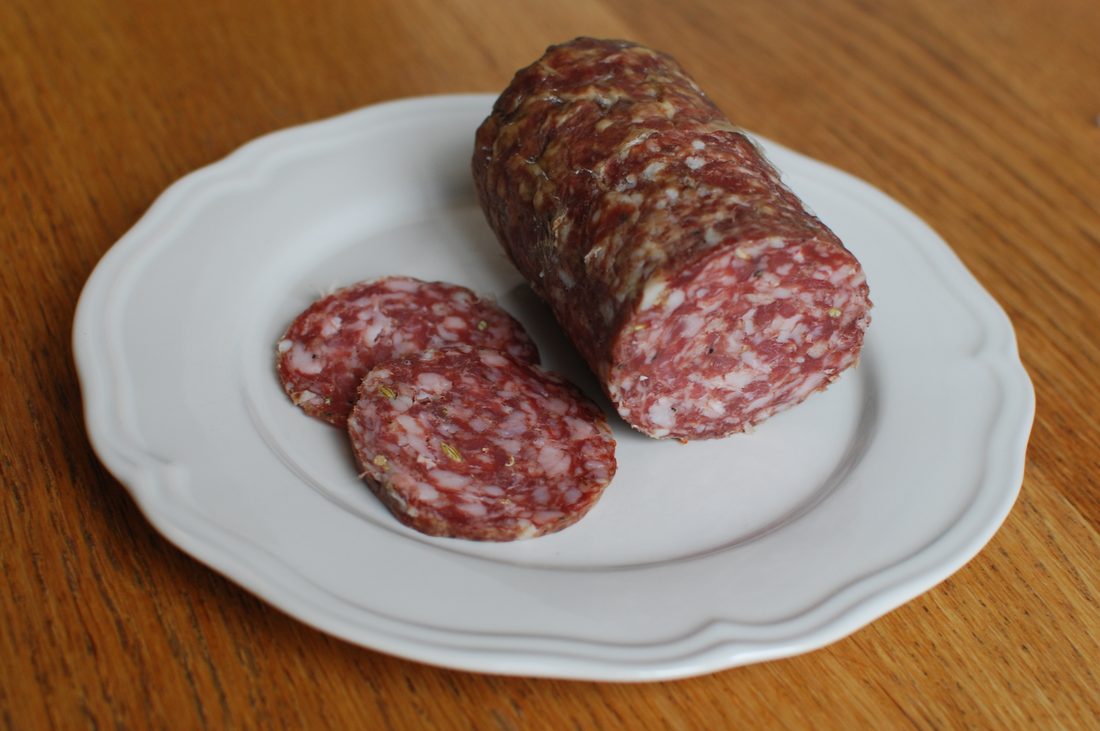
The real story has a reason in it, and the reason is money. Here’s the correction: the fennel was a substitute for black pepper, and it was a substitute because pepper was expensive and fennel was free. Go back to the late medieval and Renaissance period, and black pepper is an imported luxury — it comes overland and by sea from the far side of the world, it’s traded like currency, and a Tuscan hill-country pork butcher curing salame for his own larder is not made of pepper money. But fennel? Fennel grows wild all over the Tuscan countryside. It’s a weed. It’s free. You can walk out and gather the seed and the pollen for the cost of bending over. So the makers reached for the aromatic they had instead of the aromatic they’d have had to buy, and in doing so they invented one of the most distinctive salami in Italy.
That’s the correction, and it’s the kind I love because it reorganizes how you taste the thing. Finocchiona isn’t fennel salame because a chef preferred fennel. It’s fennel salame because fennel was the local, wild, no-cost stand-in for a spice most people couldn’t afford, and the substitution became the identity. The economics wrote the recipe, and then centuries of eating it turned the thrift into a tradition and then into a protected regional treasure. Necessity picks the ingredient, and the ingredient becomes the definition — and finocchiona is one of the cleanest examples on the whole Italian map. When I make a fennel-forward pork sausage I’m running a recipe that started as a workaround for a pepper bill. Look for finocchiona or just fennel sausage and taste the economics.
Mortadella: the ancestor of a word Americans use as an insult
Bologna. Emilia-Romagna. Mortadella — the big, pale-pink, silky-smooth cured sausage studded with white cubes of fat and, in the good stuff, whole pistachios. This is a salumi, not a salsiccia; it’s a finely emulsified, cooked-and-cured product, worlds away from a fresh link. And it’s ancient. There’s a Roman-era funerary stele in Bologna’s archaeological museum showing a mortar and pestle and pigs — the pounding of the meat is right there in stone — which is exactly the kind of primary evidence I trust, because you can go stand in front of it.
Two things about mortadella are worth doing properly: where the name comes from, and where the American word baloney comes from. They’re different questions with different answers, and people mash them together.
The name. Two serious candidates, both plausible. One derives mortadella from the Latin mortarium, the mortar — because the meat was pounded fine in a mortar, which is the defining technique and matches that Roman stele exactly. The other derives it from myrtatum, from myrtle — a sausage seasoned with myrtle berries, a real ancient Mediterranean flavoring. I lean toward the mortar, because the pounded-to-a-paste texture is the whole identity of mortadella and the stele backs it, but I won’t tell you the myrtle story is dead. Call it an open question with the mortar ahead on points.
The regulation. Here’s the piece that connects mortadella to the larger argument running through this whole dive. In 1661, a Cardinal Farnese — the papal governing authority over Bologna — issued a proclamation codifying how mortadella was to be made: what could go in it, how it was to be produced, what the standard was. That is an early food regulation, three and a half centuries before the modern PDO/PGI machinery, and it’s doing exactly the thing the medieval guilds page argues is the real engine of sausage identity. Regulation doesn’t restrict a style — it manufactures one. Before you write a rule defining “mortadella,” there is just a range of Bologna pork sausages shading into one another. After you write the rule, there is a specific defined object called mortadella that a maker either does or doesn’t produce correctly. The 1661 proclamation is a link in that chain, and the chain runs straight through to 1998, when Mortadella Bologna received PGI protection — the modern legal descendant of Farnese’s edict. Same move, 337 years apart: define the sausage by law, and the law becomes the sausage. Go read that guilds page for the full thesis; mortadella is the worked Italian example of it.
And now baloney. This is the correction most Americans need. That flabby pink lunchmeat you had in sandwiches as a kid, the stuff whose name became a synonym for nonsense — “that’s a load of baloney” — is a degeneration of mortadella, named for Bologna, the city. But here’s the thing people get wrong: American bologna is not a translation of mortadella, it’s a corruption of it. “Baloney” is just the English respelling of how “Bologna” sounds to an English ear — Bo-LOAN-ya — and the product wears that corrupted spelling because the product is itself corrupted. Somewhere in the emigration across the Atlantic, the fine-ground Bologna sausage lost its identity piece by piece: the pork got cut with beef, the pistachios vanished, the delicate emulsion coarsened, and the whole PGI-disciplined thing became a cheap, mass-market cold cut. What crossed the ocean kept the name of Bologna and threw away the standard of Bologna. It’s not a variant of mortadella — it’s what mortadella degenerates into when nobody’s enforcing the rules, which is the perfect food for a word that came to mean “nonsense.” The real thing — search mortadella — is one of the great sausages of the world; baloney is its ghost.
‘Nduja: a spreadable sausage, and a genuine etymological fight
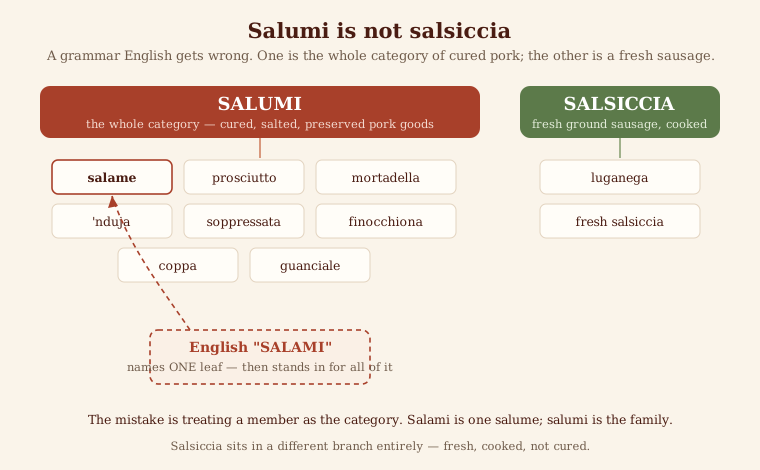
Down to the toe of the boot now — Calabria, around the town of Spilinga — for the sausage that’s having a real moment in American kitchens and deserves it. ‘Nduja (roughly en-DOO-ya) is unlike anything else on this page. It’s a salumi, cured pork, but it’s soft and spreadable — you don’t slice it, you smear it. And it is fiercely hot, because it’s built on Calabrian peperoncino, the local chili, in enormous proportion. It’s a paste of the fattier, humbler cuts of the pig, ground fine, packed with a punishing amount of chili, cased and cured until it’s this rust-red, unctuous, capsaicin-loaded spread you can work into pasta, smear on bread, or melt into a sauce. If you’ve had it, you remember it. Search nduja and you’ll find where I use it.
Two honest facts and one honest fight.
Fact one: it’s not ancient. For all its rustic, peasant-preservation character, ‘nduja as we know it is a 19th-century development — a relatively recent arrival, not some medieval Calabrian heirloom. The chili couldn’t have made the trip much earlier anyway, because peperoncino is a New World plant — chilies don’t reach the Mediterranean until after Columbus, part of the same Columbian exchange that re-drew the entire Spanish and Portuguese sausage map with paprika. No New World chili, no ‘nduja. That alone caps how old it can be.
Fact two, and this is the live debate: where does the name come from, and who introduced the format? Here there are two serious stories and I’m not going to pick a winner, because the sources themselves don’t. This is a genuine, unsettled etymological question, and I’m flagging it as one.
- The Spanish/Aragonese story. Calabria spent long stretches under Aragonese and Spanish rule, and Spain is the obvious pipeline for both the soft spreadable cured-pork format (think sobrasada, the spreadable paprika sausage of Mallorca — ‘nduja’s dead-ringer Balearic cousin) and, again, the New World chili that makes ‘nduja possible. Under this reading, ‘nduja is Calabria’s take on an Iberian idea, chili and spreadable texture arriving together through the Spanish connection.
- The French/andouille story. The competing account says the name echoes the French andouille, and points to Joachim Murat — Napoleon’s marshal, installed as King of Naples in the early 1800s — as the vector. Murat’s French administration over southern Italy is real history, the timing lines up with the 19th-century emergence, and ‘nduja really does sound like it could be a Calabrian mangling of andouille. Under this reading, a French offal-sausage word got borrowed and bent to fit a completely different Calabrian product.
These two stories don’t just disagree on trivia — they disagree on which country’s sausage tradition seeded southern Italy’s most famous modern export. The andouille link is especially juicy because it ties this page directly to the France page, where andouille is the center of a three-way name-collision (French tripe sausage, French andouillette, and Cajun pork andouille — one word, three unrelated sausages). If the Murat story is right, ‘nduja is a fourth thing wearing a version of that same traveling word. That’s a beautiful connection and I’d love it to be true. But “I’d love it to be true” is precisely the reflex the Rome page’s Constantine teardown warns against, so I’ll say plainly: the ancestry of the name ‘nduja is disputed, the Spanish and French stories are both defensible, and anyone who tells you flatly which one is correct is telling you more than the evidence supports. What’s solid is the when (19th century), the where (Calabria, around Spilinga), and the what (New World chili on humble pork, spreadable). The why it’s called that is an open file.
Soppressata: the pressed one
A quicker one, because the name does the explaining. Soppressata is a dry-cured salame of the South — you’ll find it across Basilicata, Puglia, and Calabria — and its defining trait is right there in the word: it’s pressed. As the salame cures, it’s pressed under weight, which drives out air, tightens the grain, and gives it that slightly flattened cross-section and dense, compact texture. It’s coarser-ground than a fine northern salame, often studded with visible fat and pepper (or chili, this being the South), and it’s a hard, sliceable, keep-forever product — the pressing is a preservation move as much as a textural one, since squeezing the air out is squeezing out one more thing that helps spoilage along. Nothing mythologized here, no correction to make — just a good honest name that tells you exactly what was done to the meat. Look for soppressata when you want the pressed, dry, southern style.
Cotechino and zampone: the sausages of a siege — “between reality and legend”
Back up to Modena, in Emilia-Romagna, for the last pair, and for the best story on the page — told, as it must be, with its hedge attached.
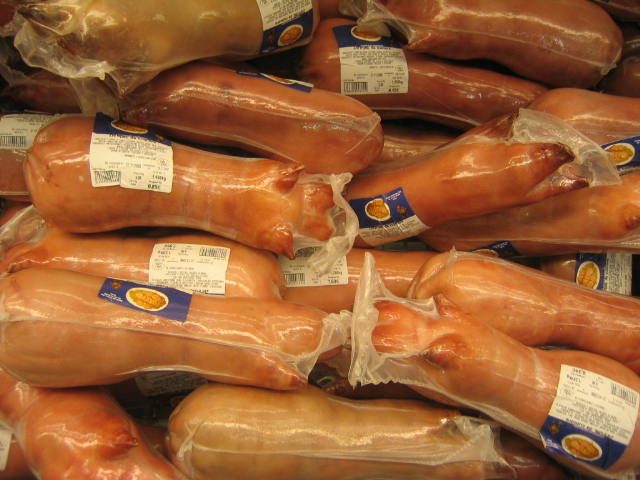
These two are salsiccia in spirit — fresh cooking sausages, not dry-cured keepers. Cotechino is a large fresh sausage of pork and, crucially, plenty of pork rind — the name comes from cotica or cotenna, meaning the rind, the skin. That rind is the whole character: cooked long and slow, it goes gelatinous and gives cotechino its rich, sticky, unctuous texture. Zampone is the same idea with a spectacular twist — it’s that rind-and-pork mixture stuffed not into an ordinary casing but into the skin of the pig’s front trotter, the zampa. Hence zampa → zampone, “the big trotter.” You simmer the whole stuffed foot for hours and slice it, skin and all. Both are cooked, both are rich, and both are now inseparable from the Italian Christmas and New Year table, traditionally served with lentils — the little coin-shaped legumes standing in for coins, eaten at the turn of the year for prosperity.
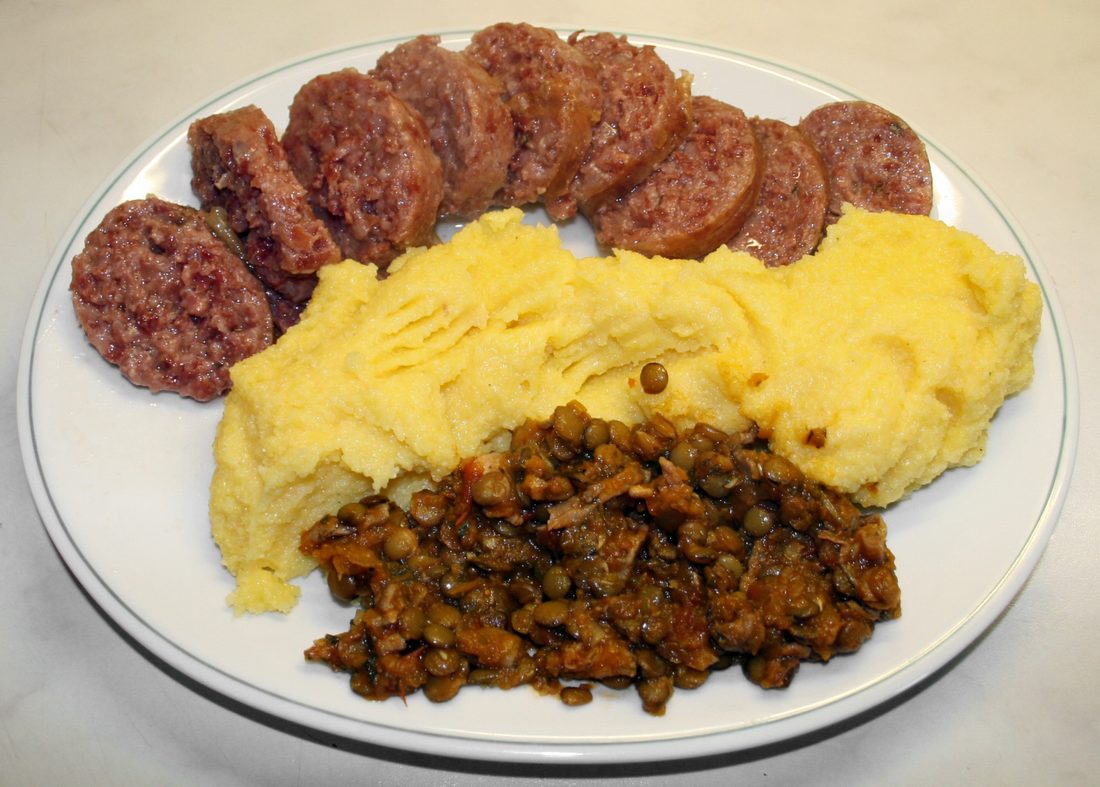
Now the origin story, and I’m going to tell it the way the sources themselves tell it, which is hedged.
The legend says zampone was born of a siege. In 1511, the town of Mirandola, near Modena, was besieged by the troops of Pope Julius II. With the town cut off and the pigs about to be either eaten by the enemy or lost, the story goes, the starving townsfolk slaughtered their animals and — needing to preserve the meat, and perhaps to hide it from the besiegers — stuffed the pork into whatever would hold it, including the skin of the pigs’ own front trotters. Necessity, under the pressure of an army at the walls, invented the zampone: the trotter-skin as an improvised casing when the ordinary ones ran out or when the meat had to be concealed. And from there it entered Modenese tradition and never left.
It’s a wonderful story and it has the shape of truth — desperate townsfolk, a real historical siege, an ingenious use of the whole animal under duress. But here’s the honest part, and I take it straight from the sources, because the sources themselves won’t vouch for it as fact. The consortia and food historians who tell this story describe it as sitting “between reality and legend.” That’s their phrase, not my hedge. There’s a real siege of Mirandola in 1511 — Julius II really did besiege it, that’s documented history. Whether the zampone was actually invented there and then is exactly the kind of satisfying just-so origin that food history loves to attach to a real event after the fact. So I’ll present it as the standard origin legend, clearly labeled as legend, with the one verifiable fact (the 1511 siege happened) separated from the charming claim (that it’s where zampone was born). The etymologies are solid — zampa gives zampone, cotica gives cotechino, those are just Italian. The siege birth is a good story the tradition itself flags as half-legend, and I pass it along the same way.
What’s beyond dispute is where they ended up: both Zampone Modena and Cotechino Modena hold PGI protection today — the same regulation-makes-the-style machinery that codified mortadella in 1661 and that the guilds page argues is the real story of sausage identity. Search cotechino or zampone and you’re cooking a sausage that Italy itself can’t quite decide whether to file under history or folklore — which is, honestly, the most Italian thing about it.
What Italy actually teaches
Step back and the Italian map isn’t a random scatter of regional sausages — it’s organized by a handful of forces, and every one shows up elsewhere in this dive. There’s the grammar — salumi the category, salsiccia the fresh sausage, and salami just one member that English mistook for the whole family. There’s the economics — finocchiona’s fennel standing in for pepper nobody could afford, ‘nduja and soppressata built from the humble cuts and the cheap heat, all of it rooted in the same “waste no part of the pig” imperative that starts the story with Homer. There’s the regulation — Farnese’s 1661 mortadella proclamation and the modern cascade of PGI marks, doing what the medieval guilds did: turning a fuzzy range of local sausages into sharply-defined legal objects, manufacturing the very styles the law claims only to protect. And there’s the traveling word, running two directions at once — lucanica going out from Rome to become luganega across a continent, and possibly andouille coming in to Calabria to become ‘nduja, if the Murat story holds.
The keepers of all of it were the norcini, coming down out of the mountains at slaughter-time to convert a family’s pig into a year’s larder before it could turn — the itinerant experts whose town-name became the word for the craft. When I break down a pork shoulder on my own bench in Michigan, cold meat, sharp knife, a plan for every part, I’m doing the small domestic version of what a norcino did for a whole village. The scale changed. The problem didn’t.
Part of the old-world history of sausage. Next: France, where charcuterie wasn’t folk craft but a licensed, guild-regulated profession — and where the word andouille fractures into three completely different sausages, one of which may have crossed the sea to become the ‘nduja we just met. The whole family, and how these regional histories fit together, is laid out on the family tree; the fresh-and-cured spectrum from luganega to soppressata is the same one mapped on blood and offal.
Comments (0)