Elsewhere: The Rest of the Family
China, Japan and Korea get their own pages because they’re the three that diverged most clearly. But once you know what a steamed egg is, you start seeing it everywhere in Southeast Asia — and there’s a sweet branch of the family most people don’t connect to it at all.
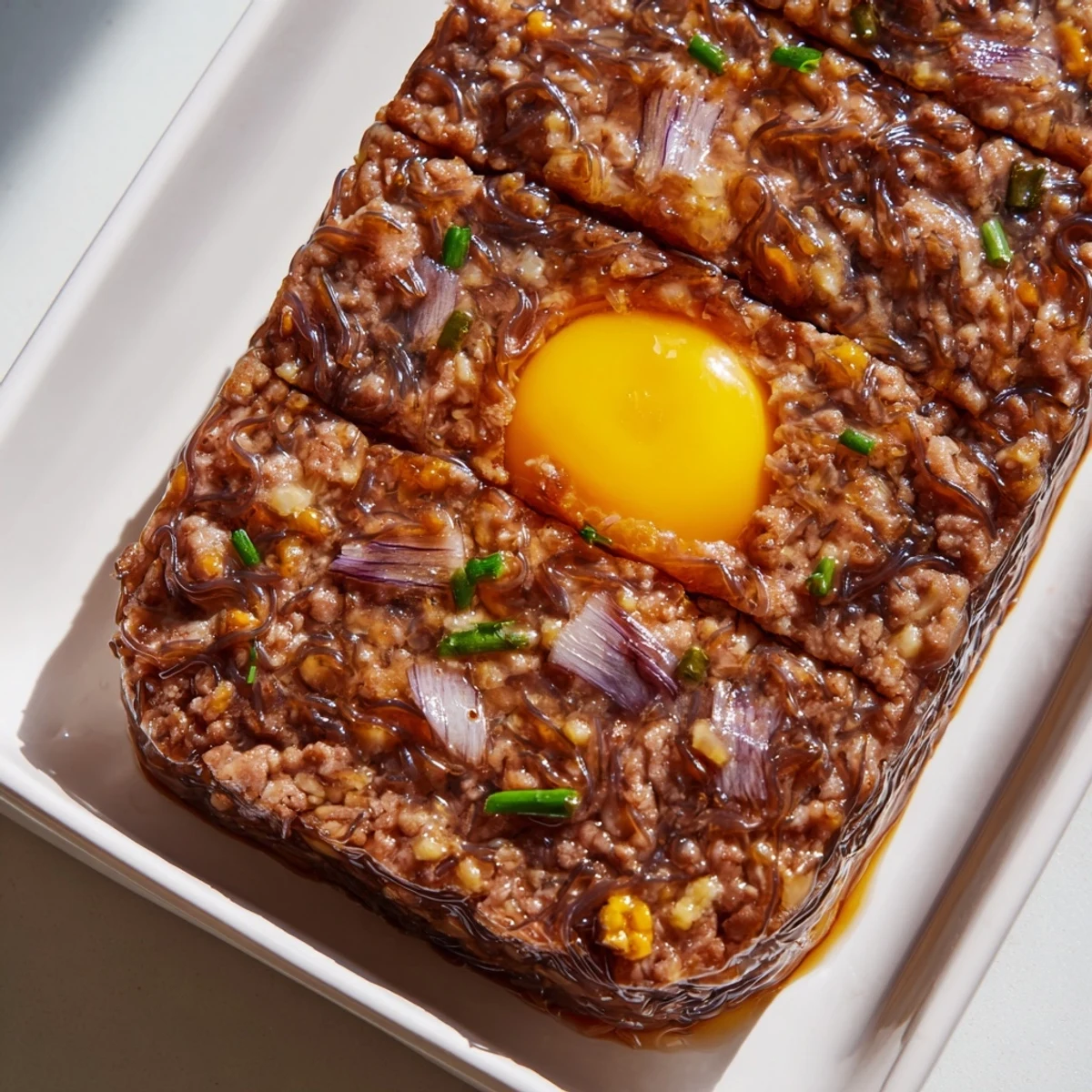
Vietnam — trứng hấp
The loaded one. Where the Chinese version is a smooth canvas and the Japanese version is a delicate composition, Vietnamese trứng hấp is packed — minced pork, glass noodles (miến), wood ear mushroom, sometimes shrimp, all stirred through rather than placed.
⭐ And the finishing move is lovely: a yolk or two is often held back, beaten with a little annatto or turmeric for colour, and brushed over the top in the last minutes of steaming. It sets into a glossy orange lid. It’s purely visual and it makes the dish.
Seasoned with fish sauce, not soy — which is the single change that most makes it taste Vietnamese rather than Chinese.
It’s substantial enough to be a main course with rice, which none of the other versions really are. Trứng Hấp (Vietnamese Steamed Egg with Pork).
Thailand — khai tun
ไข่ตุ๋น. Lighter than the Vietnamese version and closer to the Chinese one, seasoned with fish sauce and white pepper, often with a little minced pork and scallion, and frequently topped with fried garlic — which is the Thai instinct generally and is a genuinely great idea on a soft custard.
Traditionally steamed in a banana leaf cup, which imparts a faint grassy aroma and looks wonderful. A ramekin is fine.
The wider region
- Philippines — versions exist under Chinese influence, often with the egg steamed over or with rice.
- Indonesia and Malaysia — telur tim, again showing direct Chinese lineage, usually with minced meat and soy.
- Singapore — Cantonese-style steamed egg is standard in zi char restaurants, essentially unchanged from Guangdong.
- Taiwan — very close to the mainland Cantonese version, often with dried shrimp or preserved radish.
⚠ The pattern is consistent enough to be worth naming: wherever there was significant Chinese migration, the steamed egg went too, and what changed in each place was the seasoning liquid — soy in China, dashi in Japan, saeujeot in Korea, fish sauce across Southeast Asia. The custard is the constant; the salt is the variable.
The sweet branch
This is the part people don’t connect, and they should.
Cantonese steamed milk custard (炖奶) and its famous cousin double-skin milk (双皮奶) are the same technique with milk and sugar instead of stock and salt. Same gentle steam, same protein set, same failure modes — steam it too hard and it pits exactly the same way.
Steamed Milk Custard, Cantonese is worth making once just to feel the technique transfer. If you can make a good zhengdan you can make this, and vice versa.
And further out: Portuguese-influenced Macanese egg custards, crème caramel, flan — all the same physics, though baked in a water bath rather than steamed. A bain-marie is a steamer that’s given up on steam.
⭐ Which is the real conclusion of this dive: savoury steamed egg and sweet baked custard are not two techniques that happen to resemble each other. They’re one technique, and the only meaningful difference is whether you salted it or sugared it.
In this dive: The story · The science · China · Japan · Korea · The espresso steam wand · Vessels and gear
Comments (0)