The Science: Two Dials and Nowhere to Hide
There is no sauce on a steamed egg. No browning, no crust, no seasoning that can rescue it. It is the most exposed thing I cook — either the texture is right or the whole dish is a failure, and you can see which from across the room.
The good news is that it comes down to a very small number of things, and once you know them the dish stops being luck.
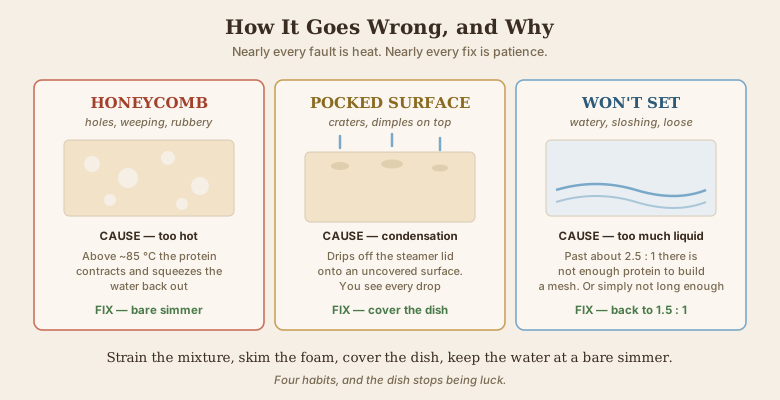
What is actually happening
Egg proteins are folded up in little balls, and they stay dissolved because they repel each other. Heat unfolds them. Once unfolded, they stick to each other, link up into a three-dimensional mesh, and trap the water in between. That mesh holding water is a custard.
Two numbers matter:
- Egg white sets from about 62 °C; yolk from about 65 °C. Whole egg beaten together sets somewhere in between.
- 🔴 Above roughly 85 °C the proteins contract hard and squeeze the water back out. That is the whole problem. The mesh doesn’t just set, it tightens, and the water it was holding gets expelled.
Everything wrong with a bad steamed egg comes from that second number. Too hot, and the protein wrings itself out: the custard weeps, the trapped water flashes to steam, and you get the honeycomb of holes that ruins it.
⭐ Which is why “steamed” is doing real work in the name. Steam at atmospheric pressure is 100 °C, which is far too hot — but a covered dish sitting above simmering water, over gentle heat, stays much cooler than that. You are not steaming it hard. You are using steam as a gentle, humid, evenly-distributed heat source, and the moment you let it boil hard you have lost.
Dial one: the ratio
Liquid to egg, measured by volume or by weight. This sets the texture more than anything else.
| Ratio (liquid : egg) | Result | Where it belongs |
|---|---|---|
| 1 : 1 | Firm, sliceable, a bit bouncy | Korean-leaning; holds up to mixing in |
| 1.5 : 1 | ⭐ The sweet spot. Silky, just holds its shape, spoon glides through | Chinese zhengdan; the default |
| 2 : 1 | Very soft, barely set, trembling | The gentle end of Japanese chawanmushi |
| 2.5 : 1 to 3 : 1 | ⭐ Barely holds together at all. Sets reliably, but only with the straining, skimming and gentle heat done properly | Chawanmushi proper — this is the real range |
| Past about 3.5 : 1 | Won’t reliably set; soup with regrets | Nowhere |
🔴 I had this wrong in the first draft of this page. I wrote that 2.5:1 and up “won’t reliably set,” and then went and published a chawanmushi recipe at 3:1 and linked an Instant Pot version at 2.5:1 — both of which set perfectly well. The high-liquid end is not a failure zone, it is the Japanese zone, and what makes it work is not a lower ratio but the technique below: strain twice, skim everything, keep the heat down. The correction is the useful part: ratio sets the target texture, technique determines whether you actually reach it.
Measure by weight if you can. Eggs vary enormously — a large egg is about 50 g out of the shell, but “large” covers a lot of ground. Crack the eggs into a bowl, weigh them, then add 1.5× that weight in liquid. It removes the single biggest source of inconsistency in the dish.
⚠ The liquid should be warm, not cold and not hot. Cold liquid means the custard takes longer to come up to temperature and sets unevenly. Hot liquid starts cooking the egg while you’re stirring it, which gives you lumps you can’t strain out. Body temperature is about right.
Dial two: the heat
Gentle. Genuinely gentle. Water at a bare simmer, not a rolling boil. If the lid of your steamer is rattling, it’s too hot.
- Bring the water to the boil, then turn it down before the dish goes in.
- Steam 10–15 minutes for a single-serving portion, longer for a big bowl.
- It’s done when the centre wobbles as a unit — like a set jelly — rather than sloshing. A toothpick comes out clean, or nearly.
- ⚠ Carry-over cooking is real. Pull it a touch before you think it’s done; it keeps setting in the hot dish for another minute or two.
The four things that make it smooth
These are the difference between a home cook’s steamed egg and a restaurant’s, and none of them is hard.
1. Strain it. Push the beaten mixture through a fine sieve. This catches the chalazae — the ropy white bits anchoring the yolk — and any unmixed white. ⭐ This is the single highest-return step in the dish and it takes fifteen seconds.
2. Skim the foam. Beating introduces air. Air bubbles become holes. Let it sit a minute after straining and skim whatever rises, or drag a paper towel across the surface.
3. Don’t beat it hard. You’re combining, not aerating. Chopsticks or a fork, gently, until it’s uniform — a whisk at speed is working against you.
4. Cover it. Foil, a lid, or a plate over the dish. 🔴 This is not optional. Condensation dripping from the steamer lid onto an unprotected custard pocks the surface, and you’ll see every drop. A tight cover also moderates the heat reaching the egg.
The three ways it goes wrong
| What you get | What happened | Fix |
|---|---|---|
| Holes, honeycomb, weeping | Too hot. Protein contracted and squeezed the water out | Lower the heat. Bare simmer only |
| Pocked, dimpled surface | Condensation dripped on it | Cover the dish |
| Won’t set / watery | Too much liquid, or not long enough | Back to 1.5:1; give it more time at low heat |
| Rubbery and firm | Overcooked, or not enough liquid | Less time, more liquid |
| Lumps and strands | Not strained, or the liquid was too hot going in | Strain. Use warm liquid, not hot |
⭐ Overwhelmingly, the answer is “turn the heat down.” If I had to give one instruction it would be that. Nearly every failure in this dish is heat, and nearly every fix is patience.
If you want the numbers rather than the rules
⭐ Eggs, Cooking by Temperature (Sous Vide, Induction, Steam) is the reference record in this collection for what egg does at what temperature, and everything on this page is downstream of it. If you own a sous vide stick, it is the more precise way to think about all of this.
Salt goes in early
Salt actually helps the set — it affects how the proteins interact and gives a slightly more tender curd — so it goes into the mixture, not on top afterward. Whether that’s soy sauce, dashi, fish sauce, or plain salt depends on which country you’re cooking in, which is the rest of this dive.
And the one shortcut that changes everything
If all of the above sounds like a lot of care for one egg — there’s a way to do it in ninety seconds with an espresso machine, and it works on completely different physics. That’s the steam wand page, and it’s how I make mine most mornings.
In this dive: The story · China · Japan · Korea · Elsewhere · The espresso steam wand · Vessels and gear
Comments (0)