One Dish, Three Names, Half of Asia
Beat eggs. Add roughly their own volume of water or stock. Steam gently until they set. That’s it — three sentences and no technique to speak of, and yet it produces something that a Chinese grandmother, a Japanese kaiseki chef and a Korean barbecue joint would each recognise instantly as theirs.
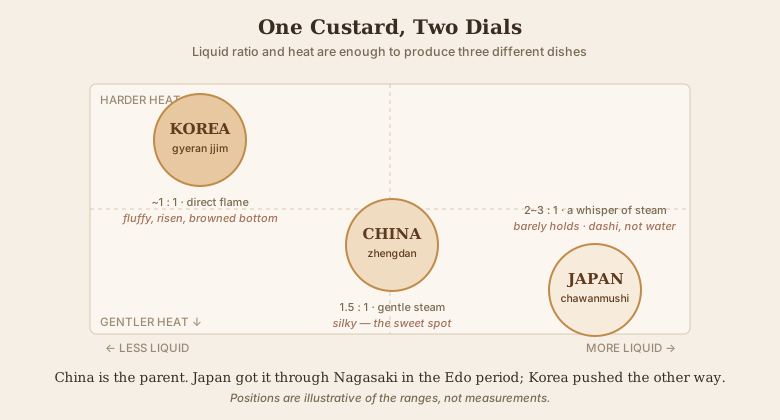
⭐ They’re all cooking the same custard. What separates them is how much liquid goes in and how hard the heat is — and those two dials are enough to produce three textures so different that most people never notice they’re eating the same dish.
I want to start with where it came from, because the family tree here is unusually clear. Most food history is a fog of parallel invention. This one has a route you can actually trace.
China first, and probably by a long way
The dish is 蒸蛋 (zhēngdàn) in Mandarin, 蒸水蛋 (zhēng shuǐ dàn) in Cantonese — literally “steamed water egg,” which is about as plain a name as food gets. Some places call it 水蒸蛋 or 蛋羹. It is not a restaurant dish and never really was. It’s what you make for a child, for someone recovering from illness, for a table that needs one more thing, for yourself at eleven at night.
That ubiquity is the point. It appears in lunchboxes, on hospital trays, at family tables. It’s cheap, it’s fast, it uses one egg and some water, and it goes down easily. Every food culture has a dish like that, and this is China’s.
Steaming as a cooking method is very old in China — bamboo and pottery steamers go back thousands of years, long predating the ovens that define European cooking — so a steamed egg custard is close to an inevitability once you have eggs and a steamer. What’s harder to date is when it became this specific dish, because a food this everyday doesn’t get written down. Cookbooks record banquets. Nobody writes down water egg.
⚠ So treat any confident “invented in the Han dynasty” claim with suspicion. The honest position is that it’s old, it’s Chinese, and the written record is thin precisely because the dish was too ordinary to be worth recording.
The route to Japan runs through one port
This is the part I find genuinely satisfying, because it’s specific.
Japanese chawanmushi (茶碗蒸し) — “tea-bowl steamed” — is generally traced to Nagasaki in the Edo period, and more precisely to a style of cooking called shippoku (卓袱). Shippoku was a Japanese-Chinese-Western fusion cuisine that developed in Nagasaki — and it developed there because Nagasaki was the one place it could.
Under the sakoku policy, Japan closed itself to most foreign contact for over two centuries. Nagasaki was the exception: Dutch traders on the artificial island of Dejima, and a Chinese quarter with real, sustained Chinese presence. Food moved through that gap. Chinese traders brought a steamed egg dish — 蒸水蛋 — and what came out the other side, adapted to Japanese ingredients and Japanese ideas about restraint, was chawanmushi.
⭐ So chawanmushi is roughly 300 years old and is an early, documented example of Asian fusion cuisine — a phrase that usually gets used about the 1990s. It predates it by three centuries.
The changes Japan made are the interesting part, and they’re all in the same direction:
- The water became dashi. This is the single biggest change and it transforms the dish from a neutral vehicle into something with a savoury spine of its own.
- The ratio went up. More liquid, softer set, something closer to a barely-holding custard than a solid.
- It got a lid and a cup. A dedicated vessel with a lid, which controls the steam and gets it to the table hot.
- It got composed. Ingredients placed deliberately — a shrimp, a ginkgo nut, a slice of kamaboko, a sprig of mitsuba — rather than stirred through.
I lived in Japan in the mid-eighties, stationed at Iwakuni, and chawanmushi was one of the things that took me a while to get. It arrives looking like nothing. It’s the least assertive thing on the table. And then you eat it and understand that assertiveness was never the point.
Korea went the other way
Gyeran jjim (계란찜) — gyeran is egg, jjim is a steamed dish — is the same custard pushed in the opposite direction from chawanmushi.
Where Japan added liquid and lowered the heat, Korea used less liquid and cooked it over a direct flame, traditionally in a ttukbaegi — a thick earthenware bowl that holds heat brutally well and comes to the table still bubbling. The result isn’t silky. It’s fluffy, spongy, risen — closer to a soufflé than a custard — with a browned, almost fried bottom where it met the hot clay.
It’s a banchan, a side dish, and it lives on Korean barbecue tables where its job is to be soft and mild against everything else that’s salty and charred and aggressive.
🔴 Same three ingredients. Opposite result. That’s not a corruption of the Chinese dish or a failed attempt at chawanmushi — it’s a deliberate choice about what a steamed egg should be, and it’s the best proof I know that the two dials really do control everything.
And then everywhere else
Once you know what to look for you find it all over the region:
- Vietnam — trứng hấp, usually loaded: minced pork, glass noodles, wood ear mushroom, sometimes a whole egg yolk set on top for colour.
- Thailand — khai tun, steamed in a bowl or, traditionally, in a banana leaf cup.
- The Philippines, Indonesia, Malaysia — all have versions, most showing Chinese influence directly.
- Cantonese sweet versions — steamed milk custard (双皮奶) and steamed egg custard are the dessert branch of the same technique.
Why I wanted to write this one
Because it’s the cheapest possible dish and it’s genuinely difficult to do well, and those two facts together are unusual.
An egg, some water, and heat. No equipment worth the name. And yet the difference between a good one and a bad one is enormous and completely visible — a good one is smooth and trembling and glossy, and a bad one is a pitted, weeping, rubbery sponge. There’s nowhere to hide. No sauce, no browning, no seasoning to rescue it. Just whether you got the ratio and the heat right.
That’s the next page, and it’s the one that actually matters.
In this dive: The science · China · Japan · Korea · Elsewhere · The espresso steam wand · Vessels and gear
Comments (0)