Sourdough
Sourdough deserves its own whole section, because it isn’t a kind of bread so much as the original bread — the way humans leavened dough for thousands of years before a packet of yeast existed. It’s also, to my mind, the most rewarding thing in the whole kitchen: you keep a living culture alive on your counter, and it rewards you with the best-flavored, best-keeping, best-crusted bread there is. It takes patience and a little understanding, and then it becomes second nature. Here’s everything I’ve learned.
What sourdough actually is
A sourdough starter is a living culture of wild yeast and lactic-acid bacteria (LAB), caught from the flour and the air, living together in a paste of flour and water. It’s a tiny ecosystem, and the two partners do different jobs:
- The wild yeast eats sugars and gives off carbon dioxide — that’s what makes the bread rise, exactly like commercial yeast, just slower.
- The bacteria produce lactic and acetic acid — that’s the sour, and it’s also a preservative and a flavor-builder that commercial yeast can’t touch.
That partnership is why sourdough tastes the way it does, keeps longer than yeast bread, and has a crust and crumb all its own. It’s slow food in the most literal sense.
Making a starter from scratch
You don’t buy the yeast — you culture it. It takes about a week:
- Day 1: mix equal weights of flour and water (say 50 g each) in a jar. Whole wheat or rye to start gives the wild microbes a head start. Loosely cover; leave it at room temperature.
- Days 2–7: once a day, discard most of it and feed what’s left with fresh equal weights of flour and water. This is the part beginners find strange — you throw most away — but you’re concentrating the good microbes and diluting the bad ones each day.
- Somewhere around day 5–7 it wakes up: bubbly, roughly doubling a few hours after a feeding, smelling pleasantly sour and yeasty. Now it’s a starter.
It’s alive, so it’s forgiving of everything except neglect and heat. My sourdough starter recipe walks through it (there’s a gluten-free version too).
Keeping it alive
- Bake often? Keep it on the counter and feed it once a day.
- Bake occasionally? Keep it in the fridge and feed it once a week — the cold slows everything down. Pull it out and give it a feeding or two to wake it up before you bake.
- A “levain” is just a portion of starter you build up fresh, in the amount and ripeness a particular loaf wants, before mixing. Same organism, purpose-built for the bake.
Treat it like a pet that only needs flour, water, and occasional attention, and it’ll outlive the loaf by years. People pass starters down for decades.
Hooch, neglect, and bringing a starter back
Here’s the thing nobody tells you when they’re warning you how “fussy” sourdough is: it is almost impossible to kill. I’ve left my starter in the fridge for many weeks without a single feeding — once the better part of a year — and it came back every time. When I open the jar after a long neglect, it’s separated into two layers: a liquid on top and a thick paste settled on the bottom. I stir it back together (it takes a little muscle), feed it, and within a day or two it’s bubbling away like nothing happened.
That liquid has a name — hooch — and it’s worth understanding, because it looks alarming and isn’t. When the culture runs out of food, the wild yeast keep working and give off alcohol and water; the hooch is essentially a weak, sour, boozy liquid the starter made for itself (the name is old Prohibition slang for homemade liquor). It’s a hunger signal, not a death sign. The separation happens because, sitting cold and unfed, fermentation slows to a crawl, the gluten structure breaks down, the gas escapes, and the solids sink while the liquid rises. The cold of the fridge drops the microbes to near-dormancy, which is exactly why a starter can ride out months — even a year — down there and still wake up.
Two small choices when you find hooch:
- Stir it in for a tangier, more sour starter — the hooch is full of accumulated acid. That’s what I do.
- Pour it off first for a milder one. Either is correct; it’s a flavor dial.
Then revive it the same way every time: stir it up, keep just a spoonful, discard the rest (you’re diluting out the built-up acid and spent byproducts), and feed it generously — a small seed against a lot of fresh flour and water, say 1:5:5 or even 1:10:10. Leave it at room temperature and repeat every 12–24 hours. It usually takes one to three feedings before it’s rising and bubbly and ready to build a levain from.
The one time to actually throw it out: hooch and a sharp sour or acetone (nail-polish) smell are normal and healthy, even when the liquid goes gray or brown. But fuzzy mold (pink, orange, green or black spots sitting on the surface), a pink or orange streak through the paste, or a genuinely rotten rather than sour smell mean the jar has been contaminated — discard it and start a fresh starter. That’s rare. Far more often, the scary-looking jar in the back of the fridge is just thirsty.
A sourdough day, start to finish
Here’s the rhythm of a bake. It sounds long, but almost all of it is the dough working while you do other things:
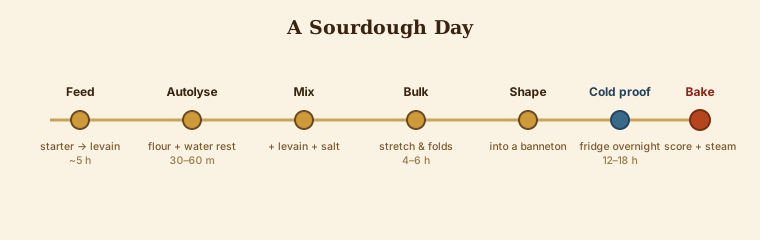
- Feed your starter into a ripe levain (a few hours ahead).
- Autolyse — mix just the flour and water and let it rest 30–60 minutes. The flour hydrates and gluten starts forming on its own, with no kneading. This one free step makes a noticeably better loaf.
- Mix in the levain and the salt.
- Bulk ferment — the long rise, a few hours at room temperature, during which you give the dough a series of gentle stretch-and-folds every 30–45 minutes instead of kneading. This builds strength in a high-hydration dough without a mixer.
- Shape the dough into a taut round or oval and set it in a floured banneton (a proofing basket).
- Cold-proof it in the fridge overnight — 12 to 18 hours. This is my favorite trick: the cold slows the yeast but lets the bacteria keep working, so the loaf develops more sour flavor, becomes far easier to score, and fits your schedule (mix one day, bake the next).
- Bake it hot, with steam and a good score (see Artisan and Ovens for the how).
Controlling the sour
How tangy your bread gets is something you steer, and it’s worth understanding why, because it’s the whole difference between the mild loaf most people bake today and the sharp, old-fashioned sourdough I prefer. There are really two sour acids at work, and they taste different:
- Lactic acid is the soft, round, yogurty tang — the same acid that’s in yogurt and buttermilk. Warm, wet, fast ferments favor it.
- Acetic acid is the sharp, bright, vinegary bite — literally the acid in vinegar. Cool, stiff, slow, slightly-more-oxygen ferments favor it. This is the one that makes a loaf taste properly sour.
The levers that push toward more — and sharper — sour:
- Cooler and slower, especially a long cold retard in the fridge. This is the big one. Cold suppresses the yeast more than it does the acid-making bacteria, so while the dough is barely rising, the bugs keep making acid. Hours in the cold buy you tang.
- A stiffer, cooler starter and a lower-hydration dough favor acetic (sharp) acid; wet and warm favors lactic (mild).
- A hungrier, less-frequently-fed starter — one that’s had time to build acid between feeds (see hooch, above) — carries more sour into the dough. A starter fed three times a day and used at its bubbly peak is mild by design.
- Whole grain and rye bring more minerals and microbial food and ferment more actively → more acid.
So if your sourdough is too mild, ferment it cooler and longer, keep the starter a little hungrier and stiffer, and work in some whole grain; too sharp, go warmer and faster and feed the starter fresh right before you bake.
Why mine comes out tangier than most sourdough today
This is the part I care about, because it’s real. A lot of what’s sold and baked as “sourdough” right now is barely sour — and that’s not an accident, it’s the method. The popular modern approach feeds the starter often, ferments warm and fast, and bakes the dough young, all of which is tuned for a big, open, Instagram crumb rather than for flavor. Nothing’s wrong with it; it’s just a mild bread wearing the sourdough name, and the tang never gets the chance to materialize. My bread tastes sharper because I do close to the opposite: a mature, sometimes long-neglected starter that’s carrying real accumulated acid, and long, cool ferments that let the acetic acid build. That built-up acid is exactly the old-fashioned sour a lot of people remember from proper bakery sourdough and can’t find on most shelves anymore.
Is that like lagering a beer?
It’s the same family of idea — cold plus time developing flavor through slow microbial work — and that’s a good instinct. But the two pull in opposite directions, which is the fun part. Lagering takes a clean, already-fermented beer and holds it cold for weeks so the yeast cleans up harsh compounds and the flavor gets smoother and rounder — cold conditioning that mellows. My cold starter does the reverse: the cold lets the bacteria keep building acid, so it gets sharper, not smoother. The closer beer cousin is really a sour or barrel-aged beer — a Lambic or a Berliner Weisse — where lactic and acetic bacteria slowly acidify the beer over months, exactly the way the bugs acidify my dough. Same principle as lagering (cold + time = flavor), opposite result (a sour beer, not a clean lager). The bread world’s own name for this is cold retarding, and it’s the single most powerful tang lever you have.
Where I take it
Once the basic loaf is in hand, sourdough goes everywhere:
- The everyday sourdough loaf and a second version I keep in rotation.
- Rosemary, garlic & sharp cheddar sourdough — a showstopper.
- A barley sourdough with scalded flour — the scalded-flour trick (a cousin of tangzhong) makes an incredibly soft, long-keeping crumb; more on scalding over on the Ingredients page.
- Beyond loaves: sourdough pretzels, sourdough pancakes, sourdough whole-wheat crackers, and even chocolate sourdough cake — great ways to use discard.
- And a whole gluten-free sourdough branch for when it’s needed.
Don’t be intimidated
Sourdough has a reputation for being fussy, but the truth is it’s just slow, and slow is forgiving. The dough waits for you. A missed feeding won’t kill your starter; an extra hour of bulk ferment won’t ruin your loaf. Start the starter, bake a few loaves, pay attention to how the dough feels, and in a month it’ll feel like the most natural thing in the world — the same thing bakers have done for ten thousand years.
Next, the craft of the crust: Artisan Breads.
Comments (0)