The Rofco B40 — My Pick to Start a Bakery
Of all the ovens I’ve looked at for scaling up bread, the one I keep coming back to is a squat Belgian brick box called the Rofco B40. It isn’t flashy, it has two dials and no screen, and it costs a fraction of a commercial deck oven — and it might be the single smartest first oven a micro-bakery can buy. It bakes artisan loaves with the stone-deck crust and spring that a home range and even my convection oven can’t quite touch, and it’s cheap and simple enough that you keep it around forever, running small special batches long after you’ve graduated to a full deck oven. This is my honest, in-the-weeds case for it.
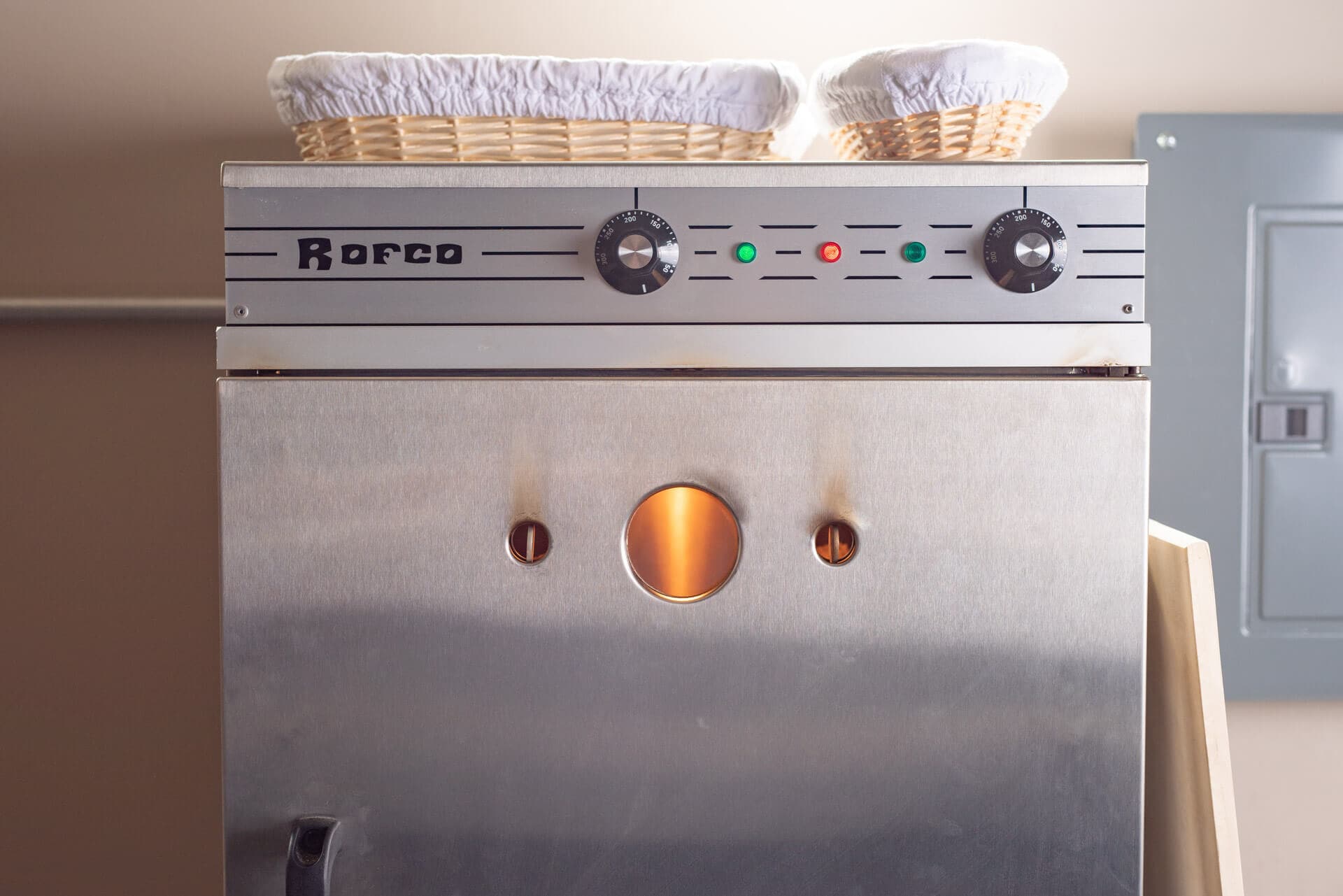
What it actually is
Rofco is a small Belgian company that’s been making electric brick ovens for decades. The idea is simple and old: instead of blowing hot air around a metal box, you heat thick slabs of chamotte (refractory fire brick) until they’re saturated with stored heat, then bake directly on the stone. It’s the same physics as a wood-fired masonry oven or a bakery deck oven — a huge reservoir of heat radiating up into the bottom of the loaf — just delivered by clean electric elements you plug into the wall. No flame, no wood, no gas line.
The B40 is the biggest of the family and the one every serious home baker means when they say “a Rofco.” It’s about the size of an under-counter fridge, weighs a genuinely awkward ~185 lb, and holds three brick decks you load and unload like a tiny deck oven. What you’re buying is thermal mass and evenness in a package that fits through a normal doorway and runs on a beefy household circuit.
The model range
Rofco makes four sizes, all the same basic stainless-and-firebrick construction — pick by how much bread you actually bake at once. The B40 is the one worth stretching for if a business is anywhere in your future.
| Model | Decks | Capacity (850 g loaves) | Power | Weight | Who it’s for |
|---|---|---|---|---|---|
| B5 | 1 | 2 | 1.3 kW / 230 V | ~48 lb | A dedicated home baker, 1–2 loaves |
| B10 | 2 | 4 | 1.8 kW / 230 V | ~77 lb | A serious hobbyist / small family |
| B20 | 3 (small) | 6 | 2.5 kW / 230 V | ~123 lb | Heavy home baker, tiny side hustle |
| B40 | 3 (large) | 12 (or ~18 smaller) | 3.1 kW / 230 V | ~185 lb | Micro-bakery — the workhorse |
The jump from the B20 to the B40 isn’t just a third deck — the B40’s decks are physically bigger (about 19″ × 19″ each versus the smaller ovens’ narrower shelves), which is what takes it from “a lot of bread for a house” to “a real day’s market table.”
Outside: two dials and a window
The whole exterior is stainless steel, inside and out. On the front you get a viewing window and an interior light so you can watch a bake without opening the door and dumping heat, and — this is the part people either love or laugh at — two dial thermostats. That’s the entire control panel. The left dial runs the top elements, the right dial runs the bottom, each up to about 250 °C (≈480 °F), with a little indicator light that glows while the elements are pulling.
There’s no display, no probe readout, no Wi-Fi, no app. And after a year of thinking about ovens, I’ve decided that’s a feature, not a gap. Two dials and a pile of firebrick is a machine that will still be running in twenty years, that any electrician can service, and that has almost nothing on it to fail. (I get into why I distrust the “smart” alternative down in where it sits versus the competition.)
Inside: three stone decks
Open the door and it’s three chamotte firebrick decks, each stone roughly 1-3/8″ thick. That thickness is the whole point — it’s a heat battery. You preheat for a good long while to soak those bricks, and once they’re loaded they slam stored heat up into the loaves and barely flinch when you open the door to load. The oven recovers in minutes, not the half hour a thinner box needs, which is exactly what lets you run batch after batch.
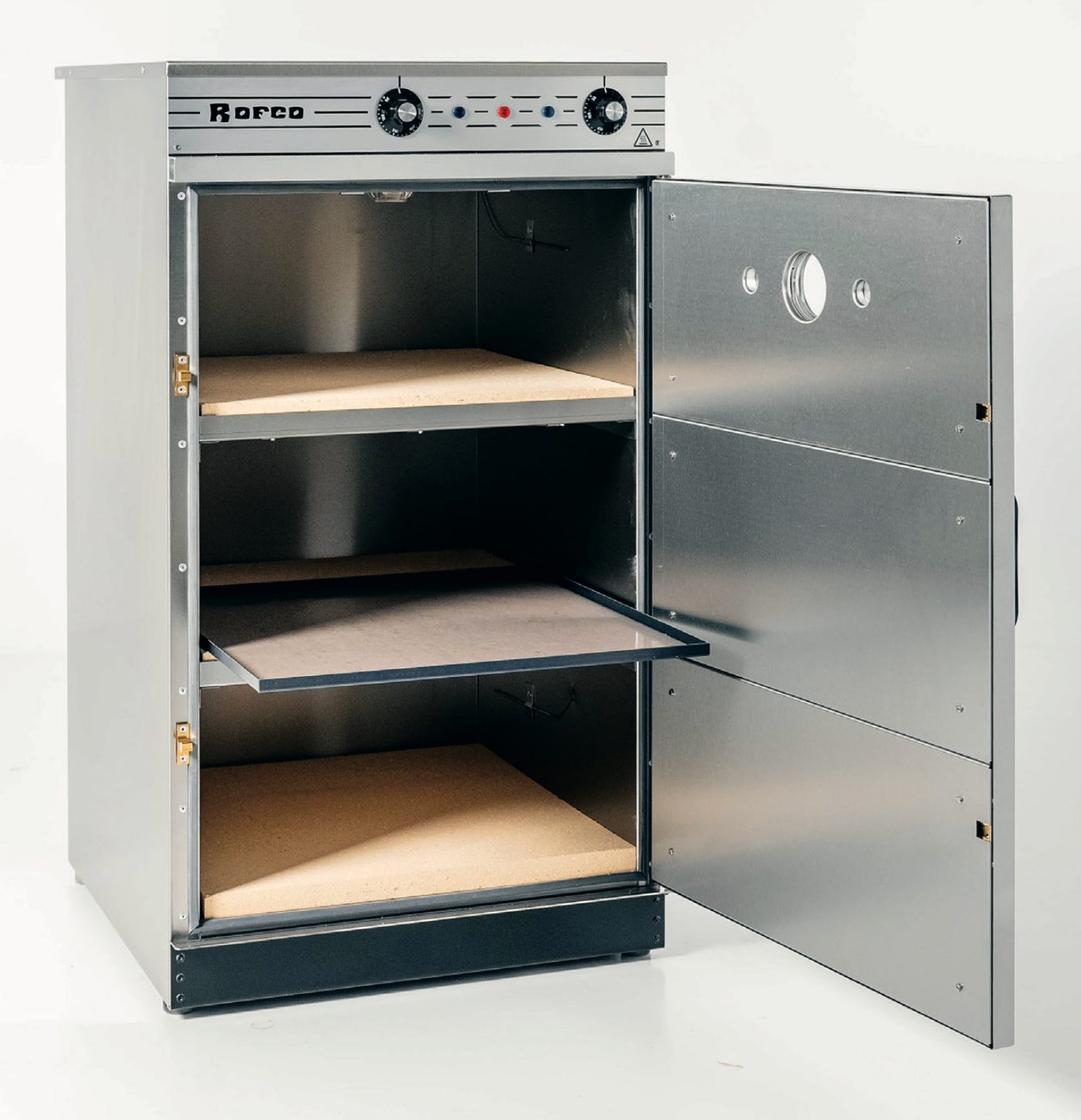
The sealed brick chamber also means it throws very little radiant heat into the room — a real consideration in a small kitchen or a hot summer market prep — and it holds moisture around the loaf far better than an open convection cavity that’s constantly venting.
Baking bread in it
Here’s a bake the way it actually goes, which is the best argument for the oven:
Preheat — long. Turn both dials to about 240 °C and walk away for 90 minutes. You’re not waiting for the air to get hot (that happens fast); you’re waiting for the bricks to fully saturate. Rush this and the first batch underperforms. This is the one real tax the Rofco charges: patience up front. (Once it’s hot, it stays hot, so that tax is paid once per baking day, not per batch.)
Load — like Tetris. You turn out your proofed loaves onto a peel or silicone sheet, score them, and slide them onto the stone. A common B40 load is two 900 g batards per deck = six loaves a turn, or a mix of boules; push it and you’re at a dozen. It genuinely is a little real-life puzzle — fit the most dough you can without loaves touching, so they can spring and brown on all sides.
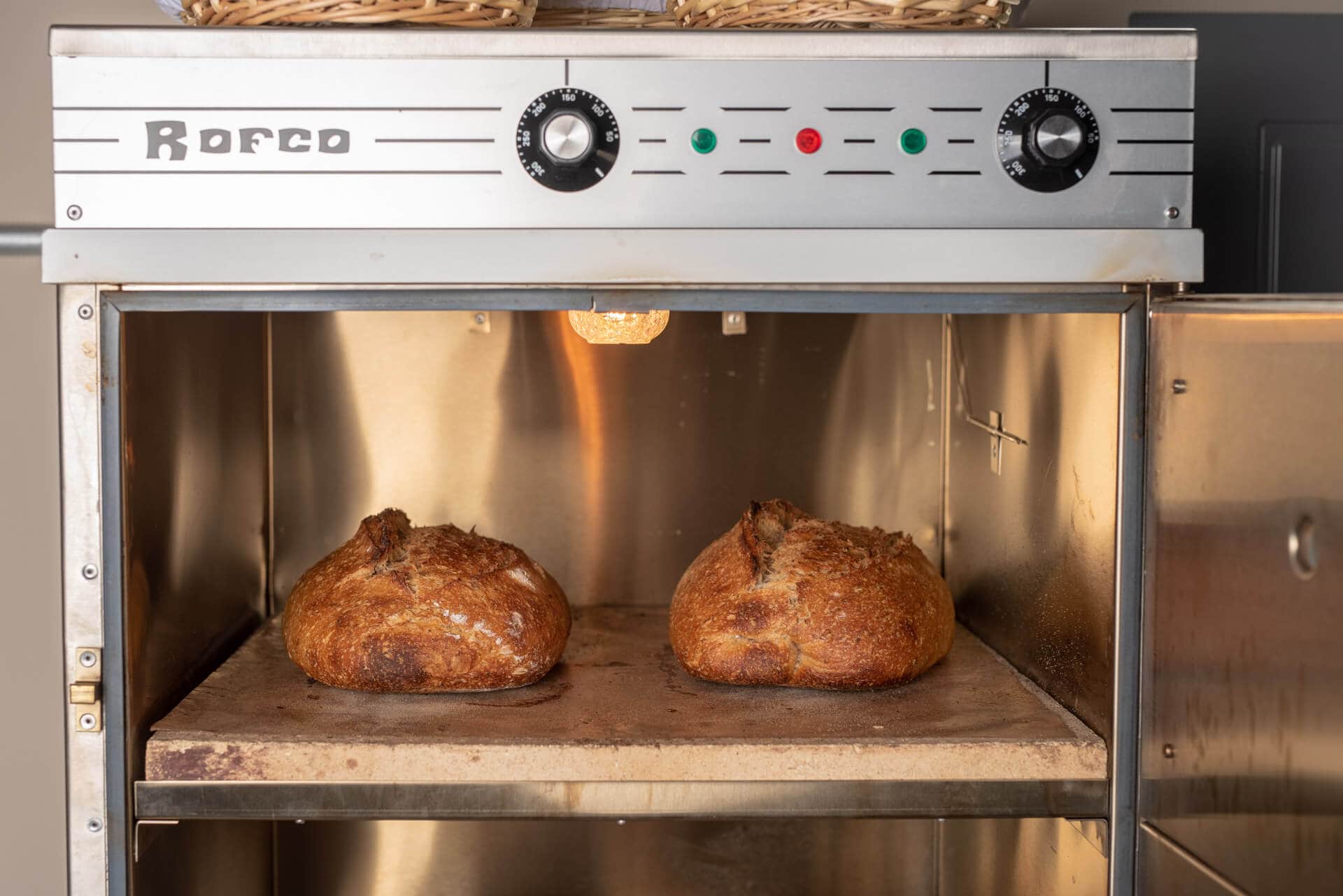
Steam — the one manual step. This is the Rofco’s honest weak spot and it’s worth being straight about: there’s no built-in steam injector. You steam it yourself. The two ways that work:
- A fine-mist sprayer. A pump or electric mister, set to the finest mist, and you spray each deck for a good 10-ish seconds as you load, then a second pass before the door shuts. Cheap, and what most people settle on.
- Steam pods / a pan. Preheated steel boxes or a cast-iron pan on the oven floor that you pour water or drop ice into. Effective, but they eat deck space and take up a slot.
You bake with the door shut for the first ~20 minutes to trap that steam and get maximum oven spring, then crack the door and flip the little vents open to dry things out and set a thin, crackly, glossy crust for the last stretch. One caution learned the hard way by others: don’t spray water at the glass light fixture — thermal shock can crack it. Aim at the bricks.
The result. This is why you put up with the manual steam and the preheat: the loaves come out with a deep, blistered, deck-oven crust, a proper open crumb, and the kind of oven spring you just can’t fake in a convection oven, where the fan dries the surface and blows your steam away. For sourdough and artisan loaves, it’s the closest thing to a professional deck oven you can put in a house.
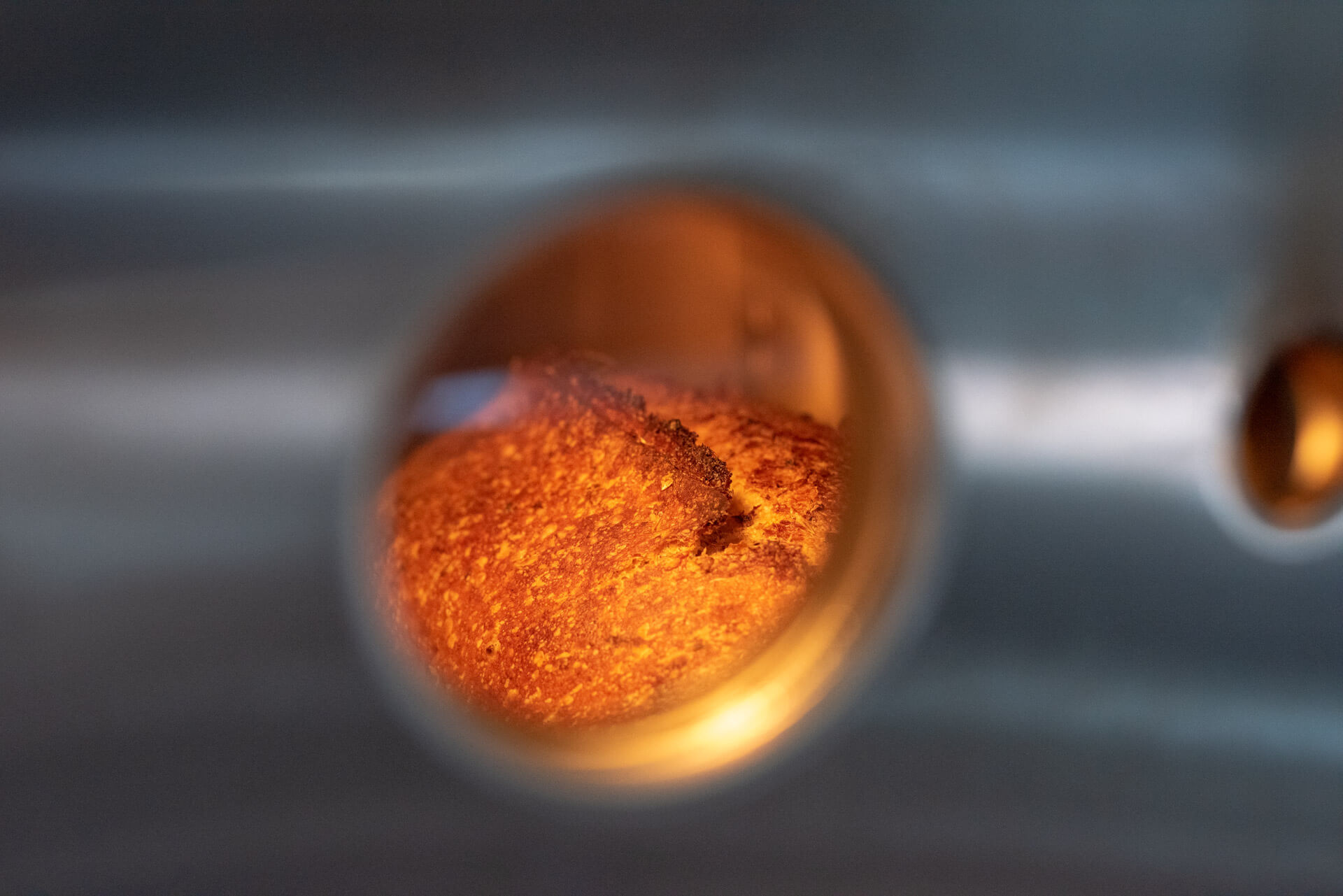
And it isn’t a one-trick oven. Those same hot stones do beautiful enriched loaves, rolls, baguettes, and — with the deck heat cranked — a very respectable pizza.
How a masonry deck oven works
If you’ve only ever baked in a convection oven, the why is worth a second. It’s all about where the heat is stored and how it moves:
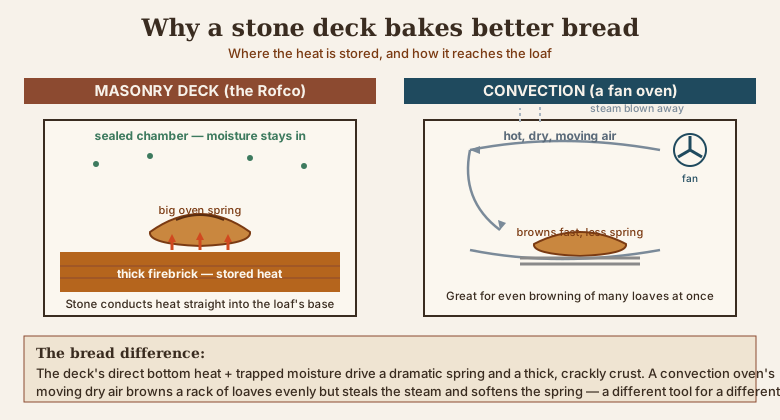
A convection oven heats air and moves it fast — great for browning a lot of loaves evenly, lousy for spring and crust because the moving air is dry and steals your steam. A masonry deck oven heats stone, and stone conducts heat straight into the bottom of the loaf on contact. That direct bottom heat is what drives a dramatic oven spring, and the still, sealed, brick-lined chamber keeps the loaf humid long enough to balloon before the crust sets. Different tool, different bread.
Installation and setup
A few practical realities before one shows up on a pallet:
- Electrical. The B40 runs on ~240 V and draws about 3.1 kW, so it needs its own dedicated circuit and the right outlet (in North America the US units ship with a NEMA 6-20 plug). Have an electrician sort the outlet before delivery day — this is the same 240 V conversation I have about every serious electric appliance, and the good news is that, like my convection oven, it burns no fuel and throws no grease, so it lives at the easy, hood-friendly end of the ventilation rules that dominate a real kitchen build.
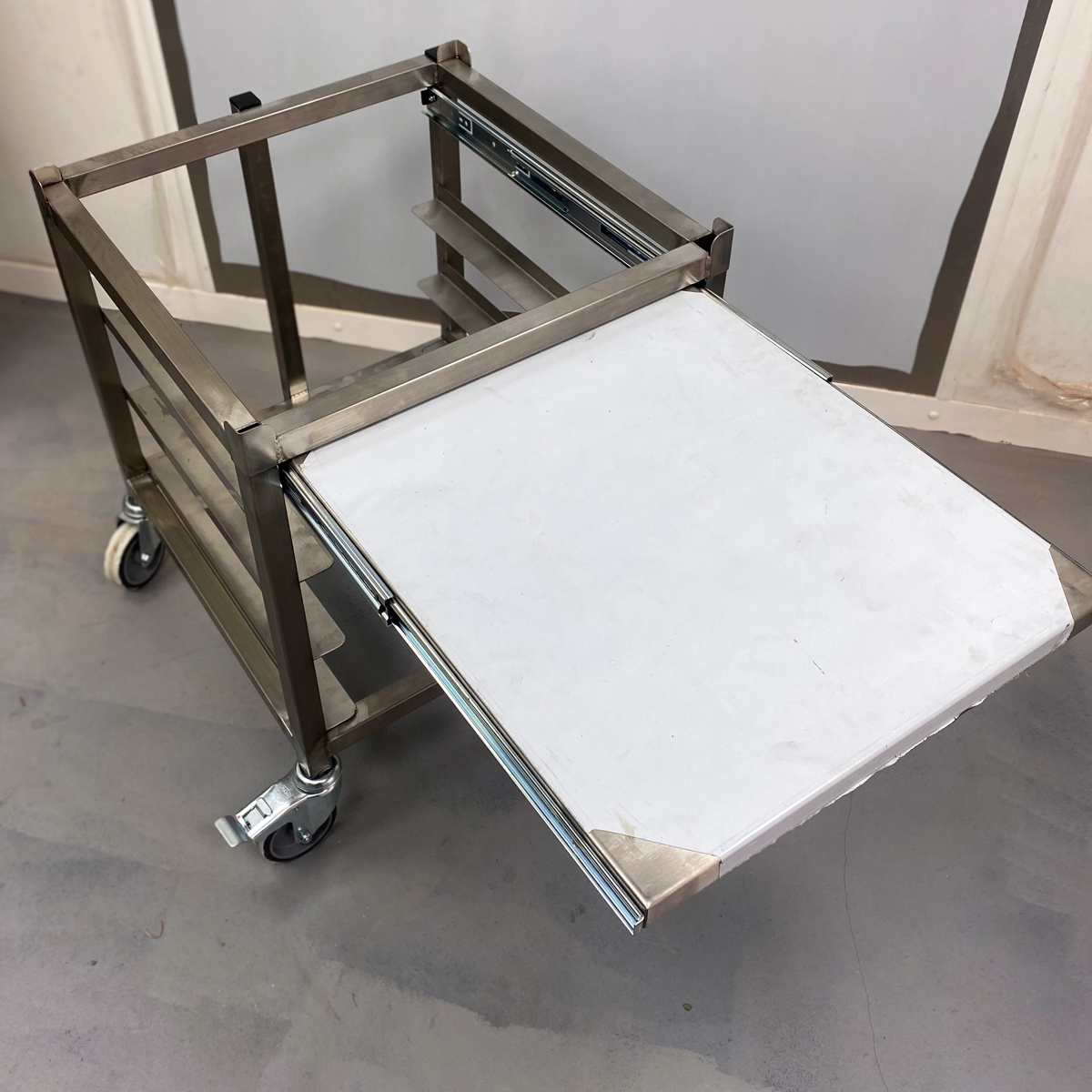
- A stand, at the right height. At ~185 lb the oven wants a solid base, and you badly want the decks at a comfortable loading height — bending to a low deck a hundred times a morning is how you wreck your back. Purpose-built stainless steel stands exist (companies like RackMaster make carts sized exactly for the B40, often with a pull-out shelf and tray runners underneath, on locking casters). Set the decks around counter height and loading becomes easy.
- Getting it in place. It’s heavy and doesn’t want to be moved often — plan the spot once. It fits through a standard door, but it’s a two-person lift.
- Tools that matter. A wide peel sized to the deck (~18″), a couple of silicone loading sheets, a fine mister for steam, and a lame for scoring. That’s about it.
What it costs and where to buy it
The price is a big part of the argument. A B40 runs roughly $1,500–$2,500 new, depending on the seller and the moment — a fraction of the cost of a commercial deck oven, which starts in the many thousands and climbs fast. Demand routinely outstrips supply, so new stock sells out and clean used B40s often go for $3,000–$4,000 — one of the few appliances that holds its value that well, which tells you something about how bakers feel about it.
Where I’d look:
- Pleasant Hill Grain (
pleasanthillgrain.com) — the long-standing US distributor; repeatedly praised for genuinely responsive support, which matters on an imported machine. - Rofco direct / European distributors (
rofco.be,rofco.com) — the source, with a distributor network across Europe, Australia, Japan, and North America. - Specialty bakery-equipment dealers (e.g. artisanbaker.eu, iscahps.com in the UK) and the used market — bakers upgrading to bigger deck ovens sell B40s that have plenty of life left; there’s very little to wear out in a firebrick box.
A 2-year warranty is standard, but honestly the reason people buy it is the opposite of warranty anxiety: there’s almost nothing on it to break, and what can (a door clasp, a light, an element) is cheap and simple to replace.
Where it sits versus the competition
I looked hard at the newer, flashier alternative — the Simply Bread Oven, a US-made ~$8,500 electric deck oven with a digital screen, Wi-Fi, and, its headline feature, built-in push-button steam (the thing the Rofco makes you do by hand). It’s a genuinely clever machine and its happy owners love it. But it’s roughly four times the price, and the independent reports include enough reliability trouble — warped doors, blown control boards, an owner class action — that I’m not willing to bet a startup on that much proprietary electronics near high heat.
That comparison is exactly what sold me on the Rofco. Its greatest strengths are that it’s cheap, simple, and nearly indestructible: three stone shelves and two dials, a machine a whole generation of cottage bakers has learned on and leaned on. The trade-offs are real and I won’t pretend otherwise — you steam it by hand, you wait out a 90-minute preheat, and there’s no digital anything. For a bakery that’s starting on a shoestring and wants to bake, not babysit firmware, those are trades I’ll take every time.
Rofco vs. the RackMaster RM2020
The Rofco’s most serious rival isn’t the flashy Simply Bread — it’s the RackMaster RM2020, a brick oven built in Essex, England by a fabrication shop that’s been at it for 40 years. Where the Simply Bread answers the Rofco with electronics, the RM2020 answers it with engineering: it takes the exact same firebrick-deck idea and fixes the specific things Rofco owners have grumbled about for years. (Fittingly, the stand under my Rofco in the photo above is a RackMaster.)
The headline fix is heat evenness. A Rofco B40 has two dials for the whole oven — one for the top elements, one for the bottom — so the three decks can’t be dialed in separately, and in practice the bottom deck runs hottest. Cottage bakers even have a name for the mid-bake rotate it forces: the “Rofco Shuffle.” The RM2020 gives every one of its three decks its own independent temperature control, which largely designs that problem out. It also swaps the Rofco’s little round porthole for a big oblong window with a separate light on each deck (you can actually see all three shelves), runs to a higher 300 °C, and uses a heavier, fully-welded chamber with a tighter door seal that holds your hand-added steam in better.
Here’s the honest head-to-head:
| Rofco B40 | RackMaster RM2020 | |
|---|---|---|
| Made in | Belgium — global distribution | Essex, UK — made to order |
| Price | ~$1,500–2,500 (≈£1,500–2,000) | £3,495 + VAT (≈£4,190; ~$5,000+ imported to US) |
| Decks | 3 × ~19″×19″ firebrick | 3 × 600×460 mm firebrick (a bit larger) |
| Deck heat control | 2 dials (top + bottom, shared across decks) | Independent control on every deck (3 zones) |
| Max temp | ~250 °C (480 °F) | 300 °C |
| Capacity | ~12 loaves (~12 kg dough) | ~12 kg dough, slightly more deck area |
| Window | Small round porthole | Large oblong window + a light per deck |
| Power | 3.1 kW · 230 V single-phase | 3.0 kW · 230 V single-phase (16 A) |
| Weight | ~85 kg (185 lb) | 162 kg (357 lb) — much heavier |
| Steam | Manual (no injection) | Manual — but welded chamber + seal = less steam loss |
| Availability | In stock + a huge used market | 4–6 wk made-to-order, 50% deposit; UK-focused |
The RM2020 is, feature for feature, arguably the better oven — one detailed brick-oven bake-off ranked the RackMaster line #1 overall, ahead of both the Rofco and the Simply Bread. But look at what you pay for it: roughly double the Rofco’s price, nearly twice the weight (162 kg is a serious floor-and-stand and two-strong-people-to-move-it consideration), a 4–6 week made-to-order wait with a 50% deposit, and a UK-centric supply chain that means import cost and lead time if you’re in the States. And for all that, it still steams by hand — the one chore neither Belgian nor British brick solves.
So the way I weigh it: if I were in the UK, or I could comfortably spend about twice as much and wanted even, per-deck heat plus real visibility and a little more room, the RM2020 is the upgrade — and probably the oven I’d eventually graduate to. But to start a bakery — buy now (or used), keep the cash for flour and rent, on a lighter, globally-serviced, thoroughly-proven machine — the Rofco B40 is still where I’d begin. The RM2020 is the oven I’d aspire to; the Rofco is the oven I’d bake on tomorrow.
Why it’s my “start here — and keep forever” oven
Here’s the whole case in one place. The Rofco B40 is the oven I’d start a bread business on because:
- It bakes true deck-oven bread — real crust, real spring — which is the actual product I’m selling, in a way my convection oven can’t.
- It’s a quarter the price of a commercial deck oven and holds its value, so the downside risk is tiny.
- It’s simple and bombproof, with a support network and a used-parts reality that mean it just keeps running.
- A dozen loaves a turn, minutes to recover — enough to supply a market table or a small wholesale route while you find your footing.
And the reason it never leaves, even after the business outgrows it and I buy a big commercial deck oven: it becomes the specialty-batch and overflow oven. A separate deck for a small run of a different loaf, a gluten-free or rye batch you want kept apart, extra capacity on a slammed holiday morning, or a rock-solid backup for the day the main oven is down. An oven this cheap, this durable, and this good at crust is one you buy once and simply never get rid of.
If you want the wider context on how the Rofco stacks up against gas, electric, and convection in general, that’s all in Ovens & Equipment — and the rest of the craft, from sourdough starter to scoring an artisan loaf, is waiting in the Breads section. Now go bake something — a lot of it.
Comments (0)