Ingredients & the Science
Bread is the most magical thing you can make from the fewest ingredients. Four things — flour, water, salt, and a leavening — become something alive and transformed. But every ingredient is pulling levers under the hood, and once you understand what each one actually does, you stop following recipes blindly and start understanding them. Here’s the science I wish I’d learned first, including one of my favorite bits of bread lore: why old recipes tell you to scald the milk, and why new ones just reach for the powder.
Flour — and gluten, the whole ballgame
Flour is mostly starch, but the part that makes bread bread is its protein. When flour meets water, two proteins — glutenin and gliadin — grab the water and, with a little kneading or time, link up into gluten: a stretchy, elastic web that traps the gas from fermentation and lets dough rise into an airy structure instead of a flat cracker.
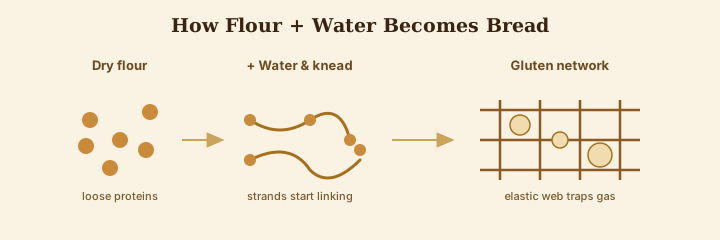
That’s why flour choice matters so much — it’s really about protein content:
- Bread flour (~12–14% protein) builds the most gluten — chewy, strong, high-rising. My choice for artisan loaves and bagels.
- All-purpose (~10–12%) is the everyday middle — fine for most loaves.
- Whole wheat carries the bran and germ (more flavor and nutrition), but the sharp bran bits cut the gluten web, so whole-grain loaves are denser and thirstier for water.
- Low-protein flours (pastry, cake) make gluten you don’t want in bread — they’re for tender, not chewy.
Water — and hydration
Water hydrates the flour, activates the yeast, and dissolves the salt — and how much you use (expressed as a percentage of the flour weight, the baker’s way) shapes the entire loaf:
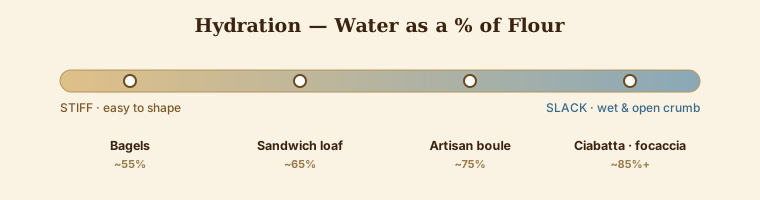
More water means a wetter, harder-to-handle dough — but also a more open, holey crumb and a crustier loaf. Less water means a stiff, easy-to-shape dough with a tight, even crumb. A bagel lives near 55%, a sandwich loaf near 65%, an artisan boule near 75%, and a slack ciabatta up past 85%. Learning to read hydration is the single biggest step from following recipes to understanding them.
Yeast — the engine
Yeast eats the sugars in the dough and gives off carbon dioxide (which inflates it) and alcohol and acids (which flavor it). You’ve got choices:
- Instant / active dry yeast — the modern packet. Fast, reliable, predictable. Instant can go straight into the flour; active dry likes a little warm water first.
- Fresh (cake) yeast — what bakeries used to use; lovely but perishable.
- Wild yeast — the yeast and bacteria you culture yourself in a sourdough starter. Slower, more temperamental, and far more flavorful. For thousands of years this was the only leavening, and it’s still my favorite.
The one rule with any yeast: it’s alive. Warmth wakes it up, cold slows it down, and too much heat (over ~130–140°F) kills it. Managing that temperature is most of the game.
Salt — never skip it
Salt does three jobs, and a loaf without it tastes instantly, weirdly flat. It seasons the bread; it strengthens the gluten network for better structure; and it controls the yeast, slowing fermentation so flavor has time to develop and the dough doesn’t run away from you. Typical is about 2% of the flour weight. Miss the salt and you’ll know immediately — I’ve done it, and the loaf is edible but lifeless.
Sugar & fat — the enrichers
Plain “lean” dough is just flour, water, salt, and yeast (that’s most artisan bread). Add sugar and fat and you get “enriched” dough — softer, richer, more tender:
- Sugar feeds the yeast for a faster start, helps the crust brown, holds moisture for a softer crumb, and (in quantity) sweetens. Too much actually slows yeast, which is why sweet doughs like cinnamon rolls rise slowly.
- Fat (butter, oil, eggs) coats the gluten strands, tenderizing the crumb and enriching the flavor — the difference between a crusty baguette and a soft, rich brioche or Hawaiian roll.
Milk — and the great scalding mystery
Here’s the one I love. Flip through old bread and roll recipes and you’ll constantly see the instruction: “scald the milk, then cool it before adding.” New recipes almost never say that — they just call for a spoon of powdered (dry) milk in with the flour. What gives?
Why the old recipes scald milk: raw milk contains a whey protein (and active enzymes) that actually weakens gluten — use raw milk straight and your dough turns slack and sticky and your loaf rises poorly and comes out denser. Heating the milk to a scald (about 180°F / 82°C, just below a boil, until it steams and shimmers with tiny bubbles at the edge) denatures that protein and knocks out the enzymes, so the milk enriches the bread without sabotaging the gluten. Back before pasteurization, scalding did double duty — it also killed bacteria that would otherwise sour the dough. The payoff is a softer, taller, better-keeping loaf.
Why new recipes use powdered milk instead: commercial dry milk powder is already heated hard during manufacture, so that gluten-weakening protein is already denatured. Toss the powder straight into your flour and you get all the benefits of milk — tenderness, browning, a soft crumb, better keeping — with no scalding, no scorched pan, and no waiting for it to cool. It’s shelf-stable and foolproof. Here’s the subtle part most people miss: ordinary pasteurization isn’t hot enough to fully denature that protein, so even today, if you bake with liquid milk, scalding it still genuinely helps. Powdered milk simply sidesteps the whole question — which is exactly why modern recipes reach for it.
The short version: old recipes scald milk to stop raw-milk proteins from weakening the gluten (and, historically, to kill bacteria). Powdered milk is pre-heated at the factory, so it’s the modern shortcut that gives the same soft, rich loaf with none of the fuss.
Putting it together
That’s the whole toolkit. Strong flour and water for structure; yeast for lift; salt for control and flavor; sugar, fat, and milk to enrich and soften. Change the ratios and you change the bread — lean and crusty, or soft and rich, or anywhere between. For the practical side of turning these into loaves, keep going: sourdough, artisan breads, everyday loaves, bagels, and the ovens that bake them. My bread-making tips recipe collects a lot of this at the bench.
Comments (0)