Canning
Canning is the method that turned my pantry into a store. It’s how I keep the summer garden, a big batch of stock, a whole deer, or a good sale on chicken shelf-stable for a year or more — no freezer, no refrigeration, just sealed jars on a shelf. It looks intimidating the first time, but it comes down to a little science and one non-negotiable safety rule. I have dozens of canning recipes, and here’s the framework that ties them all together.
How canning works
Canning does two things at once: it heats the food hot enough to destroy the microbes that cause spoilage, and it seals the jar so nothing can get back in. As a sealed jar cools, it pulls a vacuum and the lid pops down tight. Done right, the food inside is sterile and airtight — and it’ll keep for a year or more at room temperature.
The whole craft is about making sure that first part — the heat — actually reached a kill-everything temperature. And that depends entirely on one thing: how acidic the food is.
The one rule: pH 4.6
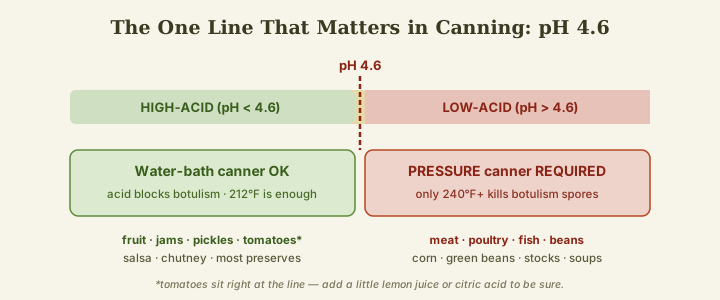
Everything in canning divides at pH 4.6, because that’s the line botulism can’t cross:
- High-acid foods (below pH 4.6) — fruit, jams and jellies, pickles, most tomatoes, chutneys, salsa — can be water-bath canned. Submerge the filled jars in boiling water for the tested time; 212°F is plenty, because the food’s own acidity blocks botulism.
- Low-acid foods (above pH 4.6) — meat, poultry, fish, beans, corn, green beans, stocks, soups — must be pressure canned. Only a pressure canner reaches the 240°F+ needed to destroy botulism spores. Boiling water alone will not make low-acid food safe, no matter how long you boil it.
⚠️ Never water-bath-can low-acid food, and never make up your own times or recipes. Canning is the one kind of cooking where I follow tested, published recipes exactly — the times and pressures come from lab testing, not tradition. When in doubt, treat it as low-acid and pressure-can. See Food Safety & the Law.
⭐ And if you are ever the one deciding which side of 4.6 a jar falls on — a recipe you adapted, a tomato variety you are unsure of, a relish of your own — that is a measurement, and Measuring pH is how it is done: which instrument the regulation accepts at which reading, how to prepare the sample, and why you must measure the finished, equilibrated jar rather than the liquid you poured in.
The two tools
- A water-bath canner is just a big pot deep enough to cover the jars with an inch of boiling water. Cheap, simple, and all you need for high-acid foods.
- A pressure canner (not the same as a pressure cooker — you want a true canner) seals and builds steam pressure to push the internal temperature past 240°F. It’s the tool that makes canning meat and vegetables possible. Worth every penny if you preserve savory food.
What I can, by category
The range is enormous once you’re set up. A tour of my shelves, all linked to the recipes:
- Meat & poultry (pressure): cubed beef, ground beef or venison, chicken, canned bacon, pulled BBQ pork, canning pork ribs, and taco meat.
- Fish (pressure): Mom’s canned salmon from a fisherman and smoked-and-canned salmon.
- Stocks, soups & stews (pressure): beef stock, chicken stock, vegetable broth, and beef or venison stew with vegetables.
- Beans & staples (pressure): dried beans, refried pinto beans, chili with meat and beans.
- Tomatoes & sauces (water-bath, with added acid): crushed tomatoes, seasoned tomato sauce, tomato paste, homemade ketchup, salsa, and enchilada sauce.
- Fruit, jams & jellies (water-bath): canned apple cider, spiced applesauce, strawberry-rhubarb jam, cider jelly, and even dandelion jelly.
For the full method — jar prep, headspace, processing times, altitude adjustments — see my canning reference guide.
Tomatoes: the one that fools people
Tomatoes sit right at the pH 4.6 line, and modern varieties are often a touch less acidic than old ones. That’s why every safe tomato-canning recipe has you add a little lemon juice or citric acid to each jar — it nudges them safely into high-acid territory so you can water-bath them. Don’t skip it.
The payoff
There’s nothing quite like walking down to a shelf of jars you filled yourself — venison from last fall, tomatoes from August, stock from the Sunday roast — and pulling dinner off it in January. Canning is preservation at its most practical, and once you’ve got the pressure canner and the one rule down, the whole savory pantry opens up.
Next, the live and lively side of preservation: Pickling and Fermenting.
Comments (0)