Curing & Salt
Salt is the oldest and most powerful preservative there is, and curing — preserving with salt, usually alongside sugar and often a curing salt — is where preservation turns into some of the most delicious food humans make. Bacon, ham, prosciutto, corned beef, pancetta, salami: every one of them is just meat and salt and time, guided by a little knowledge. This is how it works and how I do it at home.
What salt actually does
Salt preserves through osmosis. Pack meat in salt and the salt pulls water out of the meat — and, crucially, out of any bacteria on it. Microbes can’t survive in that dry, salty environment; they’re literally dehydrated. Sugar helps too (it’s also hygroscopic, and it balances the harshness of the salt and feeds beneficial bacteria in fermented cures). Take enough water out, add enough salt, and spoilage simply can’t get a foothold.
Wet vs. dry curing
There are two ways to get the salt into the meat, and the choice shapes the result:
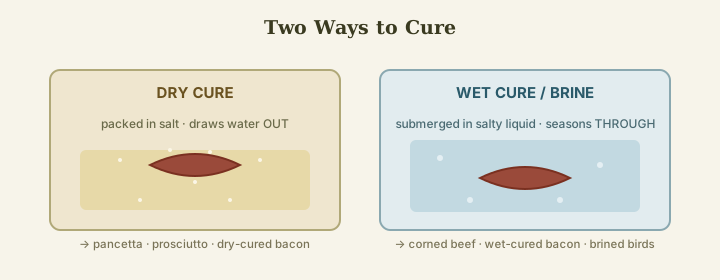
- Dry curing packs the meat directly in a salt (and sugar and spice) mix. It draws the most water out, concentrates flavor hard, and is the road to pancetta, prosciutto, and dry-cured bacon. Try homemade pancetta or the authentic Italian-style pancetta.
- Wet curing (brining) submerges the meat in a salty (often sweet, often spiced) liquid. It’s gentler, seasons evenly all the way through, and keeps the meat moist — perfect for corned beef, brine-cured pork chops, and wet-cured bacon.
Plenty of cures use both — a dry cure to set the meat, then a soak, or vice versa.
The nitrite question — cure #1 and cure #2
Here’s the piece the truly ancient methods didn’t have, and the single biggest safety upgrade in modern curing: curing salts. These are ordinary salt tinted pink (so you never confuse them with table salt) and dosed with a small, precise amount of sodium nitrite (“cure #1” or “Prague powder #1”) or, for long-aged meats, sodium nitrate (“cure #2”).
Nitrite does three jobs: it prevents botulism in cured meats (essential for anything cold-smoked or aged at unsafe temperatures), it gives cured meat its characteristic pink color and “cured” flavor, and it fights rancidity. It’s used in tiny, measured amounts — this is a place to weigh, not eyeball. My notes on curing and curing salts and my homemade salt-curing mix go deeper, and the Food Safety page explains exactly when you need cure and when plain salt is enough.
When do you need cure #1? Any time cured meat will spend time in the danger zone (40–140°F) before it’s fully preserved or cooked — above all, anything cold-smoked. For a quick dry-brine on a steak you’ll cook tonight, plain salt is fine.
Salt, sugar & smoke together
Curing rarely works alone — it teams up with the other methods in this section. Salt-cure then smoke and you get bacon and smoked ham (see my Smoking pages). Salt-cure then dry and you get jerky and air-dried salami (see Drying & Jerky). Salt-cure then ferment and you get dry-cured sausages like traditional dry-fermented pepperoni. The salt is the foundation; the other methods build the house.
Salt beyond meat
Curing isn’t only for meat. A salt cure firms and preserves fish beautifully — miso-cured black cod, cured fluke, salt-cured cod for brandade, and the Japanese salted salmon (shiozake). Salt even preserves lemons into something magical. Once you understand what salt does, you start seeing cures everywhere.
A few rules I live by
- Weigh your salt and cure. Curing is chemistry; percentages matter. This is not the place to freehand.
- Cold and clean. Cure in the refrigerator, on sanitary surfaces, with fresh meat.
- Give it time. A cure penetrates slowly — rushing it leaves the center under-cured. Patience is an ingredient.
- Label with dates. A cure log tells you what worked and keeps you from guessing how long something’s been going.
Curing is where I fell in love with preservation, because the payoff is so good and the craft runs so deep. Next, the everyday workhorse of a stocked pantry: Canning.
Comments (0)